


Recent History
January 1, 1839
Trappers and Mountain Men
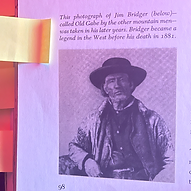
A mountain man who trapped across the plains and Rocky Mountains named Jim Bridger is described. He certainly sounded like an entertaining carnivore and an excellent outdoorsman. "he had been known to kill twenty buffaloes by the same number of consecutive shots. Tall-six feet at least- muscular, without an ounce of superfluous flesh ... he might have served as a model for a sculptor or painter, by which to express the perfection of graceful strength and easy activity."
Jim Bridger could not write his own name, but his skill in the mountains, was proverbial, and the American Fur Company was eventually happy to take him into its service. A writer who knew Jim in the late 1830's said that he had "a complete and absolute under-standing of the Indian character in all its different phases, and a firm, though by no means over-cautious distrust with regard to these savages." Jim was the perfect outdoorsman, his bravery was unquestionable, his horsemanship equally so, and ... he had been known to kill twenty buffaloes by the same number of consecutive shots. "
The physical conformation of this man was in admirable keeping with his character. Tall-six feet at least- muscular, without an ounce of superfluous flesh ... he might have served as a model for a sculptor or painter, by which to express the perfection of graceful strength and easy activity. His cheekbones were high, his nose hooked or aquiline, the expression of his eve mild and thoughtful, and that of his face grave almost to solemnity. "To complete the picture, he was perfectly ignorant of all knowledge contained in books, not even knowing the letters of the alphabet; put perfect faith in dreams and omens, and was unutterably scandalized if even the most childish of the superstitions of the Indians were treated with anything like contempt or disrespect; for in all these he was a firm and devout believer."
Like other mountain men, Jim became a guide and scout when the beaver trails thinned out. A West Point officer for whom Bridger worked in his later years said that Jim had never heard of Shakespeare until one night at the campfire he asked who wrote the world's best book. The West Pointer named the Bard of Avon, and Jim dashed away to find a covered-wagon train. He located a set of the plays which he bought for a yoke of oxen worth $125. He also hired a youth to 120 read the books to him. Jim was able to commit Shakespeare's poetry to memory as easily as he had absorbed every geographical detail of the West. There. after he entertained his mates by reciting the stories, with a liberal sprinkling of mountain vernacular, which he used for emphasis.
Like Jim Beckwourth, Bridger was a yarn-spinner of considerable genius After stories of petrified forests became current in the West, he liked to tell of petrified birds that sang petrified songs, and of a wide chasm that he could cross because the law of gravity was petrified. But Jim's tall tales never limited his usefulness. When in the late 1830's it became apparent that beaver could no longer maintain the fur trade-the emphasis was shifting to trade with the Indians for buffalo robes-and fixed posts were springing up at many places in the mountains, Jim began to think of establishing a post of his own somewhere in the Green River Valley. In 1841, in association with Louis Vasquez, he built the first of several such forts, finally made permanent in 1843 as Fort Bridger in the southwest corner of Wyoming, on what was then becoming the Oregon Trail. The fort served as a supply station for the emigrant trains, and Jim ended his active days in doing something he was well qualified to do-helping others in their struggle to settle in the West.
http://wyoming-fact-and-fiction.blogspot.com/2016/01/the-diet-of-mountain-man.html
The Diet of a Mountain Man
We read and watch daily opinions about our overweight society, “Americans are too fat,” we are continually told. Maybe so, today anyway, but not always. I smile each time I remember the story of Jim Bridger making his own supper. He skinned and gutted a jack rabbit and a nice sized trout, skewered them and propped both over the fire for roasting. Once they were cooked to his taste, likely not long, he ate both quietly and drank an entire pot of boiled coffee to wash down the meat. No seasoning of any kind, maybe smoke flavor from the fire, but that’s it. This was not uncommon for early hunters/trappers in the American West. Meat and coffee. Surprising to some, that many of these men also drank a lot of tea, it was as popular as coffee for many of the early explorers.
January 1, 1841
Total dietary regulation in the treatment of diabetes

"Bouchardat's treatment": Treatment of diabetes mellitus by use of a low-carbohydrate diet. He added green low carb vegetables to the all meat Rollo diet. Bouchardat also used fasting and exercise and even invented gluten bread.
Though Bouchardat (1806-1886) read his first memoir to the Academy of Sciences in 1838, and the final edition of his book appeared in 1875, he came into prominence through important contributions in the decade 1840 to 1850. Like Rollo and all other founders of the dietetic treatment, he considered diabetes a disease of digestion. According to his theory, normal gastric juice has no action upon starch, which is digested in the intestine; but in diabetes, an abnormal ferment digests starch in the stomach, and glycosuria, polyuria, and other symptoms result. He claimed to demonstrate the presence of diastase in the vomitus of diabetics and its absence in that of normal persons. Hypertrophy of the stomach and atrophy of the pancreas in diabetic necropsies were also held to support his theory; and he was thus the first to suggest an influence of the pancreas in the causation of diabetes, and the originator of the attempt to produce it by pancreatectomy in dogs. For sugar determination in urine, he used fermentation, the polariscope, and the Frommherz copper reagent. By the fermentation method he showed the presence of sugar in diabetic blood, but found none in normal blood. At how low an ebb was the Rollo treatment at this time is shown by the pleading and arguments of Bouchardat. He begs all friends of truth to hear him; whatever be the original cause of glycosuria, diabetics, who otherwise all die, are actually saved when his dietetic treatment is used.
Bouchardat in the clinical field ranks with Claude Bernard in the experimental field. He is easily the most brilliant clinician in the history of diabetes. He resurrected and transformed the Rollo treatment, and almost all the modern details in diabetic therapy date back to Bouchardat. He was first to insist on the need of individualizing the treatment for each patient. He disapproved the rancid character of the fats in the Rollo diet, but followed an intelligent principle of substituting fat and alcohol for carbohydrate in the diet. He forbade milk because of its carbohydrate content. He urged that patients eat as little as possible, and masticate carefully; also (1841) he inaugurated the use of occasional fast-days to control glycosuria. Subsequently he noted the disappearance of glycosuria in some of his patients during the privations of the siege of Paris.
Though the introduction of green vegetables is credited by Prout to Dr. B. H. Babington, the honor of thus successfully breaking the monotony of the Rollo diet, properly belongs to Bouchardat. He recommended them as furnishing little sugar, a little protein and fat, but especially potassium, organic acids, and various salts. He also devised the practice of boiling vegetables and throwing away the water, to reduce the quantity of starch when necessary. As a similar trick he "torrefied" (i.e., charred and caramelized) bread to improve its assimilation; possibly this is the origin of the widespread medical superstition that diabetics may have toast when other bread must be forbidden. He invented gluten bread; this started the idea of bread substitutes, from which sprang the bran bread of Prout and Camplin, Pavy's almond bread, Seegen's aleuronat bread, and the numerous later products.
Bouchardat also first introduced the intelligent use of exercise in the treatment of diabetes, and reported the first clinical experiments proving its value. He showed that carbohydrate tolerance is raised by outdoor exercise; and to a patient requesting bread, he replied: "You shall earn your bread by the sweat of your brow."
There is a modern sound to his complaints of the difficulties of having treatment efficiently carried out in hospitals, of the lack of adequate variety of suitable foods, of deception by patients, and of how, even when improved in hospital, they break diet and relapse after returning home. He advocated daily testing of the urine, to keep track of the tolerance and to guard against a return of sugar without the patient's knowledge.
He followed Mialhe in giving alkalies, viz. sodium bicarbonate up to 12 to IS gm. per day, also chalk, magnesia, citrates, tartrates, soaps, etc., also ammonium and potassium salts; he found them often beneficial to the patients but not curative of the glycosuria. He told a patient: "You have no organic disease; there is merely a functional weakness of certain parts of your apparatus of nutrition. Restore physiological harmony and you will attain perfect health."
He used glycerol for sweetening purposes, and introduced both levulose and inulin as forms of carbohydrate assimilable by diabetics, for reasons which well illustrate his intellectual keenness. On giving cane sugar to diabetics, he had found only glucose excreted. Was the levulose utilized or changed into glucose? Levulose proved under certain conditions to be more easily destroyed in vitro than glucose. Accordingly he gave levulose and inulin to diabetics, and found no sugar in the urine. Therefore he recommended levulose for sweetening purposes, and inulin-rich vegetables for the diabetic diet.
Main Works:
Manuel de matière médicale de thérapeutique et de pharmacie, (1838, fifth edition 1873) – Materia medica manual of therapeutics and pharmacy.
Eléments de matière médicale et de pharmacie (Paris 1839) – Elements of materia medica and pharmacy.
Nouveau formulaire magistral, etc. (1840, 19th edition 1874).
De la glycosurie ou Diabète sucré son traitement hygiénique, Paris, (1875, second edition 1883) – On glycosuria or diabetes mellitus and its hygienic treatment.
Traité d'hygiène publique et privée basée sur l'etiology, 1881 – Treatise on public and private hygiene, based on etiology.[2]
October 20, 1842
Osborne Russell
Journal of a Trapper

Russell says "I killed two Bulls which came in good time after living upon Dried meat all winter" which reiterates that mountaineers lived on a carnivore diet.
20th of Octr. we started to hunt Buffaloe and make meat for the winter. The party consisted of 15 men. We travelled to the head of the Jefferson fork of the Missouri where we Killed and dried our meat from there we proceeded over the mountain thro. "Cammas prarie" to the forks of Snake river where most of the party concluded to spend the winter 4 of us however (who were the only Americans in the party) returned to Fort Hall on the 10th of Decr. We encamped near the Fort and turned our horses among the springs and timber to hunt their living during the winter whilst ourselves were snugly arranged in our Skin lodge which was pitched among the large Cotton wood trees and in it provisions to serve us till the Month of April. There were 4 of us in the mess One was from Missouri one from Mass. one from Vermont and myself from Maine We passed an agreeable winter We had nothing to do but to eat attend to the horses and procure fire wood We had some few Books to read such as Byrons Shakespeares and Scotts works the Bible and Clarks Commentary on it and other small works on Geology Chemistry and Philosophy - The winter was very mild and the ground was bare in the Valley until the 15 of Jany. when the snow fell about 8 inches deep but disappeared again in a few days. This was the deepest snow and of the longest duration of any we had during the winter On the 10th of March I started again with my old companion Elbridge We travelled from the Fort on to the Blackfoot near the foot of the Mountain where the ice being broke up we set some traps for Beaver On the 15th we tried to cross the mountain to Grays Valley but were compelled to turn back for the snow On the 20th made another trial and succeeded and encamped at the Forks of `Gray's creek' here the ground was bare along the stream and some [on] the South sides of the hills but very deep on the high plains I killed two Bulls which came in good time after living upon Dried meat all winter Mch 19 we travelled up Grays creek about 10 Mls. There we found the snow very deep and hard enough to bear our horses in the morning. On the 22d we travelled on the snow up this stream about 5 Mls and encamped on a bare spot of ground where we staid three days Then started on the snow as usual and went about 8 Mls to the Valley about Grays Marsh where we found a bare spot about 40 rods square on the South side of a ridge and encamped The snow in the Valley was about 3 feet deep on a level Mch 28th We started on foot in the morning on the snow to hunt Buffaloe after going about 2 Mls we found 11 Bulls aproached and killed 10 of them on the spot we then butchered some of them and took out the tongues of the others buried the meat about 3 ft. deep in a snow drift laid some stones on the snow over it and burned gun powder upon them to keep away the wolves. We then took meat enough for our suppers and started for the Camp by this time the snow was thawed so much that we broke thro. nearly every step. Early next morning the snow being frozen we took two horses and went for our meat but when we reached the place where we had buried it we found the wolves had dug it up and taken the best of its notwithstanding our precautions. The Carcasses of the Bulls yet remained untouched by them and from these we loaded our horses and returned to camp.
January 1, 1843
Osborne Russell
Journal of a Trapper

A trapper describes the other carnivorous animals he is competing with and hunting in the Rocky Mountains.
THE WOLVERINE, CARCAJOU OR GLUTTON
This Species of animals is very numerous in the Rocky Mountains and very mischievous and annoying to the Hunters They often get into the traps setting for Beaver or searching out the deposits of meat which the weary hunter has made during a toilsome days hunt among mountains too rugged and remote for him to bear the reward of his labors to the place of Encampment, and when finding these deposits the Carcajou carries off all or as much of the contents as he is able secreting it in different places among the snow rocks or bushes in such a manner that it is very difficult for man or beast to find it. The avaricious disposition of this animal has given rise to the name of Glutton by Naturalists who suppose that it devours so much at a time as to render it stupid and incapable of moving or running about but I have never seen an instance of this Kind on the contrary I have seen them quite expert and nimble immediately after having carreyd away 4 or 5 times their weight in meat. I have good reason to believe that the Carcajou's appetite is easily satisfied upon meat freshly killed but after it becomes putrid it may become more Voracious but I never saw one myself or a person who had seen one in a stupid dormant state caused by Gluttony altho I have often wished it were the case The body is thick and long the legs short, the feet and Claws are longer in proportion than those of the Black bear which it very much resembles. with the exception of its tail which is 12 inches long and bushy. Its body is about 3 ft long and stands fifteen inches high its colour is black except along the sides which are of a dirty white or light brown -
Its movements are somewhat quicker than those of the Bear and it climbs trees with ease. I have never known either by experience or information the Carcajou to prey upon animals of its own killing larger than very young fawns or lambs altho. it has been described by Naturalists and generally believed that it climbs trees and leaps down upon Elk Deer and other large animals and clings to their back till it kills them in spite of their efforts to get rid of it by speed or resistance but we need go no further than the formation of the animal to prove those statements erroneous. Its body legs feet and mouth are shaped similarly to the Black Bear as has been already stated but its claws are somewhat longer and straighter in proportion and like the Bear its claws are somewhat blunted at the points which would render it impossible for them to cling to the back of an Elk or Deer while running. I do not pretend to say however what may be its habits in other countries I only write from Experience. They do not den up like the Bear in winter but ramble about the streams among the high mountains where they find springs open - its hair is 3 inches long and in the Summer is coarse like the Bear but in winter it is near as fine as that of the Red Fox The female brings forth its young in April and generally brings two at a birth
THE WOLF
Of this Species of animals there are several kinds as the Buffaloe Wolf the Big Prarie Wolf and the small prarie or Medicine Wolf. The Buffaloe wolf is from 2 to 3 ft high and from 4 to 5 ft long from the tip of the nose to the insertion of the tail its hair is long coarse and shaggy Its color varies from a dark gray to a snowy whiteness. They are not ferocious towards man and will run at sight of him. The big Prarie wolf is 2 ft high and 3 1/2 ft long; its hair is long and shaggy: its color is a dirty grey often inclining to a brown or brindle. The least kind is little Prarie or Medicine Wolf: its size is somewhat larger than the red fox: its color is brownish grey and its species something between the Big Wolf and the Fox. The Indians are very superstitious about this animal when it comes near a Village and barks they say there is people near Some pretend to distinguish between its warning the approach of friends and enemies and in the latter case I have often seen them secure their horses and prepare themselves to fight. I have often seen this prophecy tolerably accurately fulfilled and again I have as often seen it fail but a supperstitious Indian will always account for the failure The habits of these three kinds of wolves are similar Their rutting season is in March, the female brings forth from 2 to 6 at a birth
THE PANTHER
This animal is rarely seen in the plains but confines itself to the more woody and mountainous districts its color is light brown on the back and the belly is a sort of ash color: its length is 5 ft from the tip of the nose to the insertion of the tail which is about 1/2 the length of the body it is very destructive on Sheep and other animals that live on high mountains but will run at the sight of a man and has a great antipathy to fire.
THE GRIZZLY BEAR
Much has been said by travellers in regard to this animal yet while giving a description of animals that inhabit the Rocky Mountains I do not feel justified in silently passing over in silence the most ferocious species without endeavoring to con- tribute some little information respecting it which altho it may not be important I hope some of it at least will be new It lives chiefly upon roots and berries being of too slow a nature to live much upon game of its own killing and from May to Septr. it never tastes flesh. The rutting season is in Novr. and the Female brings forth from 1 to 3 at a birth I have not been able to ascertain the precise time that the female goes with young but I suppose from experience and enquiry it is about 14 weeks. The young are untameable and manifest a savage ferocity when scarcely old enough to crawl Several experiments have been tried in the Rocky Mountains for taming them but to no effect. They are possessed with great muscular strength I have seen a female which was wounded by a rifle ball in the loins so as to disable her kill her young with one stroke of the fore paw as fast as they approached her. If a young Cub is wounded an commences making a noise the mother immediately springs upon it and kills it when grown they never make a noise except a fearful growl they get to be fatter than any other animals in the Rocky Mts. during the season when wild fruit is abundant. The flesh of the Grizzly Bear is preferable to Pork - It likes in winter in caves in the Rocks or holes dug in the ground on high Ridges It loses no flesh while confined to its den in the winter but is equally as fat in the Spring when it leaves the den as when it enters it at the beginning of the winter. There is seldom to be found more than one in a den excepting the female and her young. I have seen them measure seven feet from the tip of the nose to the insertion of the tail. It will generally run from the scent of a man but when it does not get the scent it will often let him approach close enough to spring upon him and when wounded it is a dangerous animal to trifle with. Its speed is comparatively slow down hill but much greater in ascending it never climbs trees as its claws are too straight for that purpose.
THE BLACK BEAR
The Black Bear of the Mountains are much the same species of those in the States. In comparison with the Grizzly it is entirely harmless. It is seldom found in the plains but inhabits the Timbered and mountanous districts They are not very numerous and their habits are too well known to need a detailed description here
January 3, 1843
Osborne Russell
Journal of a Trapper

"When the band is first located the hunters keep at some distance behind to avoid dispersing them and to frighten them the more a continual noise is kept up by hallooing and shooting over them which causes immediate confusion and collision of the band and the weakest Elk soon begin to drop on the ground exhausted"
THE ELK
This animal is Eight feet long from the tip of the nose to the insertion of the tail and stands 4 1/2 ft. high its proportions are similar to those of the Deer except the tail which is 4 inches long and composed of a black gummy substance intermingled with fibres around the bone, the whole being clothed with skin and covered with hair like the body. Its color in summer is red but in winter is a browish grey except the throat and belly the former being dark brown and the latter white inclining to yellow extending to the hind part of the thighs as far as the insertion of the tail - They are very timid and harmless even when so disabled as to render escape impossible its speed is very swift when running single but when running in large bands they soon become wearied by continual collision with each other and if they are closely pursued by the hunter on horse back they soon commence dropping down flat on the ground to elude their pursuers and will suffer themselves to be killed with a knife in this position: when the band is first located the hunters keep at some distance behind to avoid dispersing them and to frighten them the more a continual noise is kept up by hallooing and shooting over them which causes immediate confusion and collision of the band and the weakest Elk soon begin to drop on the ground exhausted: their rutting time is in Sepr. when they collect in imense bands among the timber along the streams and among the Mts. It has been stated by Naturalists that the male is a very formidable and dangerous animal when pursued but I never saw it act on the offensive neither have I ever known one to offer resistance in defense of itself against man otherwise than by involuntary motions of its head or feet when too much disabled to raise from the ground. I have often seen the female come about the hunter who has found where her young is secreted uttering the most pitiful and persuasive moans and pleading in the most earnest manner that a dumb brute is capable of for the life of her young This mode of persuasion would I think excite in the sympathy breast of any human that was not entirely destitute of the passion - The fawn has a peculiar cry after it is able to run which resembles the faint scream of a child by which it answers the Dam who calls it by a note similar to the scream of a woman in distress
In the month of Septr. the males have a peculiar shrill call which commences in a piercing whistle and ends in a coarse gurggling in the throat by this they call the females to assemble and each other to the combat in which by their long antlers they are rendered formidable to each other the hair stands erect and the head is lowered to give or receive the attack but the Victor seldom pursues the vanquished
Ancient History
Germany
50000
B.C.E.
Palaeolithic and Mesolithic kill-butchering sites: the hard evidence
The upper paleolithic is characterized by advanced hunting of large animals with various weapons, and planning to maximize easy prey
Upper Palaeolithic and Mesolithic Hunting:
the archaeological record leaves us some direct evidence of man's hunting activities. At Meiendorf (Rust 1937) and Stellmoor (Rusf 1937), some bones of reindeer and birds still conserve weapon marks and a few pieces of silex have remained thrusted in mammalian bones; man kills reindeer with harpoons and sticks (fractured skulls), birds with bows and maybe slings. Three fractured skulls of red deer in Abri Pataud (Bouchud, 1975), and one bovid skull with a circular orifice in Saint Marcel (Allain, 1952) suggest the practice of the so called " co'up de merlin": man has delivered a blow similar to the one used today to butcher cattle. Probably the animal already immobilized (wounded or entrapped) was hit on the frontal with a big stone. At Kokorevo I (Siberia), a large scapula of bison is pierced by the upper end of a point made of bone (Boriskowksi, 1965). At High Furlong (Mesolithic), an elk was discovered with the marks of L7 wounds made by barbed points, of which two were found in the site, and by other arms. The animal had apparently been attacked at two distinct occasions: during the first one, hunters aimed at the legs to lame the animal (fig. 6), later hunters hit the thoracic region and the lungs to kill it. However the elk died in a little lake, perhaps imprisoned in the ice, and man had no access to the meat. The animal represents in fact a hunting loss (Hallam et a1.,1973).
Planning: very good. Many sites belong to Wpe e, were occupied periodically or seasonally and specialised in the capture of a particular game (e.g., horse, reindeeq, ibex). Game drive towards cliffs have been claimed and Solutre (Combier & Thevenot,1976) has long figured as an example, but the evidence is far from conclusive.
Scavenging: no doubt H. sapiens still killed or exploited animals in the occasional and opportunistic way of Lower Palaeolithic times. According to Lindner (Lindner,1941), hunters at Predmost utilised the carcasses of hundreds of mammoths that probably succumbed as a result of natural catastrophes, as food.
Food transport: selective transport of the most useful animal parts is claimed for many sites.
Specialised activities: sometimes the material is dislocated in distinct clusters that could reflect specialised activity areas as for example at Solutre (Combier & Thevenot, 1976). Site topography: some hunting sites were located in valleys enclosed by steep slopes as at Rascano (Gonziilez-Echegaray, 1979), Stellmoor (Rust, 1937), Meiendorf (Rust 1937), or at the foot of rocky cliffs at Solutr6 (Combier & Th6venot, 1,976).
4. Conclusions
Most of the Lower Palaeolithic sites analysed here belong to category a (butchering sites); other kind of concentrations are rare and difficult to ascertain. A number of hunting stations (category e) and a hunting stop (category f) form my sample for the age of Neanderthal man and related people. The Upper Palaeolithic is characterised by many hunting stations, while in Mesolithic times a hunting loss (category d ) was found as well as several sighting sites (category g). The foregoing distribution seems to reflect in a vague way an evolution from scavenging and haphazard opportunistic hunting to well organised, selective hunting activities. However, this reflection results no doubt in part from a priori assumptions concerning the evolution of hominid meat procurement often colouring the interpretations offered for the osseous "hard" data; these are frequently equivocal.
Vindija, 42000, Varaždin, Croatia
28500
B.C.E.
Neanderthal diet at Vindija and Neanderthal predation: The evidence from stable isotopes
The isotope evidence overwhelmingly points to the Neanderthals behaving as top-level carnivores, obtaining almost all of their dietary protein from animal sources
Archeological analysis of faunal remains and of lithic and bone tools has suggested that hunting of medium to large mammals was a major element of Neanderthal subsistence. Plant foods are almost invisible in the archeological record, and it is impossible to estimate accurately their dietary importance. However, stable isotope (13C and 15N) analysis of mammal bone collagen provides a direct measure of diet and has been applied to two Neanderthals and various faunal species from Vindija Cave, Croatia. The isotope evidence overwhelmingly points to the Neanderthals behaving as top-level carnivores, obtaining almost all of their dietary protein from animal sources. Earlier Neanderthals in France and Belgium have yielded similar results, and a pattern of European Neander- thal adaptation as carnivores is emerging. These data reinforce current taphonomic assessments of associated faunal elements and make it unlikely that the Neanderthals were acquiring animal protein principally through scavenging. Instead, these findings portray them as effective predators.
Stable Isotope Analyses.
Mammal bone collagen δ13C and δ15N values reflect the δ13C and δ15N values of dietary protein (14). They furnish a long-term record of diet, giving the average δ13C and δ15N values of all of the protein consumed over the last years of the measured individual's life. δ13C values can be used to discriminate between terrestrial and marine dietary protein in humans and other mammals (15, 16). In addition, because of the canopy effect, species that live in forest environments can have δ13C values that are more negative than species that live in open environments (17). δ15N values are, on average, 2–4‰ higher than the average δ15N value of the protein consumed (18). Therefore, δ15N values can be used to determine the trophic level of the protein consumed. By measuring the δ13C and δ15N values of various fauna in a paleo-ecosystem, it is possible to reconstruct the trophic level relationships within that ecosystem. Therefore, by comparing the δ13C and δ15N values of omnivores such as hominids with the values of herbivores and carnivores from the same ecosystem, it is possible to determine whether those omnivores were obtaining dietary protein from plant or animal sources.
Cheddar Reservoir, Cheddar BS26, UK
12000
B.C.E.
FOCUS: Gough’s Cave and Sun Hole Cave Human Stable Isotope Values Indicate a High Animal Protein Diet in the British Upper Palaeolithic
We were testing the hypothesis that these humans had a mainly hunting economy, and therefore a diet high in animal protein. We found this to be the case, and by comparing the human δ15N values with those of contemporary fauna, we conclude that the protein sources in human diets at these sites came mainly from herbivores such as Bos sp. and Cervus elaphus
We undertook stable isotope analysis of Upper Palaeolithic humans and fauna from the sites of Gough's Cave and Sun Hole Cave, Somerset, U.K., for palaeodietary reconstruction. We were testing the hypothesis that these humans had a mainly hunting economy, and therefore a diet high in animal protein. We found this to be the case, and by comparing the human δ15N values with those of contemporary fauna, we conclude that the protein sources in human diets at these sites came mainly from herbivores such as Bos sp. and Cervus elaphus. There are a large number ofEquus sp. faunal remains from this site, but this species was not a significant food resource in the diets of these Upper Palaeolithic humans.
If the humans hunted and consumed mainly horse, then their 15N values should be c. 3–5‰ (Equus 15N value of 0·7‰+enrichment of 2–4‰). Instead, their 15N values make more sense if they lived mostly off Bos and Cervus elaphus (Bos and Cervus values of c. 3‰+enrichment of 2–4‰=the observed values c. 6–7‰). It is also possible that other species, including Rangifer tarandus, were consumed by these individuals. Rangifer tarandus has 15N values similar to Cervus elaphus (Richards, 1998), and has more positive 13C values, which may explain the observed slight enrichment in the human 13C values. A number of artefacts made from Rangifer tarandus have been found at Gough’s, but there is no other evidence that this species was being exploited for food
Province of Crotone, Italy
500
B.C.E.
On the Sociology of Ancient Sport
One report states that a trainer named Pythagoras recommended a meat diet to the Olympic athletes he trained.
A lack of animal-derived protein seems to have been rectified early in history, as there are two reports of the introduction of meat into the athletes’ diet. One report states that a trainer named Pythagoras recommended a meat diet to the athletes he trained. https://www.omicsonline.org/open-access/a-comparison-of-ancient-greek-and-roman-sports-diets-with-modern-day-practices-2473-6449-1000104.php?aid=69865
8 He [Pythagoras] is said to have been the first to train athletes on a meat diet. The first athlete he did this with was Eurymenes. Formerly they had trained on dried figs, moist cheese, and wheat. Some say that it was a trainer named Pythagoras and not the philosopher who was responsible for this innovative diet. For our Pythagoras prohibited killing, not to mention eating, life which possessed souls like our own.
Diogenes Laertius, Lives of the Philosophers 8.12
Sport and Recreation
To all appearances medical knowledge in general and nutrition in particular was widespread in Pythagorean circles in Southern Italy, especially in Kroton. Burkert has pointed out that the fmaous doctor Alcmaeon came from the Pythagorean center of Kroton. From the akousmata (secret doctrines), which doubtless contain old religious traditions, we learn that the Pythagoreans were not originally strict vegetarians; the consumption of meat was permitted, with the exception of lamb and the meat of draft oxen. Burkert considers there is some likelihood that Pythagoras introduced a meat diet for athletes. He believes this tradition arose when Pythagorean vegetarianism had not yet been completely developed. In later times, when vegetarianism had prevailed, a second tradition has possibly been invented, in which it was not Pythagoras, the philosopher from Samos and Kroton, but a homonymous person who wrot the great 'trainer's recipe book'.
57: There are similar issues regarding the transmission in later sources of Pythagoras advising the successful heavy athlete Eurymenes of Samos to use a special meat-based diet instead of the dried figs and cheese he had previously been eating.
On the Sociology of Ancient Sport - page 43.
Mantineia 221 00, Greece
480
B.C.E.
A Comparison of Ancient Greek and Roman Sports Diets with Modern Day Practices
Dromeus, a long-distance runner, is said to have first thought of eating meat for training instead of just cheese and won multiple victories.
The second report is that of Pausanias, who writes of Dromeus, a long-distance runner from Stymphalos [23].
“...he won two victories in the dolichos at Olympia, the same number in the Pythian Games, three at the Isthmian and five at the Nemean. He is said to have first thought of eating meat (as part of his training diet). Until then the food for athletes was cheese fresh out of the basket.”
Clearly, if his success is anything to go by, then Dromeus had really found a winner’s diet. There are also reports of athletes eating meat from oxen, bulls, goats and deer, a very” red-meat” diet which is a rich form of protein. Moreover, with meat as a part of their diet, the performance of competing athletes would most certainly have improved noticeably.
5 A man named Dromeus from Mantineia was said to have been the first we know of to have won the pankration by default [ = akoniti]. Pausanias 6.11.4
Dromeus, Long-Distance Runner
There was a man from Stymphalos, named Dromeus, whose record as a long-distance runner was exceptional: he won two victories in the dolichos at Olympia, the same number in the Pythian Games, three at the Isthmian and five at the Nemean. He is said to have first thought of eating meat (as part of his training diet). Until then the food for athletes was cheese fresh out of the basket.


