


Recent History
May 20, 1910
Vilhjalmur Stefansson
My Life with the Eskimo - Chapter 13
All of the caribou were skin-poor and the marrow in their bones was as blood, but we had with us plenty of seal oil from seals killed farther west along the coast, so that the two together made a satisfactory diet.
As we proceeded east along Dolphin and Union Straits from Cape Bexley, we found here and there traces of Eskimo parties who were going in from their winter hunt on the sea ice to cache their clothing, household property, and stores of oil on the beach preparatory to moving inland for their summer caribou hunt. Some of these groups we never saw at all; the trails of others we picked up and followed until we overtook the parties, who were usually camped on the shore of a small lake, where they were fishing with hooks through holes they had made with their ice-picks in the seven-foot-thick ice. The caribou in this district are scarce in spring and difficult to get by the hunting methods of the Eskimo. Fish were not secured in large numbers, either, for these people know nothing of nets. Our archæological investigations have shown us that the knowledge of fishing by nets never extended farther east along the north shore of the mainland than Cape Parry, and the Copper Eskimo have no method of catching fish except that of hooks and spears. The hooks are, like most of their weapons, made of native copper. They are unsuited for setting, for there is no barb, and unless the fish be pulled out of the water as soon as he takes the hook he is sure to get off again.
West of Cape Bexley we had seen no traces of caribou for a hundred and fifty miles, but as soon as we came to where the straits began to narrow, east of Cape Bexley, we began to find more and more frequently the tracks of the northward migrating bands of cow caribou bound for Victoria Island. At first we did not see on an average more than ten or fifteen animals a day, but later on they increased in number; and with our excellent rifles we found not the slightest difficulty in supplying ourselves with plenty of venison and in having enough to spare to feed also the people at whose villages we visited.
In coming to the coast from the south, caribou take the ice with out hesitation. It cannot be that they see land to the north of the straits, for half of the time, at least, the land is hidden in a haze, even from the human eye, which is far keener than that of the caribou. Neither can it be the sense of smell that guides them, for the northward direction of their march is not interfered with by change of wind. They will sometimes go ten miles out on the ice and lie down there, then wander around in circles for several hours or half a day, and finally proceed north again. Both at Liston and Sutton islands, in Simpson Bay, and farther east at Lambert Island, we saw caribou march right past without paying any attention to the islands, although there was food upon them , and they in some cases passed within a hundred yards or so. The bands would generally be from five to twelve caribou, consisting in the main of females about to drop their fawns, but also of yearlings and two-year-olds of both sexes. All of them were skin-poor and the marrow in their bones was as blood, but we had with us plenty of seal oil from seals killed farther west along the coast, so that the two together made a satisfactory diet. The skins at this season of the year are worth less, partly because the hair is loose, but also because they are full of holes, ranging in size from that of a pea to that of a navy bean, from the grubs of the bot-fly which infest the backs of the animals. When spread out to dry, the skin of the spring-killed caribou looks like a sieve.
July 1, 1910
Vilhjalmur Stefansson
My Life with the Eskimo - Chapter 13

In summer we much preferred wolf meat to caribou, for it is usually tender and fat, and the caribou, all except the oldest bulls, are in very indifferent condition. We never ate venison when there was wolf meat to be had at this season
I was about to shoot, and he was so near that there was no doubt of the result, when suddenly, almost in line with the hare, I saw a caribou disappearing over a ridge. He evidently had seen me while my attention was concentrated on the hare and while I was exposed against the sky-line on top of the rock ridge along which the hare was running. Of course I gave no further thought to the hare. Caribou, when they merely see a man and do not get his wind, ordinarily do not run far, and within an hour I had come up to this one again. It turned out I had seen only one of two animals, both of which I now found quietly feeding upon a level spot - so level, indeed, that it took several hours of careful stalking before I got within range. The animals proved to be two young bulls, skin-poor, with the mar row as blood in their bones. Nevertheless there was great rejoicing in camp when I returned , after being out about twenty-four hours, with a back-load of caribou meat. I have found that Eskimo in a strange country are typically sceptical of the possibilities of finding food, and my people had several days ago made up their minds that all the caribou had left the district and we were destined to have to live the whole summer on squirrels and ptarmigan.
Natkusiak had not yet returned when I got home, and it was nearly another twenty-four hours before he put in an appearance, but he had been more successful than I in securing three old bull caribou which were in fair condition at this season of the year, and best of all he had shot a wolf that was as fat as a pig. In summer we much preferred wolf meat to caribou, for it is usually tender and fat, and the caribou, all except the oldest bulls, are in very indifferent condition. We never ate venison when there was wolf meat to be had at this season; at least that was true of all of us except Pannigabluk, to whose family and ancestors the wolf is taboo.
As the caribou killed by Natkusiak were in a southeasterly direction, we brought into camp at once the meat of the two that I had killed, and then proceeded farther upstream to a point from which it was only seven or eight miles to where Natkusiak had cached the other meat. We learned that at this season the caribou in the Coppermine country were all bulls, and none of them were moving. In general singly, or by twos and threes, they had taken possession of some snow-bank protected from the sun by a northward-facing precipice, and there they stayed. They would feed for an hour or two on the grass or moss in the neighborhood, and then go back to lie on the snow, where they had a measure of protection from the clouds of mosquitoes, and where the intense heat of the sun was more bearable to them.
On an average the number of caribou was not more than about one for every hundred square miles of country, and we always had to go south to kill the next one. Occasionally either Natkusiak or myself would hunt back downstream twenty or thirty miles, with the idea that caribou might have moved in behind us, but with no result; and each time we killed a caribou to the south and moved up to get its meat we got that much farther from our sled cache and from my camera and writing materials; so that by the latter part of June it had become evident that we should never be able to go back to the cache during the summer, for to go back meant starvation . By killing the caribou as we went we had burned our bridges behind us.
Later on, after we had succeeded in joining the Eskimo, there was scarcely a half-hour when some picturesque or unusual scene in their lives during the summer did not bring back to me the absence of my camera. As for my diary for the summer, it was written in my small pocket notebook in so microscopic a hand that it is difficult to read without a magnifying glass, and even so I had to trust to my memory for many things that in ordinary course I should have recorded.
July was intolerably hot. We had no thermometer, but I feel sure that many a day the temperature must have been over one hun dred degrees in the sun, and sometimes for weeks on end there was not a cloud in the sky. At midnight the sun was what we would call an hour high, so that it beat down on us without rest the twenty four hours through. The hottest period of the day was about eight o'clock in the evening, and the coolest perhaps four or five in the morning. The mosquitoes were so bad that several of our dogs went completely blind for the time, through the swelling closed of their eyes, and all of them were lame from running sores caused by the mosquito stings on the line where the hair meets the pad of the foot. It is true that on our entire expedition we had no experience that more nearly deserved the name of sufferingthan this of the combined heat and mosquitoes of our Coppermine River summer.
By the last week in July we had proceeded upstream as far as the mouth of the Kendall River, which flows in from the west from Dismal Lake. We had continually been putting off the crossing of the river, hoping to find a better place, and also being in no hurry, for we did not think the Rae River Eskimo whom we wanted to join would reach Dismal Lake before early August. We finally selected for the crossing a strip of river where there is half a mile of quiet water between two strong rapids, built a raft from dry spruce grow ing near the river, and got across with all our belongings, including at that time about three hundred pounds of dry caribou meat. Immediately upon landing on the west side we cached the meat safely in a rock crevice, under huge stones, intending it for a store against some future emergency, but our fortunes that summer never brought us back to the place again; so doubtless it is there yet unless some wandering Eskimo may have happened to find it.
On the north shore of Dismal Lake, which we reached in a two days march from the Coppermine, we ran completely out of food for the only time in our period of fourteen months of absence from our base at Langton Bay. Of course, in an extremity we could have gone back to where we had cached the dried meat two days before, but our general policy was never to retreat, for we knew well that the chances of food ahead were always a little better than behind. The morning of July 29th I broke the rule against shooting ptarmigan, and used one of my valuable Mannlicher-Schoenauer bullets to secure half a pound of meat. That half-pound was the breakfast for the four of us, and the dogs, poor fellows, got nothing. But our fortune was soon to turn, for when immediately after breakfast I climbed the high hill behind our camp I saw a caribou coming from the north and disappearing among some hills to the east in a way to make it uncertain in just what direction he was going. The three of us therefore started to meet him by different routes. It happened that I was the one to get sight of him first, and it turned out he had a companion that must evidently have preceded him into the hills a moment before I turned my field glasses that way. The two of them were in good flesh, so that by four in the afternoon both ourselves and our dogs had had a square meal of better meat than ordinary.
August 1, 1910
Vilhjalmur Stefansson
My Life with the Eskimo - Chapter 14
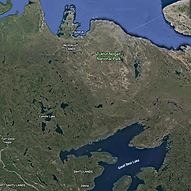
Spending the summer with the Copper Eskimo, Stefansson learned they also survived through hunting and eating game and they treated him as one of their own, despite his magic usage of a rifle. They also had no use for white man's food of flour and sugar, but considered it it a great gift to distinguish them from those who had nothing.
The summer spent with the Copper Eskimo between Bear Lake and the Coppermine River had passed pleasantly for me, and profitably. From the first they had accepted me as one of them they had not known that I was a white man until I told them so. My life was exactly as theirs in that I followed the game and hunted for a living. Even my rifle did not differentiate me from them, because they looked upon its performances as my magic, differing in no way essentially from their magic. I spoke the Mackenzie Eskimo dialect and made no attempt to learn theirs, for it was not necessary for convenience' sake, and it would have thoroughly confused me to try to keep two so similar dialects separate in my mind. Sometimes in meeting an utter stranger I found a little difficulty; not that it was difficult for me to understand him, for he spoke very much like all the others that I had dealt with, but he at first would have some difficulty in adjusting himself to the sort of language spoken by myself and my companions.
By August the caribou skins were suitable for clothing. Up to that time we had killed only for food and had eaten each animal before moving to where the next was killed, so that our baggage had not increased; but now we had to begin saving the skins against the winter, and by the latter part of August we had a bundle of some thing like forty of the soft, short-haired pelts, so that our movements began to be hampered by the bulk and weight of our back-loads. We therefore chose a large dead spruce, the trunk of which was free of bark and limbs, and fifteen feet up it we suspended our bundle of skins. This we did for fear of the wolverines, for the Indians say that the wolverine cannot climb a smooth tree-trunk if the tree be so stout that it is unable to reach half around it with its legs in trying to climb. In this I have not much faith, because I have seen so many caches made which the Indians and Eskimo say are perfectly safe, and later when the cache is found to be rifled, the natives are invariably astounded and assure you that they never heard of such a thing before. We tied our bundle with thongs to the trunk of the tree, and three weeks later when we came back it turned out that the first wolverine had just that day climbed up and eaten some of the thongs. Apparently it was mere accident that protected our clothing materials, and had we come a day later we might have found the skins destroyed.
The summer had been one of continuous sunshine, but that changed with the month of September, and the mists and fogs were then almost as continuous as the sunshine had been. The rutting season had commenced, and the bull caribou, which were numerous in summer in all the wood fringe northeast of Bear Lake, had moved out in the open country, and the hunting had become more difficult. Finally, by the end of September the caribou had become very few in number.
The Eskimo had all summer been making sledges, wooden snow shovels, bows and spear handles, and other articles of wood. All these things and a good supply of caribou meat were stored at a spot which we called the “ sled-making place, ” but which the Slaveys of “ Big Stick Island.” This is a clump of large spruce trees on the southeast branch of the Dease River. The Eskimo were now waiting for the first snow of the year so they could hitch their dogs to the sleds they had made, load their provisions upon them, and move north toward the coast where they expected to spend the winter in sealing. But starvation began to threaten, so that finally, on September 25, the last party started toward the coast, carrying their sleds on their backs, for the first snow had not yet fallen.
I wanted very much to accompany them, to become as familiar with their winter life as I already was with their summer habits, but it did not seem a safe thing to try, for their only source of food in winter is the seal, and these must be hunted, under the peculiar Coronation Gulf conditions, by methods unfamiliar to my companions and myself. Of course, we could have learned their hunting methods readily enough, but they told us that almost every winter, in spite of the most assiduous care in hunting, they are reduced to the verge of starvation. Frequently (and it turned out to be so that winter) they have to eat the caribou sinew they have saved up to use as sewing-thread, the skins they have intended for clothing, and often their clothing, too, while about one year in three some of their dogs die of hunger; a few years ago about half of one of the larger tribes starved to death. It was both fear of actual want and fear that if want came their superstition would blame us for it that kept us from going to the sea-coast with them. We decided, therefore, to winter on the head-waters of the Dease River, where the woodland throws an arm far out into the Barren Ground; to try to lay up there sufficient stores of food for the winter; to pass there the period of the absence of the sun; and to join the Coronation Gulf Eskimo in March, when abundance of hunting -light would make it safer to go into a country poorly stocked with game.
When we had decided upon this, I left my Eskimo to build a winter hut, while I walked alone down to the mouth of the Dease River, a distance of about thirty miles, to where my friends Melvill and Hornby were going to have their winter camp. I found there also Mr. Joseph Hodgson with his family, consisting of his wife, son, daughter, and nephew. Mr. Hodgson is a retired officer of the Hudson's Bay Company, who, through the many years of his service on the Mackenzie River, had had a longing to get out of the beaten track of the fur-trader. For many years, he told me, it had been his special dream to spend the winter on the Dease River, and he had now come to do it. The mouth of the Dease is a picturesque spot, and although the Indians told Mr. Hodgson that it was “ no good” as a fishing place or as a location for hunting or trapping, he nevertheless stuck to his original intention and built his house there.
Both Mr. Hodgson and the Englishmen who lived about three miles away from him had a small store of white men's food, such as flour, sugar, tea, salt, and the like. But these were articles we did completely without, and even to the others they were merely luxuries, for they had to get the main part of their food-supply from the caribou of the land and the trout of Bear Lake. In spite of the little they had they offered me a share, a thing that I much appreciated, both because it shows the spirit of the North and because my Eskimo were immeasurably gladdened by a little flour, a thing they had not expected and without which they can get along very well, but the possession of which they feel marks them off definitely from the poor trash who cannot afford such things.
November 8, 1910
Vilhjalmur Stefansson
My Life with the Eskimo - Chapter 14

A blizzard springs up while Stefansson is traveling with an Indian and an Eskimo, and he decides to build a tent in a safe place according to his experience. "We ate frozen raw caribou meat and drank cold water" since fire could only be had with heavy wood brought on sleds.
Now that we were on Bear Lake, I thought that by taking a course northwest true from the northeast corner of the lake for Langton Bay I should not only reach Langton Bay, but, incidentally, should probably find and be able to chart the upper reaches of Horton River. On this journey Natkusiak would of course go with me, while Tannaumirk and Pannigabluk remained behind on Dease River at our winter camp; but it seemed advisable to get also a Slavey Indian companion, for the Slaveys claim to know the country far to the north of Bear Lake, and one man in particular, known as Johnny Sanderson, said he knew all about it for a distance of several days' travel. Besides, we had no toboggans of our own, and our runner-sled was unsuitable on the tundra, so I hired Johnny with two toboggans and one dog-team.
On November 8, 1910, we started from the mouth of Dease River on our journey toward Franklin Bay; for two or three days before that we had been engaged in putting the finishing touches on our equipment, which meant making dog-harness and packing up dry caribou meat. Both at this time and on the two or three other occasions when we had come to Dease River Mr. Hodgson entertained us hospitably and helped us in every way. For the first forty miles after leaving his house we followed the shore of Bear Lake north westward, and then struck inland, traveling west by compass, which here means northwest true. We had only about six days' provisions with us, for among other things Johnny had told us that there would be plenty of caribou as soon as we got away from the fringe of woods about Bear Lake. I have often started upon a longer trip than the three weeks we anticipated for this one, with less than six days' provisions, but in this case we could easily have taken more, for Mr. Hodgson generously offered to supply us with as much as we wanted to haul. Johnny regarded himself, apparently, as quite infallible, and succeeded in impressing me with the probability that he was nearly so; but few men I have dealt with have panned out so poorly as Johnny Sanderson.
Going in a northwesterly direction, it takes about forty miles of traveling to reach the edge of the Barren Ground, and for all this distance we saw plenty of caribou tracks, but Johnny told us it would not be worthwhile following them and delaying our journey by a hunt in the woods, because, he said, "the Indians call the treeless country the Caribou Ground, and that is because it is always covered with caribou.” A few miles after we had left the trees behind us and entered upon what we called the Barren Ground (but what Johnny called the Caribou Ground) we crossed the tracks of half a dozen or so animals, and after that for two hundred miles we never saw another track.
Johnny was proud of his varied experiences as a traveler, and told how this and that great man of the Hudson's Bay Company had employed him as head guide, and how they always placed implicit reliance in him. He said there were few places he did not know, and that even where he was a stranger his judgment was so good that he was seldom at fault.
This confidence in himself had been so often justified in the past that the fact of its being seldom justified on the present trip evidently seemed to him an exception scarcely worthy of note. We struck the Barren Ground on the morning of our fourth day, and toward evening we had a blizzard. When it came time to camp, we searched for a small lake, because the ice at this season was not much more than a foot thick and fuel was scarce, so we wanted to get water for cooking. When we got to the shore of a small pond, I stopped the sled. The selection did not suit Johnny, however; he said that no one who knew anything about traveling would ever pick such a place for a camp. Half a mile back, he said, he had seen a cut-bank under the shelter of which we could have pitched our tent, and even now he could see, only a little way ahead of us, a round hill with a steep slope to leeward that would be a fine place under which to camp, for the hill would break the wind.
Now my idea and Natkusiak's did not coincide with Johnny's, because to us it was clear that if we camped in the lee of an obstruction the drifting snow would in the night cover up our tent and place us in danger of being smothered even were the tent not to cave in with the weight of the snow. No man of any winter experience in the open will pitch his tent in a shelter where there is the possibility of a blizzard. Johnny's ideas were all gained in the forested country, where it is wise, of course, to choose the most sheltered spots, and it seemed to him that we were little better than insane. He announced, therefore, that he would take the matter into his own hands and pitch the camp in the shelter of the hill, and he told me incidentally that I was the first white man he had ever seen who did not know enough to understand that an Indian knows more than a white man about how to make camp. Of course, the obvious answer was that now that he had the opportunity he had better watch carefully people who had different ideas from his and see what the result would be.
Natkusiak and I had to take Johnny's own sled away from him by a show of force, and had the pleasure of listening to his comments while we, without any help from him, put up the tent. During that time, and at various other times thereafter, Johnny told us much of a party of the Geological Survey of Canada which had been commanded by a white man who was my superior in every way, and who, while he was inexperienced, had the good sense to defer to Johnny in everything. Among other things Johnny had said that we would all probably freeze to death during the night, but we banked up the tent so well, Eskimo fashion, that we had not been inside of it more than an hour or so before Johnny began to complain that it was too warm, and that he was getting wet, through the snow in his clothes melting and soaking in. He had been so sure that the tent was going to be so cold — nothing could melt in it — that he had not thought it worthwhile to brush the snow off his fur coat.
We made no fire, for Natkusiak and I agreed that digging heather for fuel from underneath the snow was not worth the bother; we ate frozen raw caribou meat and drank cold water, at all of which Johnny complained bitterly. We could, he pointed out, have used the ordinary forethought of sane men; we could have hauled a load of dry spruce wood from the Bear Lake woods and could have made ourselves comfortable with a fire and a warm meal. To this we answered that our dogs agreed with us in considering the sleds heavy enough without piling a cord of wood on top of them, and that there was no need for special effort toward making us comfortable, for we were comfortable already.
December 4, 1910
Vilhjalmur Stefansson
My Life with the Eskimo - Chapter 14

"The main part of the food was whale, the carcass of which had drifted into the beach just before the freeze-up in the fall. This animal had been freshly killed when he drifted ashore, and furnished us, therefore, a supply of food which was not only abundant but also palatable." The challenges of hunting caribou and camping in the cold are also covered.
Before quite reaching Langton Bay harbor, however, we came upon sled tracks, and at the harbor itself we found Dr. Anderson and our Eskimo safe, comfortably housed and fairly well supplied with food. The main part of the food was whale, the carcass of which had drifted into the beach just before the freeze-up in the fall. This animal had been freshly killed when he drifted ashore, and furnished us, therefore, a supply of food which was not only abundant but also palatable. I found here waiting for me some mail, to get which Dr. Anderson had had to make a thousand-mile trip the previous summer west to the whaling-station at Herschel Island. My most recent letter had been written on the 13th of May, 1910, and it was now the 4th of December.
After resting about two weeks we started back toward Bear Lake, leaving the same four Eskimo behind, although Dr. Anderson accompanied us. Knowing the character of the country, and having plenty of food at Langton Bay, we loaded the sleds with provisions, which, together with the caribou meat we had cached inland, would be equal to about twenty-five days' full rations. Had everything on the homeward road been as it was on the northwestward journey, this would have been ample, for we had come from Bear Lake to the sea in twenty-six days, but we were now a month later in the season; the sun had long ago gone away and we had only twilight at noon, and the snow lay thick and soft in many places in the river where on the way north there was glare ice. Our progress southward was therefore very slow, and by the time we reached that point of Horton River where one begins the portage to Bear Lake we were on short rations again. In our two days' crossing of the Barren Ground we again had a blizzard, but again it happened to be blowing at our backs and rather helped than hindered us, although we could see practically nothing of the country through which we traveled.
On our second day in the Barren Ground we had the last and most striking proof of Johnny's infallibility. We had come to perhaps a dozen trees, and I said to Johnny, “ Well, this is fine; now we are back in your Bear Lake woods again." No, that was not so, he said. There were two ranges of hills on the Barren Ground. One of these was right in the middle of the Barren Ground, and on the southerly slope of this range were a few trees. It was at these trees we now were, and if we left them, it would take us another whole day of travel before we came to the next. He told us, therefore, that unless we wanted to camp without firewood we must camp here. Dr. Anderson and I talked this over, and we agreed that Johnny had never in the past proved right in anything; but still it seemed better to do as he advised, for, after all, this was his own country, and he ought to know something about it. The blizzard was still blowing, and it was intensely cold. If we had pitched camp where there were no trees we should have made a small tent, Eskimo fashion, and it would have taken us only a few moments to do so; but now that we had trees we put up an Indian-style tepee, a difficult thing to do in a storm, and a matter of two hours or so of hard work during which all of us froze our faces several times and suffered other minor inconveniences. My idea had been, on seeing these few trees, that we were now on the edge of the forest, and that a few miles more of travel would bring us into the thick of woods where no wind can stir the snow; and in the morning when we awoke and looked out, sure enough, there was the edge of the forest only a few hundred yards away, with the woods stretching black and unbroken toward Bear Lake. But for the wisdom of Johnny Sanderson we might have camped in its shelter and escaped one of the most disagreeable camp making experiences we ever had.
The next day we had traveled only a few miles before we came upon the tracks of caribou. Our thermometer had broken some time before, and so I speak without the book, but there is little doubt that the temperature was considerably below 50 ° Fahrenheit. There was not a breath of air stirring. While the other three proceeded with the sled I struck out to one side to look for caribou. First I saw a band that had been frightened by our main party. There were only a few clearings in the woods, but wherever the animals were you could discover their presence by the clouds of steam that rose from them high above the tops of the trees.
There are few things one sees in the North so nearly beyond belief as certain of the phenomena of intense cold as I saw and heard them that day. It turned out that the woods were full of caribou, and wherever a band was running you could not only see the steam rising from it and revealing its presence, even on the other side of a fairly high hill, but, more remarkable still, the air was so calm that where an animal ran past rapidly he left behind him a cloud of steam hovering over his trail and marking it out plainly for a mile behind him. When you stopped to listen, you could hear the tramp of marching caribou all around you. On such days as this I have watched caribou bands a full mile away whose walking I could hear distinctly although there was no crust on the snow; and as for them, they could not only hear me walking, but could even tell the difference in the sounds of my footsteps from those of the hundreds of caribou that were walking about at the same time.
My first opportunity to shoot came through my hearing the approach of a small band. I stopped still and waited for them. I was not nervous, but rather absent-minded. In other words, my mind was more fully occupied than it should have been with the importance of getting those particular caribou. I always carry the magazine of my rifle full but the chamber empty, and as the animals approached I drew back the bolt to throw a cartridge into the chamber, but when I tried to shove the bolt forward it stuck fast. This is the only time in four years of hard usage that anything has interfered with the perfect working of my Mannlicher-Schoenauer. The caribou were moving past without seeing me, and I became a bit excited. I knew the rifle was strong, and I hammered on the end of the bolt with the palm of my hand, but it would not move. When the caribou were finally out of range and when nothing more could be done, I for the first time took a good look at the rifle to try to discover the trouble, and saw that one side of the bolt had something frozen fast to it. It turned out that when I had drawn the bolt back to load the rifle I had carelessly allowed the palm of my bare hand to rest against the bolt, and a piece of skin about an inch long and a quarter of an inch wide had frozen fast to the bolt and been torn away from my hand without my noticing it. It took but a few moments scraping with my hunting knife to remove the blood from the bolt, and the rifle was in good working order again.
Three days later we reached the house of Melvill and Hornby on Bear Lake, thirty-three days after leaving Langton Bay. After a short visit with them and Mr. Hodgson we proceeded up the Dease River and found Tannaumirk and Pannigabluk well, although getting short of food, for Tannaumirk was not a hunter of much enterprise.
No caribou were just then to be found near our winter quarters, so Dr. Anderson, one of the Eskimo, and myself struck out south to look for them. On the second day we found them near the northeast corner of Bear Lake, but had hard luck that day on account of variable faint airs that continually gave the animals our wind. The next day, however, we got sixteen, and within the next twenty days thereafter fifty -two more, which was plenty of meat for the rest of the winter.
Ancient History
Germany
50000
B.C.E.
Palaeolithic and Mesolithic kill-butchering sites: the hard evidence
The upper paleolithic is characterized by advanced hunting of large animals with various weapons, and planning to maximize easy prey
Upper Palaeolithic and Mesolithic Hunting:
the archaeological record leaves us some direct evidence of man's hunting activities. At Meiendorf (Rust 1937) and Stellmoor (Rusf 1937), some bones of reindeer and birds still conserve weapon marks and a few pieces of silex have remained thrusted in mammalian bones; man kills reindeer with harpoons and sticks (fractured skulls), birds with bows and maybe slings. Three fractured skulls of red deer in Abri Pataud (Bouchud, 1975), and one bovid skull with a circular orifice in Saint Marcel (Allain, 1952) suggest the practice of the so called " co'up de merlin": man has delivered a blow similar to the one used today to butcher cattle. Probably the animal already immobilized (wounded or entrapped) was hit on the frontal with a big stone. At Kokorevo I (Siberia), a large scapula of bison is pierced by the upper end of a point made of bone (Boriskowksi, 1965). At High Furlong (Mesolithic), an elk was discovered with the marks of L7 wounds made by barbed points, of which two were found in the site, and by other arms. The animal had apparently been attacked at two distinct occasions: during the first one, hunters aimed at the legs to lame the animal (fig. 6), later hunters hit the thoracic region and the lungs to kill it. However the elk died in a little lake, perhaps imprisoned in the ice, and man had no access to the meat. The animal represents in fact a hunting loss (Hallam et a1.,1973).
Planning: very good. Many sites belong to Wpe e, were occupied periodically or seasonally and specialised in the capture of a particular game (e.g., horse, reindeeq, ibex). Game drive towards cliffs have been claimed and Solutre (Combier & Thevenot,1976) has long figured as an example, but the evidence is far from conclusive.
Scavenging: no doubt H. sapiens still killed or exploited animals in the occasional and opportunistic way of Lower Palaeolithic times. According to Lindner (Lindner,1941), hunters at Predmost utilised the carcasses of hundreds of mammoths that probably succumbed as a result of natural catastrophes, as food.
Food transport: selective transport of the most useful animal parts is claimed for many sites.
Specialised activities: sometimes the material is dislocated in distinct clusters that could reflect specialised activity areas as for example at Solutre (Combier & Thevenot, 1976). Site topography: some hunting sites were located in valleys enclosed by steep slopes as at Rascano (Gonziilez-Echegaray, 1979), Stellmoor (Rust, 1937), Meiendorf (Rust 1937), or at the foot of rocky cliffs at Solutr6 (Combier & Th6venot, 1,976).
4. Conclusions
Most of the Lower Palaeolithic sites analysed here belong to category a (butchering sites); other kind of concentrations are rare and difficult to ascertain. A number of hunting stations (category e) and a hunting stop (category f) form my sample for the age of Neanderthal man and related people. The Upper Palaeolithic is characterised by many hunting stations, while in Mesolithic times a hunting loss (category d ) was found as well as several sighting sites (category g). The foregoing distribution seems to reflect in a vague way an evolution from scavenging and haphazard opportunistic hunting to well organised, selective hunting activities. However, this reflection results no doubt in part from a priori assumptions concerning the evolution of hominid meat procurement often colouring the interpretations offered for the osseous "hard" data; these are frequently equivocal.
Vindija, 42000, Varaždin, Croatia
28500
B.C.E.
Neanderthal diet at Vindija and Neanderthal predation: The evidence from stable isotopes
The isotope evidence overwhelmingly points to the Neanderthals behaving as top-level carnivores, obtaining almost all of their dietary protein from animal sources
Archeological analysis of faunal remains and of lithic and bone tools has suggested that hunting of medium to large mammals was a major element of Neanderthal subsistence. Plant foods are almost invisible in the archeological record, and it is impossible to estimate accurately their dietary importance. However, stable isotope (13C and 15N) analysis of mammal bone collagen provides a direct measure of diet and has been applied to two Neanderthals and various faunal species from Vindija Cave, Croatia. The isotope evidence overwhelmingly points to the Neanderthals behaving as top-level carnivores, obtaining almost all of their dietary protein from animal sources. Earlier Neanderthals in France and Belgium have yielded similar results, and a pattern of European Neander- thal adaptation as carnivores is emerging. These data reinforce current taphonomic assessments of associated faunal elements and make it unlikely that the Neanderthals were acquiring animal protein principally through scavenging. Instead, these findings portray them as effective predators.
Stable Isotope Analyses.
Mammal bone collagen δ13C and δ15N values reflect the δ13C and δ15N values of dietary protein (14). They furnish a long-term record of diet, giving the average δ13C and δ15N values of all of the protein consumed over the last years of the measured individual's life. δ13C values can be used to discriminate between terrestrial and marine dietary protein in humans and other mammals (15, 16). In addition, because of the canopy effect, species that live in forest environments can have δ13C values that are more negative than species that live in open environments (17). δ15N values are, on average, 2–4‰ higher than the average δ15N value of the protein consumed (18). Therefore, δ15N values can be used to determine the trophic level of the protein consumed. By measuring the δ13C and δ15N values of various fauna in a paleo-ecosystem, it is possible to reconstruct the trophic level relationships within that ecosystem. Therefore, by comparing the δ13C and δ15N values of omnivores such as hominids with the values of herbivores and carnivores from the same ecosystem, it is possible to determine whether those omnivores were obtaining dietary protein from plant or animal sources.
Cheddar Reservoir, Cheddar BS26, UK
12000
B.C.E.
FOCUS: Gough’s Cave and Sun Hole Cave Human Stable Isotope Values Indicate a High Animal Protein Diet in the British Upper Palaeolithic
We were testing the hypothesis that these humans had a mainly hunting economy, and therefore a diet high in animal protein. We found this to be the case, and by comparing the human δ15N values with those of contemporary fauna, we conclude that the protein sources in human diets at these sites came mainly from herbivores such as Bos sp. and Cervus elaphus
We undertook stable isotope analysis of Upper Palaeolithic humans and fauna from the sites of Gough's Cave and Sun Hole Cave, Somerset, U.K., for palaeodietary reconstruction. We were testing the hypothesis that these humans had a mainly hunting economy, and therefore a diet high in animal protein. We found this to be the case, and by comparing the human δ15N values with those of contemporary fauna, we conclude that the protein sources in human diets at these sites came mainly from herbivores such as Bos sp. and Cervus elaphus. There are a large number ofEquus sp. faunal remains from this site, but this species was not a significant food resource in the diets of these Upper Palaeolithic humans.
If the humans hunted and consumed mainly horse, then their 15N values should be c. 3–5‰ (Equus 15N value of 0·7‰+enrichment of 2–4‰). Instead, their 15N values make more sense if they lived mostly off Bos and Cervus elaphus (Bos and Cervus values of c. 3‰+enrichment of 2–4‰=the observed values c. 6–7‰). It is also possible that other species, including Rangifer tarandus, were consumed by these individuals. Rangifer tarandus has 15N values similar to Cervus elaphus (Richards, 1998), and has more positive 13C values, which may explain the observed slight enrichment in the human 13C values. A number of artefacts made from Rangifer tarandus have been found at Gough’s, but there is no other evidence that this species was being exploited for food
Province of Crotone, Italy
500
B.C.E.
On the Sociology of Ancient Sport
One report states that a trainer named Pythagoras recommended a meat diet to the Olympic athletes he trained.
A lack of animal-derived protein seems to have been rectified early in history, as there are two reports of the introduction of meat into the athletes’ diet. One report states that a trainer named Pythagoras recommended a meat diet to the athletes he trained. https://www.omicsonline.org/open-access/a-comparison-of-ancient-greek-and-roman-sports-diets-with-modern-day-practices-2473-6449-1000104.php?aid=69865
8 He [Pythagoras] is said to have been the first to train athletes on a meat diet. The first athlete he did this with was Eurymenes. Formerly they had trained on dried figs, moist cheese, and wheat. Some say that it was a trainer named Pythagoras and not the philosopher who was responsible for this innovative diet. For our Pythagoras prohibited killing, not to mention eating, life which possessed souls like our own.
Diogenes Laertius, Lives of the Philosophers 8.12
Sport and Recreation
To all appearances medical knowledge in general and nutrition in particular was widespread in Pythagorean circles in Southern Italy, especially in Kroton. Burkert has pointed out that the fmaous doctor Alcmaeon came from the Pythagorean center of Kroton. From the akousmata (secret doctrines), which doubtless contain old religious traditions, we learn that the Pythagoreans were not originally strict vegetarians; the consumption of meat was permitted, with the exception of lamb and the meat of draft oxen. Burkert considers there is some likelihood that Pythagoras introduced a meat diet for athletes. He believes this tradition arose when Pythagorean vegetarianism had not yet been completely developed. In later times, when vegetarianism had prevailed, a second tradition has possibly been invented, in which it was not Pythagoras, the philosopher from Samos and Kroton, but a homonymous person who wrot the great 'trainer's recipe book'.
57: There are similar issues regarding the transmission in later sources of Pythagoras advising the successful heavy athlete Eurymenes of Samos to use a special meat-based diet instead of the dried figs and cheese he had previously been eating.
On the Sociology of Ancient Sport - page 43.
Mantineia 221 00, Greece
480
B.C.E.
A Comparison of Ancient Greek and Roman Sports Diets with Modern Day Practices
Dromeus, a long-distance runner, is said to have first thought of eating meat for training instead of just cheese and won multiple victories.
The second report is that of Pausanias, who writes of Dromeus, a long-distance runner from Stymphalos [23].
“...he won two victories in the dolichos at Olympia, the same number in the Pythian Games, three at the Isthmian and five at the Nemean. He is said to have first thought of eating meat (as part of his training diet). Until then the food for athletes was cheese fresh out of the basket.”
Clearly, if his success is anything to go by, then Dromeus had really found a winner’s diet. There are also reports of athletes eating meat from oxen, bulls, goats and deer, a very” red-meat” diet which is a rich form of protein. Moreover, with meat as a part of their diet, the performance of competing athletes would most certainly have improved noticeably.
5 A man named Dromeus from Mantineia was said to have been the first we know of to have won the pankration by default [ = akoniti]. Pausanias 6.11.4
Dromeus, Long-Distance Runner
There was a man from Stymphalos, named Dromeus, whose record as a long-distance runner was exceptional: he won two victories in the dolichos at Olympia, the same number in the Pythian Games, three at the Isthmian and five at the Nemean. He is said to have first thought of eating meat (as part of his training diet). Until then the food for athletes was cheese fresh out of the basket.


