


Recent History
June 1, 1911
The Northern Copper Inuit - A History
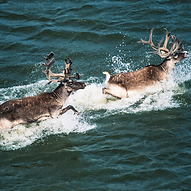
Fatty caribou are prized by Eskimos, especially during the late summer, but the time involves periods of feasting and fasting as game is scarce. Kuptana describes how a chisel tool is used by a young man on his first kill to open the brain of a freshly killed caribou for a feast. The hunting party dedicated all their time to hunting and storing caribou meat for later in the autumn when food is scarce.
Caribou Hunting
William Kuptana: I remember being packed going inland in the summer. When we were out of food, we'd eat seal fat out of the pouch. My parents would also carry a sealskin bag filled with seal blood. We'd drink out of that when were thirsty.
While we were treking inland, food would become scarce. My parents killed a lemming and cooked it. I didn't want to eat it, but they talked to me so I had to eat it. I didn't want to be left behind. We'd keep walking and looking for caribou. When we'd come to a lake that was still frozen over, they would make an agluaq (fishing hole). Hook and spear were used to catch fish. By fishing, that would prevent us from starving. Also, when the ice is gone in the river, they would fish by using spears and wading in after them.
After that, we would go wandering off into the land looking for caribou. We had no guns. Finally, when we found a small herd, the men would then build a small projection of stone slabs on a high point of land to act as a rouse to statle the fleeing caribou. The women would advance toward the caribou, humming as they approached the herd. As the caribou approached the lair where the men were hiding, the men would then kill the closest ones, the ones that they could reach.
The kill meant, "Feast." The family would eat everything: stomach, entrails, marrow. For instance, the entrails would be cleaned out and then cooked. After they were cooked, the entrails would be eaten with seal oil. The extra meat would be cut up to make dried meat.
The warm summer months were not a time of plenty for the Copper Inuit. As Diamond Jenness (1922:123-124) noted: "The traveller will find scattered families reaming about from place to place, here today and gone tomorrow in their restless search for game. Days of feasting alternate with days of fasting according to their failure or success. No fowl of the air, no creature of the land, no fish of the waters is too great or too small to attract their notice at this time."
The scarcity of food in spring and summer was partially alleviated in the late summer/early fall(August and September) when caribou hunting accelerated. At this time of year the caribou are fattest and their hides are ideals for making clothes. Usually a number of families would cooperate in the hunting of caribou using caribou drives set up on the tundra. These drives usually consisted of rows of stone piles set up in tow converging lines. Women and children chased the caribou with lances and arrows. Another technique, more commonly used on the mainland, involved hunting caribou from kayaks at crossing places in lakes. If a caribou drive was successful, much of the meat would be dried and stored for use during the lean autumn months.
First Hunt
William Kuptana: When I first killed a caribou, my biological father started wrestling with me as it is a custom to try to put a young hunter on top of the caribou corpse. After that, the hunting party told me to get the ulimuan [ a chisel-like instrument with a blade at a forty-five degree angle from the handle]. So I got one out of the pack-sack to open its head as it is a custom that a young man do that for a first kill. After I had chopped its skull, the elders started eating its inner membrane, or as it is usually called, the brain. Then, after the feast, the hunting party resumed their search for the tuktuvialuit (Banks Island Caribou). From spring to autumn, the hunting party would kill, store, and go on searching until it was too cold to hunt. Finally, returning to their wintering grounds, they'd wait for winter huddled in their sealskin tents for a time.
June 11, 1911
Vilhjalmur Stefansson
My Life with the Eskimo - Notes on Plants

The only roots which I have seen used as food by the Eskimo are the roots of a species of Knotweed Polygonum bistortum. The roots of plants of this genus, known to the Eskimo as Mā'sū, or Mā'shū, are frequently dug and eaten in summer, but usually only when there is a scarcity of meat or fish for food.
NOTES ON PLANTS
Very few plants outside of the trees and woody shrubs are put to economic use by the Eskimo. North of the limit of trees, the various species of shrub and ground willows are burned, as is also the Northern Dwarf Birch ( Betula nana Linn .). The latter, known as “ partridge-brush ” in the Great Bear Lake region, as ēk -fuk'tok by Alaskan Eskimo, and as av-al-lū'kret by the Coronation Gulf people, burns with a fierce heat, even when green , and can be used in a camp-stove if twisted into bunches. On the Barren Grounds, a species of heather, Cassiope tetragona (L.) D. Don. , is much used for fuel, particularly in the summer - time. It burns either green or dry, and can even be dug from under the snow and burned in winter. This species, or one very similar to it, is common in various places – in the Endicott Mountains, Alaska; King Point, Yukon Territory ; Langton Bay, Coronation Gulf, Dismal Lake, Dease River, and Great Bear Lake. It is called Ik -hlū'tit by the Coronation Gulf Eskimo ; Pi-la -rau -ū'it by western Alaskan Eskimo ( Port Clarence) ; and Tu -kak -shi-ū'uit by Mackenzie delta Eskimo. The inner bark of the Mountain Alder, Alnus alnobetula ( Ehrh .) Koch ., is often used to stain the inner side of tanned skins red .
The only roots which I have seen used as food by the Eskimo are the roots of a species of Knotweed either Polygonum bistortum ( Tourn .) L., Polygonum viviparum L., or Polygonum fugax Small. The roots of plants of this genus, known to the Eskimo as Mā'sū, or Mā'shū, are frequently dug and eaten in summer, but usually only when there is a scarcity of meat or fish for food. These roots are fairly edible, either raw or cooked, having a slightly sweetish taste, but are somewhat woody and fibrous. On the Colville River, Alaska, the Eskimo preserve the Masu roots in sealskin “ pokes," and eat them in a somewhat fermented state. Several species of small ground -growing berries are often eaten by the western Eskimo, particularly a yellow berry called Ak'pek (the Cloudberry, Rubus chamæmarus Linn . ), the At'tsi-ak (Alpine Bearberry, Mairania alpina (Linn .) Desv. ), and the paun'rat (Crowberry, Empetrum nigrum Linn .). These berries are eaten by the Coronation Gulf Eskimo, except the akpek, the use of which is unknown, although in the opinion of white men and of the western Eskimo it is the best of all local berries. They are eaten by the Mackenzie Eskimo, but they say they did not use them extensively until taught to do so by the Alaskan Eskimo (not more than twenty -five years ago) . The leaves of Oxyria digyna (L.) , a species of sorrel, are frequently mixed with seal-oil and eaten as a sort of salad by the western Eskimo. The plant is called Kõ'na-ritj by Alaskan Eskimo. The partly digested stomach contents of the Barren Ground caribou are frequently eaten frozen in winter. Stomachs filled with reindeer-moss are considered much better than those from caribou which have been feeding on the coarse, woody fibers of grassy plants. As with most other viands, this dish is not considered complete without a liberal dressing of seal-oil.
The collecting of plants on the expedition was only incidental for the greater part of the time, owing to lack of facilities for preserving and transporting specimens. A collection mainly of flowering plants from the north coast of Alaska was completely lost. A small lot of plants which survived the vicissitudes of northern travel were turned over to the New York Botanical Garden, Bronx Park, New York City, and were very kindly determined by Dr. P. A. Rydberg, as follows:
Coronation Gulf. Mouth of Kogaryuak River, eighteen miles east of Coppermine River, Arctic coast, Canada, June 18th, 1911 .
Salix arctica Pallas. Rather small specimen.
Draba hirta L. Tall specimen.
Astragalus sp. An unknown species, somewhat resembling A. alpinus, but more slender, with small, narrow , grayish , hirsute leaflets, purple only on the tip of the keel, black -hairy calyx shorter than in A. alpinus. No fruit is found, which makes it impossible to characterize the plant fully.
Lupinus arcticus S. Wats. A form more grayish - pubescent than the Victoria Island specimen.
Hedysarum mackenzië Richards. A low specimen.
Rhododendron lapponicum L. (This species is abundant on south side of Coronation Gulf.)
Cassiope tetragona D. Don. Luxuriant specimens. ( Used for fuel .)
Pedicularis lanata Willd. Fair specimen.
Pedicularis arctica R. Br. Good specimen. Southwestern Victoria Island, fifteen miles east of Point Williams, July 21st, 1911 .
Salix phlebophylla And. Specimen with rather large leaves.
Papaver radicatum Rottb. In fruit.
Dryas integrifolia Vahl. Both the typical and the lobed -leaved forms.
Potentilla pulchella R. Br. Good specimen with rather narrow leaf. Lupinus arcticus S. Wats. The typical form.
Mairania alpina (L.) Desv. In leaves only. It is probably the red - fruited form .
Androsace chamæiasme arctica Kunth . Excellent specimens.
Statice sibirica ( Turcz .) Ledeb . Good specimens.
Chrysanthemum integrifolium Richards. Small specimen. Cape Bathurst, Arctic coast, Northwest Territory, Canada, July 6th, 1912.
Salix anglorum Cham. Typical.
Oxyria digyna (L.) Compt. Good specimens. (Often eaten as a relish . )
Ranunculus nivalis L. Good typical specimens.
Draba glacialis Adams. In young flowers, small- leaved.
Cochlearis grænlandica L. In flowers.
Androsace chamaeiasme arctica Kunth . Excellent specimens.
Primula borealis Duby. Just beginning to bloom , therefore pedicils rather short .
Phlox richardsonii Hook. Best specimens seen of this rare plant.
Pneumaria maritima (L. ) Hill . Good specimens. King Point, Arctic coast, Yukon Territory, Canada, August 27th , 1912.
Polygonum fugax Small. Out of bloom and spike gone, but probably this form.
Vaccinim Vitis - Idæa L. Only a fragment. Valeriana capitata Pallas. Rather small specimen.
The Knotweed has some effects that might show us why it was considered famine food.
Although no specific mention has been made for this species, there have been reports that some members of this genus can cause photosensitivity in susceptible people. Many species also contain oxalic acid (the distinctive lemony flavour of sorrel) - whilst not toxic this substance can bind up other minerals making them unavailable to the body and leading to mineral deficiency.
https://pfaf.org/user/Plant.aspx?LatinName=Polygonum+viviparum
June 20, 1911
Vilhjalmur Stefansson
My Life with the Eskimo - Chapter 21

Stefansson describes a ten day slog in June where they hunted birds and ate bird eggs, but were attacked by vicious mosquitos.
It took us ten days of the hardest toil to cover the twenty miles that separated us from Langton Bay. We ventured on the ice of no more lakes, and in fact most of the lakes were already open. We had been living on seal meat up to this time, but now we lived on geese and swans . The neck of Cape Parry is one of the great swan breeding grounds. The birds themselves are not difficult to shoot with a rifle, and the nests are among the most conspicuous objects in the animal life of the Arctic. A swan's nest is the size of a bushel basket and is usually built on the barren shore of a lake. The dun color of the nest itself and the spotless white bird on top of it can be seen with the naked eye much farther than either the caribou or the grizzly bear. There are often six eggs in a nest, and as they are more than twice the size of the egg of a goose, half a dozen of them would make a square meal for a fairly hungry man. There were also some caribou in this district, and one day while Natkusiak was cooking lunch I secured three of them and two days later another two besides.
By June 20th, while we were still making the overland crossing, the mosquitoes had become so numerous as to make sleep almost impossible, for we had no mosquito nets with us. This made us struggle all the harder, for our base camp at Langton Bay was now less than twenty miles away, and we knew that we would find there not only our Eskimo companions and a comfortable camp, but best of all and most important, mosquito nets under which we could get a com fortable night's rest.
August 1, 1911
Vilhjalmur Stefansson
My Life with the Eskimo - Chapter 22

The summer of 1911 is recorded by Stefansson. He talks of hunting fat caribou for their fat and skins. He also discusses why Eskimo like flour and sugar despite not considering it as necessary food.
On the way south we happened to pick up a polar bear that was wandering about on shore. A day or two before that Palaiyak and Mangilanna had secured a young grizzly bear, and a day or two after Palaiyak got another one in the Melvill Mountains south of Langton Bay. In general, however, at this time we lived on the meat of the bearded seal, which the boys Palaiyak and Mangilanna secured by paddling out to sea in their kayaks and shooting the seals as they slept on floating cakes of ice.
July 27th Ilavinirk, Natkusiak, and Mangilanna with our umiak started west to the Baillie Islands, while I remained behind doing archæological work around Langton Bay with the intermittent assistance of Palaiyak, Mamayauk, and Nogasak. In general, as I have had many occasions to point out, Nogasak was a very lazy and useless sort of person; but scratching around in the ground with the prospect of finding spear points or knives was something that appealed to her, and she really was my most valuable assistant throughout the entire summer in the work of excavating. I am inclined to think the main reason may have been that I discouraged her from the first, for fear that she might damage through carelessness some important find that she made. She was therefore very careful, and whenever she found a sign of anything she would come to me and tell me about it before she finally dug it up. It would no doubt have been more desirable had I had the means of employing expert diggers who would have done everything according to the book, but as it was it seemed to be much more useful that Nogasak should find things in the wrong way than that they should remain buried and probably unfound forever.
The time had now come when the caribou might be expected to have a little fat on their backs and the skins were becoming suitable for clothing. Altogether, myself and various members of our party had killed only half a dozen or so caribou since we came back to Langton Bay, and the skins of all of them had been of little use, for they were full of large holes made by the escaping grubs of the bot-fly which had been growing under the hides of the poor animals' backs all winter and which had now just come out of their warm quarters and taken wing. The hair also is rather too short until towards the end of July, but from that time until the 20th of September it is in excellent condition for clothing, after which it becomes too long.
It is not only the length of hair which is right in the month of August, but also the thickness of the hide itself. From Christmas time until May the skin is as thin as parchment and there is very little strength to it. In June it begins to thicken, but is as yet full of bot-fly holes. Towards the end of July these holes heal up and the skin becomes of the right thickness, while by October it has become too thick and unpliable for use as clothing. For that reason we use the hides of ordinary animals taken in September and October for clothing only in emergencies, and otherwise utilize them for bedding only, except the skins of the old bull caribou, which have often the thickness of sole leather and which we accordingly use for boot soles for our winter footwear.
It was because we knew the caribou were getting into condition and because we had to “ take thought for the morrow ” in the matter of clothing for winter that we set out on July 30th southward to look for caribou.
The Endicott Mountains look like mountains true enough as seen from the sea, but when in the three-mile walk inland you have climbed up two thousand feet or so you find yourself on a fairly level table- land, although within three miles from the sea the streams begin to flow inland towards Horton River, which lies about fifteen miles away, parallel to the coast.
Soon after I reached the top of this plateau and about five miles from camp I came upon a grizzly bear accompanied by two small cubs. I did not realize how small the cubs were at first and shot the old animal and one of the cubs. On closer approach I saw that the living animal was but the size of a wolverine and showed no fear or concern of me whatever. It occurred to me then that it would be a very interesting thing to take the thing alive; but unfortunately I did not have any string with me or other means of taking the cub along to the coast. I therefore returned home and immediately hitched our dogs to a sled, with which and an empty box we started to fetch the bear. It was a matter of eight or ten hours until we got to where I had left the cub behind; but although he had not been afraid of me then, the poor fellow had by now evidently realized the death of his two relatives, and we were at least half a mile away when he saw us and took to his heels. I followed him a considerable distance while the others skinned the two dead bears, but I never got anywhere near him.
With me the matter of big game hunting is another case of " swords sticking to hands that seek the plow.” I am afraid I am not a true sportsman. It is impossible for me to get enjoyment out of the killing of animals (and as for that, if I did I should get a job in the Chicago stockyards rather than follow poor frightened wild things around with a rifle). It is mere nonsense to talk of wild animals (in the case of those on the continent of North America at least) having a chance for their lives against the hunter. They all give us as wide a berth as they can; their only desire and hope of safety is in hiding or in flight. None of them, so far as my experience goes, will fight unless wounded or cornered, or in the defence of their helpless young. No matter how well they are provided by nature with claws and teeth and stout muscles, they have no more chance against a man with a modern rifle than a fly has against a sledge hammer.
Unfortunately the Barren Ground grizzly is a priceless thing scientifically. There are practically none of them in museums and one of our avowed objects in coming North was to get some. I never allowed any to pass, therefore, and I shot altogether thirteen, but somehow the killing of these poor animals affected me more than that of any others. They are provided by nature with a fighting equip ment second to no animal on the continent, and yet they try their best to live peacefully and inoffensively. They feed on roots almost entirely, and whenever they discover the sign of a human being, whether they see or smell his footprints, or see him or get his wind, they immediately use every means in their power to get out of the way. But they are dull of sight and not very quick of hearing and when the hunter once sees them there is no escape.
August 8th Palaiyak hunted to the south also and shot three deer about five miles away from camp. We were about to set out to fetch the meat of them when a sail appeared to the north which our glasses told us was Captain Bernard's Teddy Bear. It was reasonable enough she should arrive just then, although we had not expected her for a week or so yet.
The Teddy Bear dropped anchor in the harbor late in the afternoon of August 9th, bringing Dr. Anderson, Tannaumirk, and Pannigabluk, all safe. Spring had been very early in Coronation Gulf, and they really could have come out sooner than they did. Cruising up along the southwest coast of Victoria Island they had found our beacon on Bell Island and had thereby, as we intended, been saved from the trip to Banks Island to look for us.
I was very confident that we would be able in the neighborhood of Langton Bay to kill caribou and grizzly bears enough for our food the coming winter, but our Eskimo knew very well that their country men at the Baillie Islands, less than a hundred miles to the westward, would have plenty of flour, tea, and things of that sort, and we felt they would not be content with us unless they had it also. Captain Bernard had a considerable stock of these things and kindly furnished us with a supply. Dr. Anderson and I are not particular about such luxuries as flour and sugar, but our Eskimo had no scientific interests to keep them in the country, and, like servants everywhere, wanted as high wages and as good food as possible. So of course we had to supply them with what we could get in the way of imported food.
It is not really so much that these Eskimo regard baking powder bread as such excellent food, but it is rather that they know it is expensive and they are human enough to want to have their neighbors know that they can afford to have this and that to eat even if it does cost money, differing not so much from the rest of humanity in that matter. They judge things chiefly by price, and desire them in proportion to their current market value.
Dr. Anderson was anxious to communicate with the whaling ships if possible for the purpose of sending out mail and for other reasons,, and so he continued west with the Teddy Bear toward the Baillie Islands with the intention of returning thence with Ilavinirk and Nat kusiak in our umiak, while Tannaumirk and Pannigabluk came ashore and joined us. As the caribou season was now at its best we stayed around Langton Bay only a few hours after the Teddy Bear left and then started inland in the search for game.
As we have pointed out elsewhere, the caribou hunt is not merely to secure meat. A supply of dried venison to tide you over the sunless days helps you to face the season with confidence, but the main consideration is to secure skins for clothing against the winter. Our method of hunting is in general that we travel from one high hill to another high hill, pause on each hilltop and with our field glasses and telescopes carefully examine every inch of visible ground in the hope of seeing caribou.
On these summer hunts the dogs are equipped with pack saddles, consisting essentially of two big pouches that nearly reach to the ground on either side of the animal when the pack is in place. These pack saddles are loaded with the heaviest and least bulky things we have to carry. A fifty-pound dog will carry a forty-pound pack or even a heavier one, and he will carry it all day, although his walking gait is rather slow, perhaps not much over two miles an hour. The people of the party will carry on their backs the bulky things, such as the bedding, tents, and cooking utensils. A man does not carry more than thirty or forty pounds, although under special conditions he may carry as much as a hundred and fifty or even two hundred.
When caribou are discovered, the women and children, if there are any in the party, stop and make camp, while the men secure the caribou, skin them, and cut them up. Usually long before the skinning is done camp has been made; and if the caribou are located so near that the women know the killing has actually taken place, they come with the dogs to help bring home the meat; or if a considerable number of caribou are killed, it may be easier than moving the meat to camp to move the camp up to the scene of the slaughter. The meat is then cut up into thin strips and spread out on the ground or on stones to dry; or if there are sticks available a frame is made over which the meat is hung up. The skins too are spread out to dry. The process of drying meat delays camp moving, so the men go out and hunt for more caribou in all directions from the camp; and if they secure any they usually bring home the meat, unless indeed they make a big killing, in which case it is easier to transport the half-dried meat and the camp gear to the deer kill than to bring home the fresh meat to camp. Then whenever the meat is dried and if no more caribou are likely to be found in that immediate vicinity, the meat is cached in the safest way possible, usually by stones being piled on top of it, and the party moves on, carrying with it the dried caribou skins, for they are too precious to leave behind to the uncertain safety of a cache. The same kind of traveling as before is resumed as soon as all the meat killable in any locality has been turned into dry meat, the party marching from hilltop to hilltop and continually looking for game, which is finally found. And then the same process repeats itself.
On the particular hunt under discussion the caribou were not very numerous. First we went about fifteen miles south from Langton Bay to the head of a small wooded creek that runs into Horton River from the north, and here during the course of a week we killed about a dozen caribou and three grizzly bears. The Eskimo generally merely wind-dry the meat, but personally I rather prefer the Indian method of smoke-drying it, and so we built a spruce bough lodge in the Indian style and dried the meat that way. This has an additional advantage, for when you want to leave for another hunting camp you can with tolerable safety cache anything you want inside of the abandoned lodge, for the smoke smell, while it is at all fresh, will keep beasts of prey at a distance. Eventually, of course (in a fortnight or so), some wolverine will become contemptuous enough of the fire smell which it at first dreaded, and will venture into the deserted house to steal.
We remained about a week in the camp on the wooded creek-head where we had made our first kill, and then we were forced to leave it on account of the absence of caribou in that neighborhood, and by the fact that I one day happened to kill four animals a long way to the eastward in a country where game signs were more numerous. Moving to these better pastures was a matter of nearly a day's walk, for we traveled heavy laden with the caribou fat and skins that were too precious to risk leaving behind with the meat. Traveling at this time of year is particularly pleasant, for while the days are still warm, the placid nights are cool and the power of the mosquito has been broken. There are few things in one's experience in the North that are so pleasant to remember as these autumn hunts, when the camp is pitched among a clump of spruce trees at the bottom of some ravine, and when at the end of a day's hunt you can gather around a crackling fire in the enveloping darkness, for the four-months' summer day is just over. The occasional howl of a wolf in the near shadow lends an additional romance, especially if, as not seldom happens, the wolves are so numerous and near that the dogs become frightened and gather in a close circle around the fire. Few meals can be more satisfying, either, at the end of a hard day's work, than a caribou head that has been rotated continuously before the fire until it is roasted through, even to the base of the tongue and the center of the brain. The dreams of boyhood seldom come true, but I am not sure that there is not sometimes as much romance about the reality of such evenings as there was about the dreams of Crusoe- like adventures on desert islands.
October 10, 1911
The Northern Copper Inuit - A History

Kuptana describes how Eskimos would congregate to catch fatty char in weirs and collect them through October and then meet near the forming ice to make winter gear and hunting equipment.
Early fall, however, was a productive time for spear fishing in rivers and streams. This was the time of year in many river systems when arctic char returned to lakes after spending much of the summer feeding in the ocean. The char were fattest at this time of year and hence a desirable food item. Families arrived at fishing sites eraly enough to repair the stone weirs, which might have been disturbed the previous winter by ice movement. The repair work completed, families waited for the run to start. In areas with large char runs, a number of families might congregate. A successful fishing season was marked by great numbers of filleted fish hung to dry. Much of this fish, as well as the caribou, was stored for use during late fall and early winter.
Autumn
William Kuptana: When fall approached, they [Inuit] treked back to their wintering grounds. Along the way when they killed caribou, they built stone caches to store the food for winter. The cache also served as protection from scavengers such as wolves and foxes. Sometmmies, too, depending on the weather, the caribou meat was cut up to make more dried meat. The dried meat was lighter to carry and fermentation didn't take place as quickly as it did with raw meat if not eaten right away.
When they arrived in the vicinity of their wintering grounds, they started fishing through the frozen ice on the lakes. Arctic char was baited by a polar bear tooth, then speared. The fish was then scooped with a sealskin bag wrapped to a wooden or bone handle by a sealskin thong. They filled those bags with fish. The preferred catch was male fish and the preferred area of fishing was in the spawning areas.
Fishing for char was done through October when the ice got too thick to chop through.
As the fall season brought colder and windier weather, groups generally met at traditional fall gathering places where women prepared the winter's clothing. Once families moved out onto the ice, women were forbidden to sew, and all had to be accomplished at the gathering place. While women prepared the clothing, men made ready the winter hunting equipment. Hunting and fishing continued, but on a limited scale. At this time of year, game was relatively scarce. Often, families had to live on accumulated food reserves. Once ice conditions permitted the migration on to the ice, the winter season of sealing and polar bear hunting would commence.
Ancient History
Germany
50000
B.C.E.
Palaeolithic and Mesolithic kill-butchering sites: the hard evidence
The upper paleolithic is characterized by advanced hunting of large animals with various weapons, and planning to maximize easy prey
Upper Palaeolithic and Mesolithic Hunting:
the archaeological record leaves us some direct evidence of man's hunting activities. At Meiendorf (Rust 1937) and Stellmoor (Rusf 1937), some bones of reindeer and birds still conserve weapon marks and a few pieces of silex have remained thrusted in mammalian bones; man kills reindeer with harpoons and sticks (fractured skulls), birds with bows and maybe slings. Three fractured skulls of red deer in Abri Pataud (Bouchud, 1975), and one bovid skull with a circular orifice in Saint Marcel (Allain, 1952) suggest the practice of the so called " co'up de merlin": man has delivered a blow similar to the one used today to butcher cattle. Probably the animal already immobilized (wounded or entrapped) was hit on the frontal with a big stone. At Kokorevo I (Siberia), a large scapula of bison is pierced by the upper end of a point made of bone (Boriskowksi, 1965). At High Furlong (Mesolithic), an elk was discovered with the marks of L7 wounds made by barbed points, of which two were found in the site, and by other arms. The animal had apparently been attacked at two distinct occasions: during the first one, hunters aimed at the legs to lame the animal (fig. 6), later hunters hit the thoracic region and the lungs to kill it. However the elk died in a little lake, perhaps imprisoned in the ice, and man had no access to the meat. The animal represents in fact a hunting loss (Hallam et a1.,1973).
Planning: very good. Many sites belong to Wpe e, were occupied periodically or seasonally and specialised in the capture of a particular game (e.g., horse, reindeeq, ibex). Game drive towards cliffs have been claimed and Solutre (Combier & Thevenot,1976) has long figured as an example, but the evidence is far from conclusive.
Scavenging: no doubt H. sapiens still killed or exploited animals in the occasional and opportunistic way of Lower Palaeolithic times. According to Lindner (Lindner,1941), hunters at Predmost utilised the carcasses of hundreds of mammoths that probably succumbed as a result of natural catastrophes, as food.
Food transport: selective transport of the most useful animal parts is claimed for many sites.
Specialised activities: sometimes the material is dislocated in distinct clusters that could reflect specialised activity areas as for example at Solutre (Combier & Thevenot, 1976). Site topography: some hunting sites were located in valleys enclosed by steep slopes as at Rascano (Gonziilez-Echegaray, 1979), Stellmoor (Rust, 1937), Meiendorf (Rust 1937), or at the foot of rocky cliffs at Solutr6 (Combier & Th6venot, 1,976).
4. Conclusions
Most of the Lower Palaeolithic sites analysed here belong to category a (butchering sites); other kind of concentrations are rare and difficult to ascertain. A number of hunting stations (category e) and a hunting stop (category f) form my sample for the age of Neanderthal man and related people. The Upper Palaeolithic is characterised by many hunting stations, while in Mesolithic times a hunting loss (category d ) was found as well as several sighting sites (category g). The foregoing distribution seems to reflect in a vague way an evolution from scavenging and haphazard opportunistic hunting to well organised, selective hunting activities. However, this reflection results no doubt in part from a priori assumptions concerning the evolution of hominid meat procurement often colouring the interpretations offered for the osseous "hard" data; these are frequently equivocal.
Vindija, 42000, Varaždin, Croatia
28500
B.C.E.
Neanderthal diet at Vindija and Neanderthal predation: The evidence from stable isotopes
The isotope evidence overwhelmingly points to the Neanderthals behaving as top-level carnivores, obtaining almost all of their dietary protein from animal sources
Archeological analysis of faunal remains and of lithic and bone tools has suggested that hunting of medium to large mammals was a major element of Neanderthal subsistence. Plant foods are almost invisible in the archeological record, and it is impossible to estimate accurately their dietary importance. However, stable isotope (13C and 15N) analysis of mammal bone collagen provides a direct measure of diet and has been applied to two Neanderthals and various faunal species from Vindija Cave, Croatia. The isotope evidence overwhelmingly points to the Neanderthals behaving as top-level carnivores, obtaining almost all of their dietary protein from animal sources. Earlier Neanderthals in France and Belgium have yielded similar results, and a pattern of European Neander- thal adaptation as carnivores is emerging. These data reinforce current taphonomic assessments of associated faunal elements and make it unlikely that the Neanderthals were acquiring animal protein principally through scavenging. Instead, these findings portray them as effective predators.
Stable Isotope Analyses.
Mammal bone collagen δ13C and δ15N values reflect the δ13C and δ15N values of dietary protein (14). They furnish a long-term record of diet, giving the average δ13C and δ15N values of all of the protein consumed over the last years of the measured individual's life. δ13C values can be used to discriminate between terrestrial and marine dietary protein in humans and other mammals (15, 16). In addition, because of the canopy effect, species that live in forest environments can have δ13C values that are more negative than species that live in open environments (17). δ15N values are, on average, 2–4‰ higher than the average δ15N value of the protein consumed (18). Therefore, δ15N values can be used to determine the trophic level of the protein consumed. By measuring the δ13C and δ15N values of various fauna in a paleo-ecosystem, it is possible to reconstruct the trophic level relationships within that ecosystem. Therefore, by comparing the δ13C and δ15N values of omnivores such as hominids with the values of herbivores and carnivores from the same ecosystem, it is possible to determine whether those omnivores were obtaining dietary protein from plant or animal sources.
Cheddar Reservoir, Cheddar BS26, UK
12000
B.C.E.
FOCUS: Gough’s Cave and Sun Hole Cave Human Stable Isotope Values Indicate a High Animal Protein Diet in the British Upper Palaeolithic
We were testing the hypothesis that these humans had a mainly hunting economy, and therefore a diet high in animal protein. We found this to be the case, and by comparing the human δ15N values with those of contemporary fauna, we conclude that the protein sources in human diets at these sites came mainly from herbivores such as Bos sp. and Cervus elaphus
We undertook stable isotope analysis of Upper Palaeolithic humans and fauna from the sites of Gough's Cave and Sun Hole Cave, Somerset, U.K., for palaeodietary reconstruction. We were testing the hypothesis that these humans had a mainly hunting economy, and therefore a diet high in animal protein. We found this to be the case, and by comparing the human δ15N values with those of contemporary fauna, we conclude that the protein sources in human diets at these sites came mainly from herbivores such as Bos sp. and Cervus elaphus. There are a large number ofEquus sp. faunal remains from this site, but this species was not a significant food resource in the diets of these Upper Palaeolithic humans.
If the humans hunted and consumed mainly horse, then their 15N values should be c. 3–5‰ (Equus 15N value of 0·7‰+enrichment of 2–4‰). Instead, their 15N values make more sense if they lived mostly off Bos and Cervus elaphus (Bos and Cervus values of c. 3‰+enrichment of 2–4‰=the observed values c. 6–7‰). It is also possible that other species, including Rangifer tarandus, were consumed by these individuals. Rangifer tarandus has 15N values similar to Cervus elaphus (Richards, 1998), and has more positive 13C values, which may explain the observed slight enrichment in the human 13C values. A number of artefacts made from Rangifer tarandus have been found at Gough’s, but there is no other evidence that this species was being exploited for food
Province of Crotone, Italy
500
B.C.E.
On the Sociology of Ancient Sport
One report states that a trainer named Pythagoras recommended a meat diet to the Olympic athletes he trained.
A lack of animal-derived protein seems to have been rectified early in history, as there are two reports of the introduction of meat into the athletes’ diet. One report states that a trainer named Pythagoras recommended a meat diet to the athletes he trained. https://www.omicsonline.org/open-access/a-comparison-of-ancient-greek-and-roman-sports-diets-with-modern-day-practices-2473-6449-1000104.php?aid=69865
8 He [Pythagoras] is said to have been the first to train athletes on a meat diet. The first athlete he did this with was Eurymenes. Formerly they had trained on dried figs, moist cheese, and wheat. Some say that it was a trainer named Pythagoras and not the philosopher who was responsible for this innovative diet. For our Pythagoras prohibited killing, not to mention eating, life which possessed souls like our own.
Diogenes Laertius, Lives of the Philosophers 8.12
Sport and Recreation
To all appearances medical knowledge in general and nutrition in particular was widespread in Pythagorean circles in Southern Italy, especially in Kroton. Burkert has pointed out that the fmaous doctor Alcmaeon came from the Pythagorean center of Kroton. From the akousmata (secret doctrines), which doubtless contain old religious traditions, we learn that the Pythagoreans were not originally strict vegetarians; the consumption of meat was permitted, with the exception of lamb and the meat of draft oxen. Burkert considers there is some likelihood that Pythagoras introduced a meat diet for athletes. He believes this tradition arose when Pythagorean vegetarianism had not yet been completely developed. In later times, when vegetarianism had prevailed, a second tradition has possibly been invented, in which it was not Pythagoras, the philosopher from Samos and Kroton, but a homonymous person who wrot the great 'trainer's recipe book'.
57: There are similar issues regarding the transmission in later sources of Pythagoras advising the successful heavy athlete Eurymenes of Samos to use a special meat-based diet instead of the dried figs and cheese he had previously been eating.
On the Sociology of Ancient Sport - page 43.
Mantineia 221 00, Greece
480
B.C.E.
A Comparison of Ancient Greek and Roman Sports Diets with Modern Day Practices
Dromeus, a long-distance runner, is said to have first thought of eating meat for training instead of just cheese and won multiple victories.
The second report is that of Pausanias, who writes of Dromeus, a long-distance runner from Stymphalos [23].
“...he won two victories in the dolichos at Olympia, the same number in the Pythian Games, three at the Isthmian and five at the Nemean. He is said to have first thought of eating meat (as part of his training diet). Until then the food for athletes was cheese fresh out of the basket.”
Clearly, if his success is anything to go by, then Dromeus had really found a winner’s diet. There are also reports of athletes eating meat from oxen, bulls, goats and deer, a very” red-meat” diet which is a rich form of protein. Moreover, with meat as a part of their diet, the performance of competing athletes would most certainly have improved noticeably.
5 A man named Dromeus from Mantineia was said to have been the first we know of to have won the pankration by default [ = akoniti]. Pausanias 6.11.4
Dromeus, Long-Distance Runner
There was a man from Stymphalos, named Dromeus, whose record as a long-distance runner was exceptional: he won two victories in the dolichos at Olympia, the same number in the Pythian Games, three at the Isthmian and five at the Nemean. He is said to have first thought of eating meat (as part of his training diet). Until then the food for athletes was cheese fresh out of the basket.


