


Recent History
March 5, 1939
Kabloona

Goncins comes to love the taste of raw fish, preferring it over anything in France, and also thinks that fish helps warm the body better than carbs in rice.
"It wants very little time to return to the primitive. Already I had ceased to feel the need of the appurtenances of our civilization; and yet I had been reared in a far degree of comfort, I was rather more than less sensitive than the average, and I was even, in a manner of speaking , an "intellectual." After a brief few weeks, all this had dropped away from me. I do not mean that I had stopped yearning for telephones and motor cars, things I should always be able to live without. I mean that the thought of a daily change of linen was gone from my mind; that a joint of beef would not have made my mouth water, and I loved the taste of frozen fish, particualrly if it had frozen instanteously and retained its pristine savour all through the winter. As a matter of fact, I do not remember being served anything in France as much to my taste.
Besides, Father Henry was perfectly right: the white man's diet would never have lent me the power of resistance needed for this life. Boiled rice warmed you while you ate it, but its warmth died out of you almost as soon as it was eaten. Frozen fish worked the other way: you did not feel its radiation immediately; but twenty minutes later it began to warm you and it kept you warm for hours. As for raw meat, with its higher vitamin content, the advantage of eating it frozen was that you could absorb enormous quantities of it; and after a hard day on the trail there was no end to what you ate. Even the taste for rotted food came in time, through I never reached the point of considering it a delicacy. "In the beginning," Father Henry admitted, "I was like you; I always chose the freshest piece. But one day I happened upon a bit of ti-pi, the high meat, and I said to myself, 'Mm! not bad!' Since then fresh meat has seemed to me almost tasteless.
March 15, 1939
Kabloona
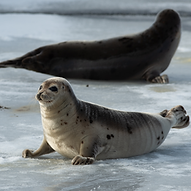
Gontran de Poncins describes a seal hunt and the resulting feast.
"I went with the natives to hunt the seal.
We reached the hunting ground. The dogs were unharnessed and chained up to the anchor fixed in the ice, and tea was made. Then the Eskimos spread fanwise over the sea, each with two specially trained dogs on a thirty-foot lead, and, slung across his chest, a sack containing his tackle. I accompanied one of the hunters and saw the rest dwindle into black dots in the limitless distance. We walked the dogs up into the wind, and soon they began to pull and trot, for they knew that the chase had started. First they ran like pointers, then after a bit they stopped and started off again more slowly and cautiously, nose to the snow. Suddenly they stood quivering in their tracks and sniffing the ground. They had located the aglu, the seal's breathing-hole. We could not see it, for it did not pierce through the snow; but the dogs could smell it. When it was a bull-seal's hole, even the men could smell it, once the dogs had led them there.
Every seal keeps a number of holes open in the ice through wihch to breathe. While the ice is forming over the sea, the seal bobs up and plunges down and bobs up for air again so frequently that the sea freezes very thinly between his visits to the hole, and his body can easily break through the thin sheet of ice. All round the hole, the ice is six or eight feet deep. Above it, over the sheet of ice, snow collects and hides the hole from the passing Eskimo. What is curious also is that the seal comes up to sit on the ice, beneath the surface of the snow, at either side the hole; and here in spring the cow-seal bears her young. A sort of arch of snow is thus formed, and at either end of the arch the seal takes his ease, like a tramp under a bridge.
Our dogs went round and round, sniffing, and that they had truly found the seal-hole was confrimed by my Eskimo after a bit of gentle prodding with the handle fo his harpoon. As I stood by watching, I saw him go suddenly down on his knees. He brought out of his sack a feeler, curved in such a fashion that by making only one hole in the snow, and moving the feeler round in a circle, he could tell just how large the hole was and where its center was. What he found seemed to satifsy him, for he stood up with a grunt and led his dogs about a hundred yards down-wind, where if they chanced to bark they would not be heard by the seal-an animal practically blind but very acute of hearing. He was down-wind and the seal-hole had not yet been opened when he called out across the sea:
"Nik-pa-rar-tun-ga!"--I have found the hole."
His face, as he came back to the hole, was wonderful in the concentrated purpose it expressed, the sober concern with his craft that it revealed.
Now he produced from his sack a marker of the length and shape of a long knitting needle, and sent it straight through the snow into the water that filled the seal-hole. The seal would displace the water as he rose, and with the water the marker would rise. When the marker sank, the hunter would know that the water was back in place and the seal had risen.
From his sack, again, he took a square of bearskin and stood on it about a foot away from the hole. He brought out a steel spear-head which he fastened to the point of his harpoon, and he rested the harpoon horizontally in front of him on a pair of forked sticks that stood upright in the snow. Round his hand he looped the cord tied to the detachable spear-head, and he stood now ready for the kill. When the marker rose he would take the harpoon in his hand. When it sank again, he would drive the spear straight down with one powerful stroke. The spear-head would be deeply imbedded in the seal. He would detach the handle and pull at the cord with all his strength, hauling up the hundred-pound beast.
But the kill might be long delayed. The seal, having several breathing-holes, might be hours coming or might not come at all. I myself had met a hunter who had spent three days motionless....to no avail.
I had been ordered by my Eskimo to move off, and it was from a distance of a hundred feet that I waited and watched, and photographed the sceen. I was in great luck. An hour had not gone by before we heard a shout. A seal! As soon as a seal has been speared, the hunter cries out', "I have killed the seal!" and instantly the others abandon their aglu and race to be in at the kill.
We ran as fast as we could, for the winner of the race receives a choice quarter of the beast, the hunter himself taking the hindquarters, while the rest is distributed thoughout the camp. IT was Tutannuak who had killed the seal, and already he was hauling it out of the hole. Blood ran in streams as th ebeast was brought up, and the dogs bounded over the snow, licking up the blood. Th seal was dragged a few yards from the hole, and then all the hunters knelt round to perform their rite fo thanks to Nuliayuk.
I can describe the scene, but how can I convey its solemnity? There was a hush as Tutannuak picked up his snowknife, made a small incision in the abdomen of the seal, put in his hand, and drew out the liver, all red and smoking. The five hunters knelt in silence as he proceeded. He put the liver down on the seal and cut it into six pieces, one for each, and he set a slice on the snow at his place and before each of the men who knelt, still as in prayer, in that circle. Next he cut and laid beside the liver six chunks of blubber. Six men, members of the hungriest and most voracious race on earth, were motionless in the presence of the greatest delicacies known to the palate of their race. Blubber and liver lay uneaten on the ice while the hunters mutely rendered thanks to Nuliayuk for the gift of the seal. Behind the men sat the dogs, quirvering with greed, their eyes on the seal, but no less still and motionless than their masters. Here, before me, six men and their dogs sat worshipping the sea from which they drew their sustenance, like sun-worshippers adoring the source of light and life. The wide immensity, the hush that overspread this world, lent to this scenec a measureless grandeur.
Suddenly the charm was broken. Each man picked up a pointed stick, stuck it into his bit of liver, and swallowed the liver at a gulp while the blood ran down his chin. Then he popped into his mouth the blubber held in his left hand, and joy spread over all their faces while I, outside the circle, photographed them.
.....
We shoved the seal through the porch, and inside the butchering began. The honor of cutting up and distributing the meat fell to Tutannuak's wife. She skinned the seal, and as she worked she went mentally through the list of households and decided who was to get which cut. The blubber was removed and set aside, the blood was scooped out with a great ladle and poured into a bowl, and the moment for distribution arrived. All the women in the camp were crowding into the porch. Children crawling between their legs and over their backs, the sight and smell of meat creating a prodigious agitiation. On her knees in the porch, her head framed in the opening, the wife of the man who had won the race to Tutannuak held out a basin. And as soon as it was filled she made her way out, and was replaced by the next wife in the same animal posture.
May 26, 1939
Vilhjalmur Stefansson
A Dilemma in Vitamins

Stefansson explains how Vitamin C is actually in meat and dietitians have gotten it wrong. Organs do not have to be consumed, and there is enough vitamin C in cooked meat.
A HALF century ago the geologists were demanding a hundred million years for the age of the earth, while the astronomers mere not willing to concede them more than ten million. Now there seems to be a corresponding situation between the anthropologists and the dietitians with regard to vitamin C.
The position of the dietitians, or at least of a certain school of dietetics, may be taken from the 1938 revised edition of "The Foundations of Nutrition," by Dr. Mary Swartz Rose, and reinforced by quotations which Dr. Rose gives (personal Communication) from Dr. Henry Clapp Sherman's ('The Vitamins" (in collaboration with S. L. Smith) :
. . .what little (vitamin C) there may be in fresh raw muscle becomes practically negligible in meat as ordinarily eaten. Even in liver, which is normally well supplied with vitamins A and B, vitamin C is found in low concentration and is lost in cooking. (Rose, p. 305.)
The vitamin C which they (kidney and liver) contain is mostly destroyed in cooking. (Rose, p. 429.)
Muscle tissues, ordinary meats, are so poor in antiscorbutic vitamin that attempts to show its presence by eqeriments upon guinea pigs have given negative results. .. .Dutcher, Pierson and Biester (1919) were not able to observe any antiscorbutic effect from raw lean beef fed to guinea pigs. (Sherman and Smith.)
. . . meat, if eaten sufficiently fresh, raw, or "rare" and in large quantities has an appreciable though small antiscorbutic value. (Sherman and Smith.)
In view of the fact that even when eaten in very large amounts meat can be expected to prevent scurvy only if eaten raw or nearly so, we must that meat, as ordinarily eaten, probably furnishes but insignificant amounts of the antiscorbutic vitamin. (Sherman and Smith.)
Few readers nrould think either from these quotations or from the whole of the cited book of Dr. Rose that it would be possible to live in good health on a diet consisting of thoroughly cooked meat (medium-done to well-done) and from which diet are absent most or all of the organs described as "particularly rich in vitamin C." But it is known to students of "primitive" peoples, whether ancient or modern, that this is just what hunting man has been doing from time immemorial.
The records of travelers, field anthropologists and frontiersmen (e.g., post managers of the Hudson's Bay Company throughout the north of Canada) are full of case histories and general information which show that exclusive meat-eaters never show a vitamin C deficiency and that many of them consume few or none of the organs said to be rich in vitamin C.
Nor do all groups of exclusively carnivorous people eat large or even considerable amounts of raw or underdone animal tissue, as Rose and Sherman-Smith say and imply they would have to do in order to avoid scurvy.
The diet experimenters and the diet historians are, then, in square contradiction. The experiments say of animal tissues that vitamin C is negligible to begin with, except in certain glandular organs, and that in any case this vitamin C is nearly or quite destroyed by ordinaly cooking; so that to avoid scurvy on a meat diet you have to eat considerable quantities of these organs and have to eat them raw or underdone. To this contention the diet historians reply that meateaters, such as the northern Canadian Eskimos and the northern Athapascans, feed to dogs or throw away most of the "glandular organs rich in vitamin C"; and that the Athapascans, without ever developing scurvy symptoms, punctiliously cook their food to that extent which Rose and Sherman-Smith say or imply would either wholly or practically destroy their vitamin C efficiency.
With regard to the solutlon of this apparent dilemma between the animal experimenters and the observers of "primitive" human diets, we make four suggestions :
(1)The experimenters reach unsound conclusions with regard to human needs when they analogize for vitamin C from guinea pigs to humans.
(2) Those who measure the vitamin C content of animal tissues through the current methods have probably overestimated by from two to ten times the amount necessary to prevent scurvy symptoms in man -or perhaps they have underestimated the superiority of the human over the guinea pig mechanism for extracting and utilizing vitamin C.
(3) The experimenters have overestimated the destructive effect of ordinary cooking upon the vitamin C efficiency of animal tissues-in all probability the vitamin C is greatly weakened or destroyed only in the outermost layer of a piece of meat. Most carnivorous people boil or roast their meat in large pieces and cook to where the outside only is well done while the inside of either boiled or roast is about like the inside of our roasts. In such cooking the vitamin C efficiency may remain nearly or quite undiminished through 90 per cent of the diameter of each chunk.
(4) Or possibly there is some component of animal tissues other than vitamin C which is able to prevent scurvy. Perhaps the solution is in a combination of two or more of the suggestions, or in one that has not occurred to us. In any case, it is as necessary for the experimenters and the observers to get together on the "vitamin C in animal tissues" problem as it was for the astronomers and the geologists to get together on the chronology of the solar system.
Vihljalmur Stefansson
27 WEST 44th STREET, NEW YORK CITY
July 1, 1939
Medical experiments carried out in Sheffield on conscientious objectors to military service during the 1939-45 war

"In a study from the 1930s-early 1940s, they experimented with doses of vitamin C to determine minimum requirement to avoid scurvy. The researchers supplemented 10mg/day. In their trials, they found that that the 10mg amount was sufficient not only to prevent scurvy but also to reverse scurvy. A few of the participants were given reduced doses, after 160 days with only 10 mg a day, three volunteers were left on less, which averaged 3.2, 3.2, and 4.5 mg vitamin C daily, and even that was enough to prevent scurvy."
The Sheffield Experiment on the Vitamin C Requirement of Human Adults*
BY H. A. KREBS, Medical Research Council Unit for Research in Cell Metabolism, Department of Biochemistry, University of Shefield
In 1938 the League of Nations Technical Commission on Nutrition estimated the daily vitamin C requirement of human adults at 30 mg (League of Nations Health Organization: Technical Commission on Nutrition, 1938). In 1943 the (U.S.A.) National Research Council Committee on Food and Nutrition recommended an allowance of 75 mg (National Research Council: Food and Nutrition Board, 1943). Some authorities, e.g. Zilva (1941, 1944) put the daily requirements much below 30 mg. These were the main data on which dietary planning had to be based during the war years. The divergences in the estimates arose from the different standards used in assessing the requirement. The high values were based on studies of the saturation of the body with vitamin C, whereas the lower values were inferred from observations on the prevention and cure of the clinical manifestations of scurvy. The differences were also an indication of the lack of accurate information, and in 1944 Professor R. A. Peters suggested to the Medical Research Council that it would be worth while obtaining additional information on the vitamin C requirements of human adults by a trial on human volunteers who had offered themselves for this kind of investigation at the Sorby Research Institute at Sheffield. Professor Peters’s suggestion was accepted and the Vitamin C Subcommittee of the Medical Research Council under the chairmanship of Professor Peters was entrusted with the task of designing and conducting the trial. This was carried out at Sheffield from October 1944 to February 1946. The main plan was to induce scurvy by a vitamin C-deficient diet and to establish the minimum dose of the vitamin that cures scurvy. A subsidiary aim was to study, the clinical signs and symptoms of scurvy and to correlate them with laboratory findings. Owing to the limited number of volunteers, the scope and design of the trial were bound to be restricted. Nineteen men and one woman, aged 21-34, volunteered for the experiment. They lived a normal life without strenuous physical work. Their basal diet was designed to be as low as possible in vitamin C but complete in every other respect. It was sufficiently varied to be acceptable. From chemical analyses it was calculated that on the average a volunteer obtained not more than I mg vitamin C daily from the diet. To obtain base-line data the trial began with a preliminary period, in most cases of 6 weeks, on a complete diet including about 70 mg vitamin C daily. At the end of the period all the volunteers were given the basal deficient diet and divided into three groups, ten having no supplements, seven 10 mg of vitamin C daily, and three 70 mg vitamin C daily. The group receiving 70 mg was intended to serve as a positive control and the group receiving 10 mg as a prophylactic test. The volunteers did not know to which group they belonged, nor did the physicians responsible for the clinical investigation. All the volunteers were daily given seven supplementary tablets of identical taste and appearance, some containing vitamin C, the others being dummies. Investigations, made on the volunteers at regular intervals, included general clinical examinations, chemical analyses of blood and urine, haematological examinations, capillary-fragility tests, capillaroscopy, radiography, electrocardiography, studies of fatigue, and studies of experimental wounds.
Development of signs of deficiency The clinical examinations, by inspection and physical methods, revealed no definite changes during the first 17 weeks of deprivation. The first changes which retrospectively were recognized as significant were enlargement and keratosis of the hair follicles in one volunteer, particularly on the outer aspect of the upper arm. After 21 weeks six of the ten deprived volunteers had developed follicular changes, and after 26 weeks all had done so. The main areas affected were the upper arms, backs, buttocks, back of thighs, calves and shins. In all of them except one the enlarged hair follicles eventually became haemorrhagic. Examination with the skin microscope showed that the initial change was the plugging of follicles by horny material in which the hair was coiled or looped. A few weeks later the enlarged follicles turned red. Under the microscope this redness presented itself as congestion and proliferation of the blood-vessels round the hair follicles. The colour gradually deepened and within another week or two the enlarged hair follicles became haemorrhagic, the red colour turning dark purple and no longer disappearing on compression; at this stage many red cells could be seen outside the vessels. After 26 weeks of deprivation, six of the ten volunteers, and 9 weeks later nine of the ten, had numerous haemorrhagic follicles. In general it was on the legs that the follicles showed the greatest tendency to become haemorrhagic. No subjective sensations accompanied the appearance of the haemorrhages. As the development of enlarged and haemorrhagic hair follicles progressed, five of the ten deprived volunteers showed a very pronounced exacerbation of the acne present in a mild form at the start of the experiment. The papules became more numerous after about 22 weeks; they increased in size and later became bright red and eventually haemorrhagic. The other five deprived volunteers who had no acne at the start remained free throughout the experiment. Other changes generally noted during the period of deprivation were in the gums. The earliest signs were tiny haemorrhages in the tips of the interdental papillae, and swelling, seen first after 26 weeks of deprivation. About 10 weeks later, nine of the ten deprived volunteers had developed abnormalities of the gums, gross in two cases, less advanced but definite in five other cases, and slight in the remaining two cases. Another striking observation, in agreement with the old accounts of scurvy, was made after 30 weeks in six of the ten deprived volunteers. It concerned the behaviour of the scars of experimental wounds that had been made to study wound healing. Scars of wounds made earlier during the trial, whose healing had proceeded normally, became red and livid. New wounds made at the stage of pronounced haemorrhagic scurvy showed a reduced tendency to heal. Some important abnormalities were observed in single cases. One man developed effusions into both knee joints and ecchymoses of the leg during the 30th week of deprivation after a long walk. Another was taken ill 4 weeks later, 19 h after heavy physical exercise. He had severe pain in the lower sternal region, and became dyspnoeic and cyanosed. The pulse was rapid and the blood pressure low. The clinical picture was that of an acute cardiac emergency. He was immediately admitted to hospital and dosed with vitamin C. The lower sternal pain, which at first had increased in intensity, passed off after 9 h. The electrocardiogram showed high ST levels in leads I and 11. A radiogram of the chest showed no abnormality. Eighteen days later another deprived volunteer complained of a sudden constrictive pain in the chest. Physical examination revealed a systolic murmur which had not been heard before, and the electrocardiogram showed a partial heart-block, the P-R interval being 0.32 sec. Before the experiment the electrocardiogram had been normal with a P-R interval of 0.20 sec. It was thought necessary to treat this volunteer immediately with large doses of vitamin C. The chest pain and the systolic murmur disappeared within 24 h, but during the following months the P-R interval showed variable periods between 0.13 and 0.32 sec. depending on posture, breathing, administration of drugs, and other factors. The pathological process underlying this cardiac emergency is bound to remain uncertain. The older records of scurvy contain many references to sudden death. Lind (1757, p. 137) writes: ‘Persons that appear to be but slightly scorbutic, are apt to be suddenly and unexpectedly seized with some of its worse symptoms. Their dropping down dead upon an exertion of their strength, or change of air, is not easily foretold’. As these incidents occur at a stage when multiple skin petechiae are the main clinical manifestation of scurvy, and when general fitness still appears to be fairly good, it is not improbable that a haemorrhage at a critical point of the conducting system of the heart forms the basis of the cardiac syndrome. Negative findings during the period of deprivation included no significant change in body-weight, no increased incidence of infection, and no change in the appearance of the capillaries of the nail bed and of the conjunctivae. Dark adaptation, haemoglobin concentration, red-cell count, total and differential leucocyte counts, platelet count, and bleeding time remained normal. There were no complaints of general pains or weakness. The capillary-resistance tests of Hess (1920, p. 212) and of Gothlin (1931) showed no consistent trends throughout the period of deprivation. To sum up, the clinical course of the development of scurvy was fairly uniform in the ten volunteers: no clinical signs for about 17 weeks; the first sign, after 17-21 weeks, was hyperkeratosis of the hair follicles; after 26-34 weeks perifollicular haemorrhages occurred and after 30-38 weeks swelling and haemorrhages of the gums. Exacerbation of acne, not apparently hitherto recognized as a sign of scurvy, began after 22 weeks. Like all the other single clinical signs of scurvy, neither hyperkeratosis nor congestion of the hair follicles is a specific sign, and the occurrence of gradual development of either of them in a person does not necessarily indicate lack of vitamin C. They occur in many people ‘saturated’ with vitamin C. Deficiency in this vitamin is only one of a variety of causes that can evoke them. In the Sheffield experiment the appearance and disappearance of the skin changes reflected the intake of vitamin C, and this proved beyond doubt that they were the early stages of the typical haemorrhagic spots of scurvy. It is noteworthy that vitamin A deficiency, in a similar trial, did not lead to hyperkeratosis (Hume & Krebs, 1949). The gum lesions appeared always after the skin lesions. Though this may not always be true of scurvy, it might nevertheless be a useful diagnostic pointer in deciding on the cause of gum lesions of doubtful origin. Many signs listed as scorbutic in the classical description of the disease, e.g. pallor, dryness of the skin, anaemia, and night-blindness, were not observed. It is probable that classical scurvy was often a multiple deficiency.
Effects of vitamin C supplements
In the seven volunteers receiving a supplement of 10 mg vitamin C daily no abnormalities were noted during the first 160 days of the experimental period. It was then decided that four of the volunteers should continue with the 10 mg supplement and three of them be deprived of it, the object being to ascertain whether signs of deficiency would develop quickly on withdrawal of the supplement. Three of the four volunteers who received 10 mg continued for another 264 days, and one abandoned the experiment after another 92 days. No abnormalities were recorded. The second group of three volunteers had no supplement for 71 days, broken in one case by a 26-day period on a supplement of 10 mg. Again no definite signs of deficiency developed. To sum up, a prophylactic dose of 10 mg vitamin C daily gave complete protection from clinical scurvy for periods up to 424 days. The three volunteers who served as positive controls for 300, 326 and 331 days and received 70 mg vitamin C daily also showed no abnormalities. Curative efJects of various doses of vitamin C Seven deprived volunteers, all showing unequivocal signs of scurvy-multiple skin haemorrhages and gum lesions-were available for dosing tests. In choosing the dose the intention was to give the smallest dose likely to produce a cure within a reasonable time but to aim too low rather than too high, since the dose could be increased later if necessary. A daily dose of 10 mg was chosen and given to six of the seven volunteers. The seventh received 20 mg because this volunteer was not available for long. The response to the dose of 10 mg followed the same pattern in all six cases. Within a week haemorrhages into the perifollicular region ceased, and within I or 2 weeks the older haemorrhages began to lose their dark purple colour and gradually faded. Within a month the hair in most of the follicles uncoiled, lifting out the plug. The dilation and congestion of the capillaries round the hair follicles disappeared, and within 7-9 weeks the skin appeared normal except for a slight brown pigmentation at the site of the former haemorrhages. The liability to haemorrhage in the wound tissue and the failure of the wounds to heal disappeared as the follicular eruptions regressed. The wound haemorrhages disappeared within 2 months, the original blue and purple colour gradually giving way to a pure red, pink, and finally pale brown, and changes in the appearance of the wounds indicated improved healing. The acneiform papules likewise regressed to the pre-experimental state, though in most cases somewhat more slowly than the other skin signs. The initial state was regained within 10-18 weeks. The gum lesions did not respond as promptly to dosing as the follicular skin lesions. When improvement began, the first sign was a change from livid blue to bright red, followed by the normal pink. Slowly the swelling decreased and the consistency of the gums improved, restoration being complete within 10-14 weeks. In brief, a dose of 10 mg daily was followed in all cases by a gradual disappearance of the clinical manifestations of scurvy.
Vitamin C requirement The main facts relevant to the assessment of the requirement are as follows : (I) A supplement of 10 mg cured clinical scurvy in all six cases examined. (2) A supplement of 10 mg protected seven volunteers throughout the period of observation, which, €or three of them, extended to 424 days. (3) When a 10 mg supplement was withdrawn from three volunteers after 160 days and was followed by a period of 195 days during which the intake varied slightly, with an average for the three of 3.2, 3.2, and 4.5 mg vitamin C daily, no definite clinical signs of scurvy appeared. These facts suggest that in the group under test the ‘minimum protective dose’ of vitamin C, as measured by the criteria of the presence of scurvy, was in the region of, perhaps somewhat below, 10 mg daily.
December 30, 1939
Kabloona

Gontran de Poncins describes the meat eating habits of the Eskimo but doesn't fully try out their diet
EvolutionistX finds from Kabloona:
I do not know what the hour was, but I who had dozed off woke up. Under my eye were the three Eskimos, three silhouettes lit up from behind by the uncertain glow of a candle that threw on the walls of the igloo a mural of fantastically magnified shadows. All three men were down on the floor in the same posture… They were eating, and whether it was that the smell of the seal had been irresistible, or that the idea of the hunt had stimulated their appetites, they had embarked upon a feast. Each had a huge chunk of meat in his hands and mouth, and by the soundless flitting of their arms made immeasurably long in the shadows on the wall, I could see that even before one piece had been wholly gobbled their hands were fumbling in the basin for the next quarter. The smell in the igloo was of seal and of savages hot and gulping. …
I have seen astonishing things, in remote places and not merely in circuses. In the New Hebrides, for example, I have unpacked my own meat in a circle of cannibals and have seen in their eyes a gleam that was perhaps more intense than comforting. Here, in this igloo, all that I had seen before was now surpassed. There were three men, and there must have been fifty pounds of meat. The three men attacked that meat with the rumbling and growling of animals warning their kind away from their private prey. They ground their teeth and their jaws cracked as they ate, and they belched… The walls of the igloo were horrid with the ruddy dripping of bloody spittle and still they ate on, and still they put out simian arms and turned over with indescribable hands morsels in the beginning disdained and now become dainties greedily swallowed. And till, like beats, they picked up chunks and flung them almost instantly down again in order to put their teeth into other and perhaps more succulent bits. They had long since stopped cutting the meat with their circular knives: their teeth sufficed, and the very bones of the seal cracked and splintered in their faces. What those teeth could do, I already knew. When the cover of a gasoline drum could not be pried off with the fingers, an Eskimo would take it between his teeth and it would come easily away. When a strap made of seal skin freezes hard–and I know nothing tougher than seal skin–an Eskimo will put it in his mouth and chew it soft again. And those teeth were hardly to be called teeth. Worn down to the gums, they were sunken and unbreakable stumps of bone. If I were to fight with an Eskimo, my greatest fear would be lest he crack my skull with his teeth.
But on this evening their hands were even more fantastic than their teeth. … Their capacity of itself was fascinating to observe, and it was clear that like animals they were capable of absorbing amazing quantities of food, quite ready to take their chances with hunger a few days later.
The traditional Eskimo diet contains little to no vegetable matter, because very few plants grow up near the North Pole, especially in winter. It consists primarily of fish, seal, polar bear, foxes, and other meats, but by calorie, it is mostly fat. (This is because you can’t actually survive on a majority-protein diet.)
To run through the dietary science quickly, de Poncins has throughout the book been generally eating white-man’s food, which includes things like bread and beans. This is not to say that he disdained fish and seals–he does not make much mention of whether he ate those, but he does talk about bread, potatoes, beans, etc.
Ancient History
Germany
50000
B.C.E.
Palaeolithic and Mesolithic kill-butchering sites: the hard evidence
The upper paleolithic is characterized by advanced hunting of large animals with various weapons, and planning to maximize easy prey
Upper Palaeolithic and Mesolithic Hunting:
the archaeological record leaves us some direct evidence of man's hunting activities. At Meiendorf (Rust 1937) and Stellmoor (Rusf 1937), some bones of reindeer and birds still conserve weapon marks and a few pieces of silex have remained thrusted in mammalian bones; man kills reindeer with harpoons and sticks (fractured skulls), birds with bows and maybe slings. Three fractured skulls of red deer in Abri Pataud (Bouchud, 1975), and one bovid skull with a circular orifice in Saint Marcel (Allain, 1952) suggest the practice of the so called " co'up de merlin": man has delivered a blow similar to the one used today to butcher cattle. Probably the animal already immobilized (wounded or entrapped) was hit on the frontal with a big stone. At Kokorevo I (Siberia), a large scapula of bison is pierced by the upper end of a point made of bone (Boriskowksi, 1965). At High Furlong (Mesolithic), an elk was discovered with the marks of L7 wounds made by barbed points, of which two were found in the site, and by other arms. The animal had apparently been attacked at two distinct occasions: during the first one, hunters aimed at the legs to lame the animal (fig. 6), later hunters hit the thoracic region and the lungs to kill it. However the elk died in a little lake, perhaps imprisoned in the ice, and man had no access to the meat. The animal represents in fact a hunting loss (Hallam et a1.,1973).
Planning: very good. Many sites belong to Wpe e, were occupied periodically or seasonally and specialised in the capture of a particular game (e.g., horse, reindeeq, ibex). Game drive towards cliffs have been claimed and Solutre (Combier & Thevenot,1976) has long figured as an example, but the evidence is far from conclusive.
Scavenging: no doubt H. sapiens still killed or exploited animals in the occasional and opportunistic way of Lower Palaeolithic times. According to Lindner (Lindner,1941), hunters at Predmost utilised the carcasses of hundreds of mammoths that probably succumbed as a result of natural catastrophes, as food.
Food transport: selective transport of the most useful animal parts is claimed for many sites.
Specialised activities: sometimes the material is dislocated in distinct clusters that could reflect specialised activity areas as for example at Solutre (Combier & Thevenot, 1976). Site topography: some hunting sites were located in valleys enclosed by steep slopes as at Rascano (Gonziilez-Echegaray, 1979), Stellmoor (Rust, 1937), Meiendorf (Rust 1937), or at the foot of rocky cliffs at Solutr6 (Combier & Th6venot, 1,976).
4. Conclusions
Most of the Lower Palaeolithic sites analysed here belong to category a (butchering sites); other kind of concentrations are rare and difficult to ascertain. A number of hunting stations (category e) and a hunting stop (category f) form my sample for the age of Neanderthal man and related people. The Upper Palaeolithic is characterised by many hunting stations, while in Mesolithic times a hunting loss (category d ) was found as well as several sighting sites (category g). The foregoing distribution seems to reflect in a vague way an evolution from scavenging and haphazard opportunistic hunting to well organised, selective hunting activities. However, this reflection results no doubt in part from a priori assumptions concerning the evolution of hominid meat procurement often colouring the interpretations offered for the osseous "hard" data; these are frequently equivocal.
Vindija, 42000, Varaždin, Croatia
28500
B.C.E.
Neanderthal diet at Vindija and Neanderthal predation: The evidence from stable isotopes
The isotope evidence overwhelmingly points to the Neanderthals behaving as top-level carnivores, obtaining almost all of their dietary protein from animal sources
Archeological analysis of faunal remains and of lithic and bone tools has suggested that hunting of medium to large mammals was a major element of Neanderthal subsistence. Plant foods are almost invisible in the archeological record, and it is impossible to estimate accurately their dietary importance. However, stable isotope (13C and 15N) analysis of mammal bone collagen provides a direct measure of diet and has been applied to two Neanderthals and various faunal species from Vindija Cave, Croatia. The isotope evidence overwhelmingly points to the Neanderthals behaving as top-level carnivores, obtaining almost all of their dietary protein from animal sources. Earlier Neanderthals in France and Belgium have yielded similar results, and a pattern of European Neander- thal adaptation as carnivores is emerging. These data reinforce current taphonomic assessments of associated faunal elements and make it unlikely that the Neanderthals were acquiring animal protein principally through scavenging. Instead, these findings portray them as effective predators.
Stable Isotope Analyses.
Mammal bone collagen δ13C and δ15N values reflect the δ13C and δ15N values of dietary protein (14). They furnish a long-term record of diet, giving the average δ13C and δ15N values of all of the protein consumed over the last years of the measured individual's life. δ13C values can be used to discriminate between terrestrial and marine dietary protein in humans and other mammals (15, 16). In addition, because of the canopy effect, species that live in forest environments can have δ13C values that are more negative than species that live in open environments (17). δ15N values are, on average, 2–4‰ higher than the average δ15N value of the protein consumed (18). Therefore, δ15N values can be used to determine the trophic level of the protein consumed. By measuring the δ13C and δ15N values of various fauna in a paleo-ecosystem, it is possible to reconstruct the trophic level relationships within that ecosystem. Therefore, by comparing the δ13C and δ15N values of omnivores such as hominids with the values of herbivores and carnivores from the same ecosystem, it is possible to determine whether those omnivores were obtaining dietary protein from plant or animal sources.
Cheddar Reservoir, Cheddar BS26, UK
12000
B.C.E.
FOCUS: Gough’s Cave and Sun Hole Cave Human Stable Isotope Values Indicate a High Animal Protein Diet in the British Upper Palaeolithic
We were testing the hypothesis that these humans had a mainly hunting economy, and therefore a diet high in animal protein. We found this to be the case, and by comparing the human δ15N values with those of contemporary fauna, we conclude that the protein sources in human diets at these sites came mainly from herbivores such as Bos sp. and Cervus elaphus
We undertook stable isotope analysis of Upper Palaeolithic humans and fauna from the sites of Gough's Cave and Sun Hole Cave, Somerset, U.K., for palaeodietary reconstruction. We were testing the hypothesis that these humans had a mainly hunting economy, and therefore a diet high in animal protein. We found this to be the case, and by comparing the human δ15N values with those of contemporary fauna, we conclude that the protein sources in human diets at these sites came mainly from herbivores such as Bos sp. and Cervus elaphus. There are a large number ofEquus sp. faunal remains from this site, but this species was not a significant food resource in the diets of these Upper Palaeolithic humans.
If the humans hunted and consumed mainly horse, then their 15N values should be c. 3–5‰ (Equus 15N value of 0·7‰+enrichment of 2–4‰). Instead, their 15N values make more sense if they lived mostly off Bos and Cervus elaphus (Bos and Cervus values of c. 3‰+enrichment of 2–4‰=the observed values c. 6–7‰). It is also possible that other species, including Rangifer tarandus, were consumed by these individuals. Rangifer tarandus has 15N values similar to Cervus elaphus (Richards, 1998), and has more positive 13C values, which may explain the observed slight enrichment in the human 13C values. A number of artefacts made from Rangifer tarandus have been found at Gough’s, but there is no other evidence that this species was being exploited for food
Province of Crotone, Italy
500
B.C.E.
On the Sociology of Ancient Sport
One report states that a trainer named Pythagoras recommended a meat diet to the Olympic athletes he trained.
A lack of animal-derived protein seems to have been rectified early in history, as there are two reports of the introduction of meat into the athletes’ diet. One report states that a trainer named Pythagoras recommended a meat diet to the athletes he trained. https://www.omicsonline.org/open-access/a-comparison-of-ancient-greek-and-roman-sports-diets-with-modern-day-practices-2473-6449-1000104.php?aid=69865
8 He [Pythagoras] is said to have been the first to train athletes on a meat diet. The first athlete he did this with was Eurymenes. Formerly they had trained on dried figs, moist cheese, and wheat. Some say that it was a trainer named Pythagoras and not the philosopher who was responsible for this innovative diet. For our Pythagoras prohibited killing, not to mention eating, life which possessed souls like our own.
Diogenes Laertius, Lives of the Philosophers 8.12
Sport and Recreation
To all appearances medical knowledge in general and nutrition in particular was widespread in Pythagorean circles in Southern Italy, especially in Kroton. Burkert has pointed out that the fmaous doctor Alcmaeon came from the Pythagorean center of Kroton. From the akousmata (secret doctrines), which doubtless contain old religious traditions, we learn that the Pythagoreans were not originally strict vegetarians; the consumption of meat was permitted, with the exception of lamb and the meat of draft oxen. Burkert considers there is some likelihood that Pythagoras introduced a meat diet for athletes. He believes this tradition arose when Pythagorean vegetarianism had not yet been completely developed. In later times, when vegetarianism had prevailed, a second tradition has possibly been invented, in which it was not Pythagoras, the philosopher from Samos and Kroton, but a homonymous person who wrot the great 'trainer's recipe book'.
57: There are similar issues regarding the transmission in later sources of Pythagoras advising the successful heavy athlete Eurymenes of Samos to use a special meat-based diet instead of the dried figs and cheese he had previously been eating.
On the Sociology of Ancient Sport - page 43.
Mantineia 221 00, Greece
480
B.C.E.
A Comparison of Ancient Greek and Roman Sports Diets with Modern Day Practices
Dromeus, a long-distance runner, is said to have first thought of eating meat for training instead of just cheese and won multiple victories.
The second report is that of Pausanias, who writes of Dromeus, a long-distance runner from Stymphalos [23].
“...he won two victories in the dolichos at Olympia, the same number in the Pythian Games, three at the Isthmian and five at the Nemean. He is said to have first thought of eating meat (as part of his training diet). Until then the food for athletes was cheese fresh out of the basket.”
Clearly, if his success is anything to go by, then Dromeus had really found a winner’s diet. There are also reports of athletes eating meat from oxen, bulls, goats and deer, a very” red-meat” diet which is a rich form of protein. Moreover, with meat as a part of their diet, the performance of competing athletes would most certainly have improved noticeably.
5 A man named Dromeus from Mantineia was said to have been the first we know of to have won the pankration by default [ = akoniti]. Pausanias 6.11.4
Dromeus, Long-Distance Runner
There was a man from Stymphalos, named Dromeus, whose record as a long-distance runner was exceptional: he won two victories in the dolichos at Olympia, the same number in the Pythian Games, three at the Isthmian and five at the Nemean. He is said to have first thought of eating meat (as part of his training diet). Until then the food for athletes was cheese fresh out of the basket.


