


Recent History
December 1, 1962
The Northern Copper Inuit - A History

Tuberculosis treatment required evacuations to Canada and take several years. Dr Schaefer believed the lower rate of tuberculosis in one Inuit community reflected their better traditional meat diet while the higher rate in another reflected the southern foods purchased at the local trading store.
These evacuations, although necessary, often proved to be very stressful and disruptive to Inuit families, who might find themselves without a mother or a father for years on end. The duration of TB treatment could vary, from several months to several years, depending upon the severity of the infection. One man from Holman was forced to spend almost ten years in Edmonton separated from family and friends. By and large, however, the Inuit from the Holman region were not as dramatically affected by TB as Inuit in the Coppermine region. Between 1962 and 1966, only 4.2 percent of the people from the Holman region were evacuated for TB; this is to be compared with 11.3 percent for the Coppermine region. Dr. Otto Schaefer(personal communication) believes that this lower rate for Holman families was due to a better and more traditional diet, compared with the Coppermine Inuit, who relied more heavily on southern foods from the HBC store.
These diseases, plus a high infant-mortality rate, had a significant impact upon the numbers of Copper Inuit.
January 1, 1963
Joel K. Kahn
The Diet of the Mountain Men

Holston describes the diet of the largely meat that trappers ate.
"The trapper's diet, in particular, mirrored the Indian way of life. Both the mountain men and Indians had to live off the land. Their diet was largely meat, especially the flesh of the bison. Elk was probably second in consumption for most of the trappers. Less frequently, the mountain men ate deer, bear, antelope, horses, dogs, beaver, and other small game."
July 8, 1964
George V. Mann
Cardiovascular Disease in the Masai
Mann describes how dairy fat and meat were eaten by Masai leading to a paradox.
"These studies, like those of SHAPER among the Samburu and of GSELL AND MAYER among the mountain Swiss show no support for the contention that a large intake of dairy fat and meat necessarily causes either hypercholesterolemia or coronary heart disease. Indeed, if such dietary habits are causes of hypercholesterolemia, atherosclerosis and clinical cardiovascular disease, one must invoke overriding protective mechanisms among the Masai. It cannot be a failure to reach the susceptible age. We should have found coronary heart disease among the 233 Masai men examined who were 30 years or over if the prevalence rate is near that of American men."
Summary
A field survey of 400 Masai men and additional women and children in Tanganyika indicates little or no clinical or chemical evidence for atherosclerosis. Despite a long continued diet of exclusively meat and milk the men have low levels of serum cholesterol and no evidence for arteriosclerotic heart disease. The reasons for this disagreement with the popular hypothesis relating animal fat intake to coronary disease are examined. The authors concede that some overriding protective mechanism such as freedom from emotional stress or abundance of physical exercise may be present. They favor the conclusion that diet fat is not responsible for coronary disease.
August 1, 1966
Fred Bruemmer
Arctic Memories
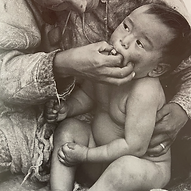
Elizabeth Arnajarnek feeds a pre-chewed morsel of caribou meat to her baby at a camp on the Barren Grounds in 1966. The Inuit gather thousands of duck eggs and eat them raw or hard-boiled. They store them for the winter.
Noises and voices drifted through the fog; the creak and groan of tide-moved ice; the honking of Canada geese; the plaintive calling of red-throated loons; the lilting song of snow buntings; the haunting, mellow woodwind crooning of courting eider drakes.
Early next morning, the fog lifted. We climbed a hill topped by an inukshuk, an ancient, roughly man-shaped Inuit stone marker, and gazed across the sea dotted with dark granite islands bathed in the golden light of dawn.
Our boats full of pots, pails, zinc and plastic wash basins, and large wooden crates, we set out to raid the holms, the rocky islets that are the eiders' favorite nesting places. Men, women, and children stumbled across the algae-slippery coastal rocks of each islet, scrambled up the sheer ice foot, and then spread, screaming with glee, across the island as dozens of eiders, sometimes hundreds, rushed and clattered off their nests. Each nest was lined with a thick, soft layer of brownish gray-flecked eiderdown and contained, on the average, four large olive eggs. The Inuit took the eggs but left the down; traditionally they dressed in furs and had no use for down. Since it was early in the season, most ducks had just laid their eggs.
We rushed from island to island and collected eggs all day, and at night we feasted on them. The children, impatient, pricked many and sucked them dry. The adults preferred them hard-boiled. They made a filling meal; each egg, in volume, equals nearly two hen's eggs, and many Inuit ate six to ten at each meal. The albumen of the hard-boiled eider egg is a smooth, gleaming white, the yolk a vivid orange. The taste is rich and rather oily.
In a week we visited dozens of islets and amassed thousands of eggs. The Inuit also shot at least a hundred ducks and several seals. It seemed amazing that these yearly raids had not decimated the ducks. But they were made so early in the season that most of the robbed ducks probably laid another clutch of eggs.
Killiktee explained to me that in earlier days a taboo forbade the Inuit to camp on eider islands. They visited the islets and took the eggs, but they camped, as we did, only on the largest islands, where few ducks nest, thus avoiding prolonged disturbances in the breeding areas. The ducks, Killiktee said, seemed just as numerous now as sixty years ago when he had first visited the Savage Islands as a boy. Polar bears sometimes swim to the islands, kill all the ducks they can, and eat the eggs. One year, Killiktee said, while the Inuit were on holms, collecting eggs, a polar bear came to camp and robbed their stores. He ate at least a thousand eggs and crushed the rest, leaving a gooey mess upon the beach. Killiktee laughed, amused and without rancor. "Happy bear!" he said.
Less lucky was a gosling caught on an islet by one of the girls. She kept it in a Danish cookie tin and tried to make a pet of it. The fluffy yellow bird peeped pathetically and, inevitably, died after a few days. The girl cried, heartbroken, over her dead pet, and then she skinned it and ate it.
All crates were full of eggs, and ducks, seals, and whale meat filled the boats. The fog rolled in again and our boats traveled through a clammy, grayish, eerie emptiness. Killiktee led, the two other boats followed closely. Dark rocks appeared for moments and vanished into the gloomy gray; ice floes loomed up abruptly. Killiktee never hesitated. "How do you know where to go?" I asked. He smiled. "I know," he said. He had traveled along this coast a long lifetime; he had seen it, memorized it, knew every current, every shoal, every danger spot. He stood in the stern like a graven image and guided our boats through the weird gray void of the fog.
In the evening he veered into a bay, a good place, he said, to catch char on the rising tide. The men set nets, the women boiled pots of meat and tea, the children played. Killiktee, tired, lay down on the shore, and moments later he was sound asleep. A dark shape upon the dark, ice-carved granite, he seemed to meld with rock and land.
Back home at Kiijuak, all eggs were carefully examined. The cracked ones we ate soon. The others were placed in large crates and stored in a cool shady cleft among the rocks. They would last the people in our camp well into the winter.
In fall, an Inuk from Lake Harbour passed our camp and took me along to Aberdeen Bay where the people quarry the jade-green soapstone for their carvings. While he had tea and talked with Killiktee, I packed and carried my things to his boat. Killiktee came to the beach. We both felt awkward. Inuit traditionally joyfully greet visitors, but visitors leave in silence and alone with none to see them off. Their language has many words of wisdom, but none for good-bye.
April 15, 1967
Fred Bruemmer
Arctic Memories - The All-Purpose Caribou

Bruemmer explains the importance of the caribou to the Inuit and reminisces about a hunting trip he took with them. "Caribou meat was eaten fresh, or cut into strips and air-dried for future use. Fat fall caribou, often killed far from camp, were cut up and cached, food for the coming winter."
THE ALL-PURPOSE CARIBOU
Glorious it is to see
The caribou flocking down from the forests
And beginning
Their wandering to the north.
Timidly they watch
For the pitfalls of man.
Glorious it is to see
The great herds from the forests
Spreading out over plains of white.
Glorious to see.
- INUIT POEM RECORDED BY KNUD RASMUSSEN IN THE EARLY 1920s
Once they flowed like a living and life-giving tide across the tundra plains of the North. When the caribou came, an old Inuk told Knud Rasmussen in the 1920s, "the whole country is alive, and one can see neither the beginning of them nor the end - the whole earth seems to be moving.
Two animals were vital to human survival in the Arctic: seal and caribou. Seals provided food for humans and their sled dogs, strong, durable skins for boots and tents, and, above all, blubber that could be rendered into oil for the stone lamps of the Inuit, to cook their food, melt snow or ice into drinking water, dry their clothes, and warm their winter homes.
Caribou gave Inuit food and, through bones, hoofs, and antlers, a multitude of tools, toys, and weapons. Above all, from caribou skins Inuit women made the best Arctic clothing ever designed: light, durable, and so warm it made the wearer nearly impervious to any Arctic weather.
To kill caribou, Inuit used bows and arrows, lances, ambushes, traps, and a multitude of ingenious stratagems, many of them based on the hunters' knowledge of animal behavior and the quirks and weaknesses of their prey. Caribou are curious and myopic, and Inuit used these failings to get within shooting range - and that, before guns, was very close. The Inuit bow, made of pieces of driftwood, brittle and fragile, laboriously carved and pegged together, backed with plaited sinew cord to give it spring, and lashed with caribou or seal leather to give it strength, was a marvel of skill and ingenuity, but it was still a very weak weapon compared to bows of other regions where suitable wood was available. The longbow made of yew used by English archers to win the battle of Crécy in 1346 was deadly at 200 yards (180 m) and more. The Inuk bow, said Ekalun of Bathurst Inlet, who used it as a young hunter, killed only at thirty paces and less.
In 1967, I joined two Inuit hunters, Akpaleeapik and his brother Akceagok from Grise Fiord on Ellesmere Island, and their oldest sons on the last of the great polar-bear hunts made by Canadian inuie. We left the village in April and returned in June, five people, two sleds and twenty-nine dogs, and never again in my life have I known such freedom. (The diaries I kept became the basis of my first book, The Long Hunt) The rest of the world just ceased to be; time lost all meaning. We lived only for the here and now; it was a primal life, with primal joys - the endless travel through a pristine land; the great hardships of the trip; the satisfaction of being able to cope, endure, and overcome; and, although I do not hunt and never use a gun, the undeniable thrill of the hunt. And since we and our sled dogs were invariably famished after ten to twenty hours of travel every day, we looked forward with keen anticipation to our daily meal of seal or polar bear.
To hungry people every meal is a feast. A change of menu, however, is always welcome and when we crossed northern Devon Island in June and spotted caribou on a distant plain, Akeeagok / took me along to hunt them. We sledged in a valley to the edge of the plain and then we played an ancient Inuit game of deception. We advanced across the white, open plain, pretending to be a caribou: Akeeagok with arms and gun held high was the antlered torepart; I, bent at right angles, my head in the small of his back, was the rear end of the caribou. The caribou, of course, spotted us. instantly and were both curious and uneasy. Something, they realized, was not quite right. Whenever fear outweighed curiosity and they seemed ready to flee, we turned in profile to them, showing the rough outline of a caribou, and Akecagok grunted exactly like a caribou. Reassured, the caribou continued to stand and stare; once they even trotted toward us. When we were 30 yards (27 m) away, they finally panicked. But it was too late: Akeeagok shot and killed two animals. The others fled; he let them go. Both brothers were old-time hunters; they never killed more than we needed for food.
Another ruse Inuit hunters used also relied on the caribou's curiosity and shortsightedness. Two men walked past a herd. As they passed a boulder, one hid behind it and the other continued, waving, perhaps, a piece of white caribou belly skin to attract the curious animals. They followed him at a safe distance - and were shot by the hidden hunter.
In winter, Inuit cut pitfalls into drifts, covered them with thin sheets of hard Arctic snow, and baited them with urine, which caribou like for its saltiness. In spring and fall, they lay in wait with their kayaks where migrating caribou crossed rivers and lakes, and speared the swimming animals. And they built elaborate alignments of inukshuit, man-shaped cairns, on strategic ridges, which scared caribou herds toward hidden hunters. Women and children, crouched behind ridges and boulders, supplemented the line of stone men and, at a signal, rose and screamed. ("Hoo-hoo- hoo, they yelled, just like wolves," Ekalun recalled.)
Caribou meat was eaten fresh, or cut into strips and air-dried for future use. Fat fall caribou, often killed far from camp, were cut up and cached, food for the coming winter. Skins were made into clothing, bed robes, and tents.
Caribou sinew was the Inuit's thread. Plaited sinew cord was used to back the bow and give it elasticity and spring. It was used as fishing lines, and as guy lines for the tent. Depilated caribou skin was made into containers and packsacks, and covered the kayaks of inland Inuit. Toggles for dog-team harnesses were carved of caribou bone, as were the prongs of leisters (where musk-ox horn was not available), spear blades and arrowheads, and a diabolically ingenious wolf killer. Sharpened splinters of caribou shin bone were set into ice and covered with blood and fat. When a wolf came along and licked the blood, it lacerated its tongue on the frozen-in bone knife and, excited by the taste of fresh blood, licked and bled and licked and bled until it died; its skin was used for clothing.
Caribou antlers were boiled and immersed in hot water and then straightened with a qatersionfik, a big bone or palmate piece of antler into which a large hole had been worked. (Identical implements were made by reindeer hunters of the Aurignacian and Magdalenian periods in Europe, 15,000 to 30,000 years ago. Under the delusion that these were symbols of ancient authority, archaeologists have given them the grandiloquent name batons de commandment.) Straightened antler sections were scarfed, glued (with caribou blood), pegged (with pegs of caribou bone), and lashed (with strips of moist caribou skin), and made into spear shafts, tent poles, leister handles, and sled sections.
All was used, nothing was wasted. What humans did not eat, their sled dogs did. Caribou provided Inuit with food, clothing, shelter, and many tools and weapons. It was essential to life and lived in their legends and myths. The newborn Inuit baby was wiped clean with a piece of caribou fur, and when an Inuk died his shroud was made of caribou skins.
Caribou were in their thoughts and caribou marched through their dreams. In spring at Bathurst Inlet, as we waited for caribou to come to our far-northern coast, Ekalun on the sleeping platform next to me often mumbled in his sleep, and it was "tuktu, always "tuktu," endless herds of caribou, migrating through the sleeping mind of the old hunter.
Ancient History
Germany
50000
B.C.E.
Palaeolithic and Mesolithic kill-butchering sites: the hard evidence
The upper paleolithic is characterized by advanced hunting of large animals with various weapons, and planning to maximize easy prey
Upper Palaeolithic and Mesolithic Hunting:
the archaeological record leaves us some direct evidence of man's hunting activities. At Meiendorf (Rust 1937) and Stellmoor (Rusf 1937), some bones of reindeer and birds still conserve weapon marks and a few pieces of silex have remained thrusted in mammalian bones; man kills reindeer with harpoons and sticks (fractured skulls), birds with bows and maybe slings. Three fractured skulls of red deer in Abri Pataud (Bouchud, 1975), and one bovid skull with a circular orifice in Saint Marcel (Allain, 1952) suggest the practice of the so called " co'up de merlin": man has delivered a blow similar to the one used today to butcher cattle. Probably the animal already immobilized (wounded or entrapped) was hit on the frontal with a big stone. At Kokorevo I (Siberia), a large scapula of bison is pierced by the upper end of a point made of bone (Boriskowksi, 1965). At High Furlong (Mesolithic), an elk was discovered with the marks of L7 wounds made by barbed points, of which two were found in the site, and by other arms. The animal had apparently been attacked at two distinct occasions: during the first one, hunters aimed at the legs to lame the animal (fig. 6), later hunters hit the thoracic region and the lungs to kill it. However the elk died in a little lake, perhaps imprisoned in the ice, and man had no access to the meat. The animal represents in fact a hunting loss (Hallam et a1.,1973).
Planning: very good. Many sites belong to Wpe e, were occupied periodically or seasonally and specialised in the capture of a particular game (e.g., horse, reindeeq, ibex). Game drive towards cliffs have been claimed and Solutre (Combier & Thevenot,1976) has long figured as an example, but the evidence is far from conclusive.
Scavenging: no doubt H. sapiens still killed or exploited animals in the occasional and opportunistic way of Lower Palaeolithic times. According to Lindner (Lindner,1941), hunters at Predmost utilised the carcasses of hundreds of mammoths that probably succumbed as a result of natural catastrophes, as food.
Food transport: selective transport of the most useful animal parts is claimed for many sites.
Specialised activities: sometimes the material is dislocated in distinct clusters that could reflect specialised activity areas as for example at Solutre (Combier & Thevenot, 1976). Site topography: some hunting sites were located in valleys enclosed by steep slopes as at Rascano (Gonziilez-Echegaray, 1979), Stellmoor (Rust, 1937), Meiendorf (Rust 1937), or at the foot of rocky cliffs at Solutr6 (Combier & Th6venot, 1,976).
4. Conclusions
Most of the Lower Palaeolithic sites analysed here belong to category a (butchering sites); other kind of concentrations are rare and difficult to ascertain. A number of hunting stations (category e) and a hunting stop (category f) form my sample for the age of Neanderthal man and related people. The Upper Palaeolithic is characterised by many hunting stations, while in Mesolithic times a hunting loss (category d ) was found as well as several sighting sites (category g). The foregoing distribution seems to reflect in a vague way an evolution from scavenging and haphazard opportunistic hunting to well organised, selective hunting activities. However, this reflection results no doubt in part from a priori assumptions concerning the evolution of hominid meat procurement often colouring the interpretations offered for the osseous "hard" data; these are frequently equivocal.
Vindija, 42000, Varaždin, Croatia
28500
B.C.E.
Neanderthal diet at Vindija and Neanderthal predation: The evidence from stable isotopes
The isotope evidence overwhelmingly points to the Neanderthals behaving as top-level carnivores, obtaining almost all of their dietary protein from animal sources
Archeological analysis of faunal remains and of lithic and bone tools has suggested that hunting of medium to large mammals was a major element of Neanderthal subsistence. Plant foods are almost invisible in the archeological record, and it is impossible to estimate accurately their dietary importance. However, stable isotope (13C and 15N) analysis of mammal bone collagen provides a direct measure of diet and has been applied to two Neanderthals and various faunal species from Vindija Cave, Croatia. The isotope evidence overwhelmingly points to the Neanderthals behaving as top-level carnivores, obtaining almost all of their dietary protein from animal sources. Earlier Neanderthals in France and Belgium have yielded similar results, and a pattern of European Neander- thal adaptation as carnivores is emerging. These data reinforce current taphonomic assessments of associated faunal elements and make it unlikely that the Neanderthals were acquiring animal protein principally through scavenging. Instead, these findings portray them as effective predators.
Stable Isotope Analyses.
Mammal bone collagen δ13C and δ15N values reflect the δ13C and δ15N values of dietary protein (14). They furnish a long-term record of diet, giving the average δ13C and δ15N values of all of the protein consumed over the last years of the measured individual's life. δ13C values can be used to discriminate between terrestrial and marine dietary protein in humans and other mammals (15, 16). In addition, because of the canopy effect, species that live in forest environments can have δ13C values that are more negative than species that live in open environments (17). δ15N values are, on average, 2–4‰ higher than the average δ15N value of the protein consumed (18). Therefore, δ15N values can be used to determine the trophic level of the protein consumed. By measuring the δ13C and δ15N values of various fauna in a paleo-ecosystem, it is possible to reconstruct the trophic level relationships within that ecosystem. Therefore, by comparing the δ13C and δ15N values of omnivores such as hominids with the values of herbivores and carnivores from the same ecosystem, it is possible to determine whether those omnivores were obtaining dietary protein from plant or animal sources.
Cheddar Reservoir, Cheddar BS26, UK
12000
B.C.E.
FOCUS: Gough’s Cave and Sun Hole Cave Human Stable Isotope Values Indicate a High Animal Protein Diet in the British Upper Palaeolithic
We were testing the hypothesis that these humans had a mainly hunting economy, and therefore a diet high in animal protein. We found this to be the case, and by comparing the human δ15N values with those of contemporary fauna, we conclude that the protein sources in human diets at these sites came mainly from herbivores such as Bos sp. and Cervus elaphus
We undertook stable isotope analysis of Upper Palaeolithic humans and fauna from the sites of Gough's Cave and Sun Hole Cave, Somerset, U.K., for palaeodietary reconstruction. We were testing the hypothesis that these humans had a mainly hunting economy, and therefore a diet high in animal protein. We found this to be the case, and by comparing the human δ15N values with those of contemporary fauna, we conclude that the protein sources in human diets at these sites came mainly from herbivores such as Bos sp. and Cervus elaphus. There are a large number ofEquus sp. faunal remains from this site, but this species was not a significant food resource in the diets of these Upper Palaeolithic humans.
If the humans hunted and consumed mainly horse, then their 15N values should be c. 3–5‰ (Equus 15N value of 0·7‰+enrichment of 2–4‰). Instead, their 15N values make more sense if they lived mostly off Bos and Cervus elaphus (Bos and Cervus values of c. 3‰+enrichment of 2–4‰=the observed values c. 6–7‰). It is also possible that other species, including Rangifer tarandus, were consumed by these individuals. Rangifer tarandus has 15N values similar to Cervus elaphus (Richards, 1998), and has more positive 13C values, which may explain the observed slight enrichment in the human 13C values. A number of artefacts made from Rangifer tarandus have been found at Gough’s, but there is no other evidence that this species was being exploited for food
Province of Crotone, Italy
500
B.C.E.
On the Sociology of Ancient Sport
One report states that a trainer named Pythagoras recommended a meat diet to the Olympic athletes he trained.
A lack of animal-derived protein seems to have been rectified early in history, as there are two reports of the introduction of meat into the athletes’ diet. One report states that a trainer named Pythagoras recommended a meat diet to the athletes he trained. https://www.omicsonline.org/open-access/a-comparison-of-ancient-greek-and-roman-sports-diets-with-modern-day-practices-2473-6449-1000104.php?aid=69865
8 He [Pythagoras] is said to have been the first to train athletes on a meat diet. The first athlete he did this with was Eurymenes. Formerly they had trained on dried figs, moist cheese, and wheat. Some say that it was a trainer named Pythagoras and not the philosopher who was responsible for this innovative diet. For our Pythagoras prohibited killing, not to mention eating, life which possessed souls like our own.
Diogenes Laertius, Lives of the Philosophers 8.12
Sport and Recreation
To all appearances medical knowledge in general and nutrition in particular was widespread in Pythagorean circles in Southern Italy, especially in Kroton. Burkert has pointed out that the fmaous doctor Alcmaeon came from the Pythagorean center of Kroton. From the akousmata (secret doctrines), which doubtless contain old religious traditions, we learn that the Pythagoreans were not originally strict vegetarians; the consumption of meat was permitted, with the exception of lamb and the meat of draft oxen. Burkert considers there is some likelihood that Pythagoras introduced a meat diet for athletes. He believes this tradition arose when Pythagorean vegetarianism had not yet been completely developed. In later times, when vegetarianism had prevailed, a second tradition has possibly been invented, in which it was not Pythagoras, the philosopher from Samos and Kroton, but a homonymous person who wrot the great 'trainer's recipe book'.
57: There are similar issues regarding the transmission in later sources of Pythagoras advising the successful heavy athlete Eurymenes of Samos to use a special meat-based diet instead of the dried figs and cheese he had previously been eating.
On the Sociology of Ancient Sport - page 43.
Mantineia 221 00, Greece
480
B.C.E.
A Comparison of Ancient Greek and Roman Sports Diets with Modern Day Practices
Dromeus, a long-distance runner, is said to have first thought of eating meat for training instead of just cheese and won multiple victories.
The second report is that of Pausanias, who writes of Dromeus, a long-distance runner from Stymphalos [23].
“...he won two victories in the dolichos at Olympia, the same number in the Pythian Games, three at the Isthmian and five at the Nemean. He is said to have first thought of eating meat (as part of his training diet). Until then the food for athletes was cheese fresh out of the basket.”
Clearly, if his success is anything to go by, then Dromeus had really found a winner’s diet. There are also reports of athletes eating meat from oxen, bulls, goats and deer, a very” red-meat” diet which is a rich form of protein. Moreover, with meat as a part of their diet, the performance of competing athletes would most certainly have improved noticeably.
5 A man named Dromeus from Mantineia was said to have been the first we know of to have won the pankration by default [ = akoniti]. Pausanias 6.11.4
Dromeus, Long-Distance Runner
There was a man from Stymphalos, named Dromeus, whose record as a long-distance runner was exceptional: he won two victories in the dolichos at Olympia, the same number in the Pythian Games, three at the Isthmian and five at the Nemean. He is said to have first thought of eating meat (as part of his training diet). Until then the food for athletes was cheese fresh out of the basket.


