


Recent History
February 20, 1911
Vilhjalmur Stefansson
My Life with the Eskimo - Moose

The moose is not populous enough to warrant much hunting by the Eskimo.
Alces americanus Jardine. Eastern Moose. Tûk'tū - vûk ( Alaskan , Mackenzie, and Coronation Gulf Eskimo). Ko-gon (Slavey Indian).
The Moose is common throughout the timbered country all along the Mackenzie River, and has occasionally been seen north of the timber line near Richard Island. According to the opinion of old residents and to data collected by the expedition, the Moose is increasing all through the northern country as well as extending its range rapidly and noticeably. Owing to its solitary habits and the nature of its habitat, the Moose cannot be slaughtered wholesale as can the Caribou and the Musk-ox, and the northern Indians have decreased in numbers at such a rapid rate as to more than compensate for the increased killing power of their more modern weapons. Moose venture very rarely into the region of the lower Horton River. Mr. Joseph Hodgson, one of the oldest of Hudson Bay traders, says that in the early days, up to less than fifty years ago, Moose were very rarely seen east of the Mackenzie, and told us in 1911 that it was only within the past half-dozen years that Moose had been seen on the east side of Great Bear Lake. Moose are now fairly numerous on Caribou Point, the great peninsula between Dease Bay and McTavish Bay, Great Bear Lake, and on the Dease River, northeast of Great Bear Lake. A Coronation Gulf Eskimo from the region near Rae River (Pal'lirk) told us that he had seen two Moose (which he thought cows, from their small antlers) near the mouth of Rae River in 1909 or 1910. These Eskimo often hunt in summer down to Great Bear Lake and know the Moose from that region. Rae River flows into the southwestern corner of Coronation Gulf, and the Moose undoubtedly wandered here from the region around Great Bear Lake.
March 22, 1911
Vilhjalmur Stefansson
My Life with the Eskimo - Chapter 15
"Two caribou were hardly sufficient meat to go on with, so that I went across the Horton River a mile or two east of where the Eskimo went to get the cached meat, and shot three caribou and a fine specimen of white wolf. This wolf was not only fat and excellent eating..."
When about four miles from the eastern end of the lake we left it, striking off on the north side to make a short cut along the southern side of some steep hills which run east towards the Coppermine. We were traveling now on high ground and could see south across the valley of the Kendall bands of caribou grazing about six miles away. We accordingly camped, for our meat had about run out and it seemed well to replenish our stores.
I happened at this juncture to be suffering from a chafed foot on account of having worn a badly made stocking the day we left home. Dr. Anderson and Natkusiak therefore undertook to hunt, and I stayed at home to give my foot a chance to recover. Tannaumirk, who was a fair seamstress, also stayed at home mending boots and stockings and incidentally telling me folk-lore stories which I wrote down in the original language as he told them. Tannaumirk could never be relied upon for an enterprise of moment, but he had many good qualities, among which were an unvarying cheerfulness and an inexhaustible fund of folk-lore tales, songs, and charms, which he had at first, like the rest of his countrymen, been loath to repeat to me on account of being used to having white men make game of him for doing so. But now that he had found that I had a real interest in such things he never tired of telling them.
In the evening when our hunters came home they reported having seen caribou in great numbers, but they had not had the best of luck. Dr. Anderson had shot two and Natkusiak had failed to get any. It had been a bright sunshiny day and Dr. Anderson had carelessly gone without glasses, with the result that he was slightly snow blind the following morning.
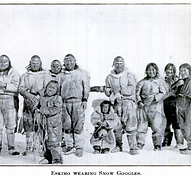
Seeing that the subject has been mentioned, it may be worthwhile to say that we have tried glasses of all colors and makes and have found the amber ones, made on the same principle as light filters for cameras, to be far superior to blue, green, plain smoked, or any other variety. The Eskimo goggles,which are made of pieces of wood with two narrow slits for the eyes, each about large enough for a half-dollar to be slipped through it, are satisfactory in that they do not cloud over and that they protect the eyes from snow-blind ness; but the difficulty with them is that the range of vision is so restricted that it is as if you were looking out through a pair of key holes in a door. This is especially troublesome on rough ice or uneven ground, where you keep stubbing your toe against every obstacle, for through the narrow slits you can see what is in front of your feet only by looking directly down.
As my chafed foot was not completely recovered yet, and as Dr. Anderson was snow-blind, it fell to Natkusiak and Tannaumirk to go for the meat of the caribou Dr. Anderson had shot. It was an other cold, clear day as it had been the day before, and it furnished us with yet another example of the fact that Eskimo do not have com passes in their heads, for although the caribou had been killed and cached only about seven miles away from camp, Natkusiak was unable to find them in an all-day search and the two of them returned home after dark with an empty sled. This meant loss of valuable time, and worst of all, the consumption by us and our dogs of the few remaining pounds of dried meat we had brought with us from home. It is of course always wise to eat your green meat first and keep the light and condensed dried meat to the last.
The place where the two deer were cached was plainly visible with the glasses from our camp, so that it seemed likely that the next day Natkusiak and Tannaumirk would be able to find it, which it turned out that they did. We had delayed so long now, however, that two caribou were hardly sufficient meat to go on with, so that I went across the Horton River a mile or two east of where the Eskimo went to get the cached meat, and shot three caribou and a fine specimen of white wolf. This wolf was not only fat and excellent eating, but its skin was of great value, either scientifically or commercially;-scientifically because the animal is rare, and commercially because the Eskimo of the Mackenzie district and therefore the members of our own party value the skin highly as trimming for their winter coats. A wolfskin of the type which the Eskimo most admire can, when cut into strips, be sold for as much as twelve foxskins, which being translated into dollars at the prices quoted in 1912 would mean from one hundred to one hundred and twenty dollars for each wolfskin. Natkusiak and Tannaumirk heard my shooting when I bagged the three caribou, and after discovering the cached meat they came over and helped me skin, and took on their sled some of the meat. The next day we spent in hauling the rest of the meat to camp and in making a platform cache upon which to leave behind what we could not take with us. Besides meat, we left also in this cache the valuable wolfskin and the skins of two caribou which we intended for scientific specimens. We knew very well that this cache would not be safe from wolverines, but counted on the rarity of those animals in these parts for a chance to get back before everything had been destroyed. The wolves and foxes, we knew, would be unable to steal from a seven-foot high platform.
May 1, 1911
Vilhjalmur Stefansson
My Life with the Eskimo - Chapter 17

Besides that, this is the season which the Eskimo give up to the accumulation of blubber for the coming year. Fresh oil is not nearly so palatable or digestible as oil that has been allowed to ferment in a sealskin bag through the summer. A single family's store of oil for the fall will run from nine hundred to two thousand pounds.
Just northeast of the east end of Lambert Islandwe found, as we had expected, the village of the Noahanirgmiut Eskimo, con sisting chiefly of old friends and hunting companions of ours from the Bear Lake hunt of the summer before, but there were with them also a few families we had not seen. The Eskimo visit about a great deal, and although it is always possible for any one to say, “ This is the village of such and such a people,” still you are almost sure to find in any village members of one or more other tribes and generally of several. These visits are sometimes temporary, but commonly a family leaves its own tribe and joins another to be with it a period of a year, returning home at the end of that time, although sometimes the visit is only for a summer. A man who is in need of a new sled or a new bow, but whose own tribe hunts in a woodless country, may, for instance, join for the summer hunt a group that intends to go south to Bear Lake, in order to supply himself with the wood he needs. The Noahanirgmiut were still living on seal meat and were making no attempt to kill any of the numerous caribou that were continually migrating past. I thought at first that there might be some taboo preventing them from hunting caribou on the ice, but this they told me was not so. It was simply that they had never hunted caribou on the ice and had not considered it possible. It would in fact be a fairly hopeless thing for them to try it; and while no doubt some of them might occasionally secure an animal, they would waste so much time that the number of pounds of meat they obtained in a week's hunt in that way would be but a small fraction of the amount of seal meat they might have secured in the same time. Besides that, this is the season which the Eskimo give up to the accumulation of blubber for the coming year. Fresh oil is not nearly so palatable or digestible as oil that has been allowed to ferment in a sealskin bag through the summer, and besides that it is difficult often to get seals in the fall . By getting seals in the spring, therefore, they secure an agreeable article of diet for the coming autumn and provide themselves as well with a sort of insurance against hard luck in the fall hunt. Each family will in the spring be able to lay away from three to seven bags of oil. Such a bag consists of the whole skin of the common seal. The animal has been skinned through the mouth in such a way that the few necessary openings in the skin can be easily sewed up or tied up with a thong. This makes a bag which will hold about three hundred pounds of blubber, so that a single family's store of oil for the fall will run from nine hundred to two thousand pounds.
To completely test the matter of whether there was a taboo or not, as well as to provide ourselves with fresh meat and our friends with a feast, Natkusiak and I intercepted one of the bands out of which he shot one and I shot three, two of the three, by the way, being killed in one shot as the animals were running past at a dis tance of about three hundred yards. The Eskimo immediately went at the skinning energetically, and I photographed them while they were at it . The meat was then cut up and divided equitably among all the families and the cooking began at once.
May 2, 1911
Vilhjalmur Stefansson
My Life with the Eskimo - Chapter 17

The system of taboos relating to eating caribou and seals at the same time are discussed by Stefansson. "The flesh of caribou and of seals must not, among some tribes, be eaten at the same time, nor must the flesh of caribou be eaten on the sea at all."
It is a theory which has been much in vogue among ethnologists that the fundamental reason back of the system of Eskimo taboos is that they are intended to keep the sea industries away from the land industries and the sea animals away from the land animals; the theory being that the Eskimo were once inland dwellers and accustomed only to land animals and hunting methods suited to the land, and that when they came down to the sea they found its requirements and its animal life so different from that of the land to which they were used that they conceived it necessary to keep the two rigidly apart and that taboos were therefore established. We have elsewhere pointed out that the western Eskimo consider that sudden death, pestilence, or famine will follow upon the sewing of caribou skin garments within a certain number of days after one of the large sea mammals has been killed. It is true among many tribes of Eskimo that caribou skin garments must not be made or mended on the sea ice. The flesh of caribou and of seals must not, among some tribes, be eaten at the same time, nor must the flesh of caribou be eaten on the sea at all. Under other circumstances when both may be eaten, they will have to be cooked in separate utensils and certain ceremonies have to be performed to cancel, as it were, the evil effects that might otherwise ensue.
Here, however, everything was different. Not only did these seal hunters engage in the cutting up of the animals, but the meat was taken home and cooked in the same pots in which seal meat had been cooked and eaten; and not only the same day that seal meat had been eaten and the seals had been killed, but the seal meat and caribou meat were actually eaten at the same meal by the same individuals. One old man, however, said that he knew that it was not right to boil caribou meat in the same pot in which seal meat had been boiled unless you suspended the pot by a different string. His wife therefore took off the old greasy string which had served as a bale for the stone pot, braided a new sinew string, and swung the pot by that over the lamp. These Eskimo have various taboos relating to seal and to caribou, but none of those that I have seen in use or heard of, except in the case of this one incident of the string, had any tendency to keep the two apart.
May 13, 1911
Vilhjalmur Stefansson
My Life with the Eskimo - Chapter 18

The Eskimo of Banks Island and Prince Albert Sound would live chiefly on polar bears through the winter because they didn't know how to hunt caribou on the ice.
Range of the Kanghirgyuargmiut. In summer some of them (a few) hunt towards Minto Inlet; some hunt southeast and meet the Puiblirgmiut; most, however, hunt east and meet the Ekallugtogmiut and Ashiagmiut who live “on the east coast of our country, which is not far from here overland, and good sledding because we go by the rivers.” Some join the Ekallugtogmiut for a time and with them visit the Arkilinik (near Baker Lake above the head of Chesterfield Inlet] “where there are trees, and where the people have guns and white men's clothes.” (Have seen many metal articles, one shirt, one red knit woollen hood, etc., brought from these trips. ) They never met the Nagyuktogmiut. One man at least — Hitkoak has been both to the Akilinik and to Umingmuktok.
In the fall they (the Kanghirgyuargmiut] come to Prince Albert Sound and proceed to Banks Island where in winter they live chiefly on bears (some entirely; others partly on seals) off Nelson Head and east of it. When bear hunting they often see Cape Parry [on the mainland to the south ]. Nelson Head can be seen from Parry only from the hill tops, and that rarely, and it is much higher than Parry, so they must hunt almost to the middle of the strait.
They usually have houses on or by the shore when in Banks Island. They often see caribou but “do not know how to hunt them in winter.” They know there are musk-oxen inland but they do not go after them. In spring they return to the Sound and soon scatter to the various hunting places. Those going to the Ekallugtogmiut are already on the way intended starting the day after we came to the village and delayed for us). Those going north towards Minto do not leave the sea till “ the snow gets soft on the ice.” Wednesday, May 17. Have given up going farther in direction of Banks Island, as there are no people that way. Started 3:30 P.M. heading for Cape Back about true southwest. Camped 7:30 P.M. to get chance to write up some of my briefer notes before the fillings-in are forgotten or misremembered. Game. No seals seen on top the ice -- ugrug (bearded seals) are to be expected nearer land and seals are not up yet. Crossed about 400 or 500 caribou tracks, i of them over a week old. Migration seems over, or at least there is a lull. Saw three bands of eight, seven, and three. The latter two Natkusiak tried but got shot at last only three misses on the run at 200 yards. Ptarmigan seen every day, mostly ( or all ?) rock ptarmigan. Crows every day. No snow buntings since leaving Walliraluk. Distance traveled: 12 miles.
Pamiungittok tells : The Banks Island people used to be well off. They killed so many deer and [musk ] oxen that their dried meat sometimes lasted the year round. They got to killing each other. One man killed had relatives in the Sound. For this reason (i.e. because of witchcraft practised by the dead man's relatives in the Sound ) food became scarce [ in Banks Island ); there were no seals for food or fuel and the people died of hunger -those that had not been murdered in the feuds. This happened some fifteen years ago i.e. when Agleroittok (who is now about twenty - five) was a boy but [after] his two brothers (were] grown up.
Ancient History
Vindija, 42000, Varaždin, Croatia
28500
B.C.E.
Neanderthal diet at Vindija and Neanderthal predation: The evidence from stable isotopes
The isotope evidence overwhelmingly points to the Neanderthals behaving as top-level carnivores, obtaining almost all of their dietary protein from animal sources
Archeological analysis of faunal remains and of lithic and bone tools has suggested that hunting of medium to large mammals was a major element of Neanderthal subsistence. Plant foods are almost invisible in the archeological record, and it is impossible to estimate accurately their dietary importance. However, stable isotope (13C and 15N) analysis of mammal bone collagen provides a direct measure of diet and has been applied to two Neanderthals and various faunal species from Vindija Cave, Croatia. The isotope evidence overwhelmingly points to the Neanderthals behaving as top-level carnivores, obtaining almost all of their dietary protein from animal sources. Earlier Neanderthals in France and Belgium have yielded similar results, and a pattern of European Neander- thal adaptation as carnivores is emerging. These data reinforce current taphonomic assessments of associated faunal elements and make it unlikely that the Neanderthals were acquiring animal protein principally through scavenging. Instead, these findings portray them as effective predators.
Stable Isotope Analyses.
Mammal bone collagen δ13C and δ15N values reflect the δ13C and δ15N values of dietary protein (14). They furnish a long-term record of diet, giving the average δ13C and δ15N values of all of the protein consumed over the last years of the measured individual's life. δ13C values can be used to discriminate between terrestrial and marine dietary protein in humans and other mammals (15, 16). In addition, because of the canopy effect, species that live in forest environments can have δ13C values that are more negative than species that live in open environments (17). δ15N values are, on average, 2–4‰ higher than the average δ15N value of the protein consumed (18). Therefore, δ15N values can be used to determine the trophic level of the protein consumed. By measuring the δ13C and δ15N values of various fauna in a paleo-ecosystem, it is possible to reconstruct the trophic level relationships within that ecosystem. Therefore, by comparing the δ13C and δ15N values of omnivores such as hominids with the values of herbivores and carnivores from the same ecosystem, it is possible to determine whether those omnivores were obtaining dietary protein from plant or animal sources.
Cheddar Reservoir, Cheddar BS26, UK
12000
B.C.E.
FOCUS: Gough’s Cave and Sun Hole Cave Human Stable Isotope Values Indicate a High Animal Protein Diet in the British Upper Palaeolithic
We were testing the hypothesis that these humans had a mainly hunting economy, and therefore a diet high in animal protein. We found this to be the case, and by comparing the human δ15N values with those of contemporary fauna, we conclude that the protein sources in human diets at these sites came mainly from herbivores such as Bos sp. and Cervus elaphus
We undertook stable isotope analysis of Upper Palaeolithic humans and fauna from the sites of Gough's Cave and Sun Hole Cave, Somerset, U.K., for palaeodietary reconstruction. We were testing the hypothesis that these humans had a mainly hunting economy, and therefore a diet high in animal protein. We found this to be the case, and by comparing the human δ15N values with those of contemporary fauna, we conclude that the protein sources in human diets at these sites came mainly from herbivores such as Bos sp. and Cervus elaphus. There are a large number ofEquus sp. faunal remains from this site, but this species was not a significant food resource in the diets of these Upper Palaeolithic humans.
If the humans hunted and consumed mainly horse, then their 15N values should be c. 3–5‰ (Equus 15N value of 0·7‰+enrichment of 2–4‰). Instead, their 15N values make more sense if they lived mostly off Bos and Cervus elaphus (Bos and Cervus values of c. 3‰+enrichment of 2–4‰=the observed values c. 6–7‰). It is also possible that other species, including Rangifer tarandus, were consumed by these individuals. Rangifer tarandus has 15N values similar to Cervus elaphus (Richards, 1998), and has more positive 13C values, which may explain the observed slight enrichment in the human 13C values. A number of artefacts made from Rangifer tarandus have been found at Gough’s, but there is no other evidence that this species was being exploited for food


