


Recent History
May 16, 1911
Vilhjalmur Stefansson
My Life with the Eskimo - Chapter 18

The Sound people are evidently the most prosperous Eskimo we have seen; they are the most "travelled” and the best informed about their own country (Victoria Island) and its surroundings. Dietary habits surrounding bear, musk-ox, fish, seals, and even macu roots are discussed.
General [ Comment). The Sound people are evidently the most prosperous Eskimo we have seen; they are the most " travelled ” and the best informed about their own country (Victoria Island) and its surroundings. While they have been to the Bay of Mercy on north Banks Island and west beyond Nelson Head on south Banks Island they do not seem any of them to have been across the [ Dolphin and Union) straits to the Akuliakattak summer hunting grounds ( near Cape Bexley on the mainland) , or to the sea anywhere on south Victoria Island except among the Haneragmiut and Puiblir miut. Those who have been to a little west of Uminmuktok have come from the east to it as visitors of the Ahiagmiut in most cases ( Hanbury's Arctic Coast Huskies? ). Hitkoak, about the most travelled of any, has been at the Bay of Mercy, well west of Nelson Head, to Uminmuktok and into Bathurst Inlet, and to the Arkilinik ( near Chesterfield Inlet]. He looks not over thirty -five. He says he has ceased travelling, for he has seen “ many places and none are so good as the [ Prince Albert] Sound country.” He told us that he and some other families with him killed not a single seal last winter - lived on polar bears alone. They got seal oil to burn from others in trade for bear fat and meat. Honesty seems on a higher level among them than among any other people we have seen except the Akuliakattagmiut and Haneragmiut. Their clothes are far the best, their tents the largest. They use far more copper than any other people — doubtless because it is more abundant [in their country ).
The Kogluktogmiut [of the Coppermine River] are very eager for metal rods for the middle piece of the seal spear. They never make any of copper, no doubt because copper is too scarce. Their ice picks are small : their seal hole feelers are all of horn or iron. In the Sound ( on the other hand] the copper ice picks are in some cases three quarters by one and a quarter inch and fifteen inches long. Most seal spears have middle pieces of copper the rest have iron (from McClure's ship? ). The seal hole feelers are most [ of them ) of copper. Some of their tent sticks are of local driftwood, some are round young spruce which they get from the Puiblirmiut who get them from our neighbors of last August. Some sleds come from Dease River; some from Cape Bexley, but in either case they have been bought of the Puiplirgmiut or the Haneragmiut. Their stone pots are said to be all from the Utkusiksialik or Kogluktualuk ( Tree River). Some they got from the Puiplirgmiut by the road Natkusiak and I came last week, some around the point [ Cape Baring) from the Hanerag miut by the road we are taking now. Their fire stones [iron pyrite for striking fire) are some from the Haneragmiut, some picked up in the mountains north of the Sound. The copper is all from the mountains northeast of the bottom of the Sound. They say some [detached ] pieces of pure copper (in those mountains) are as high as a man's shoulder and as wide as high; others project out of the hill side and are of unknown size. East of Prince Albert Sound (on the Kagloryuak River) they use willows chiefly for fuel in summer these are four to five feet high in places. Heather [for fuel] is also abundant. The musk oxen are confined to the unpeopled sections of north and northeast Victoria Island and to Banks Island. They think there are a few deer in north Victoria Island in winter but none in south Victoria Island. The charms that starved the Banks Island people ( see above] deprived that country (sea and land both ) of food animals for a time, but these have gradually increased and are Banks Island has again become a good country. Nevertheless people never hunt there summers. There is plenty driftwood along the south shore of Prince Albert Sound, some along the north shore. There is plenty (drift ]wood northwest of Nelson Head [ Banks Island) and considerably east of it, but it is hard to find in winter. There are plenty of macu roots (polygonum bistontum) on the Peninsula between the Sound and Minto (Inlet] — and elsewhere. People eat plenty of them. Many good fishing places here and there, but they do not live to nearly such an extent on fish as do the Ekalluktogmiut, who eat fish all winter, as well as seal.
These macu roots form on the mainland the chief food of the marmot and the grizzly bear, both of which are absent from Victoria Island. All Eskimo known to me use this root as food —the Alaskans extensively , but the Victorians to a negligible extent only.
May 20, 1911
Vilhjalmur Stefansson
My Life with the Eskimo - Chapter 20

"We lived during this time entirely on seals; for the grizzly bears, which had been numerous here a month earlier in the season the year before, had now all moved inland. "
During the two or three weeks that followed our crossing south from Victoria Island , our progress westward along the mainland coast was slow on account of frequent troubles in getting around the open spaces in the sea ice created by the mouths of small rivers, each of which was bringing its quota of warm inland water to help thaw out the sea. We had now and then to make a considerable detour to seaward through rough ice to avoid these river deltas. We lived during this time entirely on seals; for the grizzly bears, which had been numerous here a month earlier in the season the year before, had now all moved inland. The small seals were out in numbers, basking on the ice. Although white men agree in general in preferring the flesh of the bearded to that of the small seal, my tastes are in that matter, as in most other things, with the Eskimo, so we shot only common seals, though the bearded variety were also abundant.
I neglected to say that on our way from Bell Island across the Straits to Point Tinney Natkusiak killed a polar bear which was the largest animal of its kind I have ever happened to see, although not quite so large as others the skins of which I have seen among the Eskimo. I measured it with a common string, for my tape did not happen to be convenient at the moment, and then of course I lost the string before the measurements got recorded. I suppose the animal would have weighed in the neighborhood of eight hundred pounds. According to our custom we carried with us only about two days' supply of this bear meat. This was our only change in diet from the time we left the Victoria Island Eskimo, May 17th, until about a month later, when we shot some sea gulls near Cape Lyon. Otherwise we lived entirely on seals.
June 1, 1911
The Northern Copper Inuit - A History
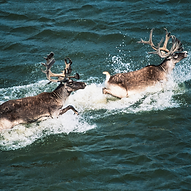
Fatty caribou are prized by Eskimos, especially during the late summer, but the time involves periods of feasting and fasting as game is scarce. Kuptana describes how a chisel tool is used by a young man on his first kill to open the brain of a freshly killed caribou for a feast. The hunting party dedicated all their time to hunting and storing caribou meat for later in the autumn when food is scarce.
Caribou Hunting
William Kuptana: I remember being packed going inland in the summer. When we were out of food, we'd eat seal fat out of the pouch. My parents would also carry a sealskin bag filled with seal blood. We'd drink out of that when were thirsty.
While we were treking inland, food would become scarce. My parents killed a lemming and cooked it. I didn't want to eat it, but they talked to me so I had to eat it. I didn't want to be left behind. We'd keep walking and looking for caribou. When we'd come to a lake that was still frozen over, they would make an agluaq (fishing hole). Hook and spear were used to catch fish. By fishing, that would prevent us from starving. Also, when the ice is gone in the river, they would fish by using spears and wading in after them.
After that, we would go wandering off into the land looking for caribou. We had no guns. Finally, when we found a small herd, the men would then build a small projection of stone slabs on a high point of land to act as a rouse to statle the fleeing caribou. The women would advance toward the caribou, humming as they approached the herd. As the caribou approached the lair where the men were hiding, the men would then kill the closest ones, the ones that they could reach.
The kill meant, "Feast." The family would eat everything: stomach, entrails, marrow. For instance, the entrails would be cleaned out and then cooked. After they were cooked, the entrails would be eaten with seal oil. The extra meat would be cut up to make dried meat.
The warm summer months were not a time of plenty for the Copper Inuit. As Diamond Jenness (1922:123-124) noted: "The traveller will find scattered families reaming about from place to place, here today and gone tomorrow in their restless search for game. Days of feasting alternate with days of fasting according to their failure or success. No fowl of the air, no creature of the land, no fish of the waters is too great or too small to attract their notice at this time."
The scarcity of food in spring and summer was partially alleviated in the late summer/early fall(August and September) when caribou hunting accelerated. At this time of year the caribou are fattest and their hides are ideals for making clothes. Usually a number of families would cooperate in the hunting of caribou using caribou drives set up on the tundra. These drives usually consisted of rows of stone piles set up in tow converging lines. Women and children chased the caribou with lances and arrows. Another technique, more commonly used on the mainland, involved hunting caribou from kayaks at crossing places in lakes. If a caribou drive was successful, much of the meat would be dried and stored for use during the lean autumn months.
First Hunt
William Kuptana: When I first killed a caribou, my biological father started wrestling with me as it is a custom to try to put a young hunter on top of the caribou corpse. After that, the hunting party told me to get the ulimuan [ a chisel-like instrument with a blade at a forty-five degree angle from the handle]. So I got one out of the pack-sack to open its head as it is a custom that a young man do that for a first kill. After I had chopped its skull, the elders started eating its inner membrane, or as it is usually called, the brain. Then, after the feast, the hunting party resumed their search for the tuktuvialuit (Banks Island Caribou). From spring to autumn, the hunting party would kill, store, and go on searching until it was too cold to hunt. Finally, returning to their wintering grounds, they'd wait for winter huddled in their sealskin tents for a time.
June 11, 1911
Vilhjalmur Stefansson
My Life with the Eskimo - Notes on Plants

The only roots which I have seen used as food by the Eskimo are the roots of a species of Knotweed Polygonum bistortum. The roots of plants of this genus, known to the Eskimo as Mā'sū, or Mā'shū, are frequently dug and eaten in summer, but usually only when there is a scarcity of meat or fish for food.
NOTES ON PLANTS
Very few plants outside of the trees and woody shrubs are put to economic use by the Eskimo. North of the limit of trees, the various species of shrub and ground willows are burned, as is also the Northern Dwarf Birch ( Betula nana Linn .). The latter, known as “ partridge-brush ” in the Great Bear Lake region, as ēk -fuk'tok by Alaskan Eskimo, and as av-al-lū'kret by the Coronation Gulf people, burns with a fierce heat, even when green , and can be used in a camp-stove if twisted into bunches. On the Barren Grounds, a species of heather, Cassiope tetragona (L.) D. Don. , is much used for fuel, particularly in the summer - time. It burns either green or dry, and can even be dug from under the snow and burned in winter. This species, or one very similar to it, is common in various places – in the Endicott Mountains, Alaska; King Point, Yukon Territory ; Langton Bay, Coronation Gulf, Dismal Lake, Dease River, and Great Bear Lake. It is called Ik -hlū'tit by the Coronation Gulf Eskimo ; Pi-la -rau -ū'it by western Alaskan Eskimo ( Port Clarence) ; and Tu -kak -shi-ū'uit by Mackenzie delta Eskimo. The inner bark of the Mountain Alder, Alnus alnobetula ( Ehrh .) Koch ., is often used to stain the inner side of tanned skins red .
The only roots which I have seen used as food by the Eskimo are the roots of a species of Knotweed either Polygonum bistortum ( Tourn .) L., Polygonum viviparum L., or Polygonum fugax Small. The roots of plants of this genus, known to the Eskimo as Mā'sū, or Mā'shū, are frequently dug and eaten in summer, but usually only when there is a scarcity of meat or fish for food. These roots are fairly edible, either raw or cooked, having a slightly sweetish taste, but are somewhat woody and fibrous. On the Colville River, Alaska, the Eskimo preserve the Masu roots in sealskin “ pokes," and eat them in a somewhat fermented state. Several species of small ground -growing berries are often eaten by the western Eskimo, particularly a yellow berry called Ak'pek (the Cloudberry, Rubus chamæmarus Linn . ), the At'tsi-ak (Alpine Bearberry, Mairania alpina (Linn .) Desv. ), and the paun'rat (Crowberry, Empetrum nigrum Linn .). These berries are eaten by the Coronation Gulf Eskimo, except the akpek, the use of which is unknown, although in the opinion of white men and of the western Eskimo it is the best of all local berries. They are eaten by the Mackenzie Eskimo, but they say they did not use them extensively until taught to do so by the Alaskan Eskimo (not more than twenty -five years ago) . The leaves of Oxyria digyna (L.) , a species of sorrel, are frequently mixed with seal-oil and eaten as a sort of salad by the western Eskimo. The plant is called Kõ'na-ritj by Alaskan Eskimo. The partly digested stomach contents of the Barren Ground caribou are frequently eaten frozen in winter. Stomachs filled with reindeer-moss are considered much better than those from caribou which have been feeding on the coarse, woody fibers of grassy plants. As with most other viands, this dish is not considered complete without a liberal dressing of seal-oil.
The collecting of plants on the expedition was only incidental for the greater part of the time, owing to lack of facilities for preserving and transporting specimens. A collection mainly of flowering plants from the north coast of Alaska was completely lost. A small lot of plants which survived the vicissitudes of northern travel were turned over to the New York Botanical Garden, Bronx Park, New York City, and were very kindly determined by Dr. P. A. Rydberg, as follows:
Coronation Gulf. Mouth of Kogaryuak River, eighteen miles east of Coppermine River, Arctic coast, Canada, June 18th, 1911 .
Salix arctica Pallas. Rather small specimen.
Draba hirta L. Tall specimen.
Astragalus sp. An unknown species, somewhat resembling A. alpinus, but more slender, with small, narrow , grayish , hirsute leaflets, purple only on the tip of the keel, black -hairy calyx shorter than in A. alpinus. No fruit is found, which makes it impossible to characterize the plant fully.
Lupinus arcticus S. Wats. A form more grayish - pubescent than the Victoria Island specimen.
Hedysarum mackenzië Richards. A low specimen.
Rhododendron lapponicum L. (This species is abundant on south side of Coronation Gulf.)
Cassiope tetragona D. Don. Luxuriant specimens. ( Used for fuel .)
Pedicularis lanata Willd. Fair specimen.
Pedicularis arctica R. Br. Good specimen. Southwestern Victoria Island, fifteen miles east of Point Williams, July 21st, 1911 .
Salix phlebophylla And. Specimen with rather large leaves.
Papaver radicatum Rottb. In fruit.
Dryas integrifolia Vahl. Both the typical and the lobed -leaved forms.
Potentilla pulchella R. Br. Good specimen with rather narrow leaf. Lupinus arcticus S. Wats. The typical form.
Mairania alpina (L.) Desv. In leaves only. It is probably the red - fruited form .
Androsace chamæiasme arctica Kunth . Excellent specimens.
Statice sibirica ( Turcz .) Ledeb . Good specimens.
Chrysanthemum integrifolium Richards. Small specimen. Cape Bathurst, Arctic coast, Northwest Territory, Canada, July 6th, 1912.
Salix anglorum Cham. Typical.
Oxyria digyna (L.) Compt. Good specimens. (Often eaten as a relish . )
Ranunculus nivalis L. Good typical specimens.
Draba glacialis Adams. In young flowers, small- leaved.
Cochlearis grænlandica L. In flowers.
Androsace chamaeiasme arctica Kunth . Excellent specimens.
Primula borealis Duby. Just beginning to bloom , therefore pedicils rather short .
Phlox richardsonii Hook. Best specimens seen of this rare plant.
Pneumaria maritima (L. ) Hill . Good specimens. King Point, Arctic coast, Yukon Territory, Canada, August 27th , 1912.
Polygonum fugax Small. Out of bloom and spike gone, but probably this form.
Vaccinim Vitis - Idæa L. Only a fragment. Valeriana capitata Pallas. Rather small specimen.
The Knotweed has some effects that might show us why it was considered famine food.
Although no specific mention has been made for this species, there have been reports that some members of this genus can cause photosensitivity in susceptible people. Many species also contain oxalic acid (the distinctive lemony flavour of sorrel) - whilst not toxic this substance can bind up other minerals making them unavailable to the body and leading to mineral deficiency.
https://pfaf.org/user/Plant.aspx?LatinName=Polygonum+viviparum
June 20, 1911
Vilhjalmur Stefansson
My Life with the Eskimo - Chapter 21

Stefansson describes a ten day slog in June where they hunted birds and ate bird eggs, but were attacked by vicious mosquitos.
It took us ten days of the hardest toil to cover the twenty miles that separated us from Langton Bay. We ventured on the ice of no more lakes, and in fact most of the lakes were already open. We had been living on seal meat up to this time, but now we lived on geese and swans . The neck of Cape Parry is one of the great swan breeding grounds. The birds themselves are not difficult to shoot with a rifle, and the nests are among the most conspicuous objects in the animal life of the Arctic. A swan's nest is the size of a bushel basket and is usually built on the barren shore of a lake. The dun color of the nest itself and the spotless white bird on top of it can be seen with the naked eye much farther than either the caribou or the grizzly bear. There are often six eggs in a nest, and as they are more than twice the size of the egg of a goose, half a dozen of them would make a square meal for a fairly hungry man. There were also some caribou in this district, and one day while Natkusiak was cooking lunch I secured three of them and two days later another two besides.
By June 20th, while we were still making the overland crossing, the mosquitoes had become so numerous as to make sleep almost impossible, for we had no mosquito nets with us. This made us struggle all the harder, for our base camp at Langton Bay was now less than twenty miles away, and we knew that we would find there not only our Eskimo companions and a comfortable camp, but best of all and most important, mosquito nets under which we could get a com fortable night's rest.
Ancient History
Vindija, 42000, Varaždin, Croatia
28500
B.C.E.
Neanderthal diet at Vindija and Neanderthal predation: The evidence from stable isotopes
The isotope evidence overwhelmingly points to the Neanderthals behaving as top-level carnivores, obtaining almost all of their dietary protein from animal sources
Archeological analysis of faunal remains and of lithic and bone tools has suggested that hunting of medium to large mammals was a major element of Neanderthal subsistence. Plant foods are almost invisible in the archeological record, and it is impossible to estimate accurately their dietary importance. However, stable isotope (13C and 15N) analysis of mammal bone collagen provides a direct measure of diet and has been applied to two Neanderthals and various faunal species from Vindija Cave, Croatia. The isotope evidence overwhelmingly points to the Neanderthals behaving as top-level carnivores, obtaining almost all of their dietary protein from animal sources. Earlier Neanderthals in France and Belgium have yielded similar results, and a pattern of European Neander- thal adaptation as carnivores is emerging. These data reinforce current taphonomic assessments of associated faunal elements and make it unlikely that the Neanderthals were acquiring animal protein principally through scavenging. Instead, these findings portray them as effective predators.
Stable Isotope Analyses.
Mammal bone collagen δ13C and δ15N values reflect the δ13C and δ15N values of dietary protein (14). They furnish a long-term record of diet, giving the average δ13C and δ15N values of all of the protein consumed over the last years of the measured individual's life. δ13C values can be used to discriminate between terrestrial and marine dietary protein in humans and other mammals (15, 16). In addition, because of the canopy effect, species that live in forest environments can have δ13C values that are more negative than species that live in open environments (17). δ15N values are, on average, 2–4‰ higher than the average δ15N value of the protein consumed (18). Therefore, δ15N values can be used to determine the trophic level of the protein consumed. By measuring the δ13C and δ15N values of various fauna in a paleo-ecosystem, it is possible to reconstruct the trophic level relationships within that ecosystem. Therefore, by comparing the δ13C and δ15N values of omnivores such as hominids with the values of herbivores and carnivores from the same ecosystem, it is possible to determine whether those omnivores were obtaining dietary protein from plant or animal sources.
Cheddar Reservoir, Cheddar BS26, UK
12000
B.C.E.
FOCUS: Gough’s Cave and Sun Hole Cave Human Stable Isotope Values Indicate a High Animal Protein Diet in the British Upper Palaeolithic
We were testing the hypothesis that these humans had a mainly hunting economy, and therefore a diet high in animal protein. We found this to be the case, and by comparing the human δ15N values with those of contemporary fauna, we conclude that the protein sources in human diets at these sites came mainly from herbivores such as Bos sp. and Cervus elaphus
We undertook stable isotope analysis of Upper Palaeolithic humans and fauna from the sites of Gough's Cave and Sun Hole Cave, Somerset, U.K., for palaeodietary reconstruction. We were testing the hypothesis that these humans had a mainly hunting economy, and therefore a diet high in animal protein. We found this to be the case, and by comparing the human δ15N values with those of contemporary fauna, we conclude that the protein sources in human diets at these sites came mainly from herbivores such as Bos sp. and Cervus elaphus. There are a large number ofEquus sp. faunal remains from this site, but this species was not a significant food resource in the diets of these Upper Palaeolithic humans.
If the humans hunted and consumed mainly horse, then their 15N values should be c. 3–5‰ (Equus 15N value of 0·7‰+enrichment of 2–4‰). Instead, their 15N values make more sense if they lived mostly off Bos and Cervus elaphus (Bos and Cervus values of c. 3‰+enrichment of 2–4‰=the observed values c. 6–7‰). It is also possible that other species, including Rangifer tarandus, were consumed by these individuals. Rangifer tarandus has 15N values similar to Cervus elaphus (Richards, 1998), and has more positive 13C values, which may explain the observed slight enrichment in the human 13C values. A number of artefacts made from Rangifer tarandus have been found at Gough’s, but there is no other evidence that this species was being exploited for food


