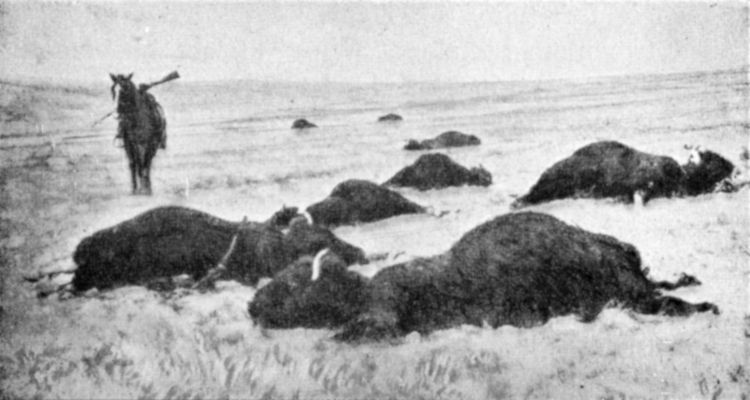
Recent History
September 1, 1926
Helge Ingstad
The Land of Feast and Famine - Portage

A dream of meat instead of fish is met with the killing of a moose. "Our chief diet had been fish. We never used salt or potatoes. It was meat we were longing for.
Our chief diet in the past had been fish. We cast out our lines each day, and, as a rule, we were able to catch enough for both ourselves and the dogs. But with boiled fish for breakfast, fried fish for lunch, and boiled fish again for dinner, in the long run meal-time began to lose something of its glamour for us. We never used salt; potatoes belonged to a bygone day. In short, we experienced no pleasure, sitting down to that sooty kettle of ours. It was meat we were longing for. Of course, we could hunt, but that required leisure. So we got along with simply dreaming about meat.
Then one day our dream became reality. We were paddling along a narrow stream which joined two lakes together. Wild ducks were splashing about in the water, and as I came paddling along behind Dale, I took a pot-shot at them. I brought down two, but to find them was not an easy task, for the reeds were so thick that the canoe could hardly move. I was pawing around in search of my game and had just found one mangled duck, when two shots echoed across the water. The only thing which occurred to me was that Dale, impatient over the delay, had fired his gun as a signal for me to hurry along. So I picked up my paddle and moved on.
Reaching the lake, I caught sight of his canoe way off under the opposite bank. What under Heaven was he doing way over there? As I approached, my astonishment increased to see him splashing about in water up to his knees. Peevish because Dale's uncalled-for behavior had obliged me to abandon that other duck of mine, I halted some distance away and asked disagreeably just what he had meant by it. "Come on and help me skin this moose!" cried Dale. — It lay where he had shot it, in three feet of water.
We began by devouring the heart. To be on the safe side, we took care of the tongue and kidneys in the same manner. After this we quartered the moose and loaded the meat into our already overladen canoe. In the bow we found a place for the head, with its mighty crown of antlers. The effect was decorative indeed. Then we paddled on till we found an attractive camp-site at the edge of a small river, and, with a sense of inner well-being, we spent the remainder of the evening puffing on our pipes and discussing the unbelievable good fortune which had suddenly come our way. But we didn't see Lion, Nagger, and Spike(the dogs) again until the following morning. At the place where the moose had been slain, they had stuffed themselves so full of meat that they had been unable to budge from the spot.
It was not difficult for us to wait with patience the three days necessary to make dried meat of the carcass. Since leaving Slave Lake we had scarcely paused for breath, and all our clothes were badly in need of repairing before it would be too late. We cut the meat into large slices and hung it from a tripod, under which we kept a low smoky fire burning constantly. On striking camp we were able to crowd most of the smoked meat into four dog-packs, so greatly had it shrunk during the drying process.
July 15, 1928
Helge Ingstad
The Land of Feast and Famine
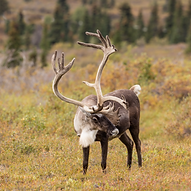
Ingstad ponders the population of the Caribou in the Canadian Arctic but acknowledges the toll of limiting the hunting would have on the natives.
If one accepts Hoare's estimate that there are five million caribou in all, and if one makes due allowance for the losses inflicted by wolf and wolverine, there would still be an appreciable surplus of calves every year. How many of these animals are annually shot by hunters can hardly be computed accurately. If, however, one makes a rough estimate of the human beings who are dependent upon the flesh of the caribou — a handful of white trappers and a few Indian and Eskimo tribes whose numbers are constantly diminishing — it would still seem that a steady increase of caribou is possible. This coincides with the view of the Indians who, influenced by the Canadian police, are, to an ever greater degree, abandoning their practices of purposeless mass slaughter. And now with the advent of the Thelon Game Sanctuary the caribou are assured of safe access to the western territories, provided this protected area is properly administered.
In this connection an additional fact of the utmost importance must be mentioned here. Trappers who live on the flesh of the caribou are simultaneously waging war upon its arch-enemy, the wolf. In order to gain some impression of the havoc wreaked by wolves, one would have to witness with his own eyes their wasteful slaughter. Often they slay for the sheer pleasure of killing and devour but a small portion of each carcass. Their murderous instincts affect, first of all, the calves. To throw some light on this situation, let me give some figures gleaned from the plainsmen east of Slave Lake: the dozen or so trappers who assemble there for the winter hunt, do away with some five hundred wolves annually. When one pauses to reckon that each wolf slays on the average of at least fifty caribou per year, the number of the latter whose lives are saved by men total twenty-five thousand. The deer in turn shot down by the hunters to provide themselves and their dogs with food constitute, in proportion to this, but a meager drain upon the herd.
If one looks a bit more closely at the other side of the question, with regard to the welfare of the people who live in the North, it is clear that their very existence would be threatened were the hunting of the caribou to be limited to any appreciable degree.
It would then no longer be possible for men to fare forth into the mighty wilderness where the dog-sled is the only means of transportation and the caribou the staple food of dog and man. And were we to deny the Caribou-Eaters their free nomad life on the trail of their daily bread, we should be robbing them of the very nerve-spring of their existence.
November 1, 1928
Helge Ingstad
The Land of Feast and Famine

The true delicacies consist of liver, heart, kidney, fat, marrow, breast, and head of caribou. The marrow is eaten raw, all else halfcooked. Moreover, it is the only diet which is effective, day in and day out, during the course of a long, cold Winter when one is obliged to nourish oneself on meat exclusively.
And it was not long before, one evening, the sound of bells was heard through the forest. Six steaming dog-trains pulled up in front of the tepees, tall men clad in heavy caribou parkas hopped out of the sleds, pushed their hoods back from their heads, and looked smilingly around. These were the Caribou-Eaters.
We greeted each other and betook ourselves to Antoine's tent, which was soon packed. A pot of meat was brought forth and emptied in silence. Not until our pipes were lighted did the conversation begin. Tijon, the eldest of the Caribou-Eaters, and Antoine talked in hushed tones about all the different things that had happened during the year. Misfortune seemed to interest them most. When at last they were finished, Tijon turned to me. " Segue — oh, brother-in-law!" he began. "You Antoine's friend. You follow Indians to Thelon River. That is all right. I show way. First many sleeps without fire. Always cold wind, maybe empty stomach. If brother-in-law not afraid, white man and Indian make big journey. Many caribou and white fox die."
The first to arrive were busy, putting the camp in order. Amidst a confusion of dogs and sleds, men were rushing hither and yon in the firelight. Some were carrying huge logs and throwing them into the fire, already piled as high as a man's head. Others were dragging in spruce brush, which they then scattered over the camp-site and tramped down in a large semicircle about the flames. A thick covering of spruce twigs completed the floor of the camp. Back from the fire a way, the sleds were arranged end to end so as to form a circular barricade.
When we arrived, we unhitched our dogs, chained them up, and gave them beds of spruce branches to lie upon; then we pitched in and helped with the general work. In the course of an hour the camp was fully settled and it was time to be thinking of ourselves. We took our seats facing the fire, each with his back to his own sled, the eldest in the middle. Heavy pots were stuffed with snow and, by means of long poles, lifted into the flames. Tea and meat were produced. About the flames there appeared a whole row of spits on which caribou heads, knuckles, ribs, and kidneys were roasting. One leg of meat after another was buried in the snow with the flat side to the heat; this was the food for the dogs, which first had to be thawed out.
First we took out the large pot of meat, for in this we each had a share. The eldest helped themselves first. With their fingers they reached down into the pot and pawed around until they had located the choicest pieces of meat. Fat and marrow were usually their portion. Then came our turn, and we others did likewise and reached down into the pot. One learned very quickly to discard all semblance of modesty. The meat was cooked on one side only; the other side was raw, but it slid down one's gullet easily enough, for all that.
When the pot was empty, we each put to good use the titbit roasting on our respective spits. Here, too, only the meat nearest the bone is eaten, the coarser cuts, such as would be used as a " roast" by civilized people, being eliminated and thrown to the dogs. The true delicacies consist of liver, heart, kidney, fat, marrow, breast, and head of caribou. The marrow is eaten raw, all else halfcooked. The head, placed in the flames without removing the skin or even the hair, is the best part of the entire beast and provides a whole menu in itself. From it one has the brains, the fat behind the eyes, the nerves of the teeth, the tongue, and, most delicious of all, the nose and lips of caribou, with their own peculiar taste of chestnuts. In addition to this, the gourmands amongst the older Indians have their own special dishes, such as blood and the contents of the stomach boiled together into a kind of soup, the tissues of the larynx, et cetera.
Such was the Caribou-Eaters' diet, which was also to be mine during that and subsequent years. Moreover, it is the only diet which is effective, day in and day out, during the course of a long, cold Winter when one is obliged to nourish oneself on meat exclusively.
These people are past masters in the art of butchering a carcass and of preparing food. With firm sure hands they turn and twist the meat on a spit, until a delicate brown color appears. They use a heavy broad knife, and hack as frequently as they slice. They know where every muscle and every joint of the carcass lies, and seldom do they cut in the wrong place
January 3, 1929
Helge Ingstad
The Land of Feast and Famine - The Barren Ground Indians

The staple food of the Indian during the summer months is fish, but he finds this variety of diet acceptable only when no other is available. Hunting is his most honorable pursuit, and meat his proper food. All else seems to dwell on a lower level.
During this period the musk-ox was also preyed upon by the Indians to a considerable extent. This species was plentiful and maintained its numbers as long as the natives had only their own weapons to use against it. The effect was otherwise with the introduction of fire-arms, for then the Indians' lust for killing was given full play. The mentality of the musk-ox was such that it refused utterly to flee from danger. As robust as a mountain, it challenged everything, and for the purpose of defense it had its " hollow square " — side by side, with lowered heads, these animals would form a fortress of powerful horns which no beast ever dared to attack. But the hunter armed with modern weapons could stand within easy range and mow these creatures down. A fair number of these rugged warriors of the Barren Lands still remain in existence, but theirs is a dying race, considering their original numbers. The musk-ox now enjoys complete protection, and a large region has been reserved for them in the Thelon Game Sanctuary.
Compared with caribou-hunting no other quest for game, now as formerly, is of the least significance. During the long winter months there is no other food problem save that of venison. During the remainder of the year moose, ducks, swans, geese, muskrats, et cetera, come to the fore. And the Indian seldom allows a year to go by without tasting a beaver tail. Beaver-hunting sometimes calls for stalking, sometimes for the art of decoying. The Indian's ability to imitate the calls of the various animals is almost inconceivable. I have seen one of them cause a flock of wild geese to swerve from their course and alight on the surface of a lake directly in front of the hunter.
The staple food of the Indian during the summer months is fish, but he finds this variety of diet acceptable only when no other is available. Hunting is his most honorable pursuit, and meat his proper food. All else seems to dwell on a lower level. It would be an easy matter for the natives to place a greater safeguard upon their existence by fishing beyond their immediate needs and storing up a reserve supply during the autumn. But such a type of activity is alien to their nature. The fish can swim by in solid phalanxes right under an Indian's nose, but he will do no more than throw out a couple of lines. He neither shifts nor disturbs his nets, merely pulls the ends far enough out of water for him to lift out what fish he can reach. There lies his seine week after week, drifting in wind and stormy sea, whilst slime collects in the meshes. All is well as long as he is able to make a fair catch from day to day. And what about the future? Good heavens, when the fishing season is over, the caribou will have arrived!
January 4, 1929
Helge Ingstad
The Land of Feast and Famine - The Barren Ground Indians

Ingstad marvels at the all-meat diet of the Indians, citing a lack of scurvy or chronic diseases. "Nowhere have I been able to discover that this excessive meat-eating has developed in the Indian a need for other forms of nourishment. If his meat-supply is adequate, for example, he will never go to the trouble of making a journey merely to procure flour."
I have already spoken of the ways in which the edible portions of the carcass are prepared. I have mentioned how the fundamental principle is to seek first the fattest and most nourishing parts, and how the necessary variety of food is achieved by making use of marrow, heart, kidneys, liver, fat, stomach contents, cartilage of the larynx, brain, tongue, tooth-nerves, nose, blood, teats, horns in velvet, unborn calf, et cetera, boiling or roasting the above to no more than a superficial degree. Meat and every other kind of food are prepared and eaten without the addition of salt. The food is washed down with unsweetened tea. As a supplement to fresh food, there are dried meat and fat. The dried meat is often ground up between stones and preserved in pulverized form; when this is mixed with fat, the result is " pemmican," a product of modern Arctic research.
Here, in a nutshell, is the secret of all Indian cuisine. These foods, as developed by a primitive people, not only make it possible for one to endure an exclusive diet of meat throughout eight months of the year, but also keep the Indians in excellent physical condition. During the meat months fresh cases of sickness seldom break out (I have never heard of a case of scurvy), and even the undernourished seem to regain their strength.
Nowhere have I been able to discover that this excessive meat-eating has developed in the Indian a need for other forms of nourishment. If his meat-supply is adequate, for example, he will never go to the trouble of making a journey merely to procure flour; but it is a different matter if he finds himself running low on tea or tobacco! If it so happens that he is invited to partake of a civilized meal, he will eat a few mouthfuls and seem to enjoy the change. But on finishing he gives it no further thought and makes straight for the nearest kettle of steaming fragrant venison.
The Indian people must have adopted an exclusive meat diet a great many years ago, and it may well be that their physical constitution has, to a certain degree, been modified by it. My own experience has been that the food of these Indians is both adequate and satisfying to the white man as well. The year I spent with the Caribou-Eaters, I nourished myself during about eight months of the winter by confining myself to the eating of wild game according to their principles. So long as I had venison enough to supply me with plenty of fat, I found myself in high spirits and noticed not the slightest indication of any kind of illness. On the other hand, whenever I was short of fat, I soon began to run down, could eat no end of meat without feeling satisfied, and became more susceptible to cold. I should like to mention in this place that, unlike most other white trappers, I neither used any salt nor missed it; I ate dried meat, dried fat, and raw marrow whenever I had the opportunity. This was food which I felt gave me ample and lasting strength to work, and on a cold winter's day a piece of bread and butter, smeared with cheese, was not to be compared with it. Naturally, one may have moments of weakness when one's thoughts wander off to a heavily laden dining-table, but these are probably due to nothing more than the remnants of old habit.
It is a custom of the Indians to devour untold quantities of food during a meal, but, on the other hand, it is possible for them to endure hunger and terrific hardships for long periods of time without experiencing dire effects. This the Indian holds in common with the Eskimo dog. In this particular the difference between the Indian and the white man, and between the Eskimo dog and the more civilized breeds, is strongly marked.