


Recent History
May 20, 1910
Vilhjalmur Stefansson
My Life with the Eskimo - Chapter 13
All of the caribou were skin-poor and the marrow in their bones was as blood, but we had with us plenty of seal oil from seals killed farther west along the coast, so that the two together made a satisfactory diet.
As we proceeded east along Dolphin and Union Straits from Cape Bexley, we found here and there traces of Eskimo parties who were going in from their winter hunt on the sea ice to cache their clothing, household property, and stores of oil on the beach preparatory to moving inland for their summer caribou hunt. Some of these groups we never saw at all; the trails of others we picked up and followed until we overtook the parties, who were usually camped on the shore of a small lake, where they were fishing with hooks through holes they had made with their ice-picks in the seven-foot-thick ice. The caribou in this district are scarce in spring and difficult to get by the hunting methods of the Eskimo. Fish were not secured in large numbers, either, for these people know nothing of nets. Our archæological investigations have shown us that the knowledge of fishing by nets never extended farther east along the north shore of the mainland than Cape Parry, and the Copper Eskimo have no method of catching fish except that of hooks and spears. The hooks are, like most of their weapons, made of native copper. They are unsuited for setting, for there is no barb, and unless the fish be pulled out of the water as soon as he takes the hook he is sure to get off again.
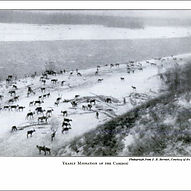
West of Cape Bexley we had seen no traces of caribou for a hundred and fifty miles, but as soon as we came to where the straits began to narrow, east of Cape Bexley, we began to find more and more frequently the tracks of the northward migrating bands of cow caribou bound for Victoria Island. At first we did not see on an average more than ten or fifteen animals a day, but later on they increased in number; and with our excellent rifles we found not the slightest difficulty in supplying ourselves with plenty of venison and in having enough to spare to feed also the people at whose villages we visited.
In coming to the coast from the south, caribou take the ice with out hesitation. It cannot be that they see land to the north of the straits, for half of the time, at least, the land is hidden in a haze, even from the human eye, which is far keener than that of the caribou. Neither can it be the sense of smell that guides them, for the northward direction of their march is not interfered with by change of wind. They will sometimes go ten miles out on the ice and lie down there, then wander around in circles for several hours or half a day, and finally proceed north again. Both at Liston and Sutton islands, in Simpson Bay, and farther east at Lambert Island, we saw caribou march right past without paying any attention to the islands, although there was food upon them , and they in some cases passed within a hundred yards or so. The bands would generally be from five to twelve caribou, consisting in the main of females about to drop their fawns, but also of yearlings and two-year-olds of both sexes. All of them were skin-poor and the marrow in their bones was as blood, but we had with us plenty of seal oil from seals killed farther west along the coast, so that the two together made a satisfactory diet. The skins at this season of the year are worth less, partly because the hair is loose, but also because they are full of holes, ranging in size from that of a pea to that of a navy bean, from the grubs of the bot-fly which infest the backs of the animals. When spread out to dry, the skin of the spring-killed caribou looks like a sieve.
September 13, 1910
Vilhjalmur Stefansson
My Life with the Eskimo - Chapter 13
A meeting is arranged by Stefansson between the Slavey Indians and the Eskimos
On our return journey from Bear Lake I was one morning surprised to see on the sky-line a party who evidently were not Eskimo. We hastened to intercept them, and found them to be Slavey Indians, one of whom spoke fairly good English. They had been to the northward hunting caribou, and with a vague notion that they wanted to go farther than usual on the chance of seeing Eskimo. Two days before we saw them, when they had found traces of Eskimo, they had completely lost their desire to see them. Their courage had suddenly given out, and they were now in full retreat. When they learned, however, that we had been spending several months with the Eskimo and had found them to be very friendly, the English speaking Slavey, who gave his name as Jimmie Soldat, told me that he was in the service of my friend Hornby; that Hornby had told him to keep a lookout for me, and to assist me in every way he could, and that Hornby had further requested that I take Jimmie in hand and bring him in contact with the Eskimo, so that later Jimmie might be able to guide Hornby to the place where the Eskimo are.
Now I did not desire to bring my unspoiled Coronation Gulf people into contact with civilization, with the ravages of which among the Eskimo of Alaska and the Mackenzie I am too familiar; but it seemed that the thing could not be staved off for more than a year or two, anyway, for the fact of my living with the Eskimo was already well known, and both the traders and missionaries who operate through Fort Norman would be sure to make use of the information. While I regretted the event in general, I was glad to be able to do a service, as I thought, to my friends Melvill and Hornby; so next day I took Jimmie and two of his Slavey companions to within a mile or two of an Eskimo encampment, and left them there in hiding behind a hill while I went to the Eskimo to ask their permission to bring the Indians into camp.
At first the Eskimo refused flatly. They said that they themselves had never had anything to do with the Indians; that their ancestors had had but rare contact with them, and that this contact had never been friendly; that sometimes Indians had killed some of them and sometimes they had killed some Indians, and that now no doubt these Indians had treacherous intentions in wanting to be introduced into camp. Through our long residence with them, however, Natkusiak and I had their confidence so fully that we finally talked them into allowing the Indians to come, on the condition that they leave their weapons behind them.
When I returned to Jimmie with this ultimatum, the Indians in their turn said that the intentions of the Eskimo were clear: that they intended to get them unarmed into their clutches and murder them, and Jimmie would have nothing more of the adventure. His backing out at this stage, however, did not suit me, for the Eskimo were sure to take that as a sign of treachery, and it would not have been a day until every Eskimo party in the neighborhood was on its way to the coast in a retreat in which they would have abandoned their sleds, their skins intended for clothing, and through which we would lose prestige by having brought this calamity upon them. Natkusiak and I therefore took the Indians practically by force into camp, threatening them with all sorts of dire results if they backed out. The Eskimo's reception of the Indians was friendly. The Indians were dressed in white men's clothing, and were not at all what the Eskimo had expected Indians to be like; and in fact several of them said to me at once that had they known the Indians were like this they would not have been so frightened of them.
This was early September, and the nights were dark at midnight. We had brought the Indians to camp about sundown, and an hour later, when supper had been eaten, the Eskimo invited the Indians to come and sleep in their tents; but this the Indians would not do, saying that it was their custom to sit beside the fire. This seemed to the Eskimo a strange thing, but to me it was a self- evident fib. The Indians were simply too frightened to trust themselves in the dwellings of the Eskimo. Natkusiak and I therefore sat up with the Indians for an hour or two until all the Eskimo were sound asleep, and then finally, by lying down one on either side, we got the Indians to go to sleep between us. The next morning after breakfast the Indians invited the Eskimo to accompany them down to their lodges, where they had considerable quantities of smoked caribou meat, caribou fat, and marrow-bones. Seven of the Eskimo went, including two women, and much of the forenoon was spent in the commodious lodges of the Slaveys in feasting and in exchanging opinions, in all of which I had to act as interpreter.
Finally when the feast was over and the Eskimo were apparently in the best of spirits, Jimmie brought forward a package of pictures of saints and holy men, and made a little speech in which he asked me to tell the Eskimo that he was an ambassador of a bishop of the Roman Catholic Church, and that the bishop said that if they were good men and never killed any more Indians and ab jured their heathenish practices, he would come and build a mission among them and would convert them to the true faith. This speech, which meant so much to the Indian, would of course have meant nothing to the Eskimo, for they had never heard of the good bishop or of the faith he preaches. Jimmie went on to say that he had a picture for each of them, and that if they would take them and wear them over their hearts, the pictures would protect them from all evil and be of the greatest value to them. Without translating any of these things, I took the pictures, which were the ordinary religious chromos, and gave them to the Eskimo.
It turned out that Jimmie had had no commission from Hornby, and that he had merely, from overhearing Melvill's and Hornby's conversation, found out that I was a friend of theirs, and he had used this knowledge in a confidence game of his own, the object of which was to become the first Indian who had been in friendly contact with the Eskimo, that he might thereafter pride himself on that fact, and might be able to represent himself to the bishop as having been a pioneer in the spread of the faith among the Eskimo. Apparently the results have been what he desired, for I have since heard that the Roman Catholic Church sent in missionaries at once, who arrived among the Eskimo soon after we left them, and whose work in that field will no doubt continue indefinitely.
Among other things, Jimmie told me that Melvill and Hornby were somewhere on Great Bear Lake. This was good news, and from that time I was continually on the lookout for some signs of them. Finally, on the 13th of September, it happened that the pursuit of a large band of bull caribou had taken me a long distance away from our camp, and when I finally shot three of the animals it was on a slope of a hill facing the southwest. While I was skinning them I happened to look in the direction of Bear Lake, which lay some fifteen miles distant, and there, not more than a mile away, was pitched a tepee. I took this for an Indian camp, but went up to it to make inquiries about my friends, and it turned out to be their camp. They had a day or two before heard from Jimmie about my presence in the country, and were also looking for me. They had been down on the Mackenzie River in the summer, and had some news of the outside world. King Edward was dead, and a heavier than air flying-machine had crossed the English Channel. This news, not half a year old, was fresh news indeed in that country.
November 8, 1910
Vilhjalmur Stefansson
My Life with the Eskimo - Chapter 14

A blizzard springs up while Stefansson is traveling with an Indian and an Eskimo, and he decides to build a tent in a safe place according to his experience. "We ate frozen raw caribou meat and drank cold water" since fire could only be had with heavy wood brought on sleds.
Now that we were on Bear Lake, I thought that by taking a course northwest true from the northeast corner of the lake for Langton Bay I should not only reach Langton Bay, but, incidentally, should probably find and be able to chart the upper reaches of Horton River. On this journey Natkusiak would of course go with me, while Tannaumirk and Pannigabluk remained behind on Dease River at our winter camp; but it seemed advisable to get also a Slavey Indian companion, for the Slaveys claim to know the country far to the north of Bear Lake, and one man in particular, known as Johnny Sanderson, said he knew all about it for a distance of several days' travel. Besides, we had no toboggans of our own, and our runner-sled was unsuitable on the tundra, so I hired Johnny with two toboggans and one dog-team.
On November 8, 1910, we started from the mouth of Dease River on our journey toward Franklin Bay; for two or three days before that we had been engaged in putting the finishing touches on our equipment, which meant making dog-harness and packing up dry caribou meat. Both at this time and on the two or three other occasions when we had come to Dease River Mr. Hodgson entertained us hospitably and helped us in every way. For the first forty miles after leaving his house we followed the shore of Bear Lake north westward, and then struck inland, traveling west by compass, which here means northwest true. We had only about six days' provisions with us, for among other things Johnny had told us that there would be plenty of caribou as soon as we got away from the fringe of woods about Bear Lake. I have often started upon a longer trip than the three weeks we anticipated for this one, with less than six days' provisions, but in this case we could easily have taken more, for Mr. Hodgson generously offered to supply us with as much as we wanted to haul. Johnny regarded himself, apparently, as quite infallible, and succeeded in impressing me with the probability that he was nearly so; but few men I have dealt with have panned out so poorly as Johnny Sanderson.
Going in a northwesterly direction, it takes about forty miles of traveling to reach the edge of the Barren Ground, and for all this distance we saw plenty of caribou tracks, but Johnny told us it would not be worthwhile following them and delaying our journey by a hunt in the woods, because, he said, "the Indians call the treeless country the Caribou Ground, and that is because it is always covered with caribou.” A few miles after we had left the trees behind us and entered upon what we called the Barren Ground (but what Johnny called the Caribou Ground) we crossed the tracks of half a dozen or so animals, and after that for two hundred miles we never saw another track.
Johnny was proud of his varied experiences as a traveler, and told how this and that great man of the Hudson's Bay Company had employed him as head guide, and how they always placed implicit reliance in him. He said there were few places he did not know, and that even where he was a stranger his judgment was so good that he was seldom at fault.
This confidence in himself had been so often justified in the past that the fact of its being seldom justified on the present trip evidently seemed to him an exception scarcely worthy of note. We struck the Barren Ground on the morning of our fourth day, and toward evening we had a blizzard. When it came time to camp, we searched for a small lake, because the ice at this season was not much more than a foot thick and fuel was scarce, so we wanted to get water for cooking. When we got to the shore of a small pond, I stopped the sled. The selection did not suit Johnny, however; he said that no one who knew anything about traveling would ever pick such a place for a camp. Half a mile back, he said, he had seen a cut-bank under the shelter of which we could have pitched our tent, and even now he could see, only a little way ahead of us, a round hill with a steep slope to leeward that would be a fine place under which to camp, for the hill would break the wind.
Now my idea and Natkusiak's did not coincide with Johnny's, because to us it was clear that if we camped in the lee of an obstruction the drifting snow would in the night cover up our tent and place us in danger of being smothered even were the tent not to cave in with the weight of the snow. No man of any winter experience in the open will pitch his tent in a shelter where there is the possibility of a blizzard. Johnny's ideas were all gained in the forested country, where it is wise, of course, to choose the most sheltered spots, and it seemed to him that we were little better than insane. He announced, therefore, that he would take the matter into his own hands and pitch the camp in the shelter of the hill, and he told me incidentally that I was the first white man he had ever seen who did not know enough to understand that an Indian knows more than a white man about how to make camp. Of course, the obvious answer was that now that he had the opportunity he had better watch carefully people who had different ideas from his and see what the result would be.
Natkusiak and I had to take Johnny's own sled away from him by a show of force, and had the pleasure of listening to his comments while we, without any help from him, put up the tent. During that time, and at various other times thereafter, Johnny told us much of a party of the Geological Survey of Canada which had been commanded by a white man who was my superior in every way, and who, while he was inexperienced, had the good sense to defer to Johnny in everything. Among other things Johnny had said that we would all probably freeze to death during the night, but we banked up the tent so well, Eskimo fashion, that we had not been inside of it more than an hour or so before Johnny began to complain that it was too warm, and that he was getting wet, through the snow in his clothes melting and soaking in. He had been so sure that the tent was going to be so cold — nothing could melt in it — that he had not thought it worthwhile to brush the snow off his fur coat.
We made no fire, for Natkusiak and I agreed that digging heather for fuel from underneath the snow was not worth the bother; we ate frozen raw caribou meat and drank cold water, at all of which Johnny complained bitterly. We could, he pointed out, have used the ordinary forethought of sane men; we could have hauled a load of dry spruce wood from the Bear Lake woods and could have made ourselves comfortable with a fire and a warm meal. To this we answered that our dogs agreed with us in considering the sleds heavy enough without piling a cord of wood on top of them, and that there was no need for special effort toward making us comfortable, for we were comfortable already.
January 2, 1911
The Passing of the Aborigines

Infant cannibalism was practised, where it could not be prevented—as it still is among all circumcised groups. One of the old men, Bully-bulluma, having been an epic meat-hunter in his day, had eight wives.
The Trappists led a life of rigorous poverty, intensified in this barren remote land to the point of starvation. There were cattle on the station, but meat was excluded for religious reasons, and the monks existed on one meal a day of pumpkin and rice, and a little beer they had made from sorghum grown in the garden. Rising at 2 a.m. they kept vigil in the dark chapel till dawn, then worked till daylight’s end, speaking no word save in necessity, and closing the day with some hours on their knees on the bare earth. I was the first white woman to appear among them at the Mission, and the first that the natives of the region had seen.
From the newly arrived stores, Brother Sebastian had provided a strange and varied meal for us according to his lights, extraordinary stews and puddings served in any order and all strongly flavoured with garlic; milkless tea in a huge jug that was both teapot and cups for us all. Poor Brother Sebastian may have been a paragon of piety, but he was no cook. In my keeping today is a fragment of petrified bread roll he made for me in 1900! It has been mistaken for a geological specimen, and, always carried with me in loving memory, it has survived, without losing a crumb, thousands of miles of rough transport.
Perhaps the first woman in history to sleep in a Trappist bed, I was allotted the abbot’s bag bed and seaweed pillow, and the sawn-off log for my chair or table. I woke to hear the natives singing a Gregorian chant in the little chapel near by. Half clothed and, for all the untiring work of the missioners, still but half-civilized, they comprised the Nyool-nyool tribe, of the totem of a local species of snake. Most of the women and men had their two front teeth knocked out, and some still wore bones through their noses. Infant cannibalism was practised, where it could not be prevented—as it still is among all circumcised groups. One of the old men, Bully-bulluma, having been an epic meat-hunter in his day, had eight wives. Another, Goodowel, was dressed in trousers and shirt, one stocking, his face painted red with white stripes from each corner of his mouth in broad lines. A red band was round his head, the hair drawn back to form a tight knob, and stuck in the knob was a tuft of white cockatoo feathers and a small wooden emblem. I know now that he was in the sixth degree of initiation.
Although they had tried their hardest, with prayer and precept, to teach these natives cleanliness and Christian living, giving their very lives to the work in torture and privation, those Spanish priests could hope for little headway in the first generation. There was one terrible manifestation of savagery that I can never forget.
A man had been found dying of spear-wounds out in the bush, and carried to the Mission as he was breathing his last. I watched two of the lay brothers bearing the stretcher to one of the huts, a horde of natives following. I noticed that they held their burden curiously high in the air. Suddenly, as it was lowered for entry to a doorway, the natives crowding round, to my horror, fell upon the body of the dying man, and put their lips to his in a brutal eagerness to inhale the last breath. They believed that in so doing they were absorbing his strength and virtue, and his very vital spark, and all the warnings of the “white father” would not keep them from it. The man was of course dead when we extricated him, and it was a ghastly sight to see the lucky “breath catcher” scoop in his cheeks as he swallowed the “spirit breath” that gave him double hunting power.
______
The women quite frankly admitted to me that they had killed and eaten some of their children—they liked “baby meat.”
_______
Baby cannibalism was rife among these central-western peoples, as it is west of the border in Central Australia. In one group, east of the Murchison and Gascoyne Rivers, every woman who had had a baby had killed and eaten it, dividing it with her sisters, who, in turn, killed their children at birth and returned the gift of food, so that the group had not preserved a single living child for some years. When the frightful hunger for baby meat overcame the mother before or at the birth of the baby, it was killed and cooked regardless of sex. Division was made according to the ancestral food-laws. I cannot remember a case where the mother ate a child she had allowed, at the beginning, to live.
______
It was no unusual sight to see anything up to 100 of these cannibals, men, women and children, several of them but a week in civilization, climb aboard an empty truck and go off to an initiation ceremony farther up the line. I use the word cannibal advisedly. Every one of these central natives was a cannibal. Cannibalism had its local name from Kimberley to Eucla, and through all the unoccupied country east of it, and there were many grisly rites attached thereto. Human meat had always been their favourite food, and there were killing vendettas from time immemorial. In order that the killing should be safe, murderers’ slippers or pads were made, emu-feathers twisted and twined together, bound to the foot with human hair, on which the natives walk and run as easily as a white man in running shoes, their feet leaving no track. Dusk and dawn were the customary hours for raiding a camp. Victims were shared according to the law. The older men ate the soft and virile parts, and the brain; swift runners were given the thighs; hands, arms or shoulders went to the best spear-throwers, and so on. Those who received skull, shoulder or arm kept the bones, which they polished and rounded, strung on hair, and kept on their person, either as pointing-bones or magic pendants.
Every one of the natives whom I encountered on the east-west line had partaken of human meat, with the exception of Nyerdain, who told me it made him sick. They freely admitted their sharing of these repasts and enumerated those killed and eaten by naming the waters, and drawing a line with the big toe on the sand as they told over in gruesome memory the names they dared not mention.
My first words to them were always “No more man-meat.” From the weekly supply train, I would procure part of a bullock or sheep and show them the game food areas, mallee-hen’s eggs, rabbits and so on, that must be their meats now, with as many dampers as I could provide, and a drink of sweetened tea.
One morning very early, the news came that Nyan-ngauera had left the camp, taking a fire-stick and accompanied by her little girl. No one would follow her or help to track her. For twelve miles I followed the track unsuccessfully, but Nyan-ngauera doubled many times and gave birth to a child a mile west of my camp, where she killed and ate the baby, sharing the food with the little daughter. Later, with the help of her sons and grandsons, the spot was found, nothing to be seen there save the ashes of a fire. “The bones are under the fire,” the boys told me, and digging with the digging-stick we came upon the broken skull, and one or two charred bones, which I later sent to the Adelaide Museum. A grown man will never avenge the death of his own child, nor will he, under any circumstances, share the meal.
The late Frank Hann, on a survey exploration, conferred the name of Mount Daisy Bates upon a height a little south of Mount Gosse. I discovered that it was the area of one of the worst groups of cannibals in the Centre.
April 15, 1911
Vilhjalmur Stefansson
My Life with the Eskimo - Chapter 16

The natural feelings of sympathy that had grown up through a year of association with these people, who in their way were so infinitely superior to their civilized brethren in the west, made me regret that civilization was following so close upon our heels.
Another story which we picked up at this time was that of the Imnait. These were vague and mysterious animals living in an unknown land to the west, which is also inhabited by the Kiligavait. This story did not give us nearly so much trouble in identifying it as did that of Kaplavinna, for the name of the monster was a correct reproduction of that used by my own Eskimo in the previous year in telling their adventures in mountain sheep hunting. Mountain sheep, of course, are found nowhere east of the Mackenzie River, and could not, therefore, be directly known to the Coronation Gulf Eskimo. These people were also unfamiliar with the dangers involved in the possible snow-slides and other peculiar conditions of mountain hunting. They had received from Natkusiak the general idea that mountain sheep hunting was dangerous, and being unable to ascribe any danger to the mountains as such, they had transferred the dangerousness of the snow-slides and precipices to the sheep themselves; and the hairbreadth escapes from death in snow-slides which Natkusiak had described became in their version hairbreadth escapes from the teeth and claws of the ferocious mountain sheep. The kiligavait, which they had associated with the mountain sheep in these narratives, were nothing but the mammoth, known to all branches of the Eskimo race by name at least, and known here also, according to what we were told, by the occasional finding of their bones. Of course Natkusiak had told nothing about mammoth hunting, but the mysterious mountain sheep naturally allied themselves in their minds with the also mysterious mammoth, and were therefore to be coupled together in recounting the same adventures. Thus we had a side-light, not only upon the origin of myths among primitive people, but also upon the startling rapidity with which they grow and change their form.
Along with these stories of Kaplavinna and the mountain sheep we were also told no doubt essentially truthful ones of the trading expeditions of certain men of this district to the lakes above the head of Chesterfield Inlet, as well as in all probability entirely fictitious accounts of how certain men had, during the last few years, made journeys to the moon. One of the local shamans had for a familiar spirit the spirit of a white man, and in séances spoke “ white men's language.” We were present at one of these séances; and when I said that I was unable to understand anything of what the white man's spirit said through the mouth of the woman whom he. possessed, it was considered a very surprising thing, and apparently inclined some of the people to doubt that I was really a white man as represented myself to be.
Not only does our experience here show how myths may originate, but it also shows how history and fact become mixed with fiction, and how facts are likely quickly to disappear, as in reality they do It is impossible among the Eskimo, in the absence of extraneous evidence, to rely upon anything that is said to have happened farther back than the memory of the narrator himself extends.
As we have remarked elsewhere, the mind of the Eskimo is keen with reference to their immediate environment, although of course unable to grasp things that are outside of their experience. This keenness is shown especially in the use which they make of practically everything that can be turned to account in their struggle against Arctic conditions. Wood is not especially scarce in Coronation Gulf; still, substitutes for wood have to be found now and then. We saw here a sled which illustrated remarkably the resourcefulness of the Eskimo in this matter. A man named Kaiariok, who is the son of Iglihsirk and of whom Hanbury speaks as being temporarily absent from his father's camp at the time when he visited it on Dismal Lake, found himself in the fall in need of a sled and with no wood out of which to make one. He then took a musk-ox skin, soaked it in water and folded it into the shape of a plank, pressed it flat and straight, and carried it outdoors where it could freeze. It froze as solid as any real plank, and then with his adze he went to work and hewed out of it a sled runner exactly as he would hew one out of a plank. On the upper edge of the runner he made notches for the crosspieces as he would had it been ordinary spruce, drilled holes for the lacings and put in wooden crosspieces, and made a sled which I had seen several times without discovering that it was in any way different from the ordinary wooden sleds. It was only one day when I was thinking of buying a sled that I discovered the difference. There were two sleds for sale, and I was told that one of them was better than the other because when the weather got warm it would still be useful, while the other one would flatten out and become worthless in warm weather and was therefore for sale for half the price of the first one. This cheaper sled turned out to be the musk-ox skin one, for which as an ethnological specimen I would have been willing to pay much more than the other, had there been any possibility of transferring it unchanged to a museum. There was, however, involved the same difficulty that has prevented in such places as Montreal the preservation of ice palaces from year to year.
Of all things that these Eskimo told us, the one that surprised us most was the undoubtedly true statement that a ship manned by white men and strange Eskimo was wintering in Coronation Gulf. This we felt as the reverse of good news, for the natural feelings of sympathy that had grown up through a year of association with these people, who in their way were so infinitely superior to their civilized brethren in the west, made me regret that civilization was following so close upon our heels. We had come into the country in May, and evidently this ship must have come the following September. She was wintering, they said, in the mouth of a small river about half a day's journey east of the mouth of the Coppermine. Seeing she was there, we would of course pay her a visit. We were not in particular need of assistance from anybody, but still in a far country like this one is always willing either to help or to be helped, and there was no doubt that the meeting was likely to be both pleasant and profitable to all concerned. In other words, now that the ship was there we would make the best of a situation we regretted; we would make what use of her we could and be of as much use to her as possible, although had we had our way we should have wished her on the other side of the earth.

