


Total Entries: 1045
Select one of the above filters
Year Filter:

Bernard Moncriff, who wrote a book about the all-meat carnivore diet, commits suicide at the age of 37. In his suicide letter - he remarks "my heart is broken. Now you will know the secret of my miserable diet and why I was sitting in a room without fire, dispensing even with milk and tea, subsisting mainly on bread, potatoes, and sugar water, a diet which has so often plauged me with dysentery, and which has all but ruined by constitution."
"my heart is broken. Now you will know the secret of my miserable diet and why I was sitting in a room without fire, dispensing even with milk and tea, subsisting mainly on bread, potatoes, and sugar water, a diet which has so often plauged me with dysentery, and which has all but ruined by constitution.

Heart Disease barely existed.
Austin Flint, the most authoritative expert on heart disease in the United States, scoured the country for reports of heart abnormalities in the mid-1800s, yet reported that he had seen very few cases, despite running a busy practice in New York City.

Garrod, in a paper read at the International Medical Congress in 1881 on "Eczema and Albuminuria in Relation to Gout," affirms that each year strengthens his conviction that gout and eczema are most closely allied.
The more persistent inflammatory lesions of the skin, such as eczema and psoriasis, which are characterized by long-continued hyperæmia with hyperplasia, are now recognized as among the possible transformations of gout. They are certainly often observed alternating with arthritic lesions, and associated with all the characteristic derangements of nutrition which belong to the gouty habit. The frequency of the various forms of acne, the inflammatory, as well as those which result from excessive function of the glands, in persons having a strong gouty inheritance, is recognized by many dermatologists. I have noticed these lesions especially in young women belonging to gouty families. They are generally accompanied by marked dyspeptic symptoms, and not infrequently by neurotic derangements.
Garrod, in a paper read at the International Medical Congress in 1881 on "Eczema and Albuminuria in Relation to Gout," affirms that each year strengthens his conviction that gout and eczema are most closely allied. Since his attention was first called to this relation in 1860, he has found a gradually increasing percentage of eczema in the cases of gout that have come under his observation. Dividing all the cases from 1860 to 1881 into ten groups, he found the percentage rose from 10 in the first group to 47 in the tenth. He accounts for this rapid increase in the percentage in the fact that in the first few years the eczema was only observed when it was very patent; during the past two or three years he has had made more careful inquiries as to the presence of eczema or other skin eruption in every case of gout, and by these means has frequently discovered its presence when it might otherwise have been overlooked. Garrod believes that eczema is the special skin-lesion of gouty subjects, and does not regard psoriasis as having anything more than an accidental connection with gout. He admits that the latter is often associated with rheumatoid arthritis. It must be remembered, however, that Garrod does not admit that gout ever exists without lithatic deposits.
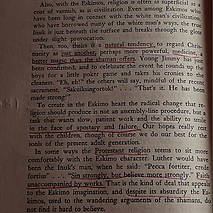
Buliard outlines the differences between Catholic and Anglican missionaries in the Arctic and how the Eskimo tends to pick the easier Anglican religion to believe in.
Naturally, the Decalogue makes weary progress against the established Eskimo morality, supported as that is by the shamans and the whole system of tabus and fetishes. Since 1860, when Father Grollier made the first attempt to preach the Gospel in the Arctic, the road of the Christian missionary has been a hard one, strewn with the rocks of prejudice and ignorance.
In the forefront of Christan missionary work in the North stands the Catholic Church. Among the Copper Eskimos alone we have three missions and. six missionary priests, as against a single Anglican missionary at Coppermine. Unlike the others, we live with the Eskimos, speak their language, and travel constantly from camp to camp. Yet the number of our converts is small, for we are a minority in the country, and the Anglican Church represents those with political power, the majority. We are the minority, and to be a minority among a primitive people puts one at a severe disadvantage, for the primite respects power and influence as he respects nothing else. To be a Catholic here in the Arctic often means to be alone, and nothing is more disturbing to the communally minded Eskimo than the prospect of being alone, being individally responsible. He is a tribe-minded man, and to go angainst the tribe, even when he believes he is right, is not in his nature.
Also, with the Eskimos, religion is often as superficial as a coat of varnish, as is civilization. Even among Eskimos who have been long in contact with the wihte man's civilization, who have borrowed many of the white man's ways, the true Inuk is just beneath the surface and breaks through the gloss under slight provocation.
Then, too, theirs is a natural tendency to regard Christianity as just another, perhaps more powerful, medicine, a better magic than the shaman offers. Young Jimmy has just been confirmed, and to celebrate the event he rounds up the boys for a little poker game and takes his cronies to the cleaners. "Eh, eh!" the others will say, mindful of the recent sacrament, "Sakuiksingortok!"..."That's it. He has been made strong!"
To create in the Eskimo heart the radical change that religion should produce is not an assembly-line procedure, but a task that wants slow, patient work and the ability to smile in the face of apostasy and failure. Our hopes really rest with the chlidren, though of course we do our best for the souls of the present adult generation.
In some ways the Protestant religion seems to sit more comfortably with the Eskimo character. Luther would have been the Inuk's man, when he said: "Pecca fortiter, crede fortius"..."Sin strongly, but believe more strongly." Faith unaccompanied by works. That is the kind of deal that appeals to the Eskimo imagination, and despite its absurdity the Eskimos, used to the wandering arguments of the shamans, do not find it hard to believe.
The Eskimo looks at the two religions. Both advertise the same God and promise the same reward in heaven. Which one asks the least? The Eskimo closes his left eye cunningly. Naturally, he is going to select the easier way.
Another stumbling block is the sacrament of confession. To unveil one's secrets, even in the sanctity of the Church, goes again[sic] the Eskimo's grain, for he has learned to guard them carefully. It is part of his code to keep things to himself. And the idea of penance doesn't appeal to him either. To be forgiven, after confession, the thief is told explicitly that he must restore the stolen goods, the bigamist give up his extra wife, the murderer make amednds to his victim's family. "No, no!" decides Inuk. The other religion will be quite sufficient, the one that can be outguessed.
Another advantage Anglicianism offers, from the Eskimo point of view, is the fact that the minister generally does not know the language well, but makes do with the kind of pidgin the British employ with natives in every part of the world. This makes it much easier to fool him, and even to mock him to his face, the kind of thing that kindles the Eskimo temperament. Alos, since the Anglican missionary resides at a faraway station, he visits his people once annually at most, and they figure that if they pray good and hard for a couple of days before he gets there that that will be enough. For the rest of the year they can forget it.
Mind you, I don't for an istant suggest that the Anglican missionary condones this laxness, or is even aware of it in many cases. Certainly he would not knowingly leave as deputy preoachers in Eskimo camps fellows famous for theivery, blasphemy, and adultery.
Unpleasant though the subject is, one must mention too the sometimes rather uncharitable methods the Protestant missionaries have used in their Christian competition with us. For a long time they showed no inclination to bring the Word or the sacraments, even baptism, to the North. Then, when we began our efforts, they rushed into Burnside and baptized everyone, men, women, and children, right and left, without ten minutes' instruction or preparation. Page Henry Ford and the good old Detroit assembly line!
Sometimes they have unsed prejudice and hatred to strengthen their cause. It is difficult to believe that an archdeacon thought he was advancing the cause of Christ when he addressed the following appeal to one of our converts:
October 1, 1929:
To Billlie Kimeksina(Tracher)
I hear news not good. I hear Akorturoat[The Long Robes] steal Billie Tracher. No, I think Billie knows God's word. He savvy Roman Catholic not right. What he give you? Little cross? Little God with string to tie on your neck? Suppose lose him, God lost! Some men no master for himself, other men piga. [In good English, "some men are not their own masters, but somebody else's property, like dogs."] That way all Catholic Indians. Priest want to make Esmiko like that. He want make him. slave. You see make Eskimo like that. He want make him slave. You see Catholic Indiians: poor, igonarrnt, all time afarid. Long time I know priest. All time teach his people lies...
No go to priest prayer. He make trap for you, just like trap for foxes. If you go in his trap, he make you slave, make trap for you wife. LOOK OUT.
It is difficult to respect the sincerity of the author of this statement, is it not? And does it not betray a certain arragance, born of power?
The Anglicans have power in the North, because the first traders certainly retained something of what they had learned at their mothers' knees. They were Protestant, to a man, the early H.B.C. post managers, the Police, and others. The Anglicans have influence with established authority, and of course the Eskimos haven't failed to notice it.
But the faults of a few will never make us forget the virtues of the many. Thoes old-timers, gentlemen all, are dear to us, and they were never men to permit prejudice or bigotry to color their dealings with men. There are many now living, some now dead, and I salute them all. These were men who knew how to share the Arctic comradeship with a smile--men of the North--and meeeting them, any one of them, on some remote northern station, or out on the barren ice, was like catching a glimpse of the sun.
Like the rising of the new sun, too, are the firm conversions we often see here. To watch an Eskimo pass endless hours struggling to learn the fundamental truths, to observe him trying to make the sign of the Cross, naturally inspires us, especially since we know that often he risks what he dreads--isolation--in order to enter the Church of Christ.
I remember old Napaok--a good, leathery Eskimo of the old school, hunter and pagan of Minto. During my first visit to Victoria I met him out on the sea ice and introduced myself.
"I am a missionary," I explained. "The Falla."
His old eyes studied the poetic sea horizon. "I have never seen a missinary until now," he said at last. "But from other Eskimos I have heard about the new God."
"Well, it is from Him I come," said I. "Would you like me to reach you?"
Napayok's answer came quickly, but I think it had been a long time in the making; all of Napaok's life, in fact. "Certainly," he said. "How should I call you? And what do I do?"
During the dark months that winter when the sun was in hiding, I passed hours in the clotted air of the snowhouse with Napayok, trying to teach him the words of God, trying to be as patient with hmi as. Iwould have been with a somewhat backward child in France.
"Our Falla..." he would begin, doggedly repeating the words after me, his ancient face wrinkled with effort, his old sea-paled eyes filled with aspiration. He learned the "Our Father" all right, but he never mastered the "I believe ini God..." It was tjust too long for him, I'm afarid. ANd I know that he went to his death still making the sign of the Cross starting on the right-hand side. It may have been because the Good Thief was crucified to the right ouf Our Lord. At any rate, Napayok could never remember that by tradition the left sohuld be first. There were many things he could not remember, but his heart was pure gold. After a longish lession on the sonwhouse he would sigh deeyl and say, leaning back, "Falla, I cannot learn anything, you see. Perhaps I am too old. Perhaps too stupid, too wooden in the head. But I believe what you believe. Is it not enough? I do not know very much, but I feel it is true. Now, could I smoke?"
When he died I was away on a trip, and I returned to find him sewn in his skins, weaiting for his Falla. I carride him back to the mission on my sled and buride him in the little cemetery there. He died a Christian, filled with faith, even though he stumbed over simply prayers and made the sign of the Cross backward.

Dr George Harley's 1866 book discussed the animal diet used by Rollo and then describes a few cases of treatments for it. He cites that animal diet requires a large amount of food, but doesn't quite distinguish the difference between protein and fat. Nevertheless, on his first patient he says "What appeared to agree with him best was animal diet."
Although advocating the employment of vegetable diet in cases of diabetes of the second class, I do not wish it for a moment to be supposed that I agree with Piorry in thinking that the cause of death, even in this form of diabetes, arises from the loss of sugar; for, on the contrary, I think it springs from the inability of the body to assimilate the sugar it possesses. In such cases, therefore, I give vegetable food, not because it contains sugar, but because it possesses many of the other substances necessary for the purposes of nutrition, which neither exist in the same quantity nor in so easily an assimilated form in animal diet.
It is well known from the reports of travellers among savage nations, that men restricted solely to animal diet must consume an almost fabulous amount in order to obtain sufficient of all the ingredients requisite in the processes of life. "We know, too, that an animal can be most effectually starved by limiting him to one particular element of food, although that element be even albumen. The benefits derivable from Piorry's plan of treatment, therefore, in my opinion, arise from the fact that when he gives sugar he at the same time ceases to restrict the patient to animal diet, and that in the mixed food they find many of the materials essential to life much more abundantly and in a more easily assimilated form than in animal diet. I shall now give a few typical cases illustrative of the two principal forms of diabetes.
Diabetes from Excessive Formation.
In the beginning of 1860 a young gentleman, aged 19, suffering from diabetes, was brought to me by his brother, a Medical Practitioner, who had detected the disease two year previously. This patient had already been under various systems of treatment. What appeared to agree with him best was animal diet, coupled with. small doses of chlorodyne.
To look at the patient one would have thought that he was a perfectly healthy individual. His weight was 135 lbs. ; the appetite was moderate ; and the amount of urine passed was not at that time excessive. The object of bringing the patient to me, it appeared, was in order that I might, if possible, suggest some remedy to replace the chlorodyne, the constipating effects of which were anything but agreeable. On carefully inquiring into the history of the patient, the case appeared to be one of diabetes by excess, and the origin of the mischief could in some measure be traced to some irritation in the liver, which was painful at its lower margin, the pain being much increased on pressure. Having an intelligent Practitioner to deal with, I at once gave my view of the case, and explained how, as scarcely any two cases of diabetes are precisely alike, it would be necessary to try the effects of different forms of treatment in order to discover what would be best for this particular case. The following table is an abstract of the results :
TABLE
The average amount of sugar passed by this patient during the next six months being from fifty to sixty grammes (775 to 930 grains) and his -weight 156 pounds, a quantitative analysis of the sugar -was no longer thought necessary. I may add that-when I last saw the gentleman in August, 1864 (on the occasion of his bringing to me a poor lad, -whose case I shall presently relate), he looked in excellent health, being, as he said, -without any feelings of discomfort, although he had still to continue his medicine, for as soon as he neglected it, the sugar again increased.

Sir George Reresby Sitwell, 4th Baronet, lived on an exclusive diet of roasted chicken according to a 2009 book.
[This is the full wiki page about this man, but the only interesting part is the last sentence]
Sir George Reresby Sitwell, 4th Baronet (27 January 1860 – 9 July 1943) was a British antiquarian writer and Conservative politician who sat in the House of Commons between 1885 and 1895.
Biography
Sitwell was born in London, the son of Sir Sitwell Reresby Sitwell, 3rd Baronet and his wife Louisa Lucy Hutchinson, daughter of the Hon. Henry Hely Hutchinson. His father died in 1862 and he succeeded to the baronetcy at the age of two. He was educated at Eton and Christ Church, Oxford. He was a lieutenant in the West Yorkshire Yeoman Cavalry.[1]
Sitwell contested Scarborough seven times, losing twice in 1884. He was elected Member of Parliament for the constituency at the 1885 general election, but lost it at the 1886 general election. After regaining the seat in the 1892 general election, he lost it again in the 1895 general election.[2]
A keen antiquarian, Sitwell worked on the Sacheverell papers, and wrote a biography of his ancestor, William Sacheverell and published The Letters of the Sitwells and Sacheverells. His collection of books and papers are said to have filled seven sitting-rooms at the family house, Renishaw Hall, in Derbyshire. He researched genealogy and heraldry, and was a keen designer of gardens (he studied garden design in Italy).[3]
In 1909 he purchased the Castello di Montegufoni, near Florence, then a wreck inhabited by three hundred peasants.[4] Over the next three decades he restored it to its original design, commissioned the Italian painter Gino Severini to paint the murals,[5] and took up permanent residence there in 1925, writing to the Archbishop of Canterbury and the Chancellor of the Exchequer to explain that taxes had forced him to settle in Italy.[4]
He remained in Italy at the outbreak of war, but in 1942 moved to Switzerland and died at Locarno at the age of 83. He held his baronetcy for 81 years 89 days, longer than all his three predecessors, and one of the longest times anyone has held a baronetcy in England.
Sitwell married, in 1886, Ida Emily Augusta Denison, daughter of William Henry Forester Denison (later 1st Earl of Londesborough). In 1915 he refused to pay off her many creditors, and saw her prosecuted and imprisoned at Holloway for three months. He was succeeded by his elder son Osbert, who described him vividly in his five-volume autobiography. Sir George's other two children were the writers Edith and Sacheverell Sitwell.[4]
Sitwell was known for his eccentric behaviour.[6] He banned electricity in his household well into the 1940s and made his guests use candles.[6] He deliberately mislabelled his self-medication to stop anyone else using it. Sitwell lived on an exclusive diet of roasted chicken.[6]

Americans ate twice as much beef as did Englishmen
A European traveler describing his visit to a Southern plantation noted that the food included beef, veal, mutton, venison, turkeys, and geese, but he does not mention a single vegetable. Infants were fed beef even before their teeth had grown in. The English novelist Anthony Trollope reported, during a trip to the United States in 1861, that Americans ate twice as much beef as did Englishmen. Charles Dickens, when he visited, wrote that “no breakfast was breakfast” without a T-bone steak.

The leading British diabetologist of the day - Dr Frederick Pavy, publishes a dietary for the diabetic full of animal meats, eggs, cheese, greens and nuts. "Must avoid eating: Sugar in any form, Bread, Potatoes. Peas. Cabbage. Pastry. Fruit of all kinds."
Page 162:
Dietary for the diabetic:
May Eat:
Butcher's meat of all kinds, except liver.
Ham, bacon.
Poultry.
Game.
Fish.
Animal soups.
Eggs, cheese, cream, butter.
Greens, spinach, lettuce, nuts sparingly.
Must avoid Eating:
Sugar, bread, Rice, Potatoes, Cauliflower, peas, broccoli, and many more.

Ellen G. White, a Seventh-Day Adventist gets a vision to reform health by abstain from eating flesh-foods.
Ellen White [prophet of Seventh-day Adventism] received her first major health reform vision, June 6, 1863, in the home of Aaron Hilliard, at Otsego, Michigan. In this vision, for the first time, God’s people were urged to abstain from flesh food in general and from swine’s flesh in particular. Ellen White characterized this vision as “great light from the Lord,” adding, “I did not seek this light; I did not study to obtain it; it was given to me by the Lord to give to others.”
Amplifying this upon another occasion, she added, "The Lord presented a general plan before me. I was shown that God would give to His commandmentkeeping people a reform diet, and that as they received this, their disease and suffering would be greatly lessened. I was shown that this work would progress."
Ellen's personal response was prompt and positive:
"I accepted the light on health reform as it came to me."
"I at once cut meat out of my bill of fare."
"I broke away from everything at once—from meat and butter, and from three meals."

Dr Salisbury runs an experiment with three men who were fed an exclusive army bisquit diet for ten days until they were too sick to continue.
It was found that whenever soldiers were thrown largely upon the use of hard bread, or army biscuit, as a diet, a peculiar train of abnormal manifestations presented themselves. These are : —
1. Constipation.
2. This constipation is preceded, accompanied and followed by fermentative changes and the development of intestinal gases and yeast plants (Saccharomyces and Mycoderma) in the food in the stomach and intestines.
3. These fermentative changes are always worse towards evening and during the night, and go on increasing from day to day till : —
4. Finally the gases and yeast plants and other products of fermentation developed, produce so much irritation, commotion, distention and paralysis of the intestinal walls, that diarrhoea ensues, which soon becomes chronic, and is not at aU amenable to the treatment of ordinary diarrhoeal conditions.
5. Accompanying the fermentative changes is always a paralytic tendency, more or less strongly marked. This is manifested in the alimentary canal, and especially in the larger intestines ; next in the extremities, the legs prickling and " getting asleep," frequently, with ringing in the ears and a numb, mixed up or confused feeling in the head, etc. These are manifestations pertaining to the history of the disease known as Locomotor Ataxy.
6. A cough, accompanied by more or less hoarseness, usually sets in, especially during the night and on rising in the morning. It is also accompanied by the expectoration of a thick, cream-colored, sweetish mucus.
7. This is followed by more or less constriction in breathing with frequently palpitation of the heart on any excitement.
8. After the diarrhoea sets in, there is generally a remarkable tendency to fibrinous depositions in the heart (Thrombosis), and to the clogging up of the pulmonary vessels with fibrinous clots (Embolism), with pains and aches in extremities and back.
9. The diarrhoea is not so likely to come on when the men are actively engaged, as it is when they go into camp and are less active. The active exercise seems to aid in working the starchy food out of the stomach into the bowels, where it is digested before it gets to fermenting badly. To demonstrate more positively that these abnormal conditions had their origin in the too exclusive use of Army biscuit as a food, it was determined to institute a series of experiments upon the exclusive use of this kind of food, as tried upon strong, healthy men, in a healthy locality, and free from the enfeebling influences of Army life. Accordingly, on arriving at Cincinnati, Ohio, I engaged the services of three strong, vigorous men of good habits and in the prime of life, for this purpose. The experiments were conducted with watchful care from day to day, and the results were most convincing and conclusive in favor of the previous observations made upon the soldiers, as will be seen from the following daily records of the experiments. , . , October 12th, at noon, began feeding the men exclusively upon Army biscuit. For drink used water, to which at dinner and tea about one ounce of good whiskey was added. Gave the men the whiskey, as they were used to taking about two or three drinks daily.
On the evening of the 9th, after giving my boarders a good beefsteak supper, I paid them off and discharged them from a diet drill to which they had submitted with a good grace for 28 days. These three subjects are all strong, healthy men in the prime of life, who had been used to the substantial diet of the active business men of our Western cities. From the commencement of the army-biscuit diet, up to the time when the discharges assumed a yeasty, chronic diarrhoea type, 19 days elapsed in one case, 18 days in the second and 20 days in the third case. The fermentative condition, and the production of alcoholic and acid yeast (Saccharomyces and Mycoderma), commenced and showed themselves in a marked degree on or about the 6th day, and increased until the army-biscuit diet was discontinued.
The first abnormal condition brought about by this diet was constipation, with a partial suppression of the biliary and intestinal secretions and lessened peristaltic action. This left the alimentary matters in the stomach and intestines an unusual time, during which fermentative changes were started. This fermentative condition increased daily, till the alimentary canal became filled with alcoholic and acid yeasts in a state of rapid multiplication and development, disengaging large quantities of carbonic acid gas which distended the bowels with flatus.
Just previous to the commencement of the diarrhoea and afterwards, there was a general paralytic tendency : this was especially marked in the intestinal walls, they losing their normal sensibihty and contractility under the irritant and poisonous action of yeast plants, carbonic acid gas, vinegar and other products developed during the fermentation of the amylaceous alimentary matters. In severe forms of the disease produced by this kind of feeding, the large intestines and sphincter become frequently so paralyzed that the feces pass involuntarily. About the time the diarrhoetic discharges commenced, there came on a huskiness and hoarseness of the voice, and a dry, constricted feeling about the larynx and pharynx. This was accompanied by a scalded, smarting soreness of the throat, as if it were inflamed, which extended into the bronchial tubes, together with the secretion of a thick, ropy, sweetish expectoration and considerable night and morning cough, with oppression and tightness about the chest. On examining the throat and larynx, the surfaces were found to be Avhiter than usual, showing that the parts were more deadened than inflamed.
This affection differed from all colds, it being caused by partial death or paralysis, instead of by over-action or inflammation. It continued while the diarrhoea lasted. There was also palpitation of the heart and oppressed breathing, on any excitement. I have noticed the same pulmonary derangement in all well-marked cases of chronic diarrhoea, or consumption of the bowels. During these experiments, the boarders were not allowed to perform any manual labor, or permitted to take any exercise besides the two to four mile walks, morning and evening. I was constantly with them, day and night, to observe all the symptoms and conditions ; to make such tests and microscopical examinations as were necessary to determine the various states and changes that were taking place and to indicate the latitudes and departures from the normal state. Had they been allowed to labor and take vigorous exercise, the fermentation and consequent consumption of the bowels would have been deferred to a later date. Vigorous exercise would have shaken and worked the food down out of the stomach into the small bowels, where it is digested, before any very serious fermentation had set in. Such as did set in, however, would have finally culminated in the disease as before, but under a much slower rate of progress. On the tenth day of the feeding, all the men began to show quite evident signs of semi-paralysis of the nerves of the extremities. This gradually increased until the army-biscuit diet was discontinued. During the last few days of the feeding the symptoms of locomotor ataxy were strongly marked, and the disease was progressing with alarming rapidity. The eyes were growing more and more dim, and the deafness and ringing in the ears were becoming strongly manifested.
Gary Taubes wrote in his new book The Case For Keto a paragraph that I want to dedicate this database towards:
"I did this obsessive research because I wanted to know what was reliable knowledge about the nature of a healthy diet. Borrowing from the philosopher of science Robert Merton, I wanted to know if what we thought we knew was really so. I applied a historical perspective to this controversy because I believe that understanding that context is essential for evaluating and understanding the competing arguments and beliefs. Doesn’t the concept of “knowing what you’re talking about” literally require, after all, that you know the history of what you believe, of your assumptions, and of the competing belief systems and so the evidence on which they’re based?
This is how the Nobel laureate chemist Hans Krebs phrased this thought in a biography he wrote of his mentor, also a Nobel laureate, Otto Warburg: “True, students sometimes comment that because of the enormous amount of current knowledge they have to absorb, they have no time to read about the history of their field. But a knowledge of the historical development of a subject is often essential for a full understanding of its present-day situation.” (Krebs and Schmid 1981.)