


Recent History
June 12, 1797
John Rollo
Cases of the diabetes mellitus : with the results of the trials of certain acids

The continuation of the John Walker Diabetes Case: an entire diet of animal food to be adopted, confining of the following articles; three eggs for breakfast, four oz of cheese for supper, two lbs of meat for dinner, with three lbs of beef-tea in the day.
SECT. II. - Cases and Communications
the first Edition of the Work. From Doctor Marcet. London, January 12, 1798
MY friend and countryman Doctor de la Rive, having informed me that Walker had been readmitted into the Infirmary at Edinburgh, and placed under the care of Doctor Gregory, I requested him to send me an account of the further progress and treatment of the case, which I now have the pleasure to transmit to you.
Continuation of the Case of Walker.
June 12th, 1797.
He had continued perfectly well till within this fortnight, though his urine, which amounted to 5.5 lb. when he left the Hospital, increased gradually to 16 lb. His thirst is at present urgent; his tongue is dry, as well as his skin, which is also hot; says that he sweats frequently ; pulse 108. He complains of a burning pain in the palms of his hands and soles of his feet; of confiderable weakness) and occasional sourness in his stomach, with pain and flatulence. His fleep is disturbed ; his ankles often swell at night.
June 14th. In the last 24 hours he has passed 17 lb. of urine, which is of the common diabetic appearance. Su.aj. pulv. alum. comp. jfs. 4. in die; libat aquae calcis 2 lb. in die. Full diet, with meat for dinner.
June 17th. Urine l6 lb. The dose of the compound powder of alum to be increafed to a drachm.
June 19th. Urine 14 lb. and rather more limpid. The alum powder to be omitted, the lime water continued, and an entire diet of animal food to be adopted, confining of the following articles ; three eggs for breakfaft, four ounces of cheese for fupper, two pounds of meat for dinner, with three pounds of beef-tea in the day.
June 21st. Urine 8 lb, ftill pale, though less so than before.
June 29th. Urine 5 lb. yellower than it has yet been and of a more natural smell.
July 7th. Urine 5 lb. To be allowed 4 ounces of bread daily, in addition to his diet.
July 9th. Urine 5.5 lb. He has drank two cups of tea with sugar
July 11th. Urine 5.5 lb.; a portion of yesterday's was evaporated, and the residuum evidently contained saccharine matter.
July l6th. The bread to be omitted, and the animal diet strictly adhered to.
July 27th. Urine 5 lb. Within these few days his strength has been recruited. He is to be discharged. This Patient was detected in following his habits of irregularity and intemperance; indeed he could not be depended upon.
August 28, 1797
John Rollo
Cases of the Diabetes Mellitus

Mr. Leigh Thomas, surgeon: He commenced eating animal food, his common beverage was water and beef tea. After pursuing this plan for days, the urine had entirely lost the sweet taste, and was greatly reduced in quantity. I consider it a favourable one for a trial of the ingenious mode of treatment you have pointed out for the cure of this disease.
From Mr. Leigh Thomas, Surgeon, Leicester Square, London.
History
I HAVE this morning (August 28, 1797) met with a confirmed cafe of Diabetes Mellitus ; and, as I consider it a favourable one for a trial of the ingenious mode of treatment you have pointed out for the cure of this disease, I shall be happy either to give it up to your entire management, or co-operate in any plan that may be suggested between us. The subject is a very industrious man, aged 38, by trade a watchmaker, much confined to business, and anxiously labouring for the support of a numerous family.
He is much emaciated, and loses strength and weight daily. He showed me a letter from a brother of his, living in Kent, who also complains of pain in the back, and great debility, with an occasional discharge of sweet urine, especially after any fatigue of body, or distress of mind. It appears that three brothers of this family laboured under the disease, but it could not be traced to either of the parents.
Treatment.
Doctor Rollo having seen the patient, and favoured me with directions how to proceed, he very readily agreed to adhere to any rules laid down for his recovery.
Sept. 2, 1797, he commenced eating animal food, and took six or eight drops of hepatifed ammonia thrice a day, with castor oil occasionally; his common beverage was water and beef tea. After pursuing this plan for days, the urine had entirely lost the sweet taste, and was greatly reduced in quantity ; by the 18th he had lost the pain in the stomach, and the appetite became more moderate.
The quantity of urine was now reduced to one pint and a half; he felt very weak ; had a violent longing for vegetable food, particularly bread. I could not resist his solicitations, especially as I had a faint hope that the disease was conquered ; I therefore allowed him a small French roll, with a glass of port wine. The urine made that night was highly impregnated with saccharine matter, and increased to the quantity of five pints. The following day, he again indulged a second time with bread and also porter, and so continued to deviate till the beginning of November, sometimes taking three pints of porter daily. In this interval, I ordered him the cinchona and sulphuric acid. His strength was improved, yet he lost weight. The gnawing pain at the stomach had returned, and also the itching and excoriation of the prepuce, the urine very sweet, and had increased to ten pints. The disease being reproduced, and its effects so considerably increased, the patient promised to be more resolute in future.
Nov. 20th, the animal food was again returned, and, I believe, faithfully adhered to until the middle of February ; the hepatifed ammonia was laid aside ; and milk was torbid, as I had strong reason to believe that it frequently produced sweet urine in the former trial. His strength, at the end of this period, was greatly reduced; the gums spongy, with frequent bleedings, a foetid breath, and a rigidity of the muscles of the lower extremities. The urine had decreased to three pints, not at all sweet, was of a brown colour, and loaded with putrescent mucilage ; in taste exceedingly salt, and much more pungent than urine in a natural state. The appetite was so completely destroyed, that the sight of animal food excited nausea, but, at the same time, there was a longing delire for vegetables and beer. His weight during this time varied something. In November he weighed more than nine stone ; in January, eight and a half; before the end of the course, he regained nine stone.
The excoriation of the prepuce had gone off, but the natural propensities never returned ; the skin became moist, the clamminess of the fauces had disappeared. A great number of boils came out in different parts, which were exceedingly painful ; some few advanced to suppuration, but never afforded true pus. Every diabetic symptom having left him, and his present state being so very distressing, induced me to allow him a small proportion of vegetable food. As we had experienced the ill effects of bread in the former trial, I directed him to eat sparingly of potatoes, and drink weak brandy and water; he drank, also the alum whey. In two days after this, the sweet urine reappeared, and all the other symptoms soon returned. He never after this adhered to any regular plan, only taking vegetable food very sparingly.
About the middle of March, he had a severe attack of pleurisy, which required two bleedings, and other evacuations, to remove it. In April he passed some time in the country, twenty miles from town, where he constantly eat vegetables, and drank large quantities of mild ale; during this time, the urine was sweet only at times. Under these circumstances, he gained four pounds weight in nine days. After his return to town, his strength daily decreased ; the boils frequently appearing, obliged him to lie almost constantly in bed. During the latter part of this period, the urine was very frequently perfectly sour, and that immediately upon passing off, so as to leave no doubt of its being so in the bladder ; the taste and smell very similar to sour whey, but perfectly transparent ; at this time, it was always small in quantity. In the beginning of July, he had another attack of pleurisy, which terminated his sufferings on the morning of the l6th. (He died)
As I have merely given a summary account of the progress of the case, I shall, in like manner, relate the effects of certain vegetables upon the disease, and which came under my own observation, Bread certainly holds the first rank in exciting the formation of saccharine matter ; nor did this appear to depend upon the fermentation it had undergone, as the sea-biscuit, or a teaspoonful of flour in melted Butter, universally produced the same effect ; potatoes flood next ; onions, leeks, radishes, and turnips, also produced much sugar. Preparation by boiling, or otherwise, did not seem to increase or diminish their effects. Spinach, carrots, peas, broccoli, and cauliflower, had each less effect than the former, particularly the two last; parsnips were eaten with impunity. The urine never tasted sweet after taking them ; at first, the urine had a sourish taste and smell, which I attributed to them, but since, it has been perfectly sour, without being able to account for it. Every kind of fruit invariably produced sweet urine, without being able to ascertain any variation in their effects. Of Liquids, porter appeared the most hurtful ; no difference could be observed with regard to the effect of any of the spirituous liquors, wines, or cider; mild ale he considered as having no effect in producing the disease, but of this I can say nothing of my own knowledge, as he only drank it in the country. He was bled five times in the course of the treatment, purposely to examine the blood; in one instance only had the serum a turbid wheyich appearance ; the slightest taste could not at any time discover anything of a saccharine quality. Upon allowing the blood to evaporate in the open air, no putrefaction took place, it became a solid brittle mafs, of a mining appearance when broken. Dissection Twenty-four hours after death, under the directions of Mr. Cruikshank I proceeded to make a careful examination of the viscera.
October 18, 1797
John Rollo
Cases of the diabetes mellitus: with the results of the trials of certain acids
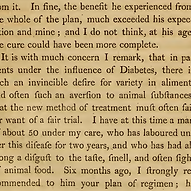
Doctor Aldridge was advised to give up all visits, and pass the winter entirely within his house, to abstain from vegetables, sweet and home made wines, to which he had been, particularly partial, and all redundance of sugar, of which he was fond, and to pursue the plan of medicine stated in his letter to you. I do not think, at his age, the cure could have been more complete.
From Doctor Storer, Nottingham. October 18 1797
THAT the cure of the Diabetes Mellitus had hitherto been a desideratum in Medicine, the candid declaration of Dr. Cullen will leave no room to doubt; and though I have reason to think that there exists in certain families a morbid disposition, occasionally showing itself in profuse and sweet urine, thirst, eagerness of appetite, and feverishness, which is relieved by medicine, disappears of itself for a time, and recurs upon any irregularity, much as happens in dyspepsia, yet I think a distinction ought to be made between this milder and more chronic species of the disease and the true Diabetes Mellitus, with rapid emaciation, as described by yourself and others. Respecting the latter, (of which seven distinct cases have fallen under my care) I must say with Dr. Currie, that after the disease was completely formed, I have never seen it cured by the former methods of practice.
The first notice I had of the new method, was from your notes of Captain Meredith's case, transmitted to me by Dr. Aldrich, (the Gentleman of 77, see page 180,) with a request to have my sentiments respecting the propriety of his pursuing a similar plan. I have reason to think that the Doctor's disease had existed a considerable time, before it was detected in September 1796, when he first complained to me of oedematous legs, great thirst and dryness in the mouth, without any corresponding degree of fever, increasing debility and frequent irritation to urine, the quantity and properties of which had not been observed, the Doctor having strongly adopted the idea, that it was more the infirmities incident to advanced life, than any positive disease under which he laboured. Having declined to recommend anything till the state of the urinary discharge was ascertained, I soon received a note to say, that the colour, taste, smell, consistence and saccharine residuum, after evaporation, all proved the urine to be truly diabetic. In consequence of this information, the Doctor was advised to give up all visits, and pass the winter entirely within his house, to abstain from vegetables, sweet and home made wines, to which he had been, particularly partial, and all redundance of sugar, of which he was fond, and to pursue the plan of medicine stated in his letter to you. Under this treatment six months elapsed before your method was known to us, during which the Doctor was in some respects relieved; the progress of the Diabetes appeared to be arrested, but all its characteristic symptoms still remained. The sequel of the case, from the end of March till the 18th of May, (the date of the report transmitted to you) is better related by the Doctor himself, than I am able to do; to this report I have only to subjoin that on the 17th of June following,
He found himself able to pass two days here (20 miles from home) on a visit. The swelling of the ankles was no more than what is customary at his age; he appeared as well as he had been for several years; and though his urine had a flight sweetness, it was neither too abundant nor otherwife defective. This state of health continued, although he had in a great measure resumed an ordinary diet (abstinence from vegetables and saccharine matters excepted) till the 14th or 15th of July, when he was seized with a cholera, at a gentleman's house in the neighbourhood; and though the bowel affection ceased, so as to admit of his being removed home, yet on the 18th I found this truly excellent and learned man in a dying state, without any other symptoms than those of debility and dyspncea; his urine was natural. The Doctor himself has stated that he would not consent to enter upon your plan of regimen in the Uriel manner that I would have recommended it to be pursued, at least for some weeks. He entirely rejected any hepatised ammonia, or any nauseating medicine. It was as a substitute for these that I proposed the soda water of Schweppe, having come to the knowledge of a diabetic case in Lancashire; which was understood to have been much relieved by that preparation; and I entirely concur in the Doctor's own opinion, that while it was a solace to his thirst, he derived other advantages from it. In fine, the benefit he experienced from the whole of the plan, much exceeded his expectation and mine; and I do not think, at his age, the cure could have been more complete.
It is with much concern I remark, that in patients under the influence of Diabetes, there is such an invincible desire for variety in aliment, and often such an aversion to animal substances, that the new method of treatment most often fail for want of a fair trial. I have at this time a man of about 50 under my care, who has laboured under this disease for two years, and who has had all along a disgust to the taste, smell, and often fight of animal food. Six months ago, I strongly recommended to him your plan of regimen; he tried it partially, I believe, without much evident effect and soon abandoned it. Taking advantage of the rapid increase of his diforder lately, and the near prospect of dissolution, if nothing essential was done, I have again enforced it with all my powers of language. The consequence has been, a fresh trial of two days, which he declares himself unable to support, and now he appears to resign himself to his fate.
January 1, 1798
R. Redfearn
A case of the Diabetes Mellitus, which terminated in a complete, and, as far as can be judged by apparent Circumstances, a permanent Cure, by Medicines, abstracting Oxygen from the System, and a Diet consisting totally of Animal Matter.

Dr Redfearn uses a diet principally of fat beef and pork to treat diabetes.
R. Redfearn M.D. of Lynn Regis, Norfolk
"I therefore immediately suggested to him the propriety, and the absolute necessity, of abstaining ridigly from all fermented liquors and vegetables, with everything else that could impart oxygen to the system by the primae viae; and at the same time ordered that his diet should consist principally of fat beef, pork, and such ailments as were of a gross or unctuous quality, and most likely to produce hydrogen in the greatest abundance. After this patient had persevered in the above medicines and regiment during a fortnight only, he found his thirst by no means so excessive. The quantity of his urine was considerably diminished, and became also of a quality more urinous, and less sweet. His amendment continued to be progressive, without feeling any interruption, either from natural or adventitious causes; and he was completely free from every symtom of the disease in less than three months after the medicines were first administered. He never once deviated from the regimen prescribed. My patient has now continued perfectly well for more than eight months, and to my enquires, very lately, he declared, that he never enjoyed a better state of health, than he does at the moment."
February 23, 1798
John Rollo
Cases of the diabetes mellitus : with the results of the trials of certain acids
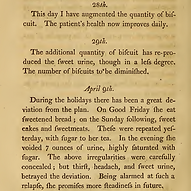
Mr. Shirref tells the detailed case study of a young woman with diabetes who abused sweetmeats and fruit and got better on an all-meat diet by visiting Dr. Rollo. "I directed a diet, consisting chiefly of animal substances"
From Mr. Shirreff, Deptford. February 23d, 1798.
A YOUNG LADY, who has lately completed her 12th year, of a thin habit of body, tall of her age, of a docile disposition, and who has a regular flow of spirits, subject, however, to sick headaches, and accustomed to eat much fruit, sweetmeats and pickles, has become affected with Diabetes.The months of June, July, August, and September, 1797 were passed in Devonshire, near the sea-coast, where she bathed in the sea, and used exercise on horseback. She returned to this neighbourhood early in October with apparently an improved constitution. About the latter end of November she had an attack of angina; the left tonsil became enlarged, as well as the submaxillary and other glands of the same side. The angina went off; but such a state of glands remained as indicated a scrofulous constitution. After the indisposition, she did not recover her usual appearance of health; the wings of the nostrils became enlarged, the upper lip tumified, and the infide of the left nostril red, and excoriated; she had alfo flight herpetic eruptions. Early in the month of January her spirits became deprefled, her disposition indolent, and equally indifferent to study and amusement. She complained of headache and flight cholics; she became thinner though her appetite remained unimpaired. About the middle of February she had an intense thirst, and frequent calls to void urine. These were attributed to an improper habit; and she was retrained from the former, as the latter was supposed to be the consequence. The restraint, however, was impracticable.
At this time I was made acquainted with the circumstances. I desired the urine to be preserved; and on examination, it was evidently characteristic of the Diabetes Mellitus. I sent a portion of it, with an account of the case, to Dr. Rollo (it furnished the purest saccharina extract he had met with, and which granulated by keeping). I directed a diet, consisting chiefly of animal substances; an opiate combined with an antimonial at bed-time; the extremities to be anointed with a liniment of hog's-lard and camphor.
February 24rd. Her thirst was great; her appetite was keen; she had frequent headaches; a costive habit of body; a bitter taste in her mouth, with frequent nausea; her nights were good, but when obliged to get up to void her urine, which was frequent, her skin was cool; no rigors, or local affection in the kidneys; the abdomen was not enlarged, but there was an evident hardness above the pubis, embracing the region of the bladder; her skin, however, put on an appearance which requires a little more attention. Upon her arrival from the seacoast, I have observed she was much improved in her looks, as well as in general health, which was nowhere more conspicuous than in the appearance of the surface of the skin. Being subject to herpetic eruptions, I was accustomed to remark the lingular dryness upon the surface, and particular feel, which seemed inconsistent with health; but after her arrival from sea-bathing; these irregularities had disappeared, and the skin of her arms and neck had a natural look; but now appearances were worse than before, and such as struck me forcibly: the skin was dry, harsh, void of elasticity, shrunk, of a leaden hue, and seemed to adhere to the muscles; one would have supposed that there was no cellular membrane, being not only void of fat, but the motion of the skin was also trifling; in a word it seemed to be what is called hide bound. An emetic was directed in the evening, and the body was to be rubbed with the liniment, to which had been added a solution of the sulphuret of potash.
February 25th.
The urine is of a deeper colour, and less sweet; an abstinence from liquids was recommended, so far as it was practicable. With my patient I called on Dr. Rollo; we agreed on the plan of treatment, which was to consist of an entire use of the animal diet; as drink, a dilute solution of the sulfurated potash in water, and two grains of the extract of hemlock, with one grain of the antimonial powder at bed-time. February 26th.
Yesterday she ate voraciously at dinner; was put into the warm bath in the evening, and the skin afterwards anointed with a preparation of hog's lard and pure ammonia. She had a good night, and without any occasion to void urine. This morning the urine is high coloured, and saltish to the taste; indeed it might be considered as natural urine.
February 27th.
I was informed that the urine voided yesterday at one o'clock was free from sweetness, and perfectly insipid; some time after it appeared natural; but two hours after dinner was sweet, and in the evening again apparently natural. She was directed castor oil, being costive : the bath and injunction to be continued, and likewise the diet.
February 28th.
Has had a good night; the urine this morning is evidently urinous, though of a pale colour; her thirst diminishes, and her appetite is less keen; the skin feels softer. Yesterday she ate bread at breakfast, which I was informed of immediately afterwards in paying my morning visit. I was determined not to lose this opportunity of watching through the day any changes in the urine. That which was voided until dinner time, was sensibly sweet. I evaporated three pints of it, and it yielded of a saccharine extract a quantity amounting to 8 ounces 3 drachms. Her dinner was entirely animal food, and what (he passed afterwards deposited a lateritious sediment, and in colour, smell, and taste, differed very little from natural urine.
March 1st.
She had a good night; the thirst diminished; urine more natural in appearance. She continues the regimen, See. and is ordered to try small doses of the powder of ipecacuanha.
March 3d. The urine differs little, either apparently in quality or quantity, from what is natural. Allowed her boiled milk and bread for breakfast this morning. At 1 o'clock this forenoon, the urine not sweet. She is to be indulged with a biscuit at dinner, and another at tea in the afternoon. The urine was examined at bed-time, and it was found very sweet.
March 4th. The urine voided in the night was insipid, this morning saltish. Visited Dr. Rollo with my patient. Continuance of the animal food recommended, and occasionally a trial to be made with a small quantity of bread.
March 6th. Urine very sweet; complains of thirst and headaches. I suspected she had been deviating, which was acknowledged; she promises a more ready adherence.
March 9th. She is able to take three biscuits in the 24 hours, without the production of sweet urine; but if this quantity is exceeded, the saccharine matter is perceptible. Therefore the assimilating powers are now able to convert a certain proportion of bread with animal food into proper chyle, which is capable of being applied to the purposes of nutrition.
March 10th. The appearance of the skin is much altered for the better. Medicines and diet to be continued. The weight of the body was this day found to be 64 pounds.
March 15th.
Nothing particular has occurred these five days past. She has been cautiously increasing and diminishing the quantity of biscuit, according to the effects produced; the number of biscuits has not exceeded three or four, and the fourth generally produces sweet urine.
March 23rd. From the 15th to this day nothing material has happened. The urine voided in the interval of her meals is insipid, and is falter and more urinous the farther distant from the meal. On the night of the 22d the body was covered with a general moisture.
March 24th. This morning the weight of the body was found to have increased, since the 10th, five pounds and upwards.
March 28th This day I have augmented the quantity of biscuit, The patient's health now improves daily.
March 29th. The additional quantity of biscuit has reproduced the sweet urine, though in a less degree. The number of biscuits to be diminished.
April 9th. During the holidays there has been a great deviation from the plan. On Good Friday she ate sweetened bread; on the Sunday following, sweet cakes and sweetmeats. These were repeated yesterday, with sugar to her tea. In the evening she voided 7 ounces of urine, highly saturated with sugar. The above irregularities were carefully concealed; but thirst, headache, and sweet urine, betrayed the deviation. Being alarmed at such a relapse, she promises more steadiness in future,
April 12th. The urine natural. She takes the biscuit.
May 4th. The whole plan now consists in regulating the quantity of bread; when a large proportion is used, sweet urine is still reproduced, and of the saccharine matter she is sensible, by the peculiar feel of uneasiness about the meatus urinarius. The skin is very soft, and appears different from what it did at the commencement of the disease, and for a long time afterwards; her appetite is good, but not particularly keen; she is not troubled with third; her sleep is undisturbed; no headache, nor any local pains about the kidneys—the tension of the region of the bladder is removed; her spirits are good; her strength returns, and she practices her juvenile studies with alacrity; the disposition, however to the disease is not yet removed.
May 6th. After having returned to the diet she has been accustomed to, before her illness, fweet urine was again reproduced, and which I apprehended before its examination, from the change in the appearance of the skin, of the neck, and arms.
May 16th. Since the 6th, her diet has been very strictly attended to, and the injunctions particularly so; the urine is not sweet.
May 31st. Since the 16th, our patient has been progressively increasing the quantity of biscuits and farinaceous substances; she can with impunity this day confume six biscuits, and the whole produce is disposed of by the assimilating powers. The urine is natural, but on Tuesday the same quantity of bread produced six ounces of water, highly saturated with sugar. The bulk of the body is increased; she is active and capable of using exercise without fatigue. I still persevere in the use of frictions, and anointing the body; the cold bath is recommended, and will be used, for the first time, on Monday next. She has been for some time using bitter and chalybeate medicines.
June 3d. The patient ate some green peas without producing sweet urine. The skin looked florid, the muscles strongly marked, and fuch a general appearance of health as had not before been observed for many months. The bread was this day diminished, lest the usual quantity added to the peas might be more than could be disposed of.
June 4th. Evaporated some of the urine; less animal substance in it than what has hitherto been observed. No sweetness in her urine, which in flavour and colour does not differ from what is natural.
June 6th. Quantity of bread considerably increased without any inconvenience occurring. Medicines, frictions, and injunctions continued; moderate exercise is recommended and used. Formidable as the Diabetes Mellitus has been hitherto found, it can now be moulded to the wish of the practitioner. To remove the disposition to the disease may be difficult, but an important advantage is gained, as we now can cure the unpleasant and most distressing symptoms, and bring the disease into a mild state, which may ultimately be eradicated by regimen and medicines. What may be the extent of time before my patient can get free from the disposition, it may be impossible to ascertain; I have no doubt, however, of its accomplishment, though it may remain until after those changes in the system have taken place, which are brought about at the age of puberty. While the case continues under my charge, every attention shall be followed, and the event shall be communicated to you.
In the management of this curious disease many reflections on its nature have arifen, but as, these have led me to adopt your opinions generally on the subject, I shall for the present reserve them. In the meantime it gives me some satisfaction to have contributed my share, so far as one case extends, towards elucidating some points in the history and progress of the disease, especially in the changes the urine undergoes at different times after eating, and according to the substances eaten.
Ancient History
Germany
50000
B.C.E.
Palaeolithic and Mesolithic kill-butchering sites: the hard evidence
The upper paleolithic is characterized by advanced hunting of large animals with various weapons, and planning to maximize easy prey
Upper Palaeolithic and Mesolithic Hunting:
the archaeological record leaves us some direct evidence of man's hunting activities. At Meiendorf (Rust 1937) and Stellmoor (Rusf 1937), some bones of reindeer and birds still conserve weapon marks and a few pieces of silex have remained thrusted in mammalian bones; man kills reindeer with harpoons and sticks (fractured skulls), birds with bows and maybe slings. Three fractured skulls of red deer in Abri Pataud (Bouchud, 1975), and one bovid skull with a circular orifice in Saint Marcel (Allain, 1952) suggest the practice of the so called " co'up de merlin": man has delivered a blow similar to the one used today to butcher cattle. Probably the animal already immobilized (wounded or entrapped) was hit on the frontal with a big stone. At Kokorevo I (Siberia), a large scapula of bison is pierced by the upper end of a point made of bone (Boriskowksi, 1965). At High Furlong (Mesolithic), an elk was discovered with the marks of L7 wounds made by barbed points, of which two were found in the site, and by other arms. The animal had apparently been attacked at two distinct occasions: during the first one, hunters aimed at the legs to lame the animal (fig. 6), later hunters hit the thoracic region and the lungs to kill it. However the elk died in a little lake, perhaps imprisoned in the ice, and man had no access to the meat. The animal represents in fact a hunting loss (Hallam et a1.,1973).
Planning: very good. Many sites belong to Wpe e, were occupied periodically or seasonally and specialised in the capture of a particular game (e.g., horse, reindeeq, ibex). Game drive towards cliffs have been claimed and Solutre (Combier & Thevenot,1976) has long figured as an example, but the evidence is far from conclusive.
Scavenging: no doubt H. sapiens still killed or exploited animals in the occasional and opportunistic way of Lower Palaeolithic times. According to Lindner (Lindner,1941), hunters at Predmost utilised the carcasses of hundreds of mammoths that probably succumbed as a result of natural catastrophes, as food.
Food transport: selective transport of the most useful animal parts is claimed for many sites.
Specialised activities: sometimes the material is dislocated in distinct clusters that could reflect specialised activity areas as for example at Solutre (Combier & Thevenot, 1976). Site topography: some hunting sites were located in valleys enclosed by steep slopes as at Rascano (Gonziilez-Echegaray, 1979), Stellmoor (Rust, 1937), Meiendorf (Rust 1937), or at the foot of rocky cliffs at Solutr6 (Combier & Th6venot, 1,976).
4. Conclusions
Most of the Lower Palaeolithic sites analysed here belong to category a (butchering sites); other kind of concentrations are rare and difficult to ascertain. A number of hunting stations (category e) and a hunting stop (category f) form my sample for the age of Neanderthal man and related people. The Upper Palaeolithic is characterised by many hunting stations, while in Mesolithic times a hunting loss (category d ) was found as well as several sighting sites (category g). The foregoing distribution seems to reflect in a vague way an evolution from scavenging and haphazard opportunistic hunting to well organised, selective hunting activities. However, this reflection results no doubt in part from a priori assumptions concerning the evolution of hominid meat procurement often colouring the interpretations offered for the osseous "hard" data; these are frequently equivocal.
Vindija, 42000, Varaždin, Croatia
28500
B.C.E.
Neanderthal diet at Vindija and Neanderthal predation: The evidence from stable isotopes
The isotope evidence overwhelmingly points to the Neanderthals behaving as top-level carnivores, obtaining almost all of their dietary protein from animal sources
Archeological analysis of faunal remains and of lithic and bone tools has suggested that hunting of medium to large mammals was a major element of Neanderthal subsistence. Plant foods are almost invisible in the archeological record, and it is impossible to estimate accurately their dietary importance. However, stable isotope (13C and 15N) analysis of mammal bone collagen provides a direct measure of diet and has been applied to two Neanderthals and various faunal species from Vindija Cave, Croatia. The isotope evidence overwhelmingly points to the Neanderthals behaving as top-level carnivores, obtaining almost all of their dietary protein from animal sources. Earlier Neanderthals in France and Belgium have yielded similar results, and a pattern of European Neander- thal adaptation as carnivores is emerging. These data reinforce current taphonomic assessments of associated faunal elements and make it unlikely that the Neanderthals were acquiring animal protein principally through scavenging. Instead, these findings portray them as effective predators.
Stable Isotope Analyses.
Mammal bone collagen δ13C and δ15N values reflect the δ13C and δ15N values of dietary protein (14). They furnish a long-term record of diet, giving the average δ13C and δ15N values of all of the protein consumed over the last years of the measured individual's life. δ13C values can be used to discriminate between terrestrial and marine dietary protein in humans and other mammals (15, 16). In addition, because of the canopy effect, species that live in forest environments can have δ13C values that are more negative than species that live in open environments (17). δ15N values are, on average, 2–4‰ higher than the average δ15N value of the protein consumed (18). Therefore, δ15N values can be used to determine the trophic level of the protein consumed. By measuring the δ13C and δ15N values of various fauna in a paleo-ecosystem, it is possible to reconstruct the trophic level relationships within that ecosystem. Therefore, by comparing the δ13C and δ15N values of omnivores such as hominids with the values of herbivores and carnivores from the same ecosystem, it is possible to determine whether those omnivores were obtaining dietary protein from plant or animal sources.
Cheddar Reservoir, Cheddar BS26, UK
12000
B.C.E.
FOCUS: Gough’s Cave and Sun Hole Cave Human Stable Isotope Values Indicate a High Animal Protein Diet in the British Upper Palaeolithic
We were testing the hypothesis that these humans had a mainly hunting economy, and therefore a diet high in animal protein. We found this to be the case, and by comparing the human δ15N values with those of contemporary fauna, we conclude that the protein sources in human diets at these sites came mainly from herbivores such as Bos sp. and Cervus elaphus
We undertook stable isotope analysis of Upper Palaeolithic humans and fauna from the sites of Gough's Cave and Sun Hole Cave, Somerset, U.K., for palaeodietary reconstruction. We were testing the hypothesis that these humans had a mainly hunting economy, and therefore a diet high in animal protein. We found this to be the case, and by comparing the human δ15N values with those of contemporary fauna, we conclude that the protein sources in human diets at these sites came mainly from herbivores such as Bos sp. and Cervus elaphus. There are a large number ofEquus sp. faunal remains from this site, but this species was not a significant food resource in the diets of these Upper Palaeolithic humans.
If the humans hunted and consumed mainly horse, then their 15N values should be c. 3–5‰ (Equus 15N value of 0·7‰+enrichment of 2–4‰). Instead, their 15N values make more sense if they lived mostly off Bos and Cervus elaphus (Bos and Cervus values of c. 3‰+enrichment of 2–4‰=the observed values c. 6–7‰). It is also possible that other species, including Rangifer tarandus, were consumed by these individuals. Rangifer tarandus has 15N values similar to Cervus elaphus (Richards, 1998), and has more positive 13C values, which may explain the observed slight enrichment in the human 13C values. A number of artefacts made from Rangifer tarandus have been found at Gough’s, but there is no other evidence that this species was being exploited for food
Province of Crotone, Italy
500
B.C.E.
On the Sociology of Ancient Sport
One report states that a trainer named Pythagoras recommended a meat diet to the Olympic athletes he trained.
A lack of animal-derived protein seems to have been rectified early in history, as there are two reports of the introduction of meat into the athletes’ diet. One report states that a trainer named Pythagoras recommended a meat diet to the athletes he trained. https://www.omicsonline.org/open-access/a-comparison-of-ancient-greek-and-roman-sports-diets-with-modern-day-practices-2473-6449-1000104.php?aid=69865
8 He [Pythagoras] is said to have been the first to train athletes on a meat diet. The first athlete he did this with was Eurymenes. Formerly they had trained on dried figs, moist cheese, and wheat. Some say that it was a trainer named Pythagoras and not the philosopher who was responsible for this innovative diet. For our Pythagoras prohibited killing, not to mention eating, life which possessed souls like our own.
Diogenes Laertius, Lives of the Philosophers 8.12
Sport and Recreation
To all appearances medical knowledge in general and nutrition in particular was widespread in Pythagorean circles in Southern Italy, especially in Kroton. Burkert has pointed out that the fmaous doctor Alcmaeon came from the Pythagorean center of Kroton. From the akousmata (secret doctrines), which doubtless contain old religious traditions, we learn that the Pythagoreans were not originally strict vegetarians; the consumption of meat was permitted, with the exception of lamb and the meat of draft oxen. Burkert considers there is some likelihood that Pythagoras introduced a meat diet for athletes. He believes this tradition arose when Pythagorean vegetarianism had not yet been completely developed. In later times, when vegetarianism had prevailed, a second tradition has possibly been invented, in which it was not Pythagoras, the philosopher from Samos and Kroton, but a homonymous person who wrot the great 'trainer's recipe book'.
57: There are similar issues regarding the transmission in later sources of Pythagoras advising the successful heavy athlete Eurymenes of Samos to use a special meat-based diet instead of the dried figs and cheese he had previously been eating.
On the Sociology of Ancient Sport - page 43.
Mantineia 221 00, Greece
480
B.C.E.
A Comparison of Ancient Greek and Roman Sports Diets with Modern Day Practices
Dromeus, a long-distance runner, is said to have first thought of eating meat for training instead of just cheese and won multiple victories.
The second report is that of Pausanias, who writes of Dromeus, a long-distance runner from Stymphalos [23].
“...he won two victories in the dolichos at Olympia, the same number in the Pythian Games, three at the Isthmian and five at the Nemean. He is said to have first thought of eating meat (as part of his training diet). Until then the food for athletes was cheese fresh out of the basket.”
Clearly, if his success is anything to go by, then Dromeus had really found a winner’s diet. There are also reports of athletes eating meat from oxen, bulls, goats and deer, a very” red-meat” diet which is a rich form of protein. Moreover, with meat as a part of their diet, the performance of competing athletes would most certainly have improved noticeably.
5 A man named Dromeus from Mantineia was said to have been the first we know of to have won the pankration by default [ = akoniti]. Pausanias 6.11.4
Dromeus, Long-Distance Runner
There was a man from Stymphalos, named Dromeus, whose record as a long-distance runner was exceptional: he won two victories in the dolichos at Olympia, the same number in the Pythian Games, three at the Isthmian and five at the Nemean. He is said to have first thought of eating meat (as part of his training diet). Until then the food for athletes was cheese fresh out of the basket.


