


Recent History
December 20, 1893
The Northern Copper Inuit - A History

Christian Klengenberg, a Dane born in 1869, signs on as a cook to travel the world and ends up exploring the Arctic in 1893, where he meets the Eskimos, learns their language and customs, and decides to marry a young Inupiat woman. He hunts bowhead whales and lives off the land and finds traces of the Northern Copper Inuit whom he would later visit.
"In 1893, he sailed on the Emily Schroeder, which traveled through the Bering Strait to the Inupiat(North Alaskan) community of Point Hope(Tikigaq). The purpose of the expedition was to trade with the Inupiat along the North Alaskan coast. Members of the expedition built a small trading post near the community of Point Hope and settled down for the long arctic winter. It was Klengenberg's first exposure to the Arctic and it is apparent in his autobiography that he relished the northern life. During the winter of 1893/1894, Klengenberg spent most of his time with the young Inupiat men from the village, whose company he preferred "over the dull adults for whom I cooked at the trading post"(Klengenberg 1932:90). Klengenberg also courted and eventually married a young Inupiat woman, Gremnia(Qimniq), with whom he had eight children.
"In summertime, the boats plied the Beaufort sea hunting bowheads. Klengenberg had planned to return immediately to Point Hope, but he could not resist the temptation of signing on as a whaler aboard the Mary D. Hume. He thus spent the summer whaling in the Beaufort Sea. At one point, the ship anchored off Banks Island to take on fresh meat and Klengenberg was among those who disembarked. While walking on the tundra, he spotted footprints and concluded they had been made the same summer. Klengengberg was excited at the possibility that there were unknown bands of Inuit on Banks Island.
January 1, 1894
Samuel Hearne
A Journey from Prince of Wales's Fort in Hudson's Bay to the Northern Ocean
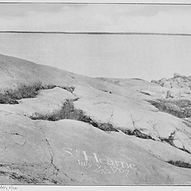
The editor of Samuel Hearne's book travels over the Northern Canadian wilderness 123 years later after Hearne and finds the population had changed from Chipewyans to Eskimos who were dependent entirely on the caribou for food and clothing.
Being possessed of much more than the average amount of ability and enthusiasm, he was chosen by Moses Norton, the energetic Governor of Fort Prince of Wales, to go out with the Indians into the vast, and as far as that was then known, limitless, territory west of Hudson Bay, in order to find and prospect the place where the native copper had been found which the Indians often brought with them to the fort.
During the year preceding his departure on his first expedition, he had had an excellent opportunity to perfect himself in a knowledge of astronomical and geodetic work, for in the summer of 1768 the annual ship had brought William Wales, F.R.S., and Joseph Dymond from London, commissioned by the Royal Society to remain at Fort Prince of Wales throughout the ensuing year in order to observe the transit of Venus over the sun on the 3rd of June 1769.[2] They remained at the fort until the ship left again for London in August of the following year (1769). Mr. Wales was one of the foremost astronomers, mathematicians, and litterateurs of his age. Shortly after his return to England he was appointed to accompany Captain Cook on his voyage around the world in the Resolution in 1772-74, and again on his last voyage in 1776-79. His presence for more than a year among the little band of white men assembled at this remote fur-trading post on Hudson Bay must have had a helpful influence in preparing Hearne for his great explorations overland to the Arctic Ocean. This book is an account of three journeys which he undertook in rapid succession into the country west of Hudson Bay and north-west of Fort Prince of Wales in search of the fabled bed of copper ore, from which pure copper could be loaded directly into ships at trifling expense. In the first and second journeys he was obliged to turn back before reaching his destination, but in the third journey all difficulties were finally overcome, and he was taken to and shown the "mine" of copper.
It has been my good fortune to travel over parts of the same country through which Hearne had journeyed one hundred and twenty-three years before me, and into which no white man had ventured during the intervening time. The conditions which I found were just such as he describes, except that the inhabitants had changed. The Chipewyan Indians, whom he found occupying advantageous positions everywhere as far as the north end of Dubawnt Lake, had disappeared, and in their places the country had been occupied by scattered bands and families of Eskimos, who had almost forgotten the ocean shores of the north, from which they had come. They were depending entirely, for food and clothing, on the caribou, which they killed on the banks of the inland streams and lakes. Traces of old Indian encampments were seen in a few of the scattered groves that are growing along the banks of Dubawnt and Kazan Rivers, but these camps had evidently not been occupied for many years.[3]
January 1, 1896
Food In Health and Disease - Functions of the Carbohydrates

The occurrence of this "amyloid substance" in the liver, even when a purely animal diet has been taken, he accounts for by the supposition that the liver is the organ in which the splitting-up of the albuminates into urea and a non-nitrogenous substance occurs, and that the latter is metamorphosed by the liver into "glycogen."
The class of carbohydrates have much in common with the fats. They serve the same purpose of checking albuminous waste ; like them, they are resolved by combustion within the body, ultimately, into carbonic acid and water, and so, like the fats, are capable of yielding heat and mechanical work. Unlike the fats and the albuminates, however, they do not appear to enter into the structure of the tissues, although they are found in some of the fluids and organs of the body.
All the carbohydrates are converted into glucose, or grape sugar (or maltose), before they are absorbed, and in this form they are much more readily metabolised than the fats or albuminates.
It is believed by many, and the weight of evidence, as will be seen, is in favour of the conclusion, that carbohydrates can be converted into fat within the organism. Bauer,* however, is indisposed to accept this view. Basing his opinions on the experiments of Pettenkofer and Voit, who showed that carbohydrates, even when administered in great excess, are almost completely destroyed within the body, he maintains that although the carbohydrates, when given together with albumen and fat, favour an increase of the constituents of the body, and especially of fat, yet it is not because they are themselves converted into fat, but because, owing to the facility with which they are metabolised, they protect the other food-stuffs from destruction.
"When fat and carbohydrates co-exist in the food, the latter are always the first to be consumed; and when they are present in sufficient amount, the consumption of fat in the body may be completely suspended." And he explains in a similar manner the fact that a deposit of fat may be observed to take place when the diet consists of albuminates and carbohydrates alone, without any fat; for in that case, he says, the fat, which "originates as a product of the splitting-up of albumen, is withdrawn from further metabolism in favour of the carbohydrates, and contributes to the gain." He also rejects the view that the ready decomposition of the carbohydrates in the body depends on their great affinity for oxygen; he considers it lies rather in the properties of the animal tissues, and he points out that the assumed equivalents of starch and fat, as 240 of the former to 100 of the latter, calculated on the quantity of oxygen required for their combustion, are incorrect; and that in the living organisms "175 parts of starch are in the material actions approximately equivalent to 100 of fat."
Germain Sée begins by supporting the view taken by Bauer, and asserts that the principal function of the carbohydrates is the immediate development of heat and mechanical work ; that they are not annexed in any way directly or indirectly to the organisms ; and that the fat that is deposited in consequence of their use is derived from the splitting-up of albuminates. He urges the experiments of Boussingault, who found that when he fed ducks on a pure carbohydrate like rice, they grew thin; but on adding a small quantity of butter, they grew fat. The same experimenter also asserted that milch-cows only gave out the quantity of fat in their milk that was contained in their food. Sée also points out that the particular kinds of grain selected for fattening animals are always such as contain, like maize, a considerable quantity of fat. But, notwithstanding all this, he appears in the end to yield to the weight of evidence that fat may be, under certain circumstances, formed from carbohydrates.
Dujardin-Beaumetz believes in the possibility of the transformation of glucose, the product of the digestion of carbohydrates, into fat. He sees a great analogy between the formula for glucose, C6H12O6, and that of glycerine, C3H8O3, and thinks that the latter may result from the splitting up of the former with the addition of hydrogen. He also shares, to a certain extent, Pavy's views, and considers that a portion of the glucose derived from the digestion of carbohydrates is deposited as " hepatic glycogen" in the liver, and thus furnishes the glucose necessary to the organism when the food does not contain any carbohydrates, Pavy maintains, as is well known, that saccharine matter, when absorbed, "on reaching the liver is transformed by that organ into amyloid sub- stance [glycogen], which is stored up in its cells for subsequent further change preliminary to being appropriated to the purposes of life." The occurrence of this "amyloid substance" in the liver, even when a purely animal diet has been taken, he accounts for by the supposition that the liver is the organ in which the splitting-up of the albuminates into urea and a non-nitrogenous substance occurs, and that the latter is metamorphosed by the liver into "glycogen." Pavy believes that carbohydrates are first converted into this "amyloid substance," and that this is afterwards converted into fat. But he points out what is doubtless a most important condition in the conversion of carbohydrates into fat, namely, "the co-operation of nitrogenous in conjunction with saline matter," for it is probably by the changes occurring during the metabolism of the albuminates that this transformation is excited. The presence of a small amount of fat with the carbohydrates would seem also to favour this conversion, for the rapid deposition of fat which sometimes occurs when animals are fed on such a mixture appears to be more than can be accounted for by the small quantities of fat ingested. Pavy dops not admit that any of the carbohydrates undergo direct oxidation in the system, or contribute strictly to force production.
January 1, 1896
J.H. Romig, M.D. Letterhead
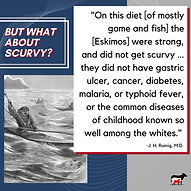
Dr Romig states that Alaskan natives on this [carnivore] diet the people were strong, and did not get scurvy ... the did not have gastric ulcer, cancer, diabetes, malaria, or typhoid fever, or the common diseases of childhood known so well among the whites.
It is written on a letterhead: “J. H. Romig, M.D., 115 East Columbia, Colorado Springs, Colo. ... 1948 ...” and signed, in ink, “J. H. Romig, M.D.” In the first part of this paper he speaks of himself in the third person:
“When Dr, J. H. Romig went to the Bering Sea region of Alaska, in the year 1896, he found the Eskimos living according to tradition, ideology, and diet, the same as they had lived for hundreds of years before.” He gives the general impression of average good health and considerable longevity. He describes their houses and housekeeping and tells that during winter most of the men spend much of their time at what whites have called club houses or bath houses, the native karrigi or kadjigi.
“The women brought the largest meal of the day to their husbands, fathers, and sons. The food was in a wooden dish ... mostly game and fish ... Dried smoked salmon was much used, and other dried fish. Seal and fish oil was much in demand and was a necessity; no one could be well without fats. Their food was cooked mostly by boiling, and was rather rare; they ate as well, especially in winter, raw frozen fish and raw meat. They kept some wild cranberries for the favored dish of akutok — made [of lean meat and] of seal or fish oil mixed with warm tallow, sprinkled with cranberries, stirred, and hardened with a little snow.
“On this diet the people were strong, and did not get scurvy ... the did not have gastric ulcer, cancer, diabetes, malaria, or typhoid fever, or the common diseases of childhood known so well among the whites. For the most part they were a happy, carefree people ...
“With the advent of gold discovery, government schools and missions, and the high price of furs, came a new era ... They were able to buy white men's food and clothing, neither of which fitted their real need. The children were sent to school and learned white man's ways ...
“These people have changed from the old way, to eating pancakes with syrup and canned goods from the store. The children have poor teeth now, as well as the older ones. They have white man's epidemics, and neither the home nor the food that once was good for them ...
“The Government is now doing much to cover up and ease these changes in native life ... It is with regret that we can see the slow passing of these once hardy people ...”
January 1, 1896
Arnaldo Cantani
Food in Health and Disease

Yeo Burney summarizes Cantani's Diet for Diabetes: He requires the adoption of this absolute meat and fat diet for three months — in very mild cases for two months, in very severe cases for six or nine months.
7. — Cantani's.
{This is a very exclusive diet.)
Sanctioned:
Meat and animal fats of all kinds (at all meals).
Fish of all kinds.
Lobsters.
Olive oil (instead of butter).
Eggs (in milder cases).
Substitute for bread: Pavy's almond cakes(only for convalescents who cannot entirely dispense with bread).
Pure Water.
Soda-water.
Persons habituated to the use of strong wines and spirits may add to the water 10 to 30 grammes of pure alcohol daily.
Red Wine.
Tea and coffee in small quantities.
Forbidden:
Liver.
Butter, as it contains traces of lactose.
Cheese.
Milk.
All farinaceous and saccharine foods absolutely.
All fruits.
All green vegetable and roots.
Lemonade.
Chocolate.
Rum, cognac.
Tea and coffee (in severe cases).
Cantani considers much salt injurious, as well as much pickled pork or salt fish.
He requires the adoption of this absolute meat and fat diet for three months — in very mild cases for two months, in very severe cases for six or nine months. If after two months the urine contains no sugar, he allows green vegetables ; after another month, cheese and old red wine ; and after another fortnight, almonds and nuts. A month or so after this he permits juicy fruits, not too sweet, as straw- berries, raspberries, peaches, apples, and sour oranges ; still later, plums, gooseberries, green beans and peas, tomatoes, melons, cucumbers, and gourds. After another fortnight, milk and fresh milk foods may be used. Finally, if after repeated examination no sugar be found in the urine, small quantities of farinaceous food may be cautiously permitted, but their use must be restricted for life. It is best to avoid altogether cane-sugar and sweets of all kinds.
Cantani urges the consumption of as much fat as possible, and especially of " pancreatic fat," as easy of digestion. It is prepared of pancreas, cut up into small pieces, well mixed with a certain quantity of melted bacon fat or lard, left to undergo an artificial digestion for about three hours, and finally lightly roasted before the fire. In mild cases he prescribes pure sugar-free cod-liver oil, in 20- to 100-gramme doses.
Ancient History
Germany
50000
B.C.E.
Palaeolithic and Mesolithic kill-butchering sites: the hard evidence
The upper paleolithic is characterized by advanced hunting of large animals with various weapons, and planning to maximize easy prey
Upper Palaeolithic and Mesolithic Hunting:
the archaeological record leaves us some direct evidence of man's hunting activities. At Meiendorf (Rust 1937) and Stellmoor (Rusf 1937), some bones of reindeer and birds still conserve weapon marks and a few pieces of silex have remained thrusted in mammalian bones; man kills reindeer with harpoons and sticks (fractured skulls), birds with bows and maybe slings. Three fractured skulls of red deer in Abri Pataud (Bouchud, 1975), and one bovid skull with a circular orifice in Saint Marcel (Allain, 1952) suggest the practice of the so called " co'up de merlin": man has delivered a blow similar to the one used today to butcher cattle. Probably the animal already immobilized (wounded or entrapped) was hit on the frontal with a big stone. At Kokorevo I (Siberia), a large scapula of bison is pierced by the upper end of a point made of bone (Boriskowksi, 1965). At High Furlong (Mesolithic), an elk was discovered with the marks of L7 wounds made by barbed points, of which two were found in the site, and by other arms. The animal had apparently been attacked at two distinct occasions: during the first one, hunters aimed at the legs to lame the animal (fig. 6), later hunters hit the thoracic region and the lungs to kill it. However the elk died in a little lake, perhaps imprisoned in the ice, and man had no access to the meat. The animal represents in fact a hunting loss (Hallam et a1.,1973).
Planning: very good. Many sites belong to Wpe e, were occupied periodically or seasonally and specialised in the capture of a particular game (e.g., horse, reindeeq, ibex). Game drive towards cliffs have been claimed and Solutre (Combier & Thevenot,1976) has long figured as an example, but the evidence is far from conclusive.
Scavenging: no doubt H. sapiens still killed or exploited animals in the occasional and opportunistic way of Lower Palaeolithic times. According to Lindner (Lindner,1941), hunters at Predmost utilised the carcasses of hundreds of mammoths that probably succumbed as a result of natural catastrophes, as food.
Food transport: selective transport of the most useful animal parts is claimed for many sites.
Specialised activities: sometimes the material is dislocated in distinct clusters that could reflect specialised activity areas as for example at Solutre (Combier & Thevenot, 1976). Site topography: some hunting sites were located in valleys enclosed by steep slopes as at Rascano (Gonziilez-Echegaray, 1979), Stellmoor (Rust, 1937), Meiendorf (Rust 1937), or at the foot of rocky cliffs at Solutr6 (Combier & Th6venot, 1,976).
4. Conclusions
Most of the Lower Palaeolithic sites analysed here belong to category a (butchering sites); other kind of concentrations are rare and difficult to ascertain. A number of hunting stations (category e) and a hunting stop (category f) form my sample for the age of Neanderthal man and related people. The Upper Palaeolithic is characterised by many hunting stations, while in Mesolithic times a hunting loss (category d ) was found as well as several sighting sites (category g). The foregoing distribution seems to reflect in a vague way an evolution from scavenging and haphazard opportunistic hunting to well organised, selective hunting activities. However, this reflection results no doubt in part from a priori assumptions concerning the evolution of hominid meat procurement often colouring the interpretations offered for the osseous "hard" data; these are frequently equivocal.
Vindija, 42000, Varaždin, Croatia
28500
B.C.E.
Neanderthal diet at Vindija and Neanderthal predation: The evidence from stable isotopes
The isotope evidence overwhelmingly points to the Neanderthals behaving as top-level carnivores, obtaining almost all of their dietary protein from animal sources
Archeological analysis of faunal remains and of lithic and bone tools has suggested that hunting of medium to large mammals was a major element of Neanderthal subsistence. Plant foods are almost invisible in the archeological record, and it is impossible to estimate accurately their dietary importance. However, stable isotope (13C and 15N) analysis of mammal bone collagen provides a direct measure of diet and has been applied to two Neanderthals and various faunal species from Vindija Cave, Croatia. The isotope evidence overwhelmingly points to the Neanderthals behaving as top-level carnivores, obtaining almost all of their dietary protein from animal sources. Earlier Neanderthals in France and Belgium have yielded similar results, and a pattern of European Neander- thal adaptation as carnivores is emerging. These data reinforce current taphonomic assessments of associated faunal elements and make it unlikely that the Neanderthals were acquiring animal protein principally through scavenging. Instead, these findings portray them as effective predators.
Stable Isotope Analyses.
Mammal bone collagen δ13C and δ15N values reflect the δ13C and δ15N values of dietary protein (14). They furnish a long-term record of diet, giving the average δ13C and δ15N values of all of the protein consumed over the last years of the measured individual's life. δ13C values can be used to discriminate between terrestrial and marine dietary protein in humans and other mammals (15, 16). In addition, because of the canopy effect, species that live in forest environments can have δ13C values that are more negative than species that live in open environments (17). δ15N values are, on average, 2–4‰ higher than the average δ15N value of the protein consumed (18). Therefore, δ15N values can be used to determine the trophic level of the protein consumed. By measuring the δ13C and δ15N values of various fauna in a paleo-ecosystem, it is possible to reconstruct the trophic level relationships within that ecosystem. Therefore, by comparing the δ13C and δ15N values of omnivores such as hominids with the values of herbivores and carnivores from the same ecosystem, it is possible to determine whether those omnivores were obtaining dietary protein from plant or animal sources.
Cheddar Reservoir, Cheddar BS26, UK
12000
B.C.E.
FOCUS: Gough’s Cave and Sun Hole Cave Human Stable Isotope Values Indicate a High Animal Protein Diet in the British Upper Palaeolithic
We were testing the hypothesis that these humans had a mainly hunting economy, and therefore a diet high in animal protein. We found this to be the case, and by comparing the human δ15N values with those of contemporary fauna, we conclude that the protein sources in human diets at these sites came mainly from herbivores such as Bos sp. and Cervus elaphus
We undertook stable isotope analysis of Upper Palaeolithic humans and fauna from the sites of Gough's Cave and Sun Hole Cave, Somerset, U.K., for palaeodietary reconstruction. We were testing the hypothesis that these humans had a mainly hunting economy, and therefore a diet high in animal protein. We found this to be the case, and by comparing the human δ15N values with those of contemporary fauna, we conclude that the protein sources in human diets at these sites came mainly from herbivores such as Bos sp. and Cervus elaphus. There are a large number ofEquus sp. faunal remains from this site, but this species was not a significant food resource in the diets of these Upper Palaeolithic humans.
If the humans hunted and consumed mainly horse, then their 15N values should be c. 3–5‰ (Equus 15N value of 0·7‰+enrichment of 2–4‰). Instead, their 15N values make more sense if they lived mostly off Bos and Cervus elaphus (Bos and Cervus values of c. 3‰+enrichment of 2–4‰=the observed values c. 6–7‰). It is also possible that other species, including Rangifer tarandus, were consumed by these individuals. Rangifer tarandus has 15N values similar to Cervus elaphus (Richards, 1998), and has more positive 13C values, which may explain the observed slight enrichment in the human 13C values. A number of artefacts made from Rangifer tarandus have been found at Gough’s, but there is no other evidence that this species was being exploited for food
Province of Crotone, Italy
500
B.C.E.
On the Sociology of Ancient Sport
One report states that a trainer named Pythagoras recommended a meat diet to the Olympic athletes he trained.
A lack of animal-derived protein seems to have been rectified early in history, as there are two reports of the introduction of meat into the athletes’ diet. One report states that a trainer named Pythagoras recommended a meat diet to the athletes he trained. https://www.omicsonline.org/open-access/a-comparison-of-ancient-greek-and-roman-sports-diets-with-modern-day-practices-2473-6449-1000104.php?aid=69865
8 He [Pythagoras] is said to have been the first to train athletes on a meat diet. The first athlete he did this with was Eurymenes. Formerly they had trained on dried figs, moist cheese, and wheat. Some say that it was a trainer named Pythagoras and not the philosopher who was responsible for this innovative diet. For our Pythagoras prohibited killing, not to mention eating, life which possessed souls like our own.
Diogenes Laertius, Lives of the Philosophers 8.12
Sport and Recreation
To all appearances medical knowledge in general and nutrition in particular was widespread in Pythagorean circles in Southern Italy, especially in Kroton. Burkert has pointed out that the fmaous doctor Alcmaeon came from the Pythagorean center of Kroton. From the akousmata (secret doctrines), which doubtless contain old religious traditions, we learn that the Pythagoreans were not originally strict vegetarians; the consumption of meat was permitted, with the exception of lamb and the meat of draft oxen. Burkert considers there is some likelihood that Pythagoras introduced a meat diet for athletes. He believes this tradition arose when Pythagorean vegetarianism had not yet been completely developed. In later times, when vegetarianism had prevailed, a second tradition has possibly been invented, in which it was not Pythagoras, the philosopher from Samos and Kroton, but a homonymous person who wrot the great 'trainer's recipe book'.
57: There are similar issues regarding the transmission in later sources of Pythagoras advising the successful heavy athlete Eurymenes of Samos to use a special meat-based diet instead of the dried figs and cheese he had previously been eating.
On the Sociology of Ancient Sport - page 43.
Mantineia 221 00, Greece
480
B.C.E.
A Comparison of Ancient Greek and Roman Sports Diets with Modern Day Practices
Dromeus, a long-distance runner, is said to have first thought of eating meat for training instead of just cheese and won multiple victories.
The second report is that of Pausanias, who writes of Dromeus, a long-distance runner from Stymphalos [23].
“...he won two victories in the dolichos at Olympia, the same number in the Pythian Games, three at the Isthmian and five at the Nemean. He is said to have first thought of eating meat (as part of his training diet). Until then the food for athletes was cheese fresh out of the basket.”
Clearly, if his success is anything to go by, then Dromeus had really found a winner’s diet. There are also reports of athletes eating meat from oxen, bulls, goats and deer, a very” red-meat” diet which is a rich form of protein. Moreover, with meat as a part of their diet, the performance of competing athletes would most certainly have improved noticeably.
5 A man named Dromeus from Mantineia was said to have been the first we know of to have won the pankration by default [ = akoniti]. Pausanias 6.11.4
Dromeus, Long-Distance Runner
There was a man from Stymphalos, named Dromeus, whose record as a long-distance runner was exceptional: he won two victories in the dolichos at Olympia, the same number in the Pythian Games, three at the Isthmian and five at the Nemean. He is said to have first thought of eating meat (as part of his training diet). Until then the food for athletes was cheese fresh out of the basket.


