


Recent History
June 6, 1915
The Northern Copper Inuit - A History

Kuptana describes the ancient practices of catching hundreds of fish using stone weirs in the summer.
Summer Fishing
William Kuptana. During the summer, the Copper Inuit would pile up stone corrals in the shallow streams to trap the fish. When the fish swam through to the corrals, the Inuit would block the entrance to prevent the fish from escaping. The take from the corral would total a few hundred fish. The various ways they'd prepare the fish is by drying and then smoking to preserve it over the winter months. The remainder of the catch was then buried with stone caches that were built so other predators could not help themselves to the fish.
June 23, 1915
The Northern Copper Inuit - A History

Jenness describes the hunting and fishing habits of the Northern Copper Inuit and was impressed by their ability to endure long walks without food in the hunt for caribou. The effect of the white men's economic habits start to make the Eskimos dependent upon civilization for survival, while making famines less likely.
Jenness did not make it to Prince Albert Sound But he had satisfied his curiosity that the Prince Albert people were as to language and culture very similar to The Copper Inuit of Dolphin and Union Strait. Toward the end of the summer Jenness and his adopted family made the slow migration back to the southern coast fishing and hunting caribou along the way. At that time of year food shortages were common and the Inuit would go for days without sighting caribou or catching fish. Jenness was impressed by the endurance and patience of his traveling companions the experience [of starvation] was no novelty in their lives they merely tighten their belts trudge steadily forward a dozen or 15 miles and said smiling smiling lately if we sight no Caribou today we will tomorrow or if not tomorrow certainly the day after (Jenness 1928:219).
After his extended research visit to the land of the copper Inuit, Jenness wrote two definitive books about the people with whom he lived and traveled: The Life of the Copper Eskimo(1922) and The People of the Twilight(1928). Stefannson, working to the north, and Jenness, to the South, documented well the traditional culture of the Copper Inuit. The scholarship was completed just in time, for the isolation of the Copper Inuit was soon shattered permanently by the activities of traitors, missionaries, and other representatives of southern culture. As Jenness wrote years later in his epilogue to The People of the Twilight:
Even as we sailed away traders enter.e their country seeking fox-furs; and for those pelts so useless for real clothing they offered rifles, shot-guns, steel tools, and other Goods that promise to make life easier so the Eskimos abandoned their communal seal hunts and scattered and isolated families along the coast in order to trap white foxes during the winter when the fur of that animal reaches its prime. Their dispersal loosened the old communal ties that had held the families together. The men no longer labored for the entire group, but hunted and trapped each one for his family alone... The commercial world of the white man had caught the Eskimos and its mesh destroying their self-sufficiency and independence, and made them economically its slaves. Only in one respect did it benefit them: it lessened the danger of those unpredictable famines which had overtaken them every 10 or 15 years, bringing suffering and death to young and old without distinction (Jenness 1928:240).
August 1, 1915
Total dietary regulation in the treatment of diabetes

The first of a case series of diabetes treatment is described by Dr Allen, where a 28 year old female was addicted to candy and tried both a vegetarian and an all-meat diet before turning into a Christian Scientist and eventually cheating on her fasting and dieting.
CASE NO . 1 . Female, unmarried, age 28 yrs. American; no occupation . Admitted Feb. 24 , 1914 . Family History . — Grandparents lived to healthy old age. Father living , aged 58 , has arterial hypertension , neuralgia , and tendency to melancholia. Mother died at birth of this patient . An uncle died of tuberculosis . One full brother of patient died at 16 of appendicitis . One half-sister aged 22 has nephritis , consequent upon scarlatina .
Past History . — No childhood diseases except measles and one dysenteric attack . Normal menstruation began at 13. Patient graduated from university at 20. She has had a nervous, overactive life with late hours and irregular eating. Was considered remarkable among her family and friends for the amount of candy and sweets she consumed. Normal weight 115 to 120 pounds. July, 1912, patient's fiancé died of accidental poisoning . Patient became melancholic and kept more to herself , while eating still more candy than usual. She and her parents were inclined to attribute onset of diabetes to grief.
Present Illness . - In Jan. , 1913 , abnormal thirst was first noted . In Mar. , pruritus vulvæ . In May , menstruation stopped and remained absent. Hair fell out and is still thin . July , 1913 , diagnosis of diabetes was made and routine diet prescribed, which was taken in huge quantities owing to polyphagia . Symptoms persisted and increased till Jan. 4 , 1914 , when she began treatment at a well known diabetic sanitarium . Qualitative and quantitative restriction of the diet, oat cures, vegetable days , etc. , failed to clear up the condition . She was then transferred to this hospital , and arrived tired but not dangerously exhausted after a journey of 32 hours .
Physical Examination . - Height 165.6 cm . Weight 40.1 kg . Marked emacia tion , face flushed and slightly puffy , drowsy and slightly alcoholic expression . No enlargement of tonsils or lymph glands . Blood pressure 103 systolic , 80 diastolic . Examination otherwise negative .
Treatment . This was the first patient for the proposed treatment , and she was closer to coma than was desired for a first trial . Accordingly the attempt was made to be conservative . She was put to bed and a light supper ordered of two eggs , a slice of toast , and a cup of milk - cocoa . Breakfast the next morning in . cluded oatmeal ; the rest of the diet was light and included vegetables and potato in limited quantities . Notice should be taken that the blank food space in the graphic chart for Feb. 24 to 25 does not represent fasting , but exact reckoning of the diet was impossible because cooking and other arrangements were not in readiness . At the same time liquids were forced to 6 or 7 liters per day , and alkali was given as stated under acidosis below. As coma was imminent , there was no choice but to take the chance of beginning the proposed treatment. Therefore Feb. 27 was a vegetable day with 45 gm . carbohydrate and 530 calories . Feb. 28 was a fast-day with nothing but 200 calories of whisky. Marked improvement was evident in the urine, which became alkaline , but there was a large bicarbonate edema as illustrated by the weight curve , and weakness and drowsiness continued . Then , in order to guard against any supposed dangers of fasting , 20 gm . oatmeal were permitted on Mar. 1 , increased to 52.5 gm . on Mar. 2. By this time glycosuria and coma symptoms were entirely cleared up , and alkali was diminished . On Mar. 3 the diet consisted of soy beans and green vegetables . On Mar. 4 the diet was greatly reduced , consisting only of 90 gm . banana , 20 gm . oat meal , 10 gm . potato , and 10 gm . cream . The patient was extremely weak , therefore the attempt was made to build her up by a routine diabetic diet , in the hope that she might be strengthened for later undernutrition treatment . No gain of weight or strength was achieved , but glycosuria returned and the persisting acido sis was greatly increased , as shown in the graphic record . It was again reduced by undernutrition , and brought to a minimum by a fast - day on Mar. 23. A carbohydrate period was then instituted to clear up the tendency to acidosis if possible , and the opportunity was taken to compare the assimilation of oatmeal and pure starch . On Mar. 24 , 40 gm . Kahlbaum's soluble starch were the only nourishment given , and 80 gm . on each of the succeeding days , in ten doses of 8 gm . each . On Mar. 29 a change was made to oatmeal , reducing the quantity of carbohydrate slightly as an allowance for the oat protein . Nevertheless a glycosuria of 1.39 gm . appeared on Mar. 31 , proving the absence of any superiority of assimilation of the oatmeal over the soluble starch . The resulting traces of glycosuria were cleared up by a fast-day on Apr. 1. Acidosis now being entirely absent , another attempt was made to overcome the persistent weakness by as high a diet as possible without glycosuria. Though the attempt was made to balance protein, fat, and carbohydrate to this end, the graphic record shows that acidosis returned promptly, and glycosuria resulted on Apr. 12. This was cleared up by a fast-day on Apr. 14. The attempt was then made to build up strength by still higher diet and to diminish acidosis by increasing carbohydrate, even at the cost of glycosuria , with the idea that glycosuria could later be checked by brief fasting. Acidosis was not controlled , and weight and strength were not gained , and on Apr. 25 this attempt was abandoned . From this date to May 1 , pure protein-fat diet was attempted , but both glycosuria and acidosis were present . At this time a more rigid program of undernutrition was begun . It will be seen that the calories during May averaged less than 1000 daily , a maximum of carbohydrate was introduced , and frequent fast-days were employed . The weight diminished very slightly . The complaints of weakness were about the same .
Most of this period from May 1 to the end of July was vegetarian , chiefly nuts and green vegetables , of which the patient was fond. On June 30 an enormous fat intake was permitted experimentally , as mentioned under acidosis . No special virtue of the vegetarian régime was perceptible . Glycosuria and acidosis were practically absent during the undernutrition of the month of May ; both returned with the higher caloric diet of June and July . This period was terminated because of the increasing weakness of the patient , due particularly to the low protein. In the period July 10 to 14 a test was made with raw pancreas feeding as described in Chapter IV .
Most of the month of Aug. was occupied with pure protein-fat diet of between 1000 and 1100 calories , and about 30 gm. protein . The patient was relieved of the fast-days , of which she had been complaining bitterly. Glycosuria was mostly absent , but acidosis was persistent . In Sept. the calories were increased , partly by use of alcohol , and a few fast-days mitigated by vegetables or alcohol were employed . Weight and strength were not thereby improved , and both glycosuria and acidosis were troublesome . Oct. was a period of marked undernutrition , the calories being mostly about 900 daily , carbohydrate-free , except for two tests in which respectively 60 and 58.8 gm.carbohydrate resulted in glycosuria , when added to this caloric intake . In Nov. and Dec. the carbohydrate-free diet was pushed to the upper limit of tolerance , so that traces of glycosuria and ketonuria kept recurring and were checked by occasional fast - days . The attempt thus to build up weight and strength failed as usual. The patient was dismissed on Feb. 26. Each day the patient took 2.4 gm . potassium citrate , small quantities of light magnesia , and calcium carbonate in quantities equal to the so dium bicarbonate . It was thus hoped to provide a balance of salts , and perhaps also to neutralize some acid with a non - irritating substance such as chalk . The sodium bicarbonate dosage was as follows : Feb. 25 , 20 gm .; Feb. 26 , 32 gm .; Feb. 27 , 72 gm .; Feb. 28 , 48 gm .; Mar. 1 to 7 , 40 gm . daily ; Mar. 8 to 20 , 20 gm . daily. All alkali was stopped at this time . No effect upon the carbohydrate tolerance was evident . As mentioned, acidosis was brought under control by the initial undernutri tion period. With the high diets ( Mar. 10 to 15 ) it returned very markedly , the ammonia nitrogen rising slightly above 1 gm. notwithstanding the alkali dosage , and the ketonuria reaching 28.7 gm . ( as B - oxybutyric ) on Mar. 15. With a single fast - day ( Mar. 16 ) the ammonia nitrogen fell to 0.63 gm . and the acetone bodies to 9.57 gm . With reduced diet the acidosis diminished further , and was entirely abolished by the carbohydrate period , Mar. 24 to 31 , the ammonia and acetone figures falling to normal , and the ferric chloride reaction turning entirely negative . Milder acidosis returned with the beginning of mixed diet after Apr. 2 , and it was proved that carbohydrate , even to the point of causing glycosuria , could not keep acidosis absent . Especially in the period Apr. 19 to 24 the carbohydrate was gradually increased to 90 gm . , with a total diet as high as 2800 calories ( over 75 calories per kg . on 37 kg . weight ) . The highest glycosuria resulting was 7.26 gm . on Apr. 24. This program was adopted on the principle frequently stated in the literature , that 90 gm . carbohydrate intake is worth a glycosuria of 7 gm . The attempt was to build up weight and strength with the high diet , while keep ing acidosis in check by a favorable carbohydrate balance. Acidosis , however , remained present as stated , and the peculiar weakness and malaise characteristic of severely diabetic patients with even moderate acidosis persisted likewise . Carbohydrate had to be discontinued in order to check the steady increase of gly cosuria . Thus the diets of Apr. 29 to 30 consisted of 61 gm . protein and 200 gm . fat . Both protein and fat were then diminished , until on May 1 the diet was 53 gm . protein and 177 gm . fat . This would correspond to an orthodox diabetic diet of about 1.5 gm . protein and 37 calories per kg . Nevertheless slight glycosuria and heavy ferric chloride reactions persisted , and the ammonia nitrogen by May 1 was up to 1.2 gm . May 2 was a fast - day with 34 gm . butter , this quantity of fat being almost negligible for either good or ill . The glycosuria ceased before the close of the 24 hours , the ferric chloride reaction diminished to a trace , and the ammonia nitrogen fell to 0.6 gm . Thus 1 day of undernutrition accomplished what had been impossible on full diets either rich or poor in carbohydrate .
For the next 3 months a vegetarian régime was tried , as described under " . weight and nutrition ” below . Because of the low protein and fat , a relatively high car bohydrate tolerance was exhibited , which was also assisted by the very frequent fast - days . In this way both glycosuria and acidosis were almost continuously absent for a month . The hope of a gain in tolerance was disappointed , however , as demonstrated by the prompt return of both glycosuria and ketonuria when a moderate increase of diet was attempted in June and July . On June 30 an enormous fat intake was allowed experimentally for a single day , followed by a series of lower diets , as shown in Table II .
The relation between combustion of food fat and body fat is here illustrated . The huge ration of June 30 did not produce any explosive increase of acidosis . The acetone bodies showed a rise on the same day , but a more marked one the follow ing day , while the ammonia nitrogen did not reach its summit until July 3. It is evident that what happened was not the conversion of any large proportion of the fat on June 30 into acetone bodies , but rather an injury of fat assimilation pro duced by this excess and continued by reason of the fat rations ( lower but still excessive ) of July 1 to 3. On the fast - day of July 5 , storage or depot fat was necessarily burned , yet the ammonia nitrogen was approximately the same as on June 30. On July 6 , with a limited fat intake , the effect of carbohydrate was evident in producing a lower ammonia nitrogen excretion than on the fast - day . The entire observation is against the idea of a difference between food fat and body fat in combustion , and indicates rather an overtaxing of fat metabolism by excessive intake and improvement of assimilation by relief from the strain . On the carbohydrate - free diet beginning in Aug. , strong ferric chloride reactions and unduly high ammonia excretion were the rule . Temporary control of both glycosuria and acidosis was achieved with the low diets ( about 900 calories ) in early Oct. Thereafter it will be noted that the ferric chloride reactions were some times negative and never more than slight , even on carbohydrate - free diet , the gen eral diabetic condition being now under better control . The continuance of slight acidosis , however , throughout so much of the period of treatment represents one of the serious mistakes in the management of this case .
Weight and Nutrition . - Weight at admission 40.1 kg . , at discharge 35.2 kg .; i.e. , a loss of 4.9 kg . The initial gain in weight , up to 43.5 kg . on Feb. 28 , repre sented a marked bicarbonate edema , simultaneous with the turning alkaline of the urine . Slighter edema was present on certain occasions later , notably Aug. 15 and Nov. 7 , being due apparently to sodium chloride and removed by diminish ing the salt intake.
On Mar. 21 the large fluid intake began to be restricted . The patient had been accustomed to large quantities of water for some months past and com plained of thirst when the allowance was diminished by order ; within a few days this complaint disappeared and the thirst remained normal thereafter.
Vegetarian diet was tried for a period of nearly 3 months, chiefly because of the claims in some quarters concerning differences in the glycosuric effect of different proteins , and the bare possibility that meat protein might at least stimulate a greater flow of gastric juice and correspondingly of pancreatic juice , and thus perhaps depress the internal function of the pancreas by stimulating its external function . Undernutrition was employed at the same time to create the most favorable conditions, and acidosis was kept absent by such quantities of carbohydrate as seemed within the tolerance. Butter was regularly allowed , eggs rather frequently , and a little bacon and bacon fat sometimes, but for much of the time the ration was vegetarian in the strictest sense , composed entirely of vegetables , fruits , nuts , soy beans , and occasional gluten preparations . There was no gain of tolerance , and no advantages of a vegetarian diet or evidence of specific differences between proteins were observed.
Neither food nor feces was analyzed. The former was calculated as usual from the Atwater - Benedict tables. On this basis the following reckoning can be made for the period from Mar. 16 to Nov. 30 , for which the records of both food and urine are complete. Also, the total period of 260 days is divisible into two nearly equal portions , namely , 136 days up to July 31 , during which the diet was largely and sometimes wholly vegetarian and contained considerable carbohydrate , and 124 days after July 31 , in which the protein was of animal origin and the diet was almost continuously carbohydrate-free . The results for the various periods may be compared as shown in Table III.
The patient lost 5 kg . weight in 9 months . If it be assumed that 90 per cent of a weight change is ascribable to fat , in this instance the loss of nitrogenous " tissue ” would not exceed 500 gm . Using Voit's figure of 3.4 per cent N , the possible loss of body nitrogen would then be 17 gm . If it be urged that in an emaciated person the wasting of “ tissue ” in proportion to fat is higher , the above comparison of intake and output shows that the patient must have been nearly in equilibrium . At worst , the nitrogen deficit must have been small , and it may be assumed that the diet fulfilled the purpose of protecting body protein from any extreme loss while maintaining prolonged undernutrition .
Two deductions seem justified.
( 1 ) Digestion and absorption of protein were , as would be expected , distinctly better during the " animal ” period , but the utilization of vegetable proteins , including the times when the diet was exclu sively vegetable , was reasonably satisfactory .
( 2 ) Though the nitrogen intake was lower in the " vegetable ” period , it must be called low also in the “ animal ” period , and it is evident that there is no serious obstacle to maintaining equilib rium on strict carbohydrate - free diet with a low protein ration . It is to be borne in mind that the energy intake is a question not of food ingested but of food ab sorbed . If it be permissible to assume that the same proportion of total calories as of nitrogen was lost in the feces , viz . 11.29 per cent , subtraction of this num ber from the 33 calories ingested daily would leave an average of between 29 and 30 calories absorbed daily per kg . of body weight . Accordingly , it would appear that this patient lived for 260 days on an average of 0.173 gm . N and 30 calories Work and exposure to cold were both far less than in ordinary individuals . On the other hand , the rather tall , very emaciated figure presented a dispropor tionate surface . Losses in sugar and acetone bodies were slight . On the whole , the figures obtained correspond satisfactorily to the known laws of metabolism in normal persons .
Subsequent History . - On Jan. 14 , 1915 , the patient reported by telephone that she was feeling well and had cleared up occasional traces of glycosuria by fast days . On Jan. 20 she reported increasing difficulty in remaining sugar - free , and was instructed to return to the hospital if difficulty continued . Nothing more was heard until Apr. 1 , when a letter stated that she had returned to her home in Indiana . On Apr. 26 a response to a letter of inquiry showed that the cause of her silence and removal was her adoption of Christian Science. Occasional later reports showed that she was eating everything at will , including much candy, and gradually losing strength . Death occurred from simple weakness the first of Oct. 1915 , the terminal collapse being brought on by taking a dose of Epsom salts .
Remarks . The patient , when received , was undoubtedly close to coma . She appeared then as having diabetes of extreme severity . The results obtained seemed highly favorable . In the light of later experience this treatment was per kg . very bad .
Part of the fault lay with the patient , who had always eaten injudiciously and was the most unruly of the entire series for dietary control . The high diets , the persistence of glycosuria and ketonuria through considerable periods , and the changes in program from time to time were in some measure forced by the necessity of appeasing the patient's demands and meeting her psychic needs . She insisted not only upon nourishment but also taste and satiety , and slight privations brought on hysterical tears and melancholy which seemed serious as a possible influence upon the diabetes , though , as a matter of fact , no particular influence of psychic upsets upon the food tolerance was observed . She was given unusual leeway as being the first patient . The cause of the final disaster was also instructive . It is noteworthy that although a very careful limitation of diet both quantitatively and qualitatively had resulted in threatened coma at the time of admission , subsequently on absolutely unrestricted diet no symptoms of acidosis were described , evidently because the patient lived so largely on carbohydrate , and the polyuria aided in the elimination of acetone bodies . Although the patient was young and the kind that typically dies in coma , death occurred from simple wasting and asthenia . The chief difficulty consisted in inexperience with the treatment . The cautious manner of beginning treatment , and the partial , irregular , and inadequate character of the measures employed belonged to this stage of uncertainty and orientation . It showed the viciousness of some of the accepted methods in the management of diabetes . The same patient admitted at a later time could have been treated far better ; and the case , though severe , was mild in comparison with some of the later ones . A bold initial fast , followed by testing of the tolerance for different classes of food and arrangement of a diet accordingly , would have brought far quicker and better results .
The actual accomplishment was that the patient was kept alive in the hospital from Feb. 24 to Dec. 20, with a loss of 5 kg. ( one-eighth of her weight at entrance ), and about a corresponding diminution of strength. Glycosuria and acidosis were kept entirely absent at certain times , and were controlled within small quantities at all times. Actual food tolerance was slightly less at the end than in the earlier part of treatment, and the progress was slowly but distinctly downward. The bungling and inadequate treatment furnished abundant reason for this slight downward progress in 10 months, and no “spontaneous” cause need be assumed. Methods and results of this sort have been common with a large proportion of practitioners who have undertaken to apply the fasting therapy. The record of this patient stands as a useful example of how a case should not be treated.
June 24, 1916
Studies on Cholesterol
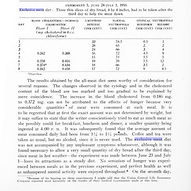
The exclusive meat diet was not accompanied by any unpleasant symptoms whatsoever. No sensation of hunger was experienced between meals as in the previous experiment, and perfect health as well as unhampered mental activity were enjoyed throughout.
The slight initial increase observed in the blood cholesterol may have been due to the rather severe nature of the diet to which the body had to become accustomed. On the first day the writer was chronically hungry and had a severe headache in consequence, but during the two following days she felt perfectly well and comfortable. It is a well-known fact that fasting is always accompanied by an increase of the blood cholesterol (Rothschild).** ‘The changes found in the cytology of the blood were still very slight, but the drop of the blood cholesterol to 0.186 mg. and the accompanying increase of lymphocytes and decrease of neutrophils is interesting when compared with the results of the subsequent experiments. The results obtained by the all-meat diet seem worthy of consideration for several reasons. The changes observed in the cytology and in the cholesterol content of the blood are too marked and too gradual to be explained by mere coincidence. The increase in the blood cholesterol from 0.186 mg. to 0.372 mg. can not be attributed to the effects of hunger because very considerable quantities of meat were consumed at each meal.
It is to be regretted that at first the exact amount was not determined by weight, but it may suffice to state that the writer conscientiously tried to eat as much meat as she possibly could for breakfast, luncheon and dinner, a smaller quantity being ingested at 4:00 p.m. It was subsequently found that the average amount of meat consumed daily had been from 1.25 to 1.5 pounds. Coffee and tea were taken as usual, but no alcohol, since it is never used. The exclusive meat diet was not accompanied by any unpleasant symptoms whatsoever, although it was found necessary to allow a very small quantity of dry bread after the third day, since meat in hot weather—the experiment was made between June 23 and July 1—loses its attractions as a steady diet. No sensation of hunger was experienced between meals as in the previous experiment, and perfect health as well as unhampered mental activity were enjoyed throughout.*.
On the seventh day, at the beginning of which the highest cholesterol value was registered, there was a slight attack of diarrhea. On the following day peristalsis was normal again, but the blood cholesterol had dropped to 0.342 per cent of cholesterol by the feces is one of the means by which the cholesterol balance is preserved (McNee), it seems logical increased peristalsis in order to maintain its equilibrium of health. regulation of the cholesterol balance was observed also more fully Since the elimination » assume that the body resorted to The fact that the same automatic regulation of the cholesterol balance was observed also in a later experiment would seem to support this view, and will be discussed in connection with Experiment 7. The gradual but steady drop in the lymphoid defense from 33 to 17 percent, the parallel increase of the polymorphoneutrophils from 46 to 72 per cent, and the unusual number of atypical neutrophils—9 percent ringforms, 12 per cent bizarre--which appeared in the blood as the cholesterol percentage reached its highest values, suggest a very definite relation between the chemical composition and the cytology of the blood, while the changes observed in both appear to be closely associated with the chemical nature closely associated the food consumed. The same observations could be made in every one of my experiments.
The cytologic changes found in the blood during the exclusive meat diet are moreover in perfect accordance with Gruner’s findings, which they corroborate. The two points on which he lays particular stress regarding the similarity between excessive meat consumption and in carcinoma the blood picture during atypical neutrophils inbetween reduction of the lymphocytes and the appearance of markedly increased numbers—seem to be borne out also by the following observations _______
The results obtained by the vegetable and fruit diet present a contrast as well as a complement to those of the exclusive meat diet. Whereas the blood cholesterol slowly but steadily decreased from 0.342 mg. to 0.202 mg. on the fifth day and finally seemed to settle down to a new standard, 0.242 mg., which was found on three consecutive days, the lymphoid defense increased from 17 per cent to 33 per cent, with a parallel drop in the neutrophils and a marked reduction of the number of atypical cells. In order to give the body sufficient time to swing back to normal values, and because of the tendency to collapse shown by the cubital veins, described above, eleven days were allowed to elapse before another blood test was made. During this interval the usual mixed diet was used again. The following values were found at its close: _______
Apart from the very slight increase in the neutrophil count, the normal stand ard had been reached again. ‘The difference between the original cholesterol standard, 0.272 mg., and the last reading, 0.266 mg., i. e., 0.006 mg., can hardly be considered significant. The intimate relation between the chemistry and the cytology of the blood and the diet, previously observed, seems to be confirmed by this experiment.
August 6, 1916
Elliott P. Joslin
The Treatment of Diabetes Mellitus

Dr Joslin uses fasting and a low carb diet to treat diabetes.
"Alternate feeding and fasting are adopted when it is found that the glycosuria persists after a preliminary four days' fast. The method which I have found most successful has been to allow, following the first fasting period, 20 to 40 grams carbohydrate not far from half a gram per kilogram body weight-and about one gram of protein per kilogram for two days.This can be avoided by still further restricting the carbohydrate, either temporarily or permanently. It is always necessary to bear in mind that one food which the diabetic patient cannot do without is protein, and to it everything else must be subservient. While testing the protein tolerance, a small quantity of fat is included in the eggs and meat given."
Ancient History
Germany
50000
B.C.E.
Palaeolithic and Mesolithic kill-butchering sites: the hard evidence
The upper paleolithic is characterized by advanced hunting of large animals with various weapons, and planning to maximize easy prey
Upper Palaeolithic and Mesolithic Hunting:
the archaeological record leaves us some direct evidence of man's hunting activities. At Meiendorf (Rust 1937) and Stellmoor (Rusf 1937), some bones of reindeer and birds still conserve weapon marks and a few pieces of silex have remained thrusted in mammalian bones; man kills reindeer with harpoons and sticks (fractured skulls), birds with bows and maybe slings. Three fractured skulls of red deer in Abri Pataud (Bouchud, 1975), and one bovid skull with a circular orifice in Saint Marcel (Allain, 1952) suggest the practice of the so called " co'up de merlin": man has delivered a blow similar to the one used today to butcher cattle. Probably the animal already immobilized (wounded or entrapped) was hit on the frontal with a big stone. At Kokorevo I (Siberia), a large scapula of bison is pierced by the upper end of a point made of bone (Boriskowksi, 1965). At High Furlong (Mesolithic), an elk was discovered with the marks of L7 wounds made by barbed points, of which two were found in the site, and by other arms. The animal had apparently been attacked at two distinct occasions: during the first one, hunters aimed at the legs to lame the animal (fig. 6), later hunters hit the thoracic region and the lungs to kill it. However the elk died in a little lake, perhaps imprisoned in the ice, and man had no access to the meat. The animal represents in fact a hunting loss (Hallam et a1.,1973).
Planning: very good. Many sites belong to Wpe e, were occupied periodically or seasonally and specialised in the capture of a particular game (e.g., horse, reindeeq, ibex). Game drive towards cliffs have been claimed and Solutre (Combier & Thevenot,1976) has long figured as an example, but the evidence is far from conclusive.
Scavenging: no doubt H. sapiens still killed or exploited animals in the occasional and opportunistic way of Lower Palaeolithic times. According to Lindner (Lindner,1941), hunters at Predmost utilised the carcasses of hundreds of mammoths that probably succumbed as a result of natural catastrophes, as food.
Food transport: selective transport of the most useful animal parts is claimed for many sites.
Specialised activities: sometimes the material is dislocated in distinct clusters that could reflect specialised activity areas as for example at Solutre (Combier & Thevenot, 1976). Site topography: some hunting sites were located in valleys enclosed by steep slopes as at Rascano (Gonziilez-Echegaray, 1979), Stellmoor (Rust, 1937), Meiendorf (Rust 1937), or at the foot of rocky cliffs at Solutr6 (Combier & Th6venot, 1,976).
4. Conclusions
Most of the Lower Palaeolithic sites analysed here belong to category a (butchering sites); other kind of concentrations are rare and difficult to ascertain. A number of hunting stations (category e) and a hunting stop (category f) form my sample for the age of Neanderthal man and related people. The Upper Palaeolithic is characterised by many hunting stations, while in Mesolithic times a hunting loss (category d ) was found as well as several sighting sites (category g). The foregoing distribution seems to reflect in a vague way an evolution from scavenging and haphazard opportunistic hunting to well organised, selective hunting activities. However, this reflection results no doubt in part from a priori assumptions concerning the evolution of hominid meat procurement often colouring the interpretations offered for the osseous "hard" data; these are frequently equivocal.
Vindija, 42000, Varaždin, Croatia
28500
B.C.E.
Neanderthal diet at Vindija and Neanderthal predation: The evidence from stable isotopes
The isotope evidence overwhelmingly points to the Neanderthals behaving as top-level carnivores, obtaining almost all of their dietary protein from animal sources
Archeological analysis of faunal remains and of lithic and bone tools has suggested that hunting of medium to large mammals was a major element of Neanderthal subsistence. Plant foods are almost invisible in the archeological record, and it is impossible to estimate accurately their dietary importance. However, stable isotope (13C and 15N) analysis of mammal bone collagen provides a direct measure of diet and has been applied to two Neanderthals and various faunal species from Vindija Cave, Croatia. The isotope evidence overwhelmingly points to the Neanderthals behaving as top-level carnivores, obtaining almost all of their dietary protein from animal sources. Earlier Neanderthals in France and Belgium have yielded similar results, and a pattern of European Neander- thal adaptation as carnivores is emerging. These data reinforce current taphonomic assessments of associated faunal elements and make it unlikely that the Neanderthals were acquiring animal protein principally through scavenging. Instead, these findings portray them as effective predators.
Stable Isotope Analyses.
Mammal bone collagen δ13C and δ15N values reflect the δ13C and δ15N values of dietary protein (14). They furnish a long-term record of diet, giving the average δ13C and δ15N values of all of the protein consumed over the last years of the measured individual's life. δ13C values can be used to discriminate between terrestrial and marine dietary protein in humans and other mammals (15, 16). In addition, because of the canopy effect, species that live in forest environments can have δ13C values that are more negative than species that live in open environments (17). δ15N values are, on average, 2–4‰ higher than the average δ15N value of the protein consumed (18). Therefore, δ15N values can be used to determine the trophic level of the protein consumed. By measuring the δ13C and δ15N values of various fauna in a paleo-ecosystem, it is possible to reconstruct the trophic level relationships within that ecosystem. Therefore, by comparing the δ13C and δ15N values of omnivores such as hominids with the values of herbivores and carnivores from the same ecosystem, it is possible to determine whether those omnivores were obtaining dietary protein from plant or animal sources.
Cheddar Reservoir, Cheddar BS26, UK
12000
B.C.E.
FOCUS: Gough’s Cave and Sun Hole Cave Human Stable Isotope Values Indicate a High Animal Protein Diet in the British Upper Palaeolithic
We were testing the hypothesis that these humans had a mainly hunting economy, and therefore a diet high in animal protein. We found this to be the case, and by comparing the human δ15N values with those of contemporary fauna, we conclude that the protein sources in human diets at these sites came mainly from herbivores such as Bos sp. and Cervus elaphus
We undertook stable isotope analysis of Upper Palaeolithic humans and fauna from the sites of Gough's Cave and Sun Hole Cave, Somerset, U.K., for palaeodietary reconstruction. We were testing the hypothesis that these humans had a mainly hunting economy, and therefore a diet high in animal protein. We found this to be the case, and by comparing the human δ15N values with those of contemporary fauna, we conclude that the protein sources in human diets at these sites came mainly from herbivores such as Bos sp. and Cervus elaphus. There are a large number ofEquus sp. faunal remains from this site, but this species was not a significant food resource in the diets of these Upper Palaeolithic humans.
If the humans hunted and consumed mainly horse, then their 15N values should be c. 3–5‰ (Equus 15N value of 0·7‰+enrichment of 2–4‰). Instead, their 15N values make more sense if they lived mostly off Bos and Cervus elaphus (Bos and Cervus values of c. 3‰+enrichment of 2–4‰=the observed values c. 6–7‰). It is also possible that other species, including Rangifer tarandus, were consumed by these individuals. Rangifer tarandus has 15N values similar to Cervus elaphus (Richards, 1998), and has more positive 13C values, which may explain the observed slight enrichment in the human 13C values. A number of artefacts made from Rangifer tarandus have been found at Gough’s, but there is no other evidence that this species was being exploited for food
Province of Crotone, Italy
500
B.C.E.
On the Sociology of Ancient Sport
One report states that a trainer named Pythagoras recommended a meat diet to the Olympic athletes he trained.
A lack of animal-derived protein seems to have been rectified early in history, as there are two reports of the introduction of meat into the athletes’ diet. One report states that a trainer named Pythagoras recommended a meat diet to the athletes he trained. https://www.omicsonline.org/open-access/a-comparison-of-ancient-greek-and-roman-sports-diets-with-modern-day-practices-2473-6449-1000104.php?aid=69865
8 He [Pythagoras] is said to have been the first to train athletes on a meat diet. The first athlete he did this with was Eurymenes. Formerly they had trained on dried figs, moist cheese, and wheat. Some say that it was a trainer named Pythagoras and not the philosopher who was responsible for this innovative diet. For our Pythagoras prohibited killing, not to mention eating, life which possessed souls like our own.
Diogenes Laertius, Lives of the Philosophers 8.12
Sport and Recreation
To all appearances medical knowledge in general and nutrition in particular was widespread in Pythagorean circles in Southern Italy, especially in Kroton. Burkert has pointed out that the fmaous doctor Alcmaeon came from the Pythagorean center of Kroton. From the akousmata (secret doctrines), which doubtless contain old religious traditions, we learn that the Pythagoreans were not originally strict vegetarians; the consumption of meat was permitted, with the exception of lamb and the meat of draft oxen. Burkert considers there is some likelihood that Pythagoras introduced a meat diet for athletes. He believes this tradition arose when Pythagorean vegetarianism had not yet been completely developed. In later times, when vegetarianism had prevailed, a second tradition has possibly been invented, in which it was not Pythagoras, the philosopher from Samos and Kroton, but a homonymous person who wrot the great 'trainer's recipe book'.
57: There are similar issues regarding the transmission in later sources of Pythagoras advising the successful heavy athlete Eurymenes of Samos to use a special meat-based diet instead of the dried figs and cheese he had previously been eating.
On the Sociology of Ancient Sport - page 43.
Mantineia 221 00, Greece
480
B.C.E.
A Comparison of Ancient Greek and Roman Sports Diets with Modern Day Practices
Dromeus, a long-distance runner, is said to have first thought of eating meat for training instead of just cheese and won multiple victories.
The second report is that of Pausanias, who writes of Dromeus, a long-distance runner from Stymphalos [23].
“...he won two victories in the dolichos at Olympia, the same number in the Pythian Games, three at the Isthmian and five at the Nemean. He is said to have first thought of eating meat (as part of his training diet). Until then the food for athletes was cheese fresh out of the basket.”
Clearly, if his success is anything to go by, then Dromeus had really found a winner’s diet. There are also reports of athletes eating meat from oxen, bulls, goats and deer, a very” red-meat” diet which is a rich form of protein. Moreover, with meat as a part of their diet, the performance of competing athletes would most certainly have improved noticeably.
5 A man named Dromeus from Mantineia was said to have been the first we know of to have won the pankration by default [ = akoniti]. Pausanias 6.11.4
Dromeus, Long-Distance Runner
There was a man from Stymphalos, named Dromeus, whose record as a long-distance runner was exceptional: he won two victories in the dolichos at Olympia, the same number in the Pythian Games, three at the Isthmian and five at the Nemean. He is said to have first thought of eating meat (as part of his training diet). Until then the food for athletes was cheese fresh out of the basket.


