


Recent History
January 1, 1969
Notes from the Century Before: A Journal from British Columbia by Edward Hoagland
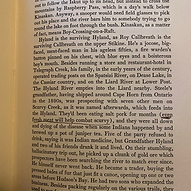
Edward Hoagland writes the obvious point that "fresh meat will help combat scurvy."
"Steele's grandfather, having shipped around Cape Horn from Ontario in the 1890's, was prospecting with seven other men on Scurvy Creek, as it was named afterwards, which feeds into the Hyland. They'd been eating salt pork for months (even fresh meat will help combat scurvy), and they were all down and dying of the disease when some Indiians happened by and brewed up a pot of juniper tea. Five of the party refused to drink, saying it was Inidian medicine, but Grandfather Hyland and two of his friends drank it and lived. On their stubmilng, hallucinatory trip out, he picked up a chunk of gold ore which prospectors have been searching the river to match ever since." page 93 Hardcover
Eddontanajon: The Hylands and Frank Pete
I actually found this book in the Canadian History section of the Strand bookstore in Manhattan New York City and decided to buy it after finding it mentioning using fresh meat to cure scurvy. I can't even find an index so I think I stumbled upon it while browsing through a couple of pages. Lucky find!
May 15, 1969
Fred Bruemmer
Arctic Memories

We lacked fat. The spring caribou were thin after their long migration and our main food, mipku, dried caribou meat, was leathery and lean. We ate pounds of it each day, yet were forever hungry. Living on an exclusive protein, fatless diet took its toll. We tired easily, and after a month developed the first signs of protein poisoning: diarrhea and swollen feet. As soon as we could supplement our lean-meat diet with fat fish, we felt fine again.
In May, the weather turned mild and muggy. Agloo hunting was finished. Our thoughts turned southward, to the land. It, now, must give us food. The caribou must come, on their annual migration from the taiga, the northern forest belt, over the vastness of the Barren Ground tundra, to the Arctic Sea.
Each day Ekalun and his sons climbed the mountain behind our camp to scan the land and sea patiently with their telescopes. And each day they came down from the mountain and shrugged. «Tuktu nauk. (No caribou.)" Our stores of seal meat and blubber dwindled rapidly. The children fished for tomcod at fissures in the ice.
Rosie went inland, with a big bag of traps, to the sandy ridges where perky ground squirrels were emerging from their long winter's sleep to bask in the spring sun. She walked fast, her small, work-worn body bent forward, set a series of traps and rushed off to the next siksik (squirrel) colony, while I trotted behind through the mushy spring snow, out of breath and oozing sweat. At night, the squirrels boiled in a big pot, pink little paws poking pathetically out of the bubbling broth. They tasted like chicken. Squirrels and the little fish the children brought home were now our main food.
Ekalun's automatic Swiss watch had stopped. "Here, Kabloo, you fix it," he said. I recoiled at the idea, and Ekalun laughed derisively. "I thought white men were supposed to be so clever," he gibed and began to take it apart. The tools he lacked he made, a few out of Rosie's darning needles. He remembered the days when the only tools his people had were of stone, bone, horn, and native copper. He had shown me how to make a stone adze, and it was similar to the ones I had seen in Paris's Musée de l'Homme made by Magdalenian hunters 20,000 years ago. Now he nonchalantly took the watch apart. Before evening he had assembled the watch again and it worked.
Our camp was nearly out of food; one cannot live long on lean spring squirrels and small fish. The families dispersed, traveling far inland to intercept the vanguard of migrating caribou. The talk in camp was of tuktu - caribou - always tuktu, the quail and manna of the Barrens.
Ekalun remained. He was carving a chess set: the board superbly inlaid with polished stones of many colors; the rooks were igloos, the knights polar bears, the bishops dogs, the pawns a little army of obese owls. King and queen were Inuit in full fur regalia. "My wife and I," he said, and smiled. The carved stone king did, in fact, look like Ekalun. It would take weeks to finish the set. And food? "The caribou will come," he said confidently.
I left with George Hakungak; his beautiful wife, Jessie; their two small children; and John Akana, George's bachelor brother. The dogs pulled eagerly, although they had fallen upon hard times. We only had a bit of blubber along, and old caribou skins for roughage.
We snaked our way up the great Hood River valley. After winter's long dormancy, the tundra throbbed with resurrection, with renewal, with life. Elegant horned larks spiraled toward the sky until they were but specks in the blue, then drifted gently downward on set wings, filling the air with their jubilant, lilting song. Ptarmigan flew up, their plumage piebald like the land, part wintry white, part summer's brown. From its nest of sticks and dry grasses on a ledge above the ice-bound river, a rough-legged hawk rose to circle high above us with wild and urgent cries. The day was warm and brilliant, the dogs ran fast, the long sled slid silently through the wet snow. We joked and laughed. It was wonderful to be alive.
That night the storm struck. Wind-driven snow wreathed the mountains like smoke. It shrieked around our small traveling tent and whistled cerily in the taut guy ropes. Jessie washed diapers. John carved. George played with the baby. While the storm raged, life went on quietly and harmoniously within the walls of our little tent.
It was night when the storm faltered. Dark clouds still scudded across the sky; the land and a nearby frozen lake lay in an ominous blue-gray El Greco light. And then the caribou came, and in their wake the wolves.
Far out on the lake ice, dark and phantom-like, the herd stood. The men harnessed the huskies and drove fast, right into the herd, the dogs frenzied with excitement, the sled slewing wildly, the caribou scattering, stopping, galloping frantically back and forth, fear forcing them to flee, the herd instinct bunching them. George and John stopped and shot, raced on and shot again, then turned the dogs loose to pull down wounded caribou.
We camped for days to feed the famished, emaciated dogs, to eat huge meals ourselves, our first in weeks, and then, the sled loaded high with caribou meat, we walked the 100 miles (160 km) back to camp. Thaw and rain had ravaged the snow; meltwater rushed to the rivers. The broad, tussocky meadows were bare and brown, and George and John harnessed themselves to the sled to help the panting huskies.
Before breakup, the planes arrived. The doctor from Cambridge Bay on medical inspection found us well, but left us germs, and soon we all came down with colds. The area administrator arrived to buy the men's stock of carvings, the fur clothes the women had made for sale, and one of our caribou-skin tents for a museum in the United States.
On the first good day, we left for Baychimo at the northeast coast of Bathurst Inlet to buy supplies at the lonely Hudson's Bay Company store. It then served the eighty-nine people of Bathurst Inlet, who lived in eleven widely scattered camps in a region as large as Belgium.
People from other camps had preceded us, or arrived during the day. Ekalun, one of the best carvers of the area, had the most money. With a fine sense of drama, he waited until the store was crowded. Every inch the grand seigneur, he strode in and handed Jimmy Stevenson, the manager, his checks. Then he started buying, and the Queen shopping at Fortnum and Mason would not have been nearly as grand. "Twenty pounds of tobacco! Twenty pounds of tea! A new gun! A new net! A carton of cigarettes for my Kabloona" - and, aside, in a not-too-sotto voce stage whisper - "His pipe stinks!" to convulse his audience.
From time to time, as the pile of goods on the floor rose, he'd ask: "How much?" meaning, how much money had he left? "Ah yes, thread for the wife. And needles. And a new pressure stove. Rosie trailed behind her master, meek and quiet. It was a perfect example of male dominance in Inuit society. But since I shared their tent, I happened to know that this was merely a front. For days prior to the trip, Rosie had carefully programmed Ekalun to buy precisely what she needed and wanted.
When he was down to five dollars, he said: "That I'll take in cash! One might need it," and all laughed. That would be his initial stake for the all-night poker game. Ekalun was sleepy and sour when we returned home next day. "How did the game go?" I asked, not too tactfully. The five dollars were gone. And his lighter. And the recently repaired Swiss watch. "Ayornamat. (It can't be helped.)" He shrugged.
We lacked fat. The spring caribou were thin after their long migration and our main food, mipku, dried caribou meat, was leathery and lean. We ate pounds of it each day, yet were forever hungry. Living on an exclusive protein, fatless diet took its toll. We tired easily, and after a month developed the first signs of protein poisoning: diarrhea and swollen feet. As soon as we could supplement our lean-meat diet with fat fish, we felt fine again.
Camp life in summer was quiet and relaxed. Our nets gave us plenty of whitefish and the odd char. Short trips by canoe provided a few seals. In the past, the Bathurst Inlet people had hunted seals only in winter and spring; they used kayaks primarily to kill migrating caribou at river crossings. Ancient patterns persisted; summer simply was not their seal-hunting season and we lived very well on fish alone.
We moved outdoors. The women cooked on open fires, surrounded by a mass of dwarf willow and heather, serving as both fuel and windbreak, and when the food was ready we'd all sit together, eat, chat, and swat mosquitoes. Weeks merged into months; season followed season; my other life seemed remote, unreal. Ekalun had unobtrusively but expertly remodeled me. I now conformed, and early problems and frictions did not recur.
At first my curiosity and my questions had riled him, for in his culture questions were considered intrusive. Nor did they ask me questions, including the most obvious ones: Why had I come? What was I doing? How long would I stay? At first I assumed they simply didn't care. Later I found that they were intensely interested, but much too polite to ask. Then I talked about myself, my family, my life, and since I had broached it, they then could ask questions and asked them eagerly.
To some questions there were no intelligible answers. Ekalun asked me once about Montreal and how many people live there and I said: "Three million." How much is three million? Ekalun wanted to know. He had never seen more than perhaps a hundred people. More than all the caribou in the world, more than all the pebbles on our beach, I said. He thought that over for a while and then he smiled one of his sardonic smiles and said: "Too many!"
At an old campsite, I found a foot (30-cm)-long stick, the spindle of a fire drill. I showed it to Ekalun. He told me what it was, I pretended ignorance and, rather than waste time explaining, Ekalun made a simple version of the fire drill and showed me how it worked. This put him into a reminiscent mood; he told of travels long ago to a remote valley to pick up "fire stones," the iron pyrite that, struck together, produced sparks that caught on lightly oiled willow catkin fluff or arctic cotton tinder and were blown into a flame. It took about five minutes to produce fire by friction with a fire drill, Ekalun said, and only moments with the "fire stones. From then on, rather than ask questions and annoy, I brought back from my long walks all artifacts I found - broken tools, worked bone, thimbles made of leather, a broken blubber pounder of musk-ox horn - and if I judged the moment and the mood propitious, I showed my finds to Rosie and Ekalun, like a child showing treasures to its parents.
It often worked. The small bone tube, brown with age and cracked, made of the leg bone of a goose was used, long ago, to suck fresh water off spring ice. That brought back memories of a trip on spring ice nearly half a century ago, when both were starving and their few dogs were near death. Ekalun had spotted a seal far out on the flooded ice and had crawled toward it through the icy water, imitating seal movements and behavior with such perfection that the seal thought he was a seal. It took more than an hour. His body went numb with cold; he dared not throw the harpoon. He crawled right up to the seal and killed it. Rosie, then about fifteen years old and just married, rushed up with the dogs. They ate the seal and lived.
Fall came, but no fat caribou for winter food, for clothing. We walked far inland. No caribou. We ascended the Hood River. No caribou. And suddenly Ekalun knew. The caribou, he said, are on the islands. We drove to the islands and the caribou were there. How had he known? Experience? Intuition? A good guess? I asked and got no answer. He simply knew. The men hunted. We took several boatloads of meat, fat, and skins back to camp. The rest we cached under heavy stones, to be picked up by dog team in winter. The racks at camp were full of drying meat; slabs of back fat filled the caches. The char were returning to the rivers; our nets were heavy with fish. This was the vital harvest season of fall, to gather supplies until seal hunting began again in winter.
December 15, 1969
Eating Christmas in the Kalahari - December 1969 Natural History Magazine - by Richard Borshay Lee

Richard Borshay Lee wrote "Eating Christmas in the Kalahari" published in the Dec 1969 issue of Natural History. The San Ju/'hoansi tease an anthropologist that an ox selected for Christmas festitivities was not fat enough. The article features extensive examples of how important fat is to the diet. “My friend, the way it is with us Bushmen,” he began, “is that we love meat. And even more than that, we love fat.”
Eating Christmas in the Kalahari
Richard Lee
“Eating Christmas in the Kalahari” by Richard Borshay Lee was published in the December 1969 issue of Natural History. It is one of the magazine’s most frequently reprinted stories. In the final paragraph, Lee wondered what the future would hold for the !Kung Bushmen with whom he had shared a memorable Christmas feast. The University of Toronto anthropologist answers that question for the Botswana San, in a 2000 postscript to his original article. (The postscript follows the main story). A more recent update will be found in Unit 3.
The "Bushmen" are more properly referred to as San in anthropology, and refer to themselves as Ju/’hoansi. The San will also be our example of a foraging mode of production, since that is what they were when Lee began his study in the late 1960's. Lee studied the San in Botswana, although they are also found in Namibia, living in one of the most difficult environments, the Kalahari Desert. Foraging will be discussed later in Unit 1, and you will read more about the San.
Editor’s Note: The !Kung and other Bushmen speak click languages. In the story, three different clicks are used:
The dental click (/), as in /Xai/xai, /ontah, and /gaugo. The click is sometimes written in English as tsk-tsk.
The alveopalatal click (!), as in Ben!a and !Kung.
The lateral click (//), as in //gom. Clicks function as consonants; a word may have more than one, as in /n!au.
he !Kung Bushmen’s knowledge of Christmas is thirdhand. The London Missionary Society brought the holiday to the southern Tswana tribes in the early nineteenth century. Later, native catechists spread the idea far and wide among the Bantu-speaking pastoralists, even in the remotest corners of the Kalahari Desert. The Bushmen’s idea of the Christmas story, stripped to its essentials, is “praise the birth of white man’s god-chief”; what keeps their interest in the holiday high is the Tswana-Herero custom of slaughtering an ox for his Bushmen neighbors as an annual goodwill gesture. Since the 1930’s, part of the Bushmen’s annual round of activities has included a December congregation at the cattle posts for trading, marriage brokering, and several days of trance-dance feasting at which the local Tswana headman is host.
As a social anthropologist working with !Kung Bushmen, I found that the Christmas ox custom suited my purposes. I had come to the Kalahari to study the hunting and gathering subsistence economy of the !Kung, and to accomplish this it was essential not to provide them with food, share my own food, or interfere in any way with their food-gathering activities. While liberal handouts of tobacco and medical supplies were appreciated, they were scarcely adequate to erase the glaring disparity in wealth between the anthropologist, who maintained a two-month inventory of canned goods, and the Bushmen, who rarely had a day’s supply of food on hand. My approach, while paying off in terms of data, left me open to frequent accusations of stinginess and hard-heartedness. By their lights, I was a miser.
The Christmas ox was to be my way of saying thank you for the co-operation of the past year; and since it was to be our last Christmas in the field, I determined to slaughter the largest, meatiest ox that money could buy, insuring that the feast and trance dance would be a success.
Through December I kept my eyes open at the wells as the cattle were brought down for watering. Several animals were offered, but none had quite the grossness that I had in mind. Then, ten days before the holiday, a Herero friend led an ox of astonishing size and mass up to our camp. It was solid black, stood five feet high at the shoulder, had a five-foot span of horns, and must have weighed 1,200 pounds on the hoof. Food consumption calculations are my specialty, and I quickly figured that bones and viscera aside, there was enough meat—at least four pounds—for every man, woman, and child of the 150 Bushmen in the vicinity of the /Xai/xai who were expected at the feast.
Having found the right animal at last, I paid the Herero £20 ($56) and asked him to keep the beast with his herd until Christmas day. The next morning word spread among the people that the big solid black one was the ox chosen by /ontah (my Bushman name; it means, roughly, “whitey”) for the Christmas feast. That afternoon I received the first delegation. Ben!a, an outspoken sixty-year-old mother of five, came to the point slowly.
“Where were you planning to eat Christmas?”
“Right here at /Xai/xai,” I replied.
“Alone or with others?”
“I expect to invite all the people to eat Christmas with me.
“Eat what?”
“I have purchased Yehave’s black ox, and I am going to slaughter and cook it.”
“That’s what we were told at the well but refused to believe it until we heard it from yourself.”
“Well, it’s the black one,” I replied expansively, although wondering what she was driving at.
“Oh, no!” Ben!a groaned, turning to her group. “They were right.” Turning back to me she asked, “Do you expect us to eat that bag of bones?”
“Bag of bones! It’s the biggest ox at /Xai/xai.”
“Big, yes, but old. And thin. Everybody knows there’s no meat on that old ox. What did you expect us to eat off it, the horns?”
Everybody chuckled at Ben!a’s one-liner as they walked away, but all I could manage was a weak grin.
That evening it was the turn of the young men. They came to sit at our evening fire. /gaugo, about my age, spoke to me man-to-man.
“/ontah, you have always been square with us,” he lied. “What has happened to change your heart? That sack of guts and bones of Yehave’s will hardly feed one camp, let alone all the Bushmen around /Xai/xai.” And he proceeded to enumerate the seven camps in the /Xai/xai vicinity, family by family. “Perhaps you have forgotten that we are not few, but many. Or are you too blind to tell the difference between a proper cow and an old wreck? That ox is thin to the point of death.”
“Look, you guys,” I retorted, “that is a beautiful animal, and I’m sure you will eat it with pleasure at Christmas.”
“Of course we will eat it; it’s food. But it won’t fill us up to the point where we will have enough strength to dance. We will eat and go home to bed with stomachs rumbling.”
That night as we turned in, I asked my wife, Nancy: “What did you think of the black ox?”
“It looked enormous to me. Why?”
“Well, about eight different people have told me I got gypped; that the ox is nothing but bones.”
“What’s the angle?” Nancy asked. “Did they have a better one to sell?”
“No, they just said that it was going to be a grim Christmas because there won’t be enough meat to go around. Maybe I’ll get an independent judge to look at the beast in the morning.”
Bright and early, Halingisi, a Tswana cattle owner, appeared at our camp. But before I could ask him to give me his opinion on Yehave’s black ox, he gave me the eye signal that indicated a confidential chat. We left the camp and sat down.
“/ontah, I’m surprised at you; you’ve lived here for three years and still haven’t learned anything about cattle.”
“But what else can a person do but choose the biggest, strongest animal one can find?” I retorted.
“Look, just because an animal is big doesn’t mean that it has plenty of meat on it. The black one was a beauty when it was younger, but now it is thin to the point of death.”
“Well I’ve already bought it. What can I do at this stage?”
“Bought it already? I thought you were just considering it. Well, you’ll have to kill it and serve it, I suppose. But don’t expect much of a dance to follow.”
My spirits dropped rapidly. I could believe that Ben!a and /gaugo just might be putting me on about the black ox, but Halingisi seemed to be an impartial critic. I went around that day feeling as though I had bought a lemon of a used car.
“My friend, the way it is with us Bushmen,” he began, “is that we love meat. And even more than that, we love fat.”
In the afternoon it was Tomazo’s turn. Tomazo is a fine hunter, a top trance performer, and one of my most reliable informants. He approached the subject of the Christmas cow as part of my continuing Bushmen education.
“My friend, the way it is with us Bushmen,” he began, “is that we love meat. And even more than that, we love fat. When we hunt we always search for the fat ones, the ones dripping with layers of white fat: fat that turns into a clear, thick oil in the cooking pot, fat that slides down your gullet, fills your stomach and gives you a roaring diarrhea,” he rhapsodized.
“So, feeling as we do,” he continued, “it gives us pain to be served such a scrawny thing as Yehave’s black ox. It is big, yes, and no doubt its giant bones are good for soup, but fat is what we really crave and so we will eat Christmas this year with a heavy heart.”
The prospect of a gloomy Christmas now had me worried, so I asked Tomazo what I could do about it.
“Look for a fat one, a young one . . . smaller, but fat. Fat enough to make us //gom (‘evacuate the bowels’), then we will be happy.”
My suspicions were aroused when Tomazo said that he happened to know of a young, fat, barren cow that the owner was willing to part with. Was Toma working on commission, I wondered? But I dispelled this unworthy thought when we approached the Herero owner of the cow in question and found that he had decided not to sell.
The scrawny wreck of a Christmas ox now became the talk of the /Xai/xai water hole and was the first news told to the outlying groups as they began to come in from the bush for the feast. What finally convinced me that real trouble might be brewing was the visit from u!lau, an old conservative with a reputation for fierceness. His nickname meant spear and referred to an incident thirty years ago in which he had speared a man to death. He had an intense manner; fixing me with his eyes, he said in clipped tones:
“I have only just heard about the black ox today, or else I would have come here earlier. /ontah, do you honestly think you can serve meat like that to people and avoid a fight?” He paused, letting the implications sink in. “I don’t mean fight you, /ontah; you are a white man. I mean a fight between Bushmen. There are many fierce ones here, and with such a small quantity of meat to distribute, how can you give everybody a fair share? Someone is sure to accuse another of taking too much or hogging all the choice pieces. Then you will see what happens when some go hungry while others eat.”
The possibility of at least a serious argument struck me as all too real. I had witnessed the tension that surrounds the distribution of meat from a kudu or gemsbok kill, and had documented many arguments that sprang up from a real or imagined slight in meat distribution. The owners of a kill may spend up to two hours arranging and rearranging the piles of meat under the gaze of a circle of recipients before handing them out. And I also knew that the Christmas feast at /Xai/xai would be bringing together groups that had feuded in the past.
Convinced now of the gravity of the situation, I went in earnest to search for a second cow; but all my inquiries failed to turn one up.
The Christmas feast was evidently going to be a disaster, and the incessant complaints about the meagerness of the ox had already taken the fun out of it for me. Moreover, I was getting bored with the wisecracks, and after losing my temper a few times, I resolved to serve the beast anyway. If the meat fell short, the hell with it. In the Bushmen idiom, I announced to all who would listen:
“I am a poor man and blind. If I have chosen one that is too old and too thin, we will eat it anyway and see if there is enough meat there to quiet the rumbling of our stomachs.”
On hearing this speech, Ben!a offered me a rare word of comfort. “It’s thin,” she said philosophically, “but the bones will make a good soup.”
At dawn Christmas morning, instinct told me to turn over the butchering and cooking to a friend and take off with Nancy to spend Christmas alone in the bush. But curiosity kept me from retreating. I wanted to see what such a scrawny ox looked like on butchering, and if there was going to be a fight, I wanted to catch every word of it. Anthropologists are incurable that way.
The great beast was driven up to our dancing ground, and a shot in the forehead dropped it in its tracks. Then, freshly cut branches were heaped around the fallen carcass to receive the meat. Ten men volunteered to help with the cutting. I asked /gaugo to make the breast bone cut. This cut, which begins the butchering process for most large game, offers easy access for removal of the viscera. But it also allows the hunter to spot-check the amount of fat on the animal. A fat game animal carries a white layer up to an inch thick on the chest, while in a thin one, the knife will quickly cut to bone. All eyes fixed on his hand as /gaugo, dwarfed by the great carcass, knelt to the breast. The first cut opened a pool of solid white in the black skin. The second and third cut widened and deepened the creamy white. Still no bone. It was pure fat; it must have been two inches thick.
“Hey /gau,” I burst out, “that ox is loaded with fat. What’s this about the ox being too thin to bother eating? Are you out of your mind?”
“Fat?” /gau shot back, “You call that fat? This wreck is thin, sick, dead!” And he broke out laughing. So did everyone else. They rolled on the ground, paralyzed with laughter. Everybody laughed except me; I was thinking.
I ran back to the tent and burst in just as Nancy was getting up. “Hey, the black ox. It’s fat as hell! They were kidding about it being too thin to eat. It was a joke or something. A put-on. Everyone is really delighted with it!”
“Some joke,” my wife replied. “It was so funny that you were ready to pack up and leave /Xai/xai.”
If it had indeed been a joke, it had been an extraordinarily convincing one, and tinged, I thought, with more than a touch of malice as many jokes are. Nevertheless, that it was a joke lifted my spirits considerably, and I returned to the butchering site where the shape of the ox was rapidly disappearing under the axes and knives of the butchers. The atmosphere had become festive. Grinning broadly, their arms covered with blood well past the elbow, men packed chunks of meat into the big cast-iron cooking pots, fifty pounds to the load, and muttered and chuckled all the while about the thinness and worthlessness of the animal and /ontah’s poor judgment.
We danced and ate that ox two days and two nights; we cooked and distributed fourteen potfuls of meat and no one went home hungry and no fights broke out.
But the “joke” stayed in my mind. I had a growing feeling that something important had happened in my relationship with the Bushmen and that the clue lay in the meaning of the joke. Several days later, when most of the people had dispersed back to the bush camps, I raised the question with Hakekgose, a Tswana man who had grown up among the !Kung, married a !Kung girl, and who probably knew their culture better than any other non-Bushmen.
“With us whites,” I began, “Christmas is supposed to be the day of friendship and brotherly love. What I can’t figure out is why the Bushmen went to such lengths to criticize and belittle the ox I had bought for the feast. The animal was perfectly good and their jokes and wisecracks practically ruined the holiday for me.”
“So it really did bother you,” said Hakekgose. “Well, that’s the way they always talk. When I take my rifle and go hunting with them, if I miss, they laugh at me for the rest of the day. But even if I hit and bring one down, it’s no better. To them, the kill is always too small or too old or too thin; and as we sit down on the kill site to cook and eat the liver, they keep grumbling, even with their mouths full of meat. They say things like, ‘Oh, this is awful! What a worthless animal! Whatever made me think that this Tswana rascal could hunt!’”
“Is this the way outsiders are treated?” I asked.
“No, it is their custom; they talk that way to each other too. Go and ask them.”
/gaugo had been one of the most enthusiastic in making me feel bad about the merit of the Christmas ox. I sought him out first.
“Why did you tell me the black ox was worthless, when you could see that it was loaded with fat and meat?”
“It is our way,” he said smiling. “We always like to fool people about that. Say there is a Bushman who has been hunting. He must not come home and announce like a braggard, ‘I have killed a big one in the bush!’ He must first sit down in silence until I or someone else comes up to his fire and asks, ‘What did you see today?’ He replies quietly, ‘Ah, I’m no good for hunting. I saw nothing at all [pause] just a little tiny one.’ Then I smile to myself,” /gaugo continued, “because I know he has killed something big.”
In the morning we make up a party of four or five people to cut up and carry the meat back to the camp. When we arrive at the kill we examine it and cry out, ‘You mean to say you have dragged us all the way out here in order to make us cart home your pile of bones? Oh, if I had known it was this thin I wouldn’t have come.’ Another one pipes up, ‘People, to think I gave up a nice day in the shade for this. At home we may be hungry but at least we have nice cool water to drink.’ If the horns are big, someone says, ’Did you think that somehow you were going to boil down the horns for soup?’
“To all this you must respond in kind. ‘I agree,’” you say, ’this one is not worth the effort; let’s just cook the liver for strength and leave the rest for the hyenas. It is not too late to hunt today and even a duiker or a steenbok would be better than this mess.’”
“Then you set to work nevertheless; butcher the animal, carry the meat back to the camp and everyone eats,” /gaugo concluded.
“But,” I asked, “why insult a man after he has gone to all that trouble to track and kill an animal and when he is going to share the meat with you so that your children will have something to eat?”
Things were beginning to make sense. Next, I went to Tomazo. He corroborated /gaugo’s story of the obligatory insults over a kill and added a few details of his own.
“But,” I asked, “why insult a man after he has gone to all that trouble to track and kill an animal and when he is going to share the meat with you so that your children will have something to eat?”
“Arrogance,” was his cryptic answer.
“Arrogance?”
“Yes, when a young man kills much meat he comes to think of himself as a chief or a big man, and he thinks of the rest of us as his servants or inferiors. We can’t accept this. We refuse one who boasts, for someday his pride will make him kill somebody. So we always speak of his meat as worthless. This way we cool his heart and make him gentle.”
“But why didn’t you tell me this before?” I asked Tomazo with some heat.
“Because you never asked me,” said Tomazo, echoing the refrain that has come to haunt every field ethnographer.
I had been taught an object lesson by the Bushmen; it had come from an unexpected corner and had hurt me in a vulnerable area.
The pieces now fell into place. I had known for a long time that in situations of social conflict with Bushmen I held all the cards. I was the only source of tobacco in a thousand square miles, and I was not incapable of cutting an individual off for noncooperation. Though my boycott never lasted longer than a few days, it was an indication of my strength. People resented my presence at the water hole, yet simultaneously dreaded my leaving. In short I was a perfect target for the charge of arrogance and for the Bushmen tactic of enforcing humility.
I had been taught an object lesson by the Bushmen; it had come from an unexpected corner and had hurt me in a vulnerable area. For the big black ox was to be the one totally generous, unstinting act of my year at /Xai/xai, and I was quite unprepared for the reaction I received.
As I read it, their message was this: There are no totally generous acts. All “acts” have an element of calculation. One black ox slaughtered at Christmas does not wipe out a year of careful manipulation of gifts given to serve your own ends. After all, to kill an animal and share the meat with people is really no more than Bushmen do for each other every day and with far less fanfare.
In the end, I had to admire how the Bushmen had played out the farce-collectively straight-faced to the end. Curiously, the episode reminded me of the Good Soldier Schweik and his marvelous encounters with authority. Like Schweik, the Bushmen had retained a thoroughgoing skepticism of good intentions. Was it this independence of spirit, I wondered, that had kept them culturally viable in the face of generations of contact with more powerful societies, both black and white? The thought that the Bushmen were alive and well in the Kalahari was strangely comforting. Perhaps, armed with that independence and with their superb knowledge of their environment, they might yet survive the future.
October 3, 1971
Medical Group, in a Major Change, Urges a Normal Carbohydrate Diet for Diabetics

The American Diabetes Association has recommended that physicians encourage their diabetic patients to eat the same amount of carbohydrate foods—sugars, starches and celluloses—as people who are unaffected by the disease.
SEATTLE, Oct. 2—The American Diabetes Association has recommended that physicians encourage their diabetic patients to eat the same amount of carbohydrate foods—sugars, starches and celluloses—as people who are unaffected by the disease.
If physicians and patients follow the association's recommendation, it will mean a major change in the rationale of treating the disease, which has afflicted man since ancient times.
The association said that the recommendation to alter diabetics' diets—raising carbohydrates and thereby lowering fats—was taken to minimize the risk of diabetic patients developing hardened arteries (called arteriosclerosis), heart attacks and strokes.
Though the private association's guidelines are not binding on physicians, the recommendations are likely to influence the dietary care of many of the 2.8 million known diabetics in this country. The association said that an additional 1.6 million Americans have undetected diabetes.
The recommendations, which were made in a “special report,” were intended as a general policy. Like all other general guidelines in medicine, they may have to be tailored by a private physician to an individual patient's needs.
A Cardinal Therapy
Diet is a cardinal therapy for diabetes because weight reduction alone can control the disease in many—but not all—adult diabetics.
In the past, the association has not set limits on the amount of carbohydrates that it has recommended diabetics to eat. However, many doctors have urged their diabetic patients to limit carbohydrates to about 30 per cent of the calories in their daily diet, and thereby, to eat a disproportionately larger amount of fats.
Now, the association said that diabetics, like other Americans, can eat diets that contain about 45 per cent carbohydrates. Carbohydrates include a wide variety of sugars. Table sugar is just one of many that nature provides.
The remainder of the diet should consist of fats and proteins in a ratio geared to the patient's taste and his doctor's advice. Because the association says that most diabetics must limit their calories each day, this means that these patients would eat less fat.
Fifty years after the discovery of insulin — the hormone that among other functions controls the blood sugar level — arteriosclerosis has become the major killer of diabetics. Americans rarely die now of diabetic coma because insulin, a hormone derived inexpensively from the pancreas glands of animals, is so widely available for human use.
However, not all diabetics require insulin. Physicians generally prescribe insulin injections just for patients whose diabetes cannot be managed by special diet or pills. Such pills do not contain insulin, but rather other drugs that, by different pharmacologic actions, affect the blood sugar level.
“There no longer appears to be any need to restrict disproportionately the intake of carbohydrates in the diet of most diabetic patients,” the association said in the current issue of Diabetes, a scientific journal that the American Diabetes Association publishes in New York.
“The average proportion of calories consumed as carbohydrate in the U. S. population as a whole approximates 45 per cent. This proportion or even higher appears to be acceptable for the usual diabetic patient as well,” the report said.
Dr. Edwin L. Bierman, who was chairman of the committee that wrote the report, stressed in an interview here:
“For those adult diabetics treated by diet alone, the cornerstone of our recommendation is restriction of total caloric intake, and it doesn't make any difference how you do it.”
Dr. Bierman, who is considered one of the nation's leading researchers on diabetes and arteriosclerosis, treats patients with such diseases at the Seattle Veterans Administration Hospital and teaches medical students at the University of Washington.
“Most adult diabetics are obese,” he said, citing statistics from the Metropolitan Life Insurance Company, which show that two‐thirds of the female diabetics and half of the male diabetics in this country are more than 20 per cent overweight. Obesity does not cause diabetes, but it does tend to bring out the disease in those patients who are genetically susceptable.
Advice for Obese and Lean
Accordingly, the Diabetes Association stressed in its report that doctors should advise their overweight diabetic patients to reduce and their leaner diabetics to avoid weight gains with advancing age.
A calorie is a unit measurement of the amount of heat energy that a specific food can yield for muscular and other bodily activity when it is chemically changed in the tissues lof man. Though the need varies with each individual, depending in such factors as age, activity, weight and height, American men generally use about 2,500 calories per day and women about 1,800 calories.
Diabetes, depending on its severity, can produce weakness, weight loss and fatigue among other symptoms. These symptoms result from the biochemical changes that scientists think result from production of an insufficient amount of insulin to meet the body's needs.
Lack of insulin impairs the body's metabolism, or biochemistry, of carbohydrates. As a result of the complex interlocking relationship of the body's biochemical reaction, diabetes also disturbs the metabolism of protein, chemicals, water and fats.
“Today many diabetologists believe that blood fat is as important to a diabetic as is blood sugar,” Dr. Bierman said, meaning that abnormal blood fat levels are now considered one of the several factors associated with a high risk for arterosclerosis.
The Diabetes Association's action comes at a time when experts are expressing a growing appreciation and concern about the role of nutrition in health.
“The basic nutritional requirement for patients with diabetes are in general the Isame as those for all individuals,” the association said. Such needs include adequate quantities of protein, vitamins, minerals and essential fatty acids.
However, the association stressed that physicians should write dietary prescriptions for diabetic patients whenever necessary as part of their broader general health care that includes:
¶Periodic medical examination.
¶Regular exercise.
¶Avoidance of cigarette smoking.
¶ Attention to personal hygiene.
¶Prevention of infection.
For many decades, physicians have noted that diabetic patients handle infections poorly. This is true despite the proper use of antibiotic drugs when infection occurs in a diabetic patient.
The reason for this phenomenon mystifies scientists who still do not know what causes the incurable, yet treatable disease, diabetes. Though most doctors say they believe diabetes is a heredetary disease, scientists do not know the precise pattern of such proposed inheritance.
Until insulin was discovered, starvation diets were doctors' best therapy for the disease.
A half‐century ago when Dr. Frederick G. Banting and Dr. Charles H. Best, working in Dr. John J. R. Macleod's laboratory at the University of Toronto, discovered insulin, physicians began prescribing regular diets for diabetes patients.
“Thereafter, somehow, carbohydrate restriction began to hold sway as the cornerstone of treatment of diabetes,” Dr. Bierman said.
Though evidence began mounting in the late nineteentwenties that diabetics could eat diets higher in carbohydrates without apparent untoward effects, results of such observations caused few physicians to change their dietary prescription habits for their diabetic patients.
Now, those earlier observations are being confirmed with more sophisticated laboratory techniques by investigators like Dr. Bierman.
Earlier this year, for example, Dr. Bierman and his colleagues, Dr. John D. Brunzell, Dr. Roger L. Lerner, Dr. William R. Hazzard and Dr. Daniel Porte Jr., reported in the New England Journal of Medicine scientific evidence that showed high carbohydrate diets lowered blood sugar in the mild diabetic and normal humans studied.
“Diets high in carbohydrates do not raise the blood sugar,” Dr. Bierman said, adding, “That's the misconception that most physicians have had during the last 30 years.”

Ancient History
Germany
50000
B.C.E.
Palaeolithic and Mesolithic kill-butchering sites: the hard evidence
The upper paleolithic is characterized by advanced hunting of large animals with various weapons, and planning to maximize easy prey
Upper Palaeolithic and Mesolithic Hunting:
the archaeological record leaves us some direct evidence of man's hunting activities. At Meiendorf (Rust 1937) and Stellmoor (Rusf 1937), some bones of reindeer and birds still conserve weapon marks and a few pieces of silex have remained thrusted in mammalian bones; man kills reindeer with harpoons and sticks (fractured skulls), birds with bows and maybe slings. Three fractured skulls of red deer in Abri Pataud (Bouchud, 1975), and one bovid skull with a circular orifice in Saint Marcel (Allain, 1952) suggest the practice of the so called " co'up de merlin": man has delivered a blow similar to the one used today to butcher cattle. Probably the animal already immobilized (wounded or entrapped) was hit on the frontal with a big stone. At Kokorevo I (Siberia), a large scapula of bison is pierced by the upper end of a point made of bone (Boriskowksi, 1965). At High Furlong (Mesolithic), an elk was discovered with the marks of L7 wounds made by barbed points, of which two were found in the site, and by other arms. The animal had apparently been attacked at two distinct occasions: during the first one, hunters aimed at the legs to lame the animal (fig. 6), later hunters hit the thoracic region and the lungs to kill it. However the elk died in a little lake, perhaps imprisoned in the ice, and man had no access to the meat. The animal represents in fact a hunting loss (Hallam et a1.,1973).
Planning: very good. Many sites belong to Wpe e, were occupied periodically or seasonally and specialised in the capture of a particular game (e.g., horse, reindeeq, ibex). Game drive towards cliffs have been claimed and Solutre (Combier & Thevenot,1976) has long figured as an example, but the evidence is far from conclusive.
Scavenging: no doubt H. sapiens still killed or exploited animals in the occasional and opportunistic way of Lower Palaeolithic times. According to Lindner (Lindner,1941), hunters at Predmost utilised the carcasses of hundreds of mammoths that probably succumbed as a result of natural catastrophes, as food.
Food transport: selective transport of the most useful animal parts is claimed for many sites.
Specialised activities: sometimes the material is dislocated in distinct clusters that could reflect specialised activity areas as for example at Solutre (Combier & Thevenot, 1976). Site topography: some hunting sites were located in valleys enclosed by steep slopes as at Rascano (Gonziilez-Echegaray, 1979), Stellmoor (Rust, 1937), Meiendorf (Rust 1937), or at the foot of rocky cliffs at Solutr6 (Combier & Th6venot, 1,976).
4. Conclusions
Most of the Lower Palaeolithic sites analysed here belong to category a (butchering sites); other kind of concentrations are rare and difficult to ascertain. A number of hunting stations (category e) and a hunting stop (category f) form my sample for the age of Neanderthal man and related people. The Upper Palaeolithic is characterised by many hunting stations, while in Mesolithic times a hunting loss (category d ) was found as well as several sighting sites (category g). The foregoing distribution seems to reflect in a vague way an evolution from scavenging and haphazard opportunistic hunting to well organised, selective hunting activities. However, this reflection results no doubt in part from a priori assumptions concerning the evolution of hominid meat procurement often colouring the interpretations offered for the osseous "hard" data; these are frequently equivocal.
Vindija, 42000, Varaždin, Croatia
28500
B.C.E.
Neanderthal diet at Vindija and Neanderthal predation: The evidence from stable isotopes
The isotope evidence overwhelmingly points to the Neanderthals behaving as top-level carnivores, obtaining almost all of their dietary protein from animal sources
Archeological analysis of faunal remains and of lithic and bone tools has suggested that hunting of medium to large mammals was a major element of Neanderthal subsistence. Plant foods are almost invisible in the archeological record, and it is impossible to estimate accurately their dietary importance. However, stable isotope (13C and 15N) analysis of mammal bone collagen provides a direct measure of diet and has been applied to two Neanderthals and various faunal species from Vindija Cave, Croatia. The isotope evidence overwhelmingly points to the Neanderthals behaving as top-level carnivores, obtaining almost all of their dietary protein from animal sources. Earlier Neanderthals in France and Belgium have yielded similar results, and a pattern of European Neander- thal adaptation as carnivores is emerging. These data reinforce current taphonomic assessments of associated faunal elements and make it unlikely that the Neanderthals were acquiring animal protein principally through scavenging. Instead, these findings portray them as effective predators.
Stable Isotope Analyses.
Mammal bone collagen δ13C and δ15N values reflect the δ13C and δ15N values of dietary protein (14). They furnish a long-term record of diet, giving the average δ13C and δ15N values of all of the protein consumed over the last years of the measured individual's life. δ13C values can be used to discriminate between terrestrial and marine dietary protein in humans and other mammals (15, 16). In addition, because of the canopy effect, species that live in forest environments can have δ13C values that are more negative than species that live in open environments (17). δ15N values are, on average, 2–4‰ higher than the average δ15N value of the protein consumed (18). Therefore, δ15N values can be used to determine the trophic level of the protein consumed. By measuring the δ13C and δ15N values of various fauna in a paleo-ecosystem, it is possible to reconstruct the trophic level relationships within that ecosystem. Therefore, by comparing the δ13C and δ15N values of omnivores such as hominids with the values of herbivores and carnivores from the same ecosystem, it is possible to determine whether those omnivores were obtaining dietary protein from plant or animal sources.
Cheddar Reservoir, Cheddar BS26, UK
12000
B.C.E.
FOCUS: Gough’s Cave and Sun Hole Cave Human Stable Isotope Values Indicate a High Animal Protein Diet in the British Upper Palaeolithic
We were testing the hypothesis that these humans had a mainly hunting economy, and therefore a diet high in animal protein. We found this to be the case, and by comparing the human δ15N values with those of contemporary fauna, we conclude that the protein sources in human diets at these sites came mainly from herbivores such as Bos sp. and Cervus elaphus
We undertook stable isotope analysis of Upper Palaeolithic humans and fauna from the sites of Gough's Cave and Sun Hole Cave, Somerset, U.K., for palaeodietary reconstruction. We were testing the hypothesis that these humans had a mainly hunting economy, and therefore a diet high in animal protein. We found this to be the case, and by comparing the human δ15N values with those of contemporary fauna, we conclude that the protein sources in human diets at these sites came mainly from herbivores such as Bos sp. and Cervus elaphus. There are a large number ofEquus sp. faunal remains from this site, but this species was not a significant food resource in the diets of these Upper Palaeolithic humans.
If the humans hunted and consumed mainly horse, then their 15N values should be c. 3–5‰ (Equus 15N value of 0·7‰+enrichment of 2–4‰). Instead, their 15N values make more sense if they lived mostly off Bos and Cervus elaphus (Bos and Cervus values of c. 3‰+enrichment of 2–4‰=the observed values c. 6–7‰). It is also possible that other species, including Rangifer tarandus, were consumed by these individuals. Rangifer tarandus has 15N values similar to Cervus elaphus (Richards, 1998), and has more positive 13C values, which may explain the observed slight enrichment in the human 13C values. A number of artefacts made from Rangifer tarandus have been found at Gough’s, but there is no other evidence that this species was being exploited for food
Province of Crotone, Italy
500
B.C.E.
On the Sociology of Ancient Sport
One report states that a trainer named Pythagoras recommended a meat diet to the Olympic athletes he trained.
A lack of animal-derived protein seems to have been rectified early in history, as there are two reports of the introduction of meat into the athletes’ diet. One report states that a trainer named Pythagoras recommended a meat diet to the athletes he trained. https://www.omicsonline.org/open-access/a-comparison-of-ancient-greek-and-roman-sports-diets-with-modern-day-practices-2473-6449-1000104.php?aid=69865
8 He [Pythagoras] is said to have been the first to train athletes on a meat diet. The first athlete he did this with was Eurymenes. Formerly they had trained on dried figs, moist cheese, and wheat. Some say that it was a trainer named Pythagoras and not the philosopher who was responsible for this innovative diet. For our Pythagoras prohibited killing, not to mention eating, life which possessed souls like our own.
Diogenes Laertius, Lives of the Philosophers 8.12
Sport and Recreation
To all appearances medical knowledge in general and nutrition in particular was widespread in Pythagorean circles in Southern Italy, especially in Kroton. Burkert has pointed out that the fmaous doctor Alcmaeon came from the Pythagorean center of Kroton. From the akousmata (secret doctrines), which doubtless contain old religious traditions, we learn that the Pythagoreans were not originally strict vegetarians; the consumption of meat was permitted, with the exception of lamb and the meat of draft oxen. Burkert considers there is some likelihood that Pythagoras introduced a meat diet for athletes. He believes this tradition arose when Pythagorean vegetarianism had not yet been completely developed. In later times, when vegetarianism had prevailed, a second tradition has possibly been invented, in which it was not Pythagoras, the philosopher from Samos and Kroton, but a homonymous person who wrot the great 'trainer's recipe book'.
57: There are similar issues regarding the transmission in later sources of Pythagoras advising the successful heavy athlete Eurymenes of Samos to use a special meat-based diet instead of the dried figs and cheese he had previously been eating.
On the Sociology of Ancient Sport - page 43.
Mantineia 221 00, Greece
480
B.C.E.
A Comparison of Ancient Greek and Roman Sports Diets with Modern Day Practices
Dromeus, a long-distance runner, is said to have first thought of eating meat for training instead of just cheese and won multiple victories.
The second report is that of Pausanias, who writes of Dromeus, a long-distance runner from Stymphalos [23].
“...he won two victories in the dolichos at Olympia, the same number in the Pythian Games, three at the Isthmian and five at the Nemean. He is said to have first thought of eating meat (as part of his training diet). Until then the food for athletes was cheese fresh out of the basket.”
Clearly, if his success is anything to go by, then Dromeus had really found a winner’s diet. There are also reports of athletes eating meat from oxen, bulls, goats and deer, a very” red-meat” diet which is a rich form of protein. Moreover, with meat as a part of their diet, the performance of competing athletes would most certainly have improved noticeably.
5 A man named Dromeus from Mantineia was said to have been the first we know of to have won the pankration by default [ = akoniti]. Pausanias 6.11.4
Dromeus, Long-Distance Runner
There was a man from Stymphalos, named Dromeus, whose record as a long-distance runner was exceptional: he won two victories in the dolichos at Olympia, the same number in the Pythian Games, three at the Isthmian and five at the Nemean. He is said to have first thought of eating meat (as part of his training diet). Until then the food for athletes was cheese fresh out of the basket.


