

Eskimo
The Inuit lived for as long as 10,000 years in the far north of Canada, Alaska, and Greenland and likely come from Mongolian Bering-Strait travelers. They ate an all-meat diet of seal, whale, caribou, musk ox, fish, birds, and eggs. Their nutritional transition to civilized plant foods spelled their health demise.

Recent History
February 1, 1939
Kabloona

Father Henry's diet of frozen fish for the past six years is described
"No white man has anything to boast of in the Arctic, but Father Henry no longer had the little with which he had started. Whatever he had possessed on first coming out here was to him part of a forgotten past, and he referred to it as "all those things." It had helped in the beginning, but now "all that" was superfluous. What, for examble, did he want with a plate when his only meal of the day was a lump of frozen fish, eaten on waking in the morning? What good was that lamp to hi, since he had no kerosene? How could he have used a pen here where ink froze? A napkin, which would have stiffened like a board in this cold? The only thing to do was to lick one's fingers, and indeed the gesture had become automatic with him. But since he knew that I was what Frenchy Chartrand at Coppermine had called a "cream puff," he gave me a ptarmigan skin to wipe my fingers on. This is theclassic towel of the Arctic. It lasts the whole winter through without washing, and if you really mean to honor your guest, it is with this ptarmigan skin that you wipe his plate.
Father Henry lacked every object known to the civilization of the white man. "Those things make no sense here,"-and with that phrase he dispose of the subject. When I unpacked my gifts f or him, rejoicing in advance over the delight they would give him, he stood by shaking his head. No, he can no longer eat wihte man's food: not even rice. He cannot digest the stuff. "That sort of food doesn't keep a man warm. Frozen fish, now ..." He loves frozen fish. There is nothing like it, he says, to warm you inside. Doctors tell you that you ought to vary your diet. Well...For six years he had been living on nothing but frozen fish, and he was none the worse off for it. When he awoke he groped on the ground, picked up a great chunk of fish frozen so hard that he had to thaw it out a little with his lips and breath before he could bite into it, and with this he ragaled himself. It was succelent, it warmed you up, it sated your hunger, and you felt fine. As for eating in the evening, no: it would have kept him awake all night."
Page 188 - 189 Kabloona - Typed up by Travis Statham
February 15, 1939
Kabloona

The Kabloona eats the largest feast he ever has, describing the seal, fish, and caribou as well as the remaining rice he owned, realizing in the process that the meat really was necessary to stay alive in the cold.
"That night I ate the biggest meal I have ever eaten. I was hungry, I was exhausted, the cold was as severe as ever, and I had taken almost no food since leaving the Arviligjuarmiut camp. Algunerk was already hacking away at a seal when we straightened up in the igloo. The seal had been dragged into the middle of the igloo by a rope run through its nose. Then Algunerk's axe had been thawed out, for otherwise it would not have cut. Now he was going at the seal like a woodman chopping down a tree. We were too hungry to wait until he had finished, and we grabbed at the chips as they flew through the air and swallowed them where we stood.
We ate for twenty hours. What a farce the white mann's table is! Whole quarters of seal were swallowed, snow and all; and the snow grated between our teeth as we bit into the meat. This cold dish finished, we began on the next course. I had contributed half a sack of rice, which was boiled with ten or twelve pounds of caribout meat; and while we chewed seal blubber from one hand, we dipped the other into the steaming vessel of caribou and rice.
Next morning we had hardly awaken before the feast continued. Frozen fish was our first delicacy, even befor the tea was brewed; and the fish was f ollowed by seal. This time it was one of Ittimangnerk's seals that went; and we were still in our sleeping-bags as we chewed it. The turn of the dogs would come later, and what we had eaten, they would eat. Ittimangnerk, who was well bred, had begun by cutting away the coicest morsels of seal and passing them to his host, and Algunerk had put them aside without a word.
Between meals, as it were, we ate peep-se, dried fish. It tasted as if smoked and made an excellent appetizer. Innumberable mugs of black tea were drunk, and then, our appetite returning, we stripped off long slices of lake fish and passed them round, each taking his bite, cutting the rest off with his knife close to the lips, and handing on what remained. A fish would go round so swiftly that I could scarcely swallow fast enough. I had to pass my turn twice, which made them laugh. There was a little boy of six years, and he was brought into the circle: it would teach him to be a man.
How I understood Ka-i-o(Father Henry)! How clear it was that if I had tried, in this land, to subsist upon white man's grub, I should long ago have frozen to death!
March 1, 1939
Kabloona

Poncins writes that "Thanks to the abundance of seal, these people exhibited to me a powerful and dignified community, a life that might have gone on in an ancient civilization." He has found a people that engage in facultative carnivory and thrive doing so.
"All this luxury was explained by the presence of seal in quantity, whereas round King, seal is, to say the least, not plentiful.
Back of each lamp, on a sort of platform of snow, lay the usual larder of the Eskimo rich in provisions, into which every visitor was free to put his knife and draw forth the chunk of seal or caribou or musk-ox that he preferred.
....
Thanks to the abundance of seal, these people exhibited to me a powerful and dignified community, a life that might have gone on in an ancient civilization with its matrons, its patriarchs, its forum in which the will of a people expressed itself in common discussion and decision. Each detail of life was here an episode: the waking in the morning and first trimming of the lamps; the feeding of children and men and dogs; the hubbub of departure for the sealing; the chatter of the matrons, and their housekeeping; the return when evening fell amid the barking of the dogs, the swearing of the men, the hauling in of the seals; and finally tea, the women sewing or serving while the men stood waiting for their steaming mugs to cool, snorting, joking, cutting off large chunks of meat, and feeling themselves indeed that which their name implied, Inuit, "Men, preemintently." What I was seeing here, few men had seen, and it was now to be seen almost nowhere else-a social existence as in olden days, a degree of prosperity and well-being contrasting markedly with the pseudo-civilized life of the western Eskimo and the pitiful, stunted, whining life of the King William clan with its wretched poverty, its tents made of coal-sacks, its snuffling, lacklustre, and characterless men clad in rags; that life like a dulled and smutted painting with only here and there a gleam to speak of what it had once been.
Page 198-199 Kabloona
March 5, 1939
Kabloona

Goncins comes to love the taste of raw fish, preferring it over anything in France, and also thinks that fish helps warm the body better than carbs in rice.
"It wants very little time to return to the primitive. Already I had ceased to feel the need of the appurtenances of our civilization; and yet I had been reared in a far degree of comfort, I was rather more than less sensitive than the average, and I was even, in a manner of speaking , an "intellectual." After a brief few weeks, all this had dropped away from me. I do not mean that I had stopped yearning for telephones and motor cars, things I should always be able to live without. I mean that the thought of a daily change of linen was gone from my mind; that a joint of beef would not have made my mouth water, and I loved the taste of frozen fish, particualrly if it had frozen instanteously and retained its pristine savour all through the winter. As a matter of fact, I do not remember being served anything in France as much to my taste.
Besides, Father Henry was perfectly right: the white man's diet would never have lent me the power of resistance needed for this life. Boiled rice warmed you while you ate it, but its warmth died out of you almost as soon as it was eaten. Frozen fish worked the other way: you did not feel its radiation immediately; but twenty minutes later it began to warm you and it kept you warm for hours. As for raw meat, with its higher vitamin content, the advantage of eating it frozen was that you could absorb enormous quantities of it; and after a hard day on the trail there was no end to what you ate. Even the taste for rotted food came in time, through I never reached the point of considering it a delicacy. "In the beginning," Father Henry admitted, "I was like you; I always chose the freshest piece. But one day I happened upon a bit of ti-pi, the high meat, and I said to myself, 'Mm! not bad!' Since then fresh meat has seemed to me almost tasteless.
March 15, 1939
Kabloona
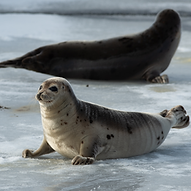
Gontran de Poncins describes a seal hunt and the resulting feast.
"I went with the natives to hunt the seal.
We reached the hunting ground. The dogs were unharnessed and chained up to the anchor fixed in the ice, and tea was made. Then the Eskimos spread fanwise over the sea, each with two specially trained dogs on a thirty-foot lead, and, slung across his chest, a sack containing his tackle. I accompanied one of the hunters and saw the rest dwindle into black dots in the limitless distance. We walked the dogs up into the wind, and soon they began to pull and trot, for they knew that the chase had started. First they ran like pointers, then after a bit they stopped and started off again more slowly and cautiously, nose to the snow. Suddenly they stood quivering in their tracks and sniffing the ground. They had located the aglu, the seal's breathing-hole. We could not see it, for it did not pierce through the snow; but the dogs could smell it. When it was a bull-seal's hole, even the men could smell it, once the dogs had led them there.
Every seal keeps a number of holes open in the ice through wihch to breathe. While the ice is forming over the sea, the seal bobs up and plunges down and bobs up for air again so frequently that the sea freezes very thinly between his visits to the hole, and his body can easily break through the thin sheet of ice. All round the hole, the ice is six or eight feet deep. Above it, over the sheet of ice, snow collects and hides the hole from the passing Eskimo. What is curious also is that the seal comes up to sit on the ice, beneath the surface of the snow, at either side the hole; and here in spring the cow-seal bears her young. A sort of arch of snow is thus formed, and at either end of the arch the seal takes his ease, like a tramp under a bridge.
Our dogs went round and round, sniffing, and that they had truly found the seal-hole was confrimed by my Eskimo after a bit of gentle prodding with the handle fo his harpoon. As I stood by watching, I saw him go suddenly down on his knees. He brought out of his sack a feeler, curved in such a fashion that by making only one hole in the snow, and moving the feeler round in a circle, he could tell just how large the hole was and where its center was. What he found seemed to satifsy him, for he stood up with a grunt and led his dogs about a hundred yards down-wind, where if they chanced to bark they would not be heard by the seal-an animal practically blind but very acute of hearing. He was down-wind and the seal-hole had not yet been opened when he called out across the sea:
"Nik-pa-rar-tun-ga!"--I have found the hole."
His face, as he came back to the hole, was wonderful in the concentrated purpose it expressed, the sober concern with his craft that it revealed.
Now he produced from his sack a marker of the length and shape of a long knitting needle, and sent it straight through the snow into the water that filled the seal-hole. The seal would displace the water as he rose, and with the water the marker would rise. When the marker sank, the hunter would know that the water was back in place and the seal had risen.
From his sack, again, he took a square of bearskin and stood on it about a foot away from the hole. He brought out a steel spear-head which he fastened to the point of his harpoon, and he rested the harpoon horizontally in front of him on a pair of forked sticks that stood upright in the snow. Round his hand he looped the cord tied to the detachable spear-head, and he stood now ready for the kill. When the marker rose he would take the harpoon in his hand. When it sank again, he would drive the spear straight down with one powerful stroke. The spear-head would be deeply imbedded in the seal. He would detach the handle and pull at the cord with all his strength, hauling up the hundred-pound beast.
But the kill might be long delayed. The seal, having several breathing-holes, might be hours coming or might not come at all. I myself had met a hunter who had spent three days motionless....to no avail.
I had been ordered by my Eskimo to move off, and it was from a distance of a hundred feet that I waited and watched, and photographed the sceen. I was in great luck. An hour had not gone by before we heard a shout. A seal! As soon as a seal has been speared, the hunter cries out', "I have killed the seal!" and instantly the others abandon their aglu and race to be in at the kill.
We ran as fast as we could, for the winner of the race receives a choice quarter of the beast, the hunter himself taking the hindquarters, while the rest is distributed thoughout the camp. IT was Tutannuak who had killed the seal, and already he was hauling it out of the hole. Blood ran in streams as th ebeast was brought up, and the dogs bounded over the snow, licking up the blood. Th seal was dragged a few yards from the hole, and then all the hunters knelt round to perform their rite fo thanks to Nuliayuk.
I can describe the scene, but how can I convey its solemnity? There was a hush as Tutannuak picked up his snowknife, made a small incision in the abdomen of the seal, put in his hand, and drew out the liver, all red and smoking. The five hunters knelt in silence as he proceeded. He put the liver down on the seal and cut it into six pieces, one for each, and he set a slice on the snow at his place and before each of the men who knelt, still as in prayer, in that circle. Next he cut and laid beside the liver six chunks of blubber. Six men, members of the hungriest and most voracious race on earth, were motionless in the presence of the greatest delicacies known to the palate of their race. Blubber and liver lay uneaten on the ice while the hunters mutely rendered thanks to Nuliayuk for the gift of the seal. Behind the men sat the dogs, quirvering with greed, their eyes on the seal, but no less still and motionless than their masters. Here, before me, six men and their dogs sat worshipping the sea from which they drew their sustenance, like sun-worshippers adoring the source of light and life. The wide immensity, the hush that overspread this world, lent to this scenec a measureless grandeur.
Suddenly the charm was broken. Each man picked up a pointed stick, stuck it into his bit of liver, and swallowed the liver at a gulp while the blood ran down his chin. Then he popped into his mouth the blubber held in his left hand, and joy spread over all their faces while I, outside the circle, photographed them.
.....
We shoved the seal through the porch, and inside the butchering began. The honor of cutting up and distributing the meat fell to Tutannuak's wife. She skinned the seal, and as she worked she went mentally through the list of households and decided who was to get which cut. The blubber was removed and set aside, the blood was scooped out with a great ladle and poured into a bowl, and the moment for distribution arrived. All the women in the camp were crowding into the porch. Children crawling between their legs and over their backs, the sight and smell of meat creating a prodigious agitiation. On her knees in the porch, her head framed in the opening, the wife of the man who had won the race to Tutannuak held out a basin. And as soon as it was filled she made her way out, and was replaced by the next wife in the same animal posture.

