


Recent History
June 1, 1911
The Northern Copper Inuit - A History
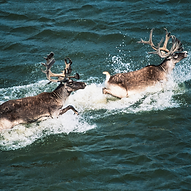
Fatty caribou are prized by Eskimos, especially during the late summer, but the time involves periods of feasting and fasting as game is scarce. Kuptana describes how a chisel tool is used by a young man on his first kill to open the brain of a freshly killed caribou for a feast. The hunting party dedicated all their time to hunting and storing caribou meat for later in the autumn when food is scarce.
Caribou Hunting
William Kuptana: I remember being packed going inland in the summer. When we were out of food, we'd eat seal fat out of the pouch. My parents would also carry a sealskin bag filled with seal blood. We'd drink out of that when were thirsty.
While we were treking inland, food would become scarce. My parents killed a lemming and cooked it. I didn't want to eat it, but they talked to me so I had to eat it. I didn't want to be left behind. We'd keep walking and looking for caribou. When we'd come to a lake that was still frozen over, they would make an agluaq (fishing hole). Hook and spear were used to catch fish. By fishing, that would prevent us from starving. Also, when the ice is gone in the river, they would fish by using spears and wading in after them.
After that, we would go wandering off into the land looking for caribou. We had no guns. Finally, when we found a small herd, the men would then build a small projection of stone slabs on a high point of land to act as a rouse to statle the fleeing caribou. The women would advance toward the caribou, humming as they approached the herd. As the caribou approached the lair where the men were hiding, the men would then kill the closest ones, the ones that they could reach.
The kill meant, "Feast." The family would eat everything: stomach, entrails, marrow. For instance, the entrails would be cleaned out and then cooked. After they were cooked, the entrails would be eaten with seal oil. The extra meat would be cut up to make dried meat.
The warm summer months were not a time of plenty for the Copper Inuit. As Diamond Jenness (1922:123-124) noted: "The traveller will find scattered families reaming about from place to place, here today and gone tomorrow in their restless search for game. Days of feasting alternate with days of fasting according to their failure or success. No fowl of the air, no creature of the land, no fish of the waters is too great or too small to attract their notice at this time."
The scarcity of food in spring and summer was partially alleviated in the late summer/early fall(August and September) when caribou hunting accelerated. At this time of year the caribou are fattest and their hides are ideals for making clothes. Usually a number of families would cooperate in the hunting of caribou using caribou drives set up on the tundra. These drives usually consisted of rows of stone piles set up in tow converging lines. Women and children chased the caribou with lances and arrows. Another technique, more commonly used on the mainland, involved hunting caribou from kayaks at crossing places in lakes. If a caribou drive was successful, much of the meat would be dried and stored for use during the lean autumn months.
First Hunt
William Kuptana: When I first killed a caribou, my biological father started wrestling with me as it is a custom to try to put a young hunter on top of the caribou corpse. After that, the hunting party told me to get the ulimuan [ a chisel-like instrument with a blade at a forty-five degree angle from the handle]. So I got one out of the pack-sack to open its head as it is a custom that a young man do that for a first kill. After I had chopped its skull, the elders started eating its inner membrane, or as it is usually called, the brain. Then, after the feast, the hunting party resumed their search for the tuktuvialuit (Banks Island Caribou). From spring to autumn, the hunting party would kill, store, and go on searching until it was too cold to hunt. Finally, returning to their wintering grounds, they'd wait for winter huddled in their sealskin tents for a time.
January 1, 1928
Julian D. Boyd
The Arrest of Dental Caries in Childhood

Dr Boyd prescribes a high fat diet for diabetic management and to curb dental cavities.
"The principle of diabetic management in this clinic represents an attempt to approximate normal metabolism. Insulin is prescribed in amounts sufficient to keep the blood sugar as nearly within normal limits as possible. The diet is designed to meet the requirements of a normal child for growth, activity, and health. It differs from the usual concept of an ideal diet for a normal child in that fat, rather than carbohydrate, is used as the chief source of energy, the fatty acid: dextrose ratio being 1.5:1. All these children were on the same ratio of protein: carbohydrate: fat, namely, 7:9:21. The total amounts prescribed varied according to each child’s degree of development.
In general, the same foodstuffs were used for all. To a large extent these consisted of milk, cream, butter, eggs, meat, cod liver oil, bulky vegetables and fruits. The menu was designed to include approximately a quart of milk and cream daily. The fat was furnished principally as cream, butter, and egg-yolk. Each child received calories sufficient for full activity; the energy value was higher than is frequently employed in diabetic diets. Adequacy of insulin dosage was verified by frequent blood sugar estimations. These values closely approximated normal concentrations. Glycosuria was different."
July 6, 1929
Clarence W. Lieb
The Effects on Human Beings of a Twelve Months' Exclusive Meat Diet - Based on Intensive Clinical and Labratory Studies on Two Arctic Explorers living under Average Conditions in a New York Climate
Dr Lieb describes a one year clinical trial of the meat-only diet
The question of minimal and optimal protein requirements has received considerable research attention in recent years. There is now very little disagreement among students of nutrition as to what these requirements are. On the effects of a high protein dietary, however, not only do opinions of authorities differ but the results of carefully controlled experiments show considerable variance. It is a traditional belief that a high protein intake leads to high blood pressure, arteriosclerosis or nephritis. Among physicians it has almost become a dietetic dogma to reduce or eliminate entirely the intake of meat whenever diets are prescribed. Unless proper interpretation is given to certain present-day investigations on protein metabolism, including the results of the experiment reviewed in this paper, there is danger that the dietetic pendulum will swing too far in the opposite direction.
January 1, 1930
The Nephropathic Effect in Man of a Diet High in Beef Muscle and Liver.

Dr Louis Newburgh, who thinks obesity is caused by overeating, publishes a case study on a man doing a 4,177 calorie all meat diet for 7 months but admits that there are no problems when not overdoing the protein content.
The Nephropathic Effect in Man of a Diet High in Beef Muscle and Liver.
Author(s) : Newburgh, L. H. ; Falcon-lesses, M. ; Johnston, Margaret W.
Author Affiliation : Med. School, Univ. of Michigan, Ann Arbor.
Journal article : American Journal of Medical Sciences 1930 Vol.179 pp.305-10 ref.8
Abstract : The authors have previously shown that rats living on a diet rich in animal tissues (muscle and liver) gradually developed sclerosis of the kidney. In the present investigation a normal man, aged 32, was given a diet containing less than 100 gm. protein daily, for a preliminary period of 35 days. There was no albumen in the urine during this period and the number of urinary casts averaged 50 per hour (ADDIS gives the average figure in group of students as 87). During the next 6 months the man ate a diet containing 327 gm. of animal protein and with a total calorie value of 4, 177. Beef liver, veal round, beef tenderloin and dried beef were given, about one-quarter of the protein being liver. Only 31 per cent. of the calories of the diet represented animal protein. No clinical or subjective abnormalities appeared. There was a gradual increase in the urine albumen which reached 2 to 4 mgm. of protein per hour in the 6th month. The cast counts during the first 7 weeks were within the normal range. Afterwards the counts were definitely pathological and during the last 6 weeks the average count was 1, 283 (15 X normal average). At first the casts were hyaline; gradually more and more granular casts appeared, and during the last 6 weeks, some were cellular and the hyaline type were in the minority. After returning to a diet of his own choice, in which meat was avoided, the man's urine became normal in 10 days. A diet containing the same proportions of animal protein was found not to affect the kidney of the rat. There are a number of observations which appear to show that an exclusive meat diet is not harmful to the kidneys of man. The Eskimos are cited in this regard, but a recent survey of a number of middle-aged Eskimos shows a definitely higher degree of albuminuria than in the policy holders of a large American insurance company. Furthermore the Eskimos have presumably over many generations become adapted to their diet. The recent investigation on 2 arctic explorers (this Bulletin, 1929, v. 4, 829), showed no renal impairment with " an exclusive meat diet " for 12 months. This diet only contained 100-140 gm. protein daily and 80 per cent. of the energy was in the form of fat.
H. N. H. Green.
January 2, 1948
People of the Deer - Feast and Famine

Farley Mowat visits the Ihalmiut Inuit in the Canadian Barrens and eats an all caribou diet. He describes the importance of fat in an all meat-diet.
VII Feast and Famine
I sat down, or rather squatted down, to eat my first meal with the People. Howmik placed the great tray on the floor of the tent and we five men grouped ourselves around it. That tray was a magnificent piece of work, nearly four feet long by two feet wide with upcurved ends and sides. It had been constructed, with what must have been heartbreaking labour, from little planks hand-hewn from the tiny dwarf spruce of the southern Barrens. At least thirty small sections of wood had been meticulously fitted together and bound in place with mortised joints and pegs of deer horn. The seams had then been tightly sewn with sinew so that the whole tray was waterproof.
The tray was magnificent, but its contents were even more impressive. Half a dozen parboiled legs of deer were spread out in a thick gravy which seemed to be composed of equal parts of fat and deer hairs. Bobbing about in the debris were a dozen tongues and, like a cage holding the lesser cuts of meat, there was an entire boiled rib basket of a deer.
There were side dishes too, for Howmik made a trip to a cache outside and returned with a skin sack, full of flakes of dry meat, which she unceremoniously dumped on the cluttered floor beside me. Nor was that all, for Hekwaw's wife fetched a smoking bundle of marrowbones as her contribution to the feast. These had been neatly cracked so that we would have no trouble extracting the succulent marrow.
I was very hungry, yet the sight of this vast array of meat left me a trifle weak. But it was evident that I was the only one to suffer any qualms of stomach. The others were waiting impatiently for me, as the major guest, to make the first move. The etiquette of the situation eluded me. I took my sheath knife and cautiously sawed off a good-sized chunk of leg meat, scraped the encrustation of hairs from it, and cuddled it in my lap since there was nothing else that could serve as a plate.
Now Franz and the three Thalmiut men tucked in–I use that word advisedly -- and Ohoto seized an entire leg. Sucking the gravy from it with appreciative lips, he sank his teeth into the tough muscle while with his left hand he held the joint away from his face, and with his right hand made a quick slash at the meat with his knife. I watched in horrified fascination. The sharp blade no more than cleared the tip of his broad nose, and he made his cut without even bothering to look where it was going. But the nose survived; the mouthful of meat was severed at the joint and was chewed a time or two and quickly swallowed.
Hekwaw seemed to prefer the soup. He dipped his cupped hands in it and then sucked up the greasy fluid with gusty relish, taking time out now and again to chew at a deer's tongue which he dropped back into the soup to keep warm between bites.
It struck me that I was being a little prissy. So I put my knife back in its sheath, took a deep breath and, seizing my meat in both hands, began to gnaw away on it. It was delicious.
Then Ootek, beaming with the pride of a good host, pressed me to try a marrowbone and showed me how to tap it with a little rock so that the long, jelly-like piece of marrow dropped out intact. I know I was in no position to be an epicurean judge, but I have never tasted anything quite as good as that hot marrow. Fat, but not oily, it did not compare at all with the insipid beef marrow we know. In fact it beggars all description, and it was wonderful!
By this time I had begun to understand why the Ihalmiut parkas were so badly matted, for they were pressed into service as table napkins and as bibs. A steady stream of juice and gravy trickled from Hekwaw's massive chin and was absorbed by the fur of his holiktuk. Try as I might, I couldn't entirely restrain a minor stream that was quickly saturating my flannel shirt. After a while I thought, "The devil with it!' and gave up any efforts to divert the flood.
Howmik, who seemed to be constantly on the run, now reappeared lugging the great iron cooking-pot I had seen outside. Only it was no longer filled with meat. The dinner having been cooked, the pot was now doing duty as a tea 'billy', without benefit of an intervening washing. We supplied the tea, of course, and the canny Ihalmiut had sought out the biggest vessel they owned to brew it in. Had there been a bathtub handy the tea would have been brewed in it, for if the People have one uncontrollable vice, it is tea drinking.
That tea was blacker and solider than any I have ever seen and it was also fortified with the inevitable scum of deer hair and with odd bits of meat. But it was popular enough. Ootek, who is a rather little man, filled and drank three pint mugs of it, stopping only for a burp or two between mugsfull. Then he ate a tongue and drank three more pint mugs of tea.
Everyone else was just as thirsty and the big pot only lasted about twenty minutes before it was sent back for a refill, with the old tea leaves left in it to help strengthen the new brew.
Naturally such a tremendous fluid intake had its inevitable results and the dinner guests were constantly leaping to their feet and dashing out behind the tent- all save Hekwaw, who was too old and dignified a man to dash on such a trivial errand. He solved the problem by making use of a large can standing near the bed. He simply reached for it when it was needed. As it grew full–and it did frequently–his elderly wife removed and emptied it.
It wasn't long before I was too full to tackle even one more marrow bone. Fianz felt the same, but the other men continued their attack on the heaping mound of meat until it was all gone, to the last drop of gravy. Then while they sat back and burped with prolonged fervour, Howmik took the tray away, refilled it, and the women had their meal.
That was my first dinner with the Eskimos but not, as may have seemed inevitable, my last. Five times each day we sat down to a new meal, and in between we had light lunches. While there is food in the Ihalmiut camps, five meals a day is considered barely adequate, though on the trail a man must manage to subsist on three.
The cooking varied somewhat, but the food did not. The rule was meat at every meal and nothing else but meat, unless you could count a few well-rotted duck eggs which served as appetizers. To satisfy my curiosity I tried to estimate the quantity of meat Hekwaw put away each day. I discovered he could handle ten to fifteen pounds when he was really hungry - though otherwise he probably subsisted on somewhat less.
This tremendous intake of protein probably explains the Eskimo thirst for tea or, if no tea is available, for water. The toxic wastes from such quantities of meat would strain the best of human kidneys, and only by drinking several gallons of fluid every day can the Ihalmiut manage to adjust to their amazıng diet. Their bodies seem to have undergone some physical modifications as well, for when you see an Ihalmiut naked - as a visitor sees them every night - you notice that their body thickness, back to front, looks as great as their body width, both measurements taken at the waist. This typical shape presumably results from the enlarged liver needed both to store glycogen against lean periods and to deal with the completely protein diet It most certainly is not a sedentary 'pot'.
The words 'food' and 'deer' are practically synonymous throughout the Barrenlands, but though there is a certain monotony in the choice of food, there are many ways of preparing it. First there is the natural style, and I have eaten my meat this way and found no complaint with it, except perhaps that law meat is singularly taste- less. If the Ihalmiut hunter shoots a deer for food when he is on a trip far from the camps, he seldom bothers to go to the trouble of building a fire. Usually his first act is to cut off the lower legs of the deer, strip away the meat, and crack the bones for marrow. Marrow is fat, and an eternal craving for fat is part of the price of living on an all-meat diet.
With the marrow disposed of, the hunter may shit the animal's throat and catch a cup of blood, for while the People do not know the use of salt, they do seem to crave it and to satisfy their craving with blood, where the saline concentration is very high.
Now having satisfied some of his specific cravings, the hungry hunter slices through the flank of the beast and carefully picks off the bits of suet clinging to the entrails. If he is still hungry – and he usually is -- the hunter may also cut off part of the brisket if the animal is fat. Before leaving the carcass he takes out the tongue and sometimes the kidneys, and these he carries with him until he can find time and fuel to light a fire.
All the parts that I have so far mentioned can be eaten cooked, of course, and when it is possible they will be cooked, for the Ihalmiut do not eat raw meat from choice. When only an open fire is available, cooking methods are delightfully simple. The roast is simply shoved into the coals and left there until it is well charred on the outside. Pulled out and scraped, the inner core is found to be well cooked to a depth of an inch or so, and this part is eaten, then the roast is again pushed into the fire and the process repeated until the bone itself is reached and the hot marrow is ready for extraction.
When meat is cooked at camp it is usually boiled, if fuel permits, for the soup is greatly loved by everyone. Originally, and not so many years ago, the Ihalmiut used great square-cut stone pots made of a kind of soapstone. These were filled with water and chunks of meat, then hot pebbles were added to the water to bring it to a boil. It was a slow chore, and parboiling was usually chore enough, but now iron pots have been obtained in trade from the coastal Eskimos, and boiling meat is easier than it once was.
Amongst the special boiled delicacies I must mention fawn's head. Any deer head is good when boiled, but the heads of fawns are best of all. They are sometimes skinned before cooking, more often not, but the meat from them is the most delicious from the animal and the fat behind the eye is the best part of the head. Incidentally, when occasional fish are speared in summer, the boiled heads are again considered to be the choicest part.
Nearly all of the caribou is eaten, one way or another. But as you may have noticed, the steaks and roasts that we prefer don't often appear on the Ihalmiut menu. Usually the dogs get the rumps and thighs, for these parts of the caribou seem to be lacking in the specific nutriments that a meat-eating man requires. The Ihalmiut believe that only by eating all parts of the deer can they achieve a satisfactory diet. So the heart, kidneys, intestines, liver and other organs are greatly esteemed and often eaten.
There is a third way of using deer meat, and that is by preparing nipku, or dried meat. The Ihalmiut make this dish because it is a variation of an otherwise monotonous diet and because it can be easily stored to tide them over times when the deer are not about. Nipku is made by slicing muscle tissues paper-thin, then spreading it to dry on willow bushes near the camps. It looks, and tastes, like cardboard sparsely sprinkled with icing sugar, and it is as tough as blazes, but an excellent trail food since it equals five times its weight in fresh meat. I liked nipku, finding it as good as most Ihalmiut dishes, though I must admit to a certain indignation when Ohoto gave me a bag of it that was already in the possession of a lively collection of fly maggots.
Undoubtedly the most important item of Ihalmiut food is fat. Amongst the coastal Eskimos the supply of fat is limited only by the number of sea mammals that are killed, and blubber, that grossly overworked arctic word, is obtained in immense quantities from seals, walrus, narwhales and other aquatic mammals who build thick blankets of fat as an insulation against the cold of the arctic seas. The coastal people have so much fat and oil available that they can meet all their dietary needs and have enough left over to heat and light their igloos, and to cook upon. Well, they are lucky. The inland people of the plains must depend for fats on what they can obtain from the deer, and the caribou is no substitute for a seal as a source of oil.
In the fall of the year, just before the rutting season for the bucks and just after for the does, the deer are in then best physical condition and this is the only time of the entire year that fat can be obtained from them in any quantity. Buck deer, killed in the autumn, may carry thirty pounds of pure white suet under their hides, and though this sounds like a lot, when it is rendered down it gives a much smaller quantity. It takes a great many fat buck deer to equal one seal in the production of oil.
During the fall hunt the Ihalmiut must collect sufficient fat to meet the year's needs, but there is never enough to provide fuel, food, and heat together. As a result the winter igloos generally remain entirely unheated, and almost without artificial light during the interminable winter darkness. Yet the People manage to survive temperatures of fifty degrees below zero in their winter homes because fat is being burned- within their bodies. Each man is his own furnace, and as long as there are enough blocks of deer fat to last until spring, the People manage to stay alive under conditions which seem completely inimical to the maintenance of human life. Enough fat is the answer, and the sole answer, to winter survival in the Barrens.
The importance of fat as a fuel is, however, only part of the story. Even in summer, when the problem is to stay cool, fat remains absolutely essential to the well-being of the People. I had its importance demonstrated to me during one long canoe trip Franz and I took. We were short of supplies- in fact we were completely out of them except for a pound of tea, half a pound of lard, and some ammunition. So we lived by the rifle, and we lived on deer.
It was late summer then and the deer were extraordinarily thin as a result of long months of persecution by the flies, and so our diet consisted almost entirely of lean meat. For the first few days I made out very well on three meals of lean meat a day, but before the end of the week I was smitten with an illness which for want of a better name I called mal de caribou. It was an unpleasant illness to have during a canoe voyage. The river was fast and filled with rapids, but nevertheless I had to go ashore at frequent intervals, whether we were in 'white water' or not. And I had to expose myself so often to the insatiable flies that it became painful for me to sit down.
But persistent diarrhoea was only a part of the effect of mal de caribou. I was filled with a sick lassitude, an increasing loss of will to work that made me quite useless in the canoe. I began to get really worried. Memories of dysentery in Sicily came uneasily to mind and the thought that the nearest medical aid was three hundred miles away did not bring me much comfort.
Then Franz turned physician. One evening he took our half- pound of precious lard, melted it in a frying-pan, and, when it was lukewarm and not yet congealed, he ordered me to drink it.
Strangely, I was greedy for it, though the thought of tepid lard nauseates me now. I drank a lot of it, then went to bed, and by morning I was completely recovered. This sounds like a shock cure, but in fact I was suffering from a deficiency of fat and did not realize it.
Exactly what the physiological effect of fat, apart from its straight nutrition value, is on the metabolism of a meat-eater is something I do not know. But I do know that man cannot function on lean meat alone. Perhaps there is an enzyme in fat which acts on lean meat in the digestive tract; perhaps certain essential vitamins are present in the fat. Whatever the factor may be it is clear that fat provides not only the large amount of calories essential to winter survival in the arctic, but also some essential substance without which a meat diet is impossible.
Of course the Ihalmiut have always been aware of this, and it is their custom, winter or summer, to eat not less than a mouthful of fat for every three of lean meat. This is the ideal proportion, but it is not always possible to maintain it, and when fat becomes scarce the Ihalmiut appear most susceptible to disease and show other symptoms of a greatly lowered resistance.
So the point I wish to make is that fat is not just a cold weather fuel to the Eskimos, but is a vitally essential part of their everyday diet. And this is a point which seems to have escaped the notice of those administrators who are entrusted with the well-being of the Northern natives. At any rate, the current trend in the arctic is to bring about the transition from native foods, and by that I mean animal or protein or fat foods, to the prepared foods of the white man which are largely composed of starch. I will have something to say about the appalling results of this policy later in this chapter.
It may be thought that the Barrens ought to be able to provide some variety from the eternal diet of deer meat. Perhaps the total reliance of the Ihalmiut on the deer may seem foolish particularly when death by starvation often results from this limited dependence.
Well, the Barrens are not given over to the deer alone. In the winter, great numbers of arctic hares move down from the northern fringes of the Barrens, and they make delicious and tender food. Then there are the ptarmigan, whose numbers are so great in spring and fall that the flocks may cover the hills like snow. The rivers and lakes are literally filled with whitefish, tout, grayling and suckers and these can be netted in quantity during the summer. Oddly enough the Ihalmiut have no nets, and have never used them, though they spear the occasional fish with the ingenious spear that is common to most Eskimo cultures.
With their usual acumen the authorities have seized upon this evidence of the remissness of the primitive mind. Obviously, they think, the ignorant natives must be unaware of the untouched reservoirs of food in the lakes and rivers, if they are so backward that they have not even learned to make and to use nets. So the authorities would supply nets, and thereby solve the starvation problem in the Barrens.
This plan was brilliantly reasoned out. On my return to the Barrens in 1948, I was given a large supply of nets to distribute to the Ihalmiut and I was told to instruct the People in their use so that they would never again be faced with a starvation winter.
I took the nets, for it is of no use to argue with men of government, and in due course I gave them to the People and showed them how to use them. The Ihalmiut thanked me, for they are a courteous lot, and they humoured me further by borrowing my canoe and learning to set the nets. Certainly I fulfilled my orders and I have no doubt this was a source of satisfaction to the authorities in Ottawa.
However, there were some minor points which had been overlooked by the enthusiastic agents. In the first place the Ihalmiut have kayaks, but no other kind of boat such as the open umiak of the coast Eskimos, and it is exceedingly difficult - if not impossible -to set or service a net from a kayak. In the second place it is during the winter and early spring that starvation comes to the People, and the problems of setting nets under ten or twelve feet of fresh-water ice would baffle even the ingenious Ihalmiut.
Yet these physical problems are relatively unimportant. There was a reason why the Ihalmiut had never learned to make and to use nets; for they were perfectly well aware of the fish that could be had for the taking. But they also knew that the results of fishing on a large scale are simply not the kind of results that can support human life in the Barrens. It all comes back again to the problem of fat. No inland fish, and this applies equally to hares and ptarmigan, can supply even a fraction of the fat requirements of the People. Fish are fine in summer as a dietary supplement when there is plenty of food in any case. In winter a prolonged diet of fish would be disastrous as poison to the People, and starvation in the form of fatal deficiencies would smite those whose bellies are distended with fish as violently as it smites those whose bellies are empty. Later I will tell the story of a race of Northern natives who were weaned over from deer meat to fish. It is evident that the tragedy which resulted did not make its mark upon the official minds of men in high quarters.
The deer must feed the People, and the deer alone can give the People life. In the years to come the Ihalmiut will eat deer meat as they have done for countless centuries and as their bodies demand that they continue to do. If, and when, the ume comes that there are no more deer, then the last Ihalmiut will die in their igloos and the problems that they pose to us as their guardians will not be problems any longer. The fish nets will fray and whiten on the rocks by the shores of the Little Lakes, but there will be none to use them. They will remain for a while as symbols of the type of aid that we gave to the People in their extremity.
Something must now be said of famine, of the real but hidden cause of the destruction which has come upon all the Northern natives, Eskimos and Indians, wherever white men have come amongst them. It is not a pretty tale.
The story is often told of the decimation of the forest Indians, brought about by disease, by lack of adaptability, by inherent laziness and indolence or by other causes. Much has been heard of these things but the truth is never heard, for all of these apparent causes are but manifestations of the real destroyer, which is starvation.
To anyone who asks about the thousands of Indians and Eskimos who die each year of tuberculosis, about the measles and smallpox epidemics which in the last two decades have destroyed over one-tenth of the Northern natives; to anyone who asks whether these people too died of starvation, I answer that they did.
One of the most popular apologies for our failure to preserve the Northern races from destruction has been the theory of 'acquired immunities.' It is something the natives haven't got- and cannot get - if we believe the propagandists. And yet no medical authority has ever been foolish enough to say that certain races can develop specific immunities to disease while others cannot. The theory that Eskimos and Indians are, and always will be, lacking in the immunities we possess has been used to explain our inability to check the ravages of tuberculosis and the other diseases that yearly take a tremendous toll of the Northern natives. But this idea is as untenable as the theory that Aryans are superior to Semitic peoples. Immunities to disease are acquired. And the ability to acquire them belongs to all men. But if it were simply a question of immunities, then the Indians of the Mackenzie River region would long since have acquired all they needed, for disease has been a mighty killer in that land for a century and a half. And yet the children's children of survivors of ancient epidemics still die by the hundred when a plague comes down the river and into the huddled settlements. It looks then as if the 'immunities' apologists may be correct - but it only looks that way.
I loathe statistics, but I must quote these to prove my point. The reported death rate from tuberculosis in the Canadian Northwest Territories between 1937 and 1941 was 761 per 100,000 as compared with 50 per 100,000 in the rest of Canada. This figure includes only those native deaths examined by a medical officer. There is good reason to believe the true figure should be well over 1,000 deaths, since a high proportion of the Northern peoples die, and are buried, without the knowledge of white men. Now tuberculosis has been present in this area for 150 years and yet, oddly enough, the natives seem to have been quite unable to develop a resistance to it. What has starvation to do with all this? I shall explain with men, instead of figures.
On Reindeer Lake in Northern Manitoba there is a settlement called Brochet. It is the centre of the surviving members of the branch of the Chipewayan Indians who call themselves Idthen Eldeli - Eaters of Deer. In 1860 when Brochet was already a well-established trading post there were about 2,000 members of the Idthen band and theirs was a peculiar and demanding life. In the winter they lived in tents within the borders of the high arctic forests where the deer also wintered. In spring, when the deer moved out into the great plains, the Idthen people followed after. So the Idthen band annually travelled over a thousand miles through the Barrens, the home of the Ihalmiut.
In the eighteenth century the famous explorer Samuel Hearne journeyed overland across the Barrens from Churchill to Coppermine River with a band of these Indians and he speaks, as do many others, of the almost superhuman endurance and physical capacity of the Idthen people.
In the winter of 1948 when I visited the Idthen Eldeli at Brochet, the band numbered a little over 150 men, women and children who spent the winters on their scanty trap lines, starving through the cold months until they could fish for life along the opening rivers. They no longer followed the deer on the long trek into the Barrens. Instead they followed the deer on the long trek to extinction. They are a passive, beaten, hopeless people who wait miserably for death. They are unclean, weak-bodied, sick caricatures of men, who spend their days in an apathy broken only when utter necessity drives them to make an effort to live a little longer. Also- and despite almost a century of contact with white men - they have acquired no immunities.
It has been nearly one hundred years now since the Idthen Eldeli began to starve. Starvation first came to them when they began to exist on a winter diet which now consists of 80 per cent white flour, with a very little lard and baking powder, and in summer almost nothing but straight fish. The Idthen people now get little of the red meat and white fat of the deer, once their sole food. Three generations have been born and lived - or died - upon a diet of flour bannocks and fish eaten three times a day and washed down with tea. Each of these generations has been weaker and had less 'immunity' from disease than the last. Some of the people died from outright hunger, with their bodies shrunken into hard bundles of dry skin, and with bones which showed startlingly clear through the parchment tissues. But most of them died coughing blood, or with festering membranes clogging their throats, or with huge sores upon the surfaces of their thin bodies. They also were the victims of that long starvation.
Before the opening of the trading posts this people lived as the Ihalmiut do, upon the deer. After Brochet was established by the Hudson Bay Company as a 'meat post' - that is, as a point of supply where deer meat could be made into pemmican and sent out on to the prairies where the buffalo had already been destroyed and meat was scarce - the Idthen people began to change their diet.
They were encouraged by the traders to forgo the summer trips out into the Barrens to live with, and on, the deer, and they learned to live instead on fish and on the handouts of flour given them on credit so that they would remain tied in the infamous 'debt system' which was, and is, the white man's way of trading with the natives. They were encouraged to slaughter the deer not for their own use but for the meat trade, and on such a scale that the deer inevitably began to follow the buffalo. The Idthen Eldeli were discouraged from eating the meat they killed, for there was no profit in that for the traders. There was profit in flour at seventy-five dollars a sack. There was profit in sugar, baking powder, and in an array of useless knick-knacks, but there was no profit in the deer as food for the people.
And so today disease, the fatal apathy which prevents men from looking into the uncertain future, and weakness of body which prevents a man from defending himself against the approach of death these three are present in the land, and they have one name, and the name is starvation.
The Idthen people who have been tricked and bribed into abandoning the gift of the deer are passing quickly from the high forests. Each year the energy of men grows less and the hunters catch less fur. Each year more women cough their life's blood on to the filthy dirt floors of the wooden hogpens which their ancestors would have scored. In the winter tents, with the subzero cold passing at will through the shoddy cloth of trade clothes instead of being kept out by warm caribou skin garments, the women mix flour and baking powder to feed the children who may live till spring. In the summer the men lift the nets they have been taught to use and the people eat fish each day, and when fall comes they are impotent beings against the night of winter. It is true- such people as these cannot acquire our immunities, for starving bodies have no strength to repulse the onslaughts of disease.
The Idthen people, who are but one of the many tribes in similar condition across the Territories, are dying of starvation.
Nor is it far from the silent camp sites of the Idthen Indians to the tent of Ootek, where I sat down to feast upon the meal he set before me, amidst the laughter and strength of people who have not yet reached the poverty of spirit and of mind which is now the birthright of the Idthen Eldeli. The Ihalmuut still have a little way to go, for as yet the starvation they have known is only the direct death of famine and though it has thinned their ranks, the hidden starvation that has come to the Indians has not yet destroyed the hearts of the Ihalmiut. Now that we have made our decision to aid the few surviving inland Eskimos, no doubt it will not be very long before they are brought to the same pass as those other Eaters of the Deer, for then there will be no eaters of the deer, and in a little while, no People of the Deer.
I am writing in terms of the present, and not of the past. When I was in the forests amongst Indians, I met a doctor who is sent in twice yearly by the authorities, and I spoke to him of the number of Indians who were dying of tuberculosis in that area. He replied by telling me he could do little for them. The hospitals were full and anyway the Indians did not seem to respond to treatment. But he pointed out with righteous pride that the government was spending hundreds of thousands of dollars building hospitals to cure the natives of their ailments across the North.
Surely there is but one way to cure a man of the diseases which are the products of three generations of starvation, and that is to feed him. It is so simple an idea that I suppose it cannot possibly have real validity- or else it would have been tried long before this. But it does not greatly matter any more, for soon there will be no mouths to feed. These parodies of men, the northern Indians, who are not God's creations as the missionaries would insist, but who were created at our hands, will not need great hospitals, for it is quite true after all, they are incapable of building up immunity against starvation.


