


Recent History
January 1, 1951
Roger Buliard
Carnivore
Inuk
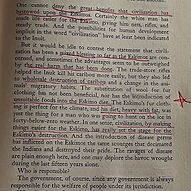
Buliard questions whether civilization has been positive for the people of the North: The Eskimo's fur clothing is perfect for the climate, and his diet, heavy with fat, was just the thing for a man who was going to hunt on the ice in forty-below-zero weather. In one sense, civilization, by making things easier for the Eskimo, has really set the stage for the Eskimo's destruction.
One cannot deny the great benefits that civilization has bestowed upon the Eskimos. Certainly the white man has made life easier for the Eskimo, giving him nets, rifles, and steady trade. And the possibilities for human development implicit in the word "civilization" have at least been indicated to the Inuit.
But it would be idle to contest the contest the statement that civilization has been a mixed blessing so far as the Eskimos are concerned, and sometimes the advantages seem to be outweighed by the real harm that has been done. The trade-store rifles helped the Inuk kill his caribou more easily, but they also led to wholesale destruction of caribou and a change in the animals' migratory habits. The substitution of wool for fur clothing has not been beneficial, nor has the introduction of unsuitable foods into the Eskimo diet. The Eskimo's fur clothing is perfect for the climate, and his diet, heavy with fat, was just the thing for a man who was going to hunt on the ice in forty-below-zero weather. In one sense, civilization, by making things easier for the Eskimo, has really set the stage for the Eskimo's destruction. And the introduction of disease germs has inflicted on the Eskimos the same scourges that decimated the Indians and destroyed their pride. The ravages of disease are plain enough here, and one may deplore the havoc wrought during the last fifteen years alone.
Who is responsible[not God, obviously]?
The government, of course, since any government is always responsible for the welfare of people under its jurisdiction.
What has been Canada's attitude toward "Natives" generally?[The same attitude that Catholic schools had?]
The goverment was unfair to the Indians. After the treaty, by means of which the Indians sold their birthright--the limitless prairies and rich forests--for a mess of lentils, the government permitted tuberculosis, starvation, and loss of liberty to reduce them from a proud, self-sufficient people to a race of permanent invalids.
Was this done innocently, or through oversight? Through ignorance?
One wonders. As an official told Bishop Breynat: "it had been thought that the Indian problem would resolve itself. Their number was diminishing steadily. They would disappear."
The same policy was adopted where Eskimos were concerned.
Toward them Canada had no written obligation, as it had toward the Indians, but only the Biblical warning that we are all our brothers' keepers. Nor did the government have any specific duty toward them, except in moral terms. And so the goverment fell back on a policy that can be summed up in a word: indifference.
Indifference!
January 1, 1953
Alfred W. Pennington
Carnivore
Treatment of OBESITY with Calorically UNRESTRICTED DIETS

Dr Pennington recommends a calorically unrestricted diet of protein and fat with restriction of carbohydrate
"Restriction of carbohydrate, alone, appears to make possible the treatment of obesity on a calorically unrestricted diet composed chiefly of protein and fat. The limiting factor on appetite, necessary to any treatment of obesity, appears to be provided by increased mobilization and utilization of fat, in conjunction with the homeostatic forces which normally regulate the appetite. Ketogensis appears to be a key factor in the increased utilization of fat. Treatment of obesity by this method appears to avoid the decline in the metabolism encountered in treatment by caloric restriction. Details of diet and regimen are given."
March 1, 1953
Effect upon Serum Cholesterol and Phospholipids of Diets Containing Large Amounts of Vegetable Fat
Institute for Metabolic Research discovers that replacing animal fats with vegetable fats dramatically lowers total cholesterol.
"At the Institute for Metabolic Research in Oakland, California, for instance, researchers first discovered in 1952 that replacing animal fats with vegetable fats would dramatically lower total cholesterol."
A later study in a patient maintained for a prolonged period of time on diets in which vegetable and animal fat were ‘alternated in calorically equivalent amounts for specific periods, revealed findings comparable with the preceding, that is, a fall in cholesterol and phospholipids on the vegetable fat intake, and a rise to average levels on formula diets in which the fat was entirely of animal origin. During a portion of this study the fat was derived entirely from egg yolk in an amount equivalent to 36 egg yolks daily. Normal hut not supernormal levels of cholesterol occurred during the egg yolk feeding.
SUMMARY The use of formula diets containing large amounts of vegetable fat has resulted consistently in a major fall in serum cholesterol and in phospholipids. Whatever the meaning of this observation, it is apparent that high dietary fat per se does not result in elevation of serum cholesterol.


