

Hunter-Gatherer
Hunter-gatherer societies refer to a way of life that prevailed for most of human history, where people relied on hunting wild animals, fishing, and gathering edible plants, fruits, and nuts for their subsistence. This lifestyle was common before the development of agriculture around 10,000 years ago.

Recent History
November 1, 1843
Osborne Russell
Journal of a Trapper

A trapper provides various references to the important of fat meat, which was plentiful in the areas to the west of the Rockies. "The Sheep were all very fat so that this could be called no other than high living"
...we travelled down this stream about 15 Mls and stopped to kill and dry Buffaloe meat sufficient to load our loose horses. On the 22d We moved down 10 mls. where we found thousands of Buffaloe Bulls and killed a great number of them as the Cows were very poor at this season of the year.
Here we Killed a couple of fine Bulls and took some of the best meat.
These peaks bear the French name of Tetons or Teats - The Snake Indians call them the hoary headed Fathers. This is a beautiful valley consisting of a Smooth plain intersected by small streams and thickly clothed with grass and herbage and abounds with Buffaloe Elk Deer antelope etc.
Here we again fell on to Lewis' fork which runs in a Southern direction thro. a valley about 80 mls long then turning to the west thro. a narrow cut in the mountain to the mouth of Salt River about 30 miles. This Valley is called "Jackson Hole" it is generally from 5 to 15 mls wide: the Southern part where the river enters the mountain is hilly and uneven but the Northern portion is wide smooth and comparatively even the whole being covered with wild sage and Surrounded by high and rugged mountains upon whose summits the snow remains during the hottest months in Summer. The alluvial bottoms along the river and streams inter sect it thro. the valley produce a luxuriant growth of vegetation among which wild flax and a species of onion are abundant. The great altitude of this place however connected with the cold descending from the mountains at night I think would be a serious obstruction to growth of most Kinds of cultivated grains. This valley like all other parts of the country abounds with game.
On the North and West were towering rocks several thousand feet high which seem to overhang this little vale - Thousands of mountain Sheep were scattered up and down feeding on the short grass which grew among the cliffs and crevices: some so high that it required a telescope to see them.
We now seated ourselves for a few minutes to rest our wearied limbs and gaze on surrounding objects near us on either hand the large bands of Mountain Sheep carelessly feeding upon the short grass and herbage which grew among the Crags and Cliffs whilst Crowds of little lambs were nimbly Skipping and playing upon the banks of snow.
The next morning at daybreak I arose and kindled a fire and seeing the mules grazing at a short distance I filled my tobacco pipe and sat down to Smoke, presently I cast my eyes down the mountain and discovered 2 Indians approaching within 200 yards of us I immediately aroused my companion who was still sleeping, we grasped our guns and presented them upon the intruders upon our Solitude, they quickly accosted us in the Snake tongue saying they were Shoshonies and friends to the whites, I invited them to approach and sit down then gave them some meat and tobacco, they seemed astonished to find us here with Mules saying they knew of but one place where they thought mules or horses could ascend the mountain and that was in a NE direction.
But for my part I was well contented for an eye could scarcely be cast in any direction around above or below without seeing the fat sheep gazing at us with anxious curiosity or lazily feeding among the rocks and scrubby pines. The bench where we encamped contained about 500 acres nearly level. 16th We staid at this place as our wounded comrade had suffered severely the day before. Some went down the stream to hunt a passage while others went to hunt Sheep. Being in Camp about 10 ock I heard the faint report of a rifle overhead I looked up and saw a sheep tumbling down the rocks which stopped close to where I stood but the man who shot it had to travel 3 or 4 miles before he could descend with safety to the Camp. The Sheep were all very fat so that this could be called no other than high living both as regarded altitude of position and rich provisions
August 1, 1854
The White Indian Boy - The Story of Uncle Nick among the Shoshones
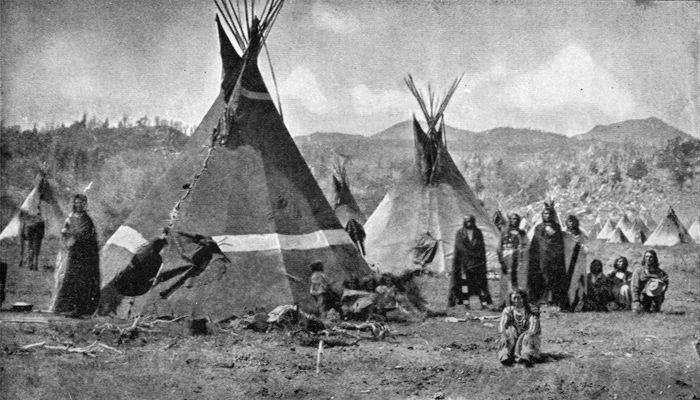
A white pioneer in Utah learns Native American language and then at 12 years old runs away to eat meat with the Indians. He is adopted as a chieftain's brother and then lives the life of hunting and fishing. His fascinating accounts points out importance of fatty meat over lean while describing a lush world just 200 years ago.
Quotes relating to meat, fat, hunting.
I was born in Illinois in 1842. I crossed the plains by ox team and came to Utah in 1850. My parents settled in Grantsville, a pioneer village just south of the Great Salt Lake. To protect themselves from the Indians, the settlers grouped their houses close together and built a high wall all around them. Some of the men would stand guard while others worked in the fields. The cattle had to be herded very closely during the day, and corralled at night with a strong guard to keep them from being stolen. But even with all our watchfulness we lost a good many of them. The Indians would steal in and drive our horses and cows away and kill them. Some times they killed the people, too.
The savages that gave us the most trouble were called Gosiutes. They lived in the deserts of Utah and Nevada. Many of them had been banished into the desert from other tribes because of crimes they had committed. The Gosiutes were a mixed breed of good and bad Indians.
They were always poorly clad. In the summer they went almost naked; but in winter they dressed themselves in robes made by twisting and tying rabbit skins together. These robes were generally all they had to wear during the day and all they had to sleep in at night.
They often went hungry, too. The desert had but little food to give them. They found some edible roots, the sego, and tintic, which is a kind of Indian potato, like the artichoke; they gathered sunflower and balzamoriza seeds, and a few berries. The pitch pine tree gave them pine nuts; and for meat they killed rabbits, prairie dogs, mice, lizards, and even snakes. Once in a great while they got a deer or an antelope. The poor savages had a cold and hungry time of it; we could hardly blame them for stealing our cattle and horses to eat. Yes, they ate horses, too. That was the reason they had no ponies, as did the Bannocks and Shoshones and other tribes.
A few tame Indians hung around the settlements begging their living. The people had a saying, “It is cheaper to feed them than to fight them,” so they gave them what they could; but the leaders thought it would be better to put them to work to earn their living; so some of the whites hired the Indians. My father made a bargain with old Tosenamp (White-foot) to help him. The Indian had a squaw and one papoose, a boy about my age. They called him Pantsuk.
At that time my father owned a small herd of sheep, and he wanted to move out on his farm, two miles from the settlement, so he could take better care of them. Old Tosenamp thought it would be safe to do so, as most of the Indians there were becoming friendly, and the wild Indians were so far away that it was thought they would not bother us; so we moved out on the farm.
Father put the Indian boy and me to herding the sheep. I had no other boy to play with. Pantsuk and I became greatly attached to each other. I soon learned to talk his language, and Pantsuk and I had great times together for about two years. We trapped chipmunks and birds, shot rabbits with our bows and arrows, and had other kinds of papoose sport.
Some months after this the poor little fellow took sick. We did all we could for him, but he kept getting worse until he died. It was hard for me to part with my dear little Indian friend. I loved him as much as if he had been my own brother.
After Pantsuk died, I had to herd the sheep by myself. The summer wore along very lonely for me, until about the first of August, when a band of Shoshone Indians came and camped near where I was watching my sheep. Some of them could talk the Gosiute language, which I had learned from my little Indian brother. The Indians seemed to take quite a fancy to me, and they would be with me every chance they could get. They said they liked to hear me talk their language, for they had never heard a white boy talk it as well as I could.
One day an Indian rode up to the place where I was herding. He had with him a little pinto pony. I thought it was the prettiest animal I ever saw. The Indian could talk Gosiute very well. He asked me if I did not want [10]to ride the pony. I told him that I had never ridden a horse. He said that the pony was very gentle, and helped me to mount it. Then he led it around for a while. The next day he came again with the pony and let me ride it. Several other Indians were with him this time. They took turns leading the pony about while I rode it. It was great sport for me. I soon got so I could ride it without their leading it. They kept coming and giving me this fun for several days.
One day, after I had ridden till I was tired, I brought the pony back to the Indian who had first come, and he asked me if I did not want to keep it.
“I would rather have that pony,” I replied, “than anything else I ever saw.”
“You may have it,” he said, “if you will go away with us.”
I told him I was afraid to go. He said he would take good care of me and would give me bows and arrows and all the buckskin clothes I needed. I asked him what they had to eat. He said they had all kinds of meat, and berries, and fish, sage chickens, ducks, geese, and rabbits. This sounded good to me. It surely beat living on “lumpy dick”(Made by cooking moistened flour in milk.) and greens, our usual pioneer fare.
“Our papooses do not have to work,” he went on, “they have heap fun all the time, catching fish and hunting and riding ponies.”
That looked better to me than herding a bunch of sheep alone in the sagebrush. I told him I would think it over. That night I talked with old Tosenamp. The Indians had tried to get him to help them induce me to go with them. He refused; but he did tell me that they would not hurt me and would treat me all right. The next day I told them I would go.
My parents knew nothing about it. They would never have consented to my going. And it did look like a foolish, risky thing to do; but I was lonely and tired and hungry for excitement, and I yielded to the temptation. In five days the Indians were to start north to join the rest of their tribe. This Indian was to hide for two days after the rest had gone and then meet me at a bunch of willows about a mile above my father’s house after dark with the little pinto pony. The plan was carried out, as you will see. I went with them, and for two years I did not see a white man. This was in August, 1854. I was just about twelve years old at the time.
The night came at last when we were to leave. Just after dark I slipped away from the house and started for the bunch of willows where I was to meet the Indian. When I got there, I found two Indians waiting for me instead of one. The sight of two of them almost made me weaken and turn back; but I saw with them my little pinto pony and it gave me new courage. They had an old Indian saddle on the pony with very rough rawhide thongs for stirrup straps. At a signal from them, I jumped on my horse and away we went. Our trail led towards the north along the western shore of the Great Salt Lake.
The Indians wanted to ride fast. It was all right at first; but after a while I got very tired. My legs began to hurt me, and I wanted to stop, but they urged me along till the peep of day, when we stopped by some very salt springs. I was so stiff and sore that I could not get off my horse, so one of them lifted me off and stood me on the ground, but I could hardly stand up. The rawhide [14]straps had rubbed the skin off my legs till they were raw. The Indians told me that if I would take off my trousers and jump into the salt springs it would make my legs better; but I found that I could not get them off alone; they were stuck to my legs. The Indians helped me, and after some very severe pain we succeeded in getting them off. A good deal of skin came with them.
I ate some duck and dried meat and felt better.
We traveled all day over a country that was more like the bottom of an old lake than anything else. We camped that night by another spring. The Indians lifted me from my horse, put me down on a robe and started a fire. Then they caught some fish and broiled them again on the coals. It was a fine supper we had that night.
The next morning I felt pretty well used up; but when I had eaten some fish and a big piece of dried elk meat for breakfast, I felt more like traveling. Then we started again.
The old squaw put her hand on my head and began to say something pitiful to me, and I began to cry. She cried, too, and taking me by the arm, led me into the tepee, and pointed to a nice bed the chief’s wife had made for me. I lay down on the bed and sobbed myself to sleep. When I awoke, this new mother of mine brought [17]me some soup and some fresh deer meat to eat. I tell you it tasted good.
The next morning my new mother thought she would give me a good breakfast. They had brought some flour from the settlements, and she tried to make me some bread, such as I had at home. They had no soda, nothing but flour and water, so the bread turned out to be pretty soggy. I think she didn’t like it very well when she found I didn’t eat it, but I simply couldn’t choke it down. I did make a good meal, however, of the fried sage chicken and the fresh service berries that she brought with the bread.
Nothing else of importance happened until we reached Big Hole Basin. There I saw the first buffalo I had seen since crossing the plains. Seven head of them appeared one morning on a hill about a mile away. Ten Indians started after them. One, having a wide, blade-like spear-head attached to a long shaft, would ride up to a buffalo and cut the hamstrings of both legs, then the others would rush up and kill the wounded animal.
About fifteen squaws followed the hunters to skin the buffaloes and get the meat. Mother and I went with them. The squaws would rip the animals down the back from head to tail, then rip them down the belly and take off the top half of the hide and cut away all the meat on that side from the bones. They would tie ropes to the feet of the carcass and turn it over with their ponies, to strip off the skin and flesh from the other side in the same way.
The meat was then carried to camp to be[23] sliced in thin strips and hung up to dry. When it was about half dry, the squaws would take a piece at a time and pound it between two stones till it was very tender. It was then hung up again to dry thoroughly. The dried meat was put into a sack and kept for use in the winter and during the general gatherings of the tribe. The older it got the better it was. This is the way the Indians cured all of their buffalo meat. Washakie had about five hundred pounds of such meat for his own family when we reached Deer Lodge Valley, now in Montana, the place of our great encampment.
Washakie’s wife was there and she told me to dash ahead and tell the chief to hurry back. When he came, he ordered the band to stop and pitch camp. We had to stay there a week to let mother get well enough to travel again. There were a great many antelope in the valley and plenty of fish in the stream by the camp. When mother would go to sleep, I would go fishing. When she awoke Hanabi would call, “Yagaki come,” and I would get back in double-quick time.
One day while we were camped here waiting for mother to get better, I went out with Washakie and the other Indians to chase antelope. About fifty of us circled around [31]a bunch and took turns chasing them. The poor little animals were gradually worn out by this running and finally they would drop down one after another, hiding their heads under the bushes, while the Indians shot them to death with their bows and arrows. I killed two myself. When I got home and told mother about it, she bragged about me so much that I thought I was a “heap big Injun.”
Mother’s arm soon got well enough for her to travel, for the medicine man had fixed it up very well, so we took up our journey again. There were a great many buffaloes and antelope too, where we next pitched camp. We stayed there for about three weeks. During the times that she could not watch me, mother had Washakie take me out on his hunting trips. That just suited me. It was lots of fun to watch the Indian with the big spear dash up and cut the hamstrings of the great animals. When they had been crippled in this way, we would rush up and shoot arrows into their necks until they dropped dead. The first day we killed six, two large bulls and four cows.
I told Washakie that my bow was too small to kill buffaloes with. He laughed and said I should have a bigger one. When we got back to camp, he told some Indians what I had said and one very old Indian, whose name was Morogonai, gave me a very fine bow and another Indian gave me eight good arrows. I felt very proud then; I told mother that the next time I went out I would kill a whole herd of buffaloes. She said she knew I would, but she did not know what they could do with all the meat.
Washakie said that I was just like the rest of the white men. They would kill buffaloes as long as there were any in sight and leave their carcasses over the prairies for the wolves. He said that was not the way of the Indians. They killed only what they needed and saved all the meat and hides.
“The Great Spirit,” he said, “would not like it if we slaughtered the game as the whites do. It would bring bad luck, and the Indians would go hungry if they killed the deer and buffaloes when they were not needed for food and clothing.”
Two or three days after this we went out again and killed two more buffaloes. When we got back mother asked how many I had killed. I told her that I shot twice at them and I believed I had hit one. She said that I would be the best hunter in the tribe afterwhile, and some day, she said, I would be a big chief.
We now started for the elk country. When we got there, the Indians killed about one hundred elk and a few bear; but by that time it was getting so cold that we set out for our winter quarters. After traveling a few days we reached a large river, called by the Indians Piatapa, by the whites the Jefferson River; it is now in Montana. Here we pitched camp to stay during the “snowy moons.”
Most of the buffaloes by this time had left for their winter range; but once in a while we saw a few as they passed our camp. The Indians did not bother them, however, because we had plenty of dried meat, and for fresh meat there were many white-tail deer that we could snare by hanging loops of rawhide over their trails through the willows. There were also a great many grouse and sage hens about in the brush. I have killed as many as six or seven of these a day with my bow and arrows.
My old mother also told me many things that happened when she was a little girl. She said that her father was a Shoshone, and her mother a Bannock. She said she was sixty-two “snows” (years) old when I came. She had had four children, three boys and a girl. When the girl was seven years old, she was dragged to death by a horse. Her two sons were killed by the snowslide, so Washakie and I were the only ones she had left.
For three or four more days we all traveled south again. The game was plentiful here, elk, deer, antelope, and buffalo, so we camped for several days and stocked up with fresh meat.
It was a great game country, too. We could see buffaloes at any time and in any direction that we looked. There were herds of antelope over the flats. I had great fun running them. Washakie said that I was riding my horse too much, that he was getting thin. He told me to turn the pony out, and he would give me another horse. I was very glad to let my little pinto have a rest and get fat again.
The next morning I went with mother and another squaw to get the elk. Washakie asked me if I thought I could find it. I told him that I knew I could, so we started and I led them right to it. As we were skinning the elk, mother said that I had spoiled the skin by shooting it so full of holes. But the meat was fat and tender.
The Indians killed a great many elk, deer, and moose while in this valley, and the squaws had all they could do tanning the skins and drying the meat. I asked Washakie if he was planning to winter in this valley.
“Oh, no,” he replied. “The snow falls too deep here. After the buffalo get fat, and we kill all we want for our winter use, we will go a long way west out of the buffalo country, but where there are plenty of deer and antelope and fish. Some of the fish,” he said, “are as long as you are.”
Berries were getting ripe, so we papooses would go with our mothers up in the hills and gather them to dry. It was great fun.
By this time we had gathered most of the berries that grew along the foothills; the squaws were afraid to go farther into the mountains after the bear excitement; so then they stopped berry picking and went to work in earnest tanning buckskin and drying meat for winter use. The Indians quit hunting for elk and deer; for they already had all of the skins that the women could get ready for the trading trip they had planned.
It was the custom of the tribe to make a journey almost every fall to Salt Lake City, and other White settlements, and swap their buckskin and buffalo robes for red blankets, beads, ammunition, and other things they needed. Mother and Hanabi worked all day and away into the night to get their skins ready in time, and I helped them all I could. I got an old horse and dragged down enough wood to last while we stayed there. I carried all the water for them, and no kid dared to call me a squaw either.
Finally the time came for us to begin killing buffaloes for our winter’s supply of meat. We did not have to hunt them, however, for we could see them at any time in almost any direction. Many a time I went out with Washakie to watch the hunters kill the buffaloes. Washakie wanted only five and we soon got them; but it took mother and Hanabi a good many days to tan their hides and get the meat ready for winter.
Mother was afraid that I would get sick from not having bread and milk to eat, for I told her that was what I always had for supper when I was home. She thought that eating meat all the time would not agree with me and would make me unhealthy. Often she would have fried fish and fried chickens or ducks for supper. When I first went to live with her, she made a small sack and tied it to my saddle. She would keep this sack full of the best dried fish when we were traveling, so that I could eat if I got hungry; for she said that I could not go all day without eating anything, as the Indians often did. Every morning she would empty my lunch sack and refill it with fresh food. She soon found out what I liked best, and she always had it for me; so you see I had plenty to eat, even if I was with Indians; and that is more than a great many white children had at that time.
I was very healthy while I was with the Indians.
Spring came at last. We moved down the river about fifteen miles where we could get better grass for our horses. Here were plenty of white-tailed deer and antelope, some elk, and a few mountain sheep. Ducks and geese also were plentiful.
We stayed here until about the middle of May. The big fish they had told me about began to come up the river. And they were really big ones; two of them made all the load I could carry. They must have weighed thirty or thirty-five pounds each. Mother and Hanabi dried about two hundred pounds of these fish. I afterwards learned that they were salmon. The first that came up were fat and very good, but they kept coming thicker and thicker until they were so thin that they were not fit to eat.
The Indians killed a great many black-tailed deer and antelope and dried the meat. I think Washakie and I killed seventeen while we stayed here.
While we were staying here, one of the War Chief’s boys was accidentally shot and killed. Oh, what crying we had to do! Every one in camp who could raise a yelp had to cry for about five days. I had to mingle my gentle voice with the rest of the mourners. They killed three horses and buried them and his bow and arrows with him. The horses were for him to ride to the Happy Hunting Grounds. When they got ready to bury him, every one in camp had to go up to him and put a hand on his head and say he was sorry to have him leave us. When it came my turn, I went into our tepee and would not come out. Mother came after me. I told her I would not go, that I was not sorry to see him go, for he was no good anyhow.
“Don’t say that so they will hear it,” she said. Then she went back and made excuses for me.
They took him up to a high cliff and put him in a crevice with his bedding, a frying pan, an ax, his bow and arrows, and some dried buffalo meat. After this they covered him with rocks. When they got back to camp, they let out the most pitiful howls I ever heard. I joined them too, just as loud as I could scream, as if I was the most broken-hearted one in the camp, but it seemed so foolish to keep up this howling, as they did for five days. I got so hoarse I could hardly talk.
Here we did nothing but fish. The buffalo were not fat enough to kill, and besides, we had all of the dried elk and deer meat we wanted. It was a beautiful place to camp, and we had the finest of grass for our horses.
I broke a few more colts, two for mother and four for Washakie. Our horses by this time were getting fat and looking fine, but my little pinto was the prettiest one of all. Hardly a day passed but some Indian would try to trade me out of him. One Indian offered me two good horses if I would swap, but I thought too much of the pony to part with him even for a whole band of horses. He was just as pretty as a horse could be.
Our next journey took us a long way northeast. Washakie said that we were going where the buffaloes were too many to count. After about a week of travel, we reached the north fork of the Madison River, about on a line with the Yellowstone Park; and oh, the kwaditsi (antelope) and padahia (elk) and kotea (buffalo) there were! Every way we looked we could see herds of them.
While we were at this camp another boy was killed by a horse. He was dragged almost to pieces through the rocks and brush.
When I heard of it, I told mother to get her voice ready for another big howling.
“Aren’t you ashamed to talk that way?” asked Hanabi.
“I am afraid you are a hard-hearted boy,” said mother.
After the poor fellow was buried, we went up the Madison River about ninety miles and camped there for a month. The buffalo were now in better condition, so we killed a good many, drying their meat and making their hides into robes. Then we went on south and came to the beautiful lake where we had had such a good time the summer before. It is now called Henry’s Lake, and is the head of the north fork of the Snake River. We did nothing here but fish, for we had enough dried meat to last till we reached the usual hunting grounds.
“We did not know,” said the old arrow maker, “what whooping cough, measles, and smallpox were until the whites brought these diseases among us. A train of emigrants once camped near us; some of their white papooses had the whooping cough; our papooses caught it from them. Our medicine man tried to cure it as he would a bad cold, and more than half of our papooses died from the disease and the treatment. Hundreds of our people have been killed with the smallpox brought to us by the white man.
“The white men keep crowding the Indians that are east of here out west, and they keep crowding us farther west. Very soon they will have us away out in Nevada where there is nothing but lizards and snakes and horned toads to live on. If they crowd us farther than that, we shall have to jump off into the Great Water.”
October 9, 1870
Arctic Passage, Whaleman's Shipping List and Merchants Transcript Letter

Captain Frederick A Barker of the Japan shipwrecks in the Arctic Ocean in 1870 and is rescued by Eskimo natives who restore the frostbitten and dying men and then feed them a diet of raw walrus meat through the winter, despite suffering from famine themselves. Captain Barker realizes that his whaling and walrus slaugtering had reduced the natives only remaining food resources and wrote to authorites for help.
From Artic Passage Book - Page 135 Physical Hardcover:
Captain Frederick A. Barker of the Japan was one of the few whaling men to cry out against the wholesale destruction of the walrus herds of the Bering Sea. In a letter to the Whalemen's Shipping List and Merchants Transcript he warned New England whaling men that the practice "will surely end in the extermination of this race of natives who rely upon these animals alone for their winter's supply of food." 28 If the butchering of the walrus did not cease, the fate of the Eskimo was inevitable: "Already this cruel persecution has been felt along the entire coast, while a wail like that of the Egyptians goes through the length and breadth of the land. There is a famine and relief comes not." 29 Eskimos had often asked Barker why the white men took away their food and left them to starve, and he had no answer to give them. They told him of their joy when the whalemen first began to come among them, and of their growing despair as the hunters began to decimate the walrus. "I have conversed with many intelligent shipmasters upon this subject," wrote Barker, "since I have seen it in its true light and all have expressed their honest conviction that it was wrong, cruel and heartless and the sure death of this inoffensive race." 30 Captains had told Barker that they would be glad to abandon walrus hunting if the ship owners would approve it, "but until the subject was introduced to public notice, they were powerless to act." 31 It would be hard to give up an enterprise that provided 10,000 barrels of oil each season. My advocacy "may seem preposterous and meet with derision and contempt, but let those who deride it see the misery entailed throughout the country by this unjust wrong." 32
Captain Barker was not the only shipmaster to appeal for an end to the walrus slaughter, but he knew better than to most what was happening to northern natives. Barker had taken his Japan into the Arctic Ocean in 1870 and had made a good catch. Whales were plentiful and the weather was good, so Barker was reluctant to return south through the Bering Strait. As the days grew colder and the shore ice thickened, Barker was forced to give up the chase and work the Japan toward the strait. Unfortunately, he encountered heavy fog which slowed his progress, then a storm which buffeted the Japan for four days. On October 9, 1870, the Japan was off East Cape, Siberia, and in serious trouble. "The gale blew harder, attended by such blinding snow that we could not see half a ship's length." 33 Although Barker had taken in most of his sails, the Japan was racing at breakneck speed before the gale. "Just then, to add to our horror, a huge wave swept over the ship, taking off all our boats and sweeping the decks clean." 34
The situation was critical. Barker steered for the beach and hoped for the best. An enormous wave hit the Japan and drove it upon the rocky shore. Miraculously, all the men got ashore safely, but their travails were just beginning. The weather was bitterly cold, and clothing and provisions had to be recovered from the disabled ship. Barker and his men struggled through the surf to the ship and back to the shore again and suffered fearful consequences. All were severely frostbitten, and eight of the thirty-man crew died in the effort. Natives came to the mariners' assistance. Barker was dragged out of the breakers, breathless and nearly frozen, loaded onto a sled, and taken to village. "I thought my teeth would freeze off." 35 Barker scrambled out of the sled and tried to run, hoping the exertion would warm him. Instead he fell down as one paralyzed. The natives picked him up and put him on the sled once more.
In the village the survivors received tender care. "The chief's wife, in whose hut I was," wrote Barker, "pulled off my boots and stockings and placed my frozen feet against her naked borom to restore warmth and animation," 36. With such care the seamen who had not died on the beach recovered. But for the natives "every soul would have perished on the beach... as there was no means at hand of kindling a fire or of helping ourselves one way or the other." 37
Barker and his men wintered with the Eskimos, They had no choice in the matter as the entire whaling fleet had returned south before the Japan started for Bering Strait, It was during these months that Barker leaned someching of the Eskimos' way of life and became their advocate. Except for a few casks of bread and flour that had washed ashore, the seamen were entirely dependent upon their hosts. The men ate raw walrus meat and blubber that was generally on the ripe side. The whalemen did not relish their diet, but it sustained them. Prejudices against a novel food inhibited Barker for a time. He fasted for three days. "Hunger at last compelled me and, strange as it may appear, it tasted good to me and before I had been there many weeks, I could eat as much raw meat as anyone, the natives excepted." 38 Barker soon understood that the natives were short of food. "I felt like a guilty culprit while eating their food with them, that I have been taking the bread out of their mouths."39 Barker knew and the Eskimos knew that the whalemen's hunting of walrus had reduced the natives to the point of famine, "still they were ready to share all they had with us." 40 Barker resolved to call for a prohibition of walrus hunting when he returned to New Bedford and further resolved that he would never kill another walrus "for those poor people along the coast have nothing else to live upon." 41
In the summer of 1871 Barker and his men were rescued when the whaling fleet returned. Some recompense was made to the Eskimos for their charity; they were given provisions and equipment from the ships. The natives plight was observed by other captains too. One wrote a letter to the New Bedford Republican Standard to describe the "cruel occupation" of walrus killing. Most of those killed were females which were lanced as they held their nursing offspring in their flippers "uttering the most heartrending and piteous cries."' 42 Many whalemen felt guilty about this butchery, and they had to have very strong stomachs to carry out the bloody job under such circumstances. "But the worst feature of the business is that the natives of the entire Arctic shores, from Cape Thaddeus and the Anadyr Sea to the farthest point north, a shoreline of more than one thousand miles on the west coast, with the large island of St. Lawrence, the smaller ones of Diomede and King's Island, all thickly inhabited are now almost entirely dependent on the walrus for their food, clothings, boots and dwellings." 43 Earlier there were plenty of whales for them, but the whales had been destroyed and driven north. "This is a sad state of things for them."
Other captains reported that they had seen natives thiry to forty miles from land on the ice, trying desperately to catch a walrus or find a carcass that had been abandoned by the whalemen. "What must the poor creatures do this cold winter, with no whale or walrus?" 45 Such appeals might have been effective eventually, though whether they would have led to a prohibition of walrus killing in time to spare the northern natives from famine is unlikely. But events took an unexpected turn in 1871: The ships which passed through the Bering Strait that season did so for the last time. The entire fleet was caught in the ice near Point Barrow, as the men including the Japan survivors-hunted walrus and whale. Thanks to the Revenue Marine, the seamen were saved, but the ships were lost. This disaster, coming six years after the Shenandoah's destructive cruise, dealt the whaling industry a blow from which it never recovered. But it may have saved the walrus and the northern natives from extinction. It was clear enough to the Bering Sea natives that they had benefited by the loss of the fleet. As an Eskimo or Chukchi of Plover Bay put it to a whaling captain when word of the loss reached Siberia: "Bad. Very bad for you. Good for us. More walrus now." 46
December 31, 1910
The Northern Copper Inuit - A History

The Copper Inuit people operate in a remote and frigid landscape and have unique habits to hunt seals and polar bears on the ice. They split up to cover more area and thus share kills between group members, separating seals up into 14 pieces while building large snowhouse communities with many families.
Despite uniformity of culture and language, the various miut displayed minor differences, based upon their adaptation to local resources. While some groups were primarily dependent on seal and polar bear, others focused on caribou and musk oxen. Although people exploited whatever resources happened to be available in their particular region, the pattern of subsistence and social organization was fundamentally the same. At the time of contact the total population of Copper Inuit was probably no more than 800 to 900, scattered over a vast territory of Arctic tundra, probably exceeding 80,000 square miles.
Environment
The environment of the Copper Inuit is mostly treeless Arctic tundra, although some wooded areas can be found in the southernmost reaches of Copper Inuit territory. The climate is severe, with winter temperatures frequently reaching -50 degrees Fahrenheit(-45 degrees C) in some areas. The monthly mean of the coldest month of the year, February, is between -20 and -28 Fahrenheit (-29 degrees C and -33 degrees Celsius) and the monthly mean of the warmest month, July, is in the high forties 7 to 10 C. Precipitation is minimal. Most of this falls as snow and accumulates in high drifts as a result of blowing winds. The amount of sunlight varies dramatically by season. In the Holman reason, for example, the sun drops below the horizon in the third week in November and stays down until January 16th or 17th. During these two months, there is only a brief daily period of twilight at midday which becomes progressively darker and shorter until the winter solstice. In summer, the sun stays above the horizon for an equivalent period, providing, as it circles, long hours of sunlight for people to hunt, fish and travel.
As is true of much of the Canadian Arctic, the tundra ecosystem is characterized by extremely low biological productivity. Significantly less energy is absorbed by the arctic ecosystem, compared with more temperate regions. Almost no energy is absorbed in winter. Even in summer, with the sun above the horizon 24 hours a day, the sun's rays are extremely weak, contributing little radiant energy to either the time or the Marine ecosystem. The net result Arctic operates under a significant energy deficient, with great implications for plant and animals and for the people who depend upon them for survival.
In winter, the straits, sounds, and gulfs in Copper Inuit territory are frozen in a continuous sheet of ice from October or November until July. This is ideal habitat for ring seals, which prefer solid, land fast ice with the early formation in fall and late Break Up In Summer.
Seasonal round
Since the environment was marked as it still is by dramatic seasonal fluctuations in temperature, light duration, snowfall, ice conditions, and game availability, copper Inuit families had to display great flexibility and economic and social organization in order to adapt successfully to the demands of each season. One of the most important phases of copper Inuit life was the winter season of breathing hole sealing. this was the coldest and the darkest time of year and it tested the Inuits ability to survive such harsh conditions large snow house communities typically formed out on the sea ice in locations close to good sealing grounds. movement onto the ice was accomplished as soon as ice conditions became stable enough for travel and camping, ideally by late November or early December. These snow house Villages buried in size from about 50 individuals to as many as 150. Damas (1984:400) estimates that the mean size range from about 91 to 117. Most of the people who resided in the snow house Villages were related, either closely or distantly, but many non-relatives were included as well. Villages moved when sealing became unproductive, with smaller groups occasionally splitting off.
Camping in Winter
Ruth Nigiyonak. I remember camping in the winter season out on the Frozen sea ice. As a child, during the winter, the people never stayed on land. When winter came, the people moved out on the ice. For the winter, the people would build large snow house with a big work space in the center. From the sides, they would build tunnels. At the end of each tunnel, a family would built their living quarters. The center was a workspace or a place to gather for games, drum dances, and stories. That was repeated each year.
During the winter, an elaborate system of seal-sharing among both kin and nonkin was the dominant form of food distribution. Breathing-hole sealing requires a degree of cooperation among hunters, who dispersed over a wide area to cover as many breathing holes as possible. Since each seal maintains a number of breathing holes, this strategy maximizes the chances that at least one hunter from a group would be successful. Once caught, the seal is divided into 12 to 14 Parts, each part given to a predetermined exchange partner who would reciprocate sometime in the future with the same body part. Names were applied to seal sharing Partners based on the animal part exchanged: flipper companion, liver companion, and so forth. A man's co-sharing partners were usually assigned by parents and other adults at the time of a hunter's first kill. Kinship factors were irrelevant to such partnerships since both kin and nonkin could be included in these networks.
Winter subsistence pursuits also included polar bear hunting and some areas, the importance of which for subsistence varied from year to year depending upon availability. The Copper Inuit who entered between Banks Island and Northwestern Victoria Island relied more heavily upon polar bear than other Copper Inuit groups.
Winter was an important time for Community social festivities, which were included in a large ceremonial snow house or qagli. Because cold, darkness, and the frequent blizzards limited the amount of time that men could stay out hunting, people would pass their time playing games, drum dancing, and occasionally observing shamanic performances. Given the size of some snow house communities, it was not unusual for the qigli to be bursting with observers and participants. The copper Inuit spent much of the spring, summer, and early fall wandering on the tundra and small family groups, and winter presented the climax of community social life.
With the arrival of warmer weather and longer daylight hours in April and May, the Copper Inuit started hunting for basking seals. This was a more individualistic pursuit, requiring the hunter to walk and crawl great distances to Harpoon seals basking next to a crack or seal hole. Breathing hole ceiling, as well, continued into May, and some copper and you it made excursions to hunt polar bears as their hibernation ended. By Spring, the large snow house communities usually started to break into smaller groups each headed in a different direction. Movement was initially along the coastline, because the tundra would still be wet and unpleasant for travel. Eventually, the ocean ice was abandoned altogether, marking the beginning of the Inland phase of the yearly cycle. The abandonment of snow houses in Spring is understandable. As warmer weather conditions made the interior wet and uncomfortable, modified snow houses were made. He's consisted of the lower half of a snow house with a skin roof over it. As the year progresses, skin test tents replaced those these modified snow houses as people moved up to the land.
June 1, 1911
The Northern Copper Inuit - A History
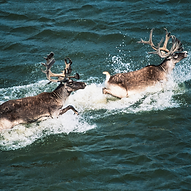
Fatty caribou are prized by Eskimos, especially during the late summer, but the time involves periods of feasting and fasting as game is scarce. Kuptana describes how a chisel tool is used by a young man on his first kill to open the brain of a freshly killed caribou for a feast. The hunting party dedicated all their time to hunting and storing caribou meat for later in the autumn when food is scarce.
Caribou Hunting
William Kuptana: I remember being packed going inland in the summer. When we were out of food, we'd eat seal fat out of the pouch. My parents would also carry a sealskin bag filled with seal blood. We'd drink out of that when were thirsty.
While we were treking inland, food would become scarce. My parents killed a lemming and cooked it. I didn't want to eat it, but they talked to me so I had to eat it. I didn't want to be left behind. We'd keep walking and looking for caribou. When we'd come to a lake that was still frozen over, they would make an agluaq (fishing hole). Hook and spear were used to catch fish. By fishing, that would prevent us from starving. Also, when the ice is gone in the river, they would fish by using spears and wading in after them.
After that, we would go wandering off into the land looking for caribou. We had no guns. Finally, when we found a small herd, the men would then build a small projection of stone slabs on a high point of land to act as a rouse to statle the fleeing caribou. The women would advance toward the caribou, humming as they approached the herd. As the caribou approached the lair where the men were hiding, the men would then kill the closest ones, the ones that they could reach.
The kill meant, "Feast." The family would eat everything: stomach, entrails, marrow. For instance, the entrails would be cleaned out and then cooked. After they were cooked, the entrails would be eaten with seal oil. The extra meat would be cut up to make dried meat.
The warm summer months were not a time of plenty for the Copper Inuit. As Diamond Jenness (1922:123-124) noted: "The traveller will find scattered families reaming about from place to place, here today and gone tomorrow in their restless search for game. Days of feasting alternate with days of fasting according to their failure or success. No fowl of the air, no creature of the land, no fish of the waters is too great or too small to attract their notice at this time."
The scarcity of food in spring and summer was partially alleviated in the late summer/early fall(August and September) when caribou hunting accelerated. At this time of year the caribou are fattest and their hides are ideals for making clothes. Usually a number of families would cooperate in the hunting of caribou using caribou drives set up on the tundra. These drives usually consisted of rows of stone piles set up in tow converging lines. Women and children chased the caribou with lances and arrows. Another technique, more commonly used on the mainland, involved hunting caribou from kayaks at crossing places in lakes. If a caribou drive was successful, much of the meat would be dried and stored for use during the lean autumn months.
First Hunt
William Kuptana: When I first killed a caribou, my biological father started wrestling with me as it is a custom to try to put a young hunter on top of the caribou corpse. After that, the hunting party told me to get the ulimuan [ a chisel-like instrument with a blade at a forty-five degree angle from the handle]. So I got one out of the pack-sack to open its head as it is a custom that a young man do that for a first kill. After I had chopped its skull, the elders started eating its inner membrane, or as it is usually called, the brain. Then, after the feast, the hunting party resumed their search for the tuktuvialuit (Banks Island Caribou). From spring to autumn, the hunting party would kill, store, and go on searching until it was too cold to hunt. Finally, returning to their wintering grounds, they'd wait for winter huddled in their sealskin tents for a time.
Ancient History
Kenya
1800000
B.C.E.
Stable Isotope Analyses and the Evolution of Human Diets
Margaret Schoeninger describes how stable isotopes tell us that humans and neanderthals were likely high level carnivores.
Abstract Stable isotope analysis of carbon and nitrogen has revolutionized anthropology’s approach and understanding of the evolution of human diet. A baseline comparison across extant nonhuman primates reveals that they all depend on C3 plants in forests, forest patches, and woodlands except during rare seasonal intake, in marginal regions, or where maize fields exist. Even large bodied hominoids that could theoretically rely on hard-to-digest C4 plants do not do so. Some Plio-Pleistocene hominins, however, apparently relied heavily on C4 and/or CAM plants, which suggests that they relied extensively on cecal-colon microbial fermentation. Neanderthals seem less carnivorous than is often assumed when we compare their δ15Nbone collagen values with those of recent human populations, including recent human foragers who also fall at or near the top of their local trophic system. Finally, the introduction of maize into North America is shown to have been more sporadic and temporally variable than previously assumed.
One of the most interesting and confounding applications of stable isotope ratios has been the study of Neanderthal δ15Nbone collagen values. On the basis of nitrogen data, authors suggest that Neanderthals ate virtually no plants or were highly carnivorous (Balter & Simon 2006, Hublin et al. 2009), predominantly ate meat (Richards & Schmitz 2008, El Zaatari et al. 2011), or obtained their protein solely from meat (Richards et al. 2008), especially large herbivores (Richards & Trinkaus 2009). Some have even suggested that Neanderthals might have differed physiologically from modern humans in order to digest such large amounts of meat (Pearson 2007). Complete carnivory in extant primates occurs only in Tarsier, which weighs ∼100 g and has distinct morphological adaptations that allow it to obtain and survive on such a diet (Fleagle 2013). Some foraging human populations such as the Dogrib, a Dene Aboriginal Canadian people living in the northwestern part of Canada, survived on almost 60% animal products (Szathmary et al. 1987), as did other human foragers living far from the equator (Kelly 1995, Cordain et al. 2000). All these groups, however, included significant amounts of plant foods and/or animal fat, and there may be a protein ceiling of ∼35% (Cordain et al. 2000) because higher levels compromise liver function owing to physiological limitations on urea synthesis (Speth & Spielmann 1983, Hardy 2010). In part, the assumption of carnivory is based on the expectation that Neanderthals lived under arctic conditions with few available plants. Yet, many Neanderthal sites are in more southern parts of western and southern Europe (Shipman 2008 and see included references), and Europe experienced temperature fluctuations, including warm intervals, during Neanderthal times (Hardy 2010). Evidence from dental calculus indicates that Neanderthals ate some plants (Henry et al. 2011, Salazar-Garcia et al. 2013), and edible plants were recovered from the Neanderthal site of Amud, Israel (Madella et al. 2002). Richards & Schmitz (2008) concluded that high carnivory was based on the similarity between Neanderthal values (9 and 7.9) and those of a red fox (8.6), even though red foxes are noted to be omnivores (Lloyd 1981). Figure 2 compares all generally accepted European Neanderthal δ15Nbone collagen values compared with European hyena, horse, and reindeer (Bocherens et al. 1991, Bocherens et al. 1999, Richards et al. 2000, Bocherens et al. 2001, Bocherens et al. 2005, Richards et al. 2008, Richards & Schmitz 2008). Although Neanderthals have the highest δ15Nbone collagen values, the overlap between individual Neanderthal δ15Nbone collagen values and those of hyenas is extensive (10.1–11.8 in the former and 7.9–11.5 in the latter). This is the same pattern seen in North American Great Basin human foragers (see Figure 2) and four additional trophic systems (Schoeninger 1995b). High relative δ15Nbone collagen values are common in humans, although it is far from clear how this result occurs. Neanderthals clearly ate meat just as human foragers worldwide do (Kelly 1995, Speth 2006); they selected prime adults and the bones most likely to contain a lot of marrow (Gaudzinski & Roebroeks 2000). Some data also suggest that they hunted marine mammals (Stringer et al. 2008), which often have much fat. Such selection would allow them to eat animal products for up to two-thirds of their diet. But, the question is, did they? Or, perhaps more realistically, did they all participate, and if so, when? Only after we understand why humans almost always have high δ15Nbone collagen values can we address these questions fully.
Africa
300000
B.C.E.
Palaeolithic and Mesolithic kill-butchering sites:
the hard evidence
Middle Palaeolithic hunting involves less occasional killings, more specialization in large prey, game driving, dismembership in butchering and marrow extraction.
3.2. Middle Palaeolithic Hunting: Sites such as Zwolen (Gautier, 1989) and Mauran (Farrzy & David, in press; Girard-Farrzy & Leclerc,1981) preserve clear evidence of active hunting.
Planning: killings are less often occasional. Neanderthal man returns periodically (or seasonally) to special places rich in game and with a natural topography propitious to hunting activities. This testifies to an intentional and calculated choice, as at the sites already mentioned.
Specialisation: sometimes man specialises in the capture of a particular animal species: big bovids at Mauran (Farizy & David, in press), horses at Zwolen (Gautier, 1989), wild goats at the Grotte de l'Hortus (de Lumley, 1971).
Hunting techniques: probably some kind of game driving was practised at Mauran (Farizy & David, in press), Zwolen (Gautieq, 1989), La Quina (Jelinek, Debenath & Dibble, 7989) and La Cotte de Saint-Brelade (Scott, 1e80).
Seasonal killings: many killings are probably seasonal, animals fall in discrete age groups at Zwolen (Gautieq, 1989) and La Quina (]elinek, Debenath & Dibble, 1989).
Food transport: the lightest and most meaty bones (hind limbs, pulni, ribs, vertebrae) may be carried away. In kill sites man leaves big and useless parts of animal skeletons (skulls, jaws etc.). Transport of meaty skeletal parts may be exemplified at Mauran (Farizy & David, in press).
Butchering activities: at Maurary Farizy and David (Fafizy & David, in press) notice many phases in the butchering process: dismemberment, removal of muscular masses and bone breakage for marrow extraction.
Germany
50000
B.C.E.
Palaeolithic and Mesolithic kill-butchering sites: the hard evidence
The upper paleolithic is characterized by advanced hunting of large animals with various weapons, and planning to maximize easy prey
Upper Palaeolithic and Mesolithic Hunting:
the archaeological record leaves us some direct evidence of man's hunting activities. At Meiendorf (Rust 1937) and Stellmoor (Rusf 1937), some bones of reindeer and birds still conserve weapon marks and a few pieces of silex have remained thrusted in mammalian bones; man kills reindeer with harpoons and sticks (fractured skulls), birds with bows and maybe slings. Three fractured skulls of red deer in Abri Pataud (Bouchud, 1975), and one bovid skull with a circular orifice in Saint Marcel (Allain, 1952) suggest the practice of the so called " co'up de merlin": man has delivered a blow similar to the one used today to butcher cattle. Probably the animal already immobilized (wounded or entrapped) was hit on the frontal with a big stone. At Kokorevo I (Siberia), a large scapula of bison is pierced by the upper end of a point made of bone (Boriskowksi, 1965). At High Furlong (Mesolithic), an elk was discovered with the marks of L7 wounds made by barbed points, of which two were found in the site, and by other arms. The animal had apparently been attacked at two distinct occasions: during the first one, hunters aimed at the legs to lame the animal (fig. 6), later hunters hit the thoracic region and the lungs to kill it. However the elk died in a little lake, perhaps imprisoned in the ice, and man had no access to the meat. The animal represents in fact a hunting loss (Hallam et a1.,1973).
Planning: very good. Many sites belong to Wpe e, were occupied periodically or seasonally and specialised in the capture of a particular game (e.g., horse, reindeeq, ibex). Game drive towards cliffs have been claimed and Solutre (Combier & Thevenot,1976) has long figured as an example, but the evidence is far from conclusive.
Scavenging: no doubt H. sapiens still killed or exploited animals in the occasional and opportunistic way of Lower Palaeolithic times. According to Lindner (Lindner,1941), hunters at Predmost utilised the carcasses of hundreds of mammoths that probably succumbed as a result of natural catastrophes, as food.
Food transport: selective transport of the most useful animal parts is claimed for many sites.
Specialised activities: sometimes the material is dislocated in distinct clusters that could reflect specialised activity areas as for example at Solutre (Combier & Thevenot, 1976). Site topography: some hunting sites were located in valleys enclosed by steep slopes as at Rascano (Gonziilez-Echegaray, 1979), Stellmoor (Rust, 1937), Meiendorf (Rust 1937), or at the foot of rocky cliffs at Solutr6 (Combier & Th6venot, 1,976).
4. Conclusions
Most of the Lower Palaeolithic sites analysed here belong to category a (butchering sites); other kind of concentrations are rare and difficult to ascertain. A number of hunting stations (category e) and a hunting stop (category f) form my sample for the age of Neanderthal man and related people. The Upper Palaeolithic is characterised by many hunting stations, while in Mesolithic times a hunting loss (category d ) was found as well as several sighting sites (category g). The foregoing distribution seems to reflect in a vague way an evolution from scavenging and haphazard opportunistic hunting to well organised, selective hunting activities. However, this reflection results no doubt in part from a priori assumptions concerning the evolution of hominid meat procurement often colouring the interpretations offered for the osseous "hard" data; these are frequently equivocal.
Unnamed Road, 89176 Asselfingen, Germany
37000
B.C.E.
Lowenmensch figurine
The lion-man sculpture is a 12 inch high figurine carved of ivory depicting a standing man with a lion face, leading me to think that men saw other apex carnivores as equals.
The Löwenmensch figurine or Lion-man of the Hohlenstein-Stadel is a prehistoric ivory sculpture discovered in the Hohlenstein-Stadel, a German cave in 1939. The German name, Löwenmensch, meaning "lion-human", is used most frequently because it was discovered and is exhibited in Germany.
The lion-headed figurine is the oldest-known zoomorphic (animal-shaped) sculpture in the world, and one of the oldest-known uncontested example of figurative art. It has been determined by carbon dating of the layer in which it was found to be between 35,000 and 40,000 years old, and therefore is associated with the archaeological Aurignacian culture of the Upper Paleolithic.[1] It was carved out of mammoth ivory using a flint stone knife. Seven parallel, transverse, carved gouges are on the left arm.
After several reconstructions that have incorporated newly found fragments, the figurine stands 31.1 cm (12.2 in) tall, 5.6 cm (2.2 in) wide, and 5.9 cm (2.3 in) thick. It currently is displayed in the Museum Ulm, Germany.
The Löwenmensch figurine lay in a chamber almost 30 metres from the entrance of the Stadel cave and was accompanied by many other remarkable objects. Bone tools and worked antlers were found, along with jewellery consisting of pendants, beads, and perforated animal teeth. The chamber was probably a special place, possibly used as a storehouse or hiding-place, or maybe as an area for cultic rituals.[16]
A similar but smaller lion-headed human sculpture was found along with other animal figurines and several flutes in the nearby Vogelherd Cave. This leads to the possibility that the Löwenmensch figurines were important in the mythology of humans of the early Upper Paleolithic. Archaeologist Nicholas Conard has suggested that the second lion-figurine "lends support to the hypothesis that Aurignacian people may have practised shamanism ... and that it should be considered strong evidence for fully symbolic communication and cultural modernity".[17]
The figurine shares certain similarities with later French cave paintings, which also show hybrid creatures with human-like lower bodies and animal heads such as the "Sorcerer" from the Trois Frères in the Pyrenees or the "Bison-man" from the Grotte de Gabillou in the Dordogne.[18][19]


