


Recent History
January 2, 1960
Fred Bruemmer
Arctic Memories - Beginnings

"The whale meant food and life and glory, the primal thrill of being, and at that moment nothing else mattered.... We ate the steaming seal meat; drank the fat, scalding broth; and glowed with marvelous warmth."
WE TRAVELED FROM NOWHERE TO NOWHERE IN A WORLD ALL WHITE, eleven dogs, a long sled, a fur-clad Inuk and I. We had spent a week at the floe edge, the limit of landfast ice, and the hunting had been good. Jes had shot and harpooned eight seals. We had eaten well and our sled was heavy with meat - food for his family and dogs - and with seal pelts he would sell at the store.
We felt the coming of the storm. The air was still and oppressive. Gulls, screaming, flew toward the distant land. The sky turned leaden black. We should have left hours ago. But a pod of narwhals was feeding close to the floe edge; the eerie stillness was filled with the plosive "pooff," "pooff," "pooff" of their breathing. Small plumes of exhaled breath hung briefly in the icy air, and a few times we saw the gleaming ivory tusks of the males.
Jes wanted a whale. His entire hunter's spirit was focused on those whales, wishing them closer, closer. He was the perfect predator, quietly poised in total concentration, the ultimate Arctic hunter, as his people had been since the dawn of time. The whale meant food and life and glory, the primal thrill of being, and at that moment nothing else mattered.
While Jes's soul was in that strange mystic sphere that links the hunter to his prey, I sat apart and nursed my white man's worries. I had spent far too many years in the Arctic not to know that the coming storm would be hell, the trip home utter misery and, if the ice broke up, exceedingly dangerous. It was 60 miles (96 km) back to the village.
The storm struck, and Jes did not get his whale. He rose slowly, reluctantly. The tension seeped out of him and then he smiled a marvelously boyish smile, shrugged, and said: "Ayornamat. (It can't be helped.)" An Inuk does not rant and rave; his language has no swearwords. He does not rail against God or Nature, but simply accepts adversity. He does his best; the rest is fate.
We lashed the load upon the long pliant sled with utmost care, passing the bearded-seal thong back and forth, pulling it tight with all our strength. Jes called to the dogs. Normally they would have leapt into a joyous gallop. Now they moved without enthusiasm, their tails, usually cockily curled, drooping sadly. Like me, they feared the storm.
At first, brief lulls alternated with vicious gusts. Then the storm became steady and we traveled into a hissing, roaring avalanche of snow. The dogs hated it. The wind-lashed ice spicules hurt their eyes, and they tried to veer away from the wind. Jes beat them, coaxed them, directed them. There was only snow, the screaming wind, and nothingness; we seemed suspended in time and space. But Jes was guided by sastrugi, snow ripples created by prevailing winds, and by the knowledge of a thousand trips since he had first gone to the floe edge as a small boy with his father.
We traveled for hours, our faces seared by the wind, our fur clothing plastered with snow. The ice changed, became rugged, hummocky. We were in a tidal zone, close to a coast. For a moment I saw a cliff and then it vanished again in the whirling white. Jes walked ahead now, leading the dogs through a maze of ice blocks. Near the base of the cliff he tied the dogs securely to a stone upon the ice. "Come," he said. We clambered up an incline, perhaps a beach in summertime, walked past a house-high rock, squeezed through a triangular hole between the rock and the cliff, and were suddenly in a spacious cave. Jes laughed, delighted by my amazement, the magician who has performed the perfect trick.
Jes unharnessed and tethered the dogs, then cut up a seal and fed them. They rolled into balls, noses tucked under bushy tails, and soon the snow covered them with an insulating blanket. I lugged our sled load into the cave, shook the snow out of the bedding furs and my clothing, and made supper: a big pot of seal meat boiled on a Primus stove.
After the elemental chaos of the storm, the cave felt calm and secure. It had obviously served as sanctuary to other Arctic hunters for hundreds, perhaps thousands of years. In the back were low sleeping platforms of pebbles and flat stones. Soot streaks along the walls and roof showed where seal-oil lamps had burned and flared. The cave floor was scattered with bones, remnants of past meals. Bone, stone, and ivory shavings and splinters marked places where men had sat and made or repaired tools or hunting weapons, and broken toys spoke of children who had once played in the cave.
We ate the steaming seal meat; drank the fat, scalding broth; and glowed with marvelous warmth. Jes made tea, boiled it until it was coffee-black, and we drank it syrupy-thick with sugar. We were safe, warm, full of food, relaxed and utterly content. Long, long ago, said Jes, Tunit had lived in this cave, a giant people but stupid, and the Inuit had killed them. His stories - part myths, part ancient oral history - - spanned the ages. The Primus hissed, and outside roared the storm.
We spread our furs on the ancient sleeping platforms and, minutes later, his deep, even breathing told me that Jes was sound asleep. Cozy in my furry cocoon, I looked at the soot patterns on the cave wall, listened to the eldritch screeching of the storm, and thought sleepily about my other life: our pleasant, book-filled home in Montreal; my wife; our children. It was early May. Maud would be working in the garden. The boys should be home from school. The first tulips would be blooming. As I drifted off to sleep, it seemed part of a dream.
January 7, 1961
Laurens Van Der Post
The Heart of the Hunter
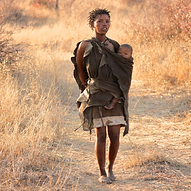
A Bushmen woman holds her son up to the stars in the pitch black night. "The stars there have heart in plenty and are great hunters. She is asking them to take from her little child his little heart and to give him the heart of a hunter."
Out there between our camp and their shelters the desert was as dark and still as I have ever known it. The only other living things capable of uttering a sound were snakes, and no serpent would have been so foolish as to hiss while about his business on a night so profound. There was no fitful air of summer even, no heat eddy of the frightful day spinning about to rustle what was left of leaf and grass on the scorched earth. But there was this intense electric murmur of the stars at one’s ears.
Then suddenly, ahead in a band of absolute black with no fire or reflection of fire to pale it down, I thought I heard the sound of a human voice. I stopped at once and listened carefully. The sound came again more distant, like the voice of a woman crooning over a cradle. I stood with my back to the horizon bright with portents of lightning, waiting for my eyes to recover from the glare of our great camp-fire. Slowly, against the water-light of the stars lapping briskly among the breakers of thorn and hardwood around us, emerged the outline of a woman holding out a child in both her hands, high above her head, and singing something with her own face lifted to the sky. Her attitude and the reverence trembling in her voice, moved me so that the hair at the back of my neck stood on end.
‘What’s she doing?’ I whispered to Dabé, who had halted without a sound, like my own star-shadow beside me.
‘She’s asking the stars up there,’ he whispered, like a man requested in the temple of his people to explain to a stranger a most solemn moment of their ritual.
‘She’s asking the stars to take the little heart of her child and to give him something of the heart of a star in return.’
‘But why the stars?’ I asked.
‘Because, Moren,’ he said in a matter-of-fact tone, ‘the stars there have heart in plenty and are great hunters. She is asking them to take from her little child his little heart and to give him the heart of a hunter.’
The explanation moved me to a silence which Dabé mistook. Afraid, I suspect, that like most of the people he knew in his life of exile I would scorn a Bushman’s belief, he wanted reassurance immediately.
‘But why don’t you say something, Moren?’ he asked, almost like an anxious child. ‘Surely you must know that the stars are great hunters? Can’t you hear them? Do listen to what they are crying! Come on! Moren! You are not so deaf that you cannot hear them.’
I have slept out under the stars in Africa for too many years not to know that they sound and resound in the sky. From the time I was born until I first went to school, I slept outside a house every night except when it was raining – and that was seldom. My first memories are of the incomparable starlight of the high veld of Southern Africa and the far sea-sound that goes with it.
I hastened to say, ‘Yes, Dabé, of course I hear them!’ But then I was forced to add, ‘Only I do not know what they are saying. Do you know?’
Reassured, he stood for a moment head on one side, while the light of another flash from the horizon flew like a ghost moth by us. Then, with the note of indulgence he could not resist using on me when he felt his authority not in doubt, he said, ‘They are very busy hunting tonight and all I hear are their hunting cries: “Tssik!” and “Tsá!”’
Had it not been for the darkness between us he would have seen, I am sure, the shock of amazement on my face. I had known those sounds all my life. Ever since I can remember we ourselves had used them out hunting with our dogs. ‘Tssik!’ repeated sharply thrice was the sound we used to alert our dogs when we were at the cover of bush, grass, cave, or donga in which we suspected our quarry to be hiding. Hearing it, the ears of our dogs would immediately prick up, their eyes shine with excitement and their noses sniff the air diligently for scent. Another ‘Tssik’ would send them to search the cover. ‘Tsá’ was the final imperative note which released them from all restraint and launched them after our chosen quarry when it was flushed.
I had always wondered about the origin of these sounds. Neither of them had ever seemed European to me. I had asked the oldest of the old people of all races and colours. I asked one of the greatest of all African hunters, too. They could only say that, like me, they had been born into a world in which they were already in long-established use. Stranger still, wherever I went in the world I found that, although hunters outside Africa did not know the sounds and therefore did not use them with their dogs, if I tried them out many of the dogs responded. They would start searching with all their senses: if I kept up the sounds for long, they became exceedingly restless, in the end letting out that involuntary and nostalgic whimper normally provoked in them only by the moon. That had deepened the mystery for me, but now I thought I knew: we had the sounds from the Bushman, and he and the dogs had them straight from the stars. The revelation filled me with awe. I felt as if I had been allowed to witness the coming of the word in the darkness before time. I thought this was enough of magic in a day which in my encounter with the little steenbuck had begun with magic.
January 9, 1961
Laurens Van Der Post
The Heart of the Hunter

The Bushmen talk about the star in the Great Dipper "that star, he said, was a great hunter who hunted in far away dangerous places in the shape of a lion." Whereas upon Sirius "Could I not see how fat it was, how heavily it sat there in the midst of plenty in the sky?"
Dabé and I sat down near them. The children looked up at me out of their slanted eyes, examining my face without fear, as I told him I too would be grateful for ‘some man’s talk’ with him.
For example, was it true that the stars were hunters? Did the little steenbuck really possess great magic, and if so, what sort of magic? Dabé, I think rather indignant that his word on the subject had not been enough for me, put the questions perfunctorily. A long silence met them. The old lady again stopped pounding. The old man gave me a steady look out of his wide eyes, oddly hypnotic in the firelight flicking on his face. My heart sank. I feared a repetition of my experience with the Bushmen at the Sip Wells. There all my first questions had been met with a similar silence. I had to wait until we had proved over the days that we could be trusted before they would talk to me about the things of their spirit. I began to feel almost culpably naïve for assuming that such bold questions could draw an answer from a member of a race which for thousands of years has been so despised and hunted down by all other men. My only hope, I thought, was to remind him that we were friends of his friends at the Sip Wells and let the fact that they had freely spoken of these things plead for me.
‘Tell him,’ I asked Dabé, my voice sounding ineffectual in my own ears in the tense silence between us, ‘tell him that his people at the Sip Wells told me about the first of all the Bushmen, Oeng-Oeng and his wives who would not put out the fire, about the little Oeng-Oengs and the elephants, the ostrich, and the finding of the first fire; Mantis and the resurrection of the dead Eland; the turtledove and the honey and many other things; but they never told me these things about which I have just asked him. Surely so old and wise a father as he knows the answers and can help me.’
At the mention of the Sip Wells, the magic name of OengOeng and this brief recapitulation of some of the great themes of the imagination of his race, the tension between us snapped. His eyes brightened, the old lady began to pound with vigour again, and said:
‘Yes. Oh, yes! Yes! Yes! It is true: the stars are hunters.’
‘All the stars?’ I asked, my heart beating faster.
He paused for just a second, then it all came out at length. Yes! They were all hunters, great hunters, but some were greater than others. For instance there was that star there! He raised his thin old arm to point with a long finger at the brightest star in the Great Dipper. It just cleared the fringe of a camel-thorn tree and in the dry air was bright enough to lay a water-sheen on the topmost leaves. That star, he said, was a great hunter who hunted in far away dangerous places in the shape of a lion. Could I not see how fierce its eye shone and hear the distant murmur of its roar? And there was one even greater! He pointed at Sirius, the star of thedog, at the head of the belted and nimble Orion. It was so full and overflowing with light that it was almost shapeless – a sort of careless gash in the night through which the brightness of the day beyond was leaking like clear water from a broken tap. As fast as the great drops of light fell, others swelled in their place to fall with a silky sort of swish on the bush around us. Yes! You only had to look at it once, the old father said, to see what a great hunter it was. Could I not see how fat it was, how heavily it sat there in the midst of plenty in the sky? He paused and I hastened to ask, afraid that silence might cool the subject: ‘Is it the greatest of all the hunters up there?’
From the delight that shone in his eyes, I realized the pause had been a trap set to catch just that question. He shook his head vigorously. The greatest hunter was not there yet. It hunted in the darkest and most dangerous places of all, so far away that we could not see it yet. We could see it only in the early morning when it came nearer on its way home. There, there was a hunter for you! The old father made a lively whistling sound of wonder at the greatness of the hunter. Yes, just before the dawn one could see him striding over the horizon, his eye bold and shining, an arrow ready in his bow. When he appeared, the night whisked around to make way for him, the red dust spurting at its black heels. He broke off and shook his grey old head, as he once more uttered that sound of wonder, before asking as if the thought had just come to him: ‘But can’t you hear for yourself the cries of the hunt going on up there?’ I assured him I could. He gave a grunt of satisfaction and leaned back on both his elbows with a look on his face as if to say, ‘Well, then! There is nothing more to be said about it.’
January 11, 1961
Laurens Van Der Post
The Heart of the Hunter
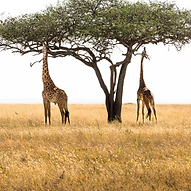
"If a Bushman killed a giraffe, an eland, a gemsbok, or even a bird like the giant bustard for food because he was dying of hunger, and the police discovered it, he was taken away to prison and often never seen again."
So gradually in these and other ways a natural pride in himself came alive again. Once it nearly had serious consequences. Jeremiah tended to have a noticeably superior manner with his companions, particularly Dabé. For long he never called Dabé by his name, referring to him simply as ‘Massarwa’. This term is used by Africans to describe not only the Bushman but all the mixed peoples in the Kalahari living the Bushman way. No one suspected how much this hurt Dabé until one morning, after having been referred to repeatedly as Massarwa, he could bear it no longer.
‘How would you like it if I called you not Jeremiah but Kaffir?’ he asked sharply. Kaffir is the term used by Europeans to describe all black people in Africa irrespective of their race and origin, and has come to be used as a deadly insult among Africans themselves. Dabé could not have hit on a more accurate or provocative parallel. ‘Massarwa!’ Jeremiah exclaimed, putting down the saucepan in his hand, while John, his chief assistant, stopped working too and looked as injured as he did. ‘Massarwa. You must not call me Kaffir.’
‘But if you call me Massarwa, why should I not call you Kaffir?’ Dabé insisted, the fiery Bushman temper of which my grandfather had so often spoken, for the first time visible.
‘You must not call us that!’ Jeremiah and John said together now, both their dark faces paler with emotion. They came belligerently to their feet and looked tall over Dabé’s sturdy little figure.
Luckily I was near and stopped the argument before it became a fight by sending Dabé away on an errand, while I told the others they were never again to call him Massarwa and I would see that he never called them Kaffir. But to me, slight as the incident was, it was a shining example of a truth I have always believed – that one of the great hungers of the human spirit from the earliest to the most contemporary level is the hunger for honour. I am certain Dabé, Jeremiah, and John had been prepared to fight to the death because the matter appeared to concern their honour. I am certain, too, that no one will ever understand the complex and desperate situation in Africa unless he realizes first that at bottom it is an affair of honour. But besides the hunger for honour there are other great hungers as well: that for justice, for forgiveness, and the one that sums up all – the hunger for love. Some of those too showed themselves a little that day I left ‘Bushman’s Reprieve’ with Dabé at my side.
When he had been silent for some time, I remarked cheerfully, since his old melancholy seemed to be joined to him again like his shadow, ‘Well, Dabé. It looks as if the rain is really coming to your people back there. They ought to be all right now.’
‘Yes. They ought to be all right now.’ He answered without any great conviction, as if he and I inevitably must have different notions of what ‘all right’ was. He hesitated for a brief moment, his brown eyes going black with shadow from within; then he began speaking not so much to me as to that immense glittering overlordship of the day in front of us. His voice was flat, unemotional, and so without anger that I thought my stomach would turn.
Had I noticed, he asked, how everything in life had a place of its own? For instance, the springbok had their pans; the eland and the hartebeest their great plains; the jackal, the hyena, the lynx, the mongoose, and the leopard had each a hole of his own: the lion could come and go and eat and sleep where he liked. Even the locusts had their grass, the ants their mounds of earth – and had I ever seen a bird without a nest? The black man, the Herero, the Bastaards, had kraals and lands of their own, and the white man houses of stone. But could I tell him what and where was a Bushman’s place? The echo of the New Testament cry about the birds having nests and the foxes holes but the Son of Man no place to lay his head, rang out so loudly in my head that I would have suspected Dabé of having heard it, had I not known otherwise.
Moreover, he went on, many of these animals were protected by the white man. If a Bushman killed a giraffe, an eland, a gemsbok, or even a bird like the giant bustard for food because he was dying of hunger, and the police discovered it, he was taken away to prison and often never seen again. Yet, if the Bushman killed his own desert animals for food, he was punished. No one punished the white man, the black man, and the Herero when they killed their animals, their cattle and sheep for food. But if the Bushman killed the cattle and sheep that came into the Kalahari to eat the grass of his animals, again he was hunted down and punished. How could such things be? Did I know that, when the first white men came to the Kalahari, they would have died if it had not been for the Bushman? The same was true for the blackman. The Bushman showed them where the water was, took their cattle to grass and helped them to live. Once the Bushman walked the desert like a lion from end to end with no one to trouble him, but today every man and every lion was against the Bushman. He alone had nowhere to go, no one to protect him, and no animal of his own. Again, was that how it was meant to be?
August 1, 1966
Fred Bruemmer
Arctic Memories
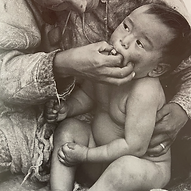
Elizabeth Arnajarnek feeds a pre-chewed morsel of caribou meat to her baby at a camp on the Barren Grounds in 1966. The Inuit gather thousands of duck eggs and eat them raw or hard-boiled. They store them for the winter.
Noises and voices drifted through the fog; the creak and groan of tide-moved ice; the honking of Canada geese; the plaintive calling of red-throated loons; the lilting song of snow buntings; the haunting, mellow woodwind crooning of courting eider drakes.
Early next morning, the fog lifted. We climbed a hill topped by an inukshuk, an ancient, roughly man-shaped Inuit stone marker, and gazed across the sea dotted with dark granite islands bathed in the golden light of dawn.
Our boats full of pots, pails, zinc and plastic wash basins, and large wooden crates, we set out to raid the holms, the rocky islets that are the eiders' favorite nesting places. Men, women, and children stumbled across the algae-slippery coastal rocks of each islet, scrambled up the sheer ice foot, and then spread, screaming with glee, across the island as dozens of eiders, sometimes hundreds, rushed and clattered off their nests. Each nest was lined with a thick, soft layer of brownish gray-flecked eiderdown and contained, on the average, four large olive eggs. The Inuit took the eggs but left the down; traditionally they dressed in furs and had no use for down. Since it was early in the season, most ducks had just laid their eggs.
We rushed from island to island and collected eggs all day, and at night we feasted on them. The children, impatient, pricked many and sucked them dry. The adults preferred them hard-boiled. They made a filling meal; each egg, in volume, equals nearly two hen's eggs, and many Inuit ate six to ten at each meal. The albumen of the hard-boiled eider egg is a smooth, gleaming white, the yolk a vivid orange. The taste is rich and rather oily.
In a week we visited dozens of islets and amassed thousands of eggs. The Inuit also shot at least a hundred ducks and several seals. It seemed amazing that these yearly raids had not decimated the ducks. But they were made so early in the season that most of the robbed ducks probably laid another clutch of eggs.
Killiktee explained to me that in earlier days a taboo forbade the Inuit to camp on eider islands. They visited the islets and took the eggs, but they camped, as we did, only on the largest islands, where few ducks nest, thus avoiding prolonged disturbances in the breeding areas. The ducks, Killiktee said, seemed just as numerous now as sixty years ago when he had first visited the Savage Islands as a boy. Polar bears sometimes swim to the islands, kill all the ducks they can, and eat the eggs. One year, Killiktee said, while the Inuit were on holms, collecting eggs, a polar bear came to camp and robbed their stores. He ate at least a thousand eggs and crushed the rest, leaving a gooey mess upon the beach. Killiktee laughed, amused and without rancor. "Happy bear!" he said.
Less lucky was a gosling caught on an islet by one of the girls. She kept it in a Danish cookie tin and tried to make a pet of it. The fluffy yellow bird peeped pathetically and, inevitably, died after a few days. The girl cried, heartbroken, over her dead pet, and then she skinned it and ate it.
All crates were full of eggs, and ducks, seals, and whale meat filled the boats. The fog rolled in again and our boats traveled through a clammy, grayish, eerie emptiness. Killiktee led, the two other boats followed closely. Dark rocks appeared for moments and vanished into the gloomy gray; ice floes loomed up abruptly. Killiktee never hesitated. "How do you know where to go?" I asked. He smiled. "I know," he said. He had traveled along this coast a long lifetime; he had seen it, memorized it, knew every current, every shoal, every danger spot. He stood in the stern like a graven image and guided our boats through the weird gray void of the fog.
In the evening he veered into a bay, a good place, he said, to catch char on the rising tide. The men set nets, the women boiled pots of meat and tea, the children played. Killiktee, tired, lay down on the shore, and moments later he was sound asleep. A dark shape upon the dark, ice-carved granite, he seemed to meld with rock and land.
Back home at Kiijuak, all eggs were carefully examined. The cracked ones we ate soon. The others were placed in large crates and stored in a cool shady cleft among the rocks. They would last the people in our camp well into the winter.
In fall, an Inuk from Lake Harbour passed our camp and took me along to Aberdeen Bay where the people quarry the jade-green soapstone for their carvings. While he had tea and talked with Killiktee, I packed and carried my things to his boat. Killiktee came to the beach. We both felt awkward. Inuit traditionally joyfully greet visitors, but visitors leave in silence and alone with none to see them off. Their language has many words of wisdom, but none for good-bye.


