


Recent History
September 21, 1926
Helge Ingstad
The Land of Feast and Famine

Ingstad collects berries to make a berry jam but runs into a bear without his rifle
Directly across the lake from our cabin was "Cranberry Hill." There berries grew in red profusion, simply begging to be plucked. I lost no time in paddling across to gather a bucketful so that we might have a bit of jam to eat during the winter. One day I was walking along deep in thought, as I shoveled up handfuls of berries and threw them into the pail. Suddenly I heard a rustle back in the brush and looked up. At the same time another pair of eyes looked up. They belonged to a bear. It stood behind a rise of ground and blinked stupidly at me. It would be difficult to determine which one of us was the more amazed. We glared at each other for several moments, no doubt each thinking much the same thought: " What the devil are you doing here in my berry patch? " At length the bear turned on his heel and slowly shuffled off among the trees. From that day on, I never went berry-picking without my rifle.
______
Note by Travis: Berries are discussed in many Arctic texts, but it never seems to be a necessary component of the diet - for instance to ward off scurvy or other deficiency diseases. It's a local food source that's easy to collect and thus makes for a great "spice" to be added to other foods to increase their palatability.
January 5, 1928
Helge Ingstad
The Land of Feast and Famine - The Barren Ground Indians

The diseases of the white men can be blamed for the general ill health of the Indians, but adopting a life of flour has even worse consequences for chronic disease according to Ingstad.
The Indians seldom live to a ripe old age. It is their custom to bury the dead and erect a circle of tall pointed poles about the grave. If the death takes place in the winter-time, the corpse is preserved in a wooden coffin, and later, when the frost has gone out of the ground, the relatives provide it with burial, even though they must make a long and arduous journey for this purpose.
Formerly the aged and others unfitted to make the long journeys were left behind in the wilderness. This custom is no longer adhered to. Even so, it is as pathetic today as before for an Indian to become old and infirm. By and large, he receives full sympathy from the others, but he who must remain at home with the womenfolk, whilst the hunters are afield after the caribou, no longer enjoys the respect of his fellows, and this is indeed a bitter fate for men who rank the honor of the hunter above all else in life.
In olden times the Indians were susceptible to various illnesses; amongst these may be mentioned the plague of boils. The malady still occurs, although to a lesser extent. The boils often appear on the hips and buttocks and I have seen them as large as clenched fists. It takes quite a long time to effect a cure.
The ancient illnesses are of little significance contrasted with the diseases derived from the white race. Thus tuberculosis has wreaked havoc with the Indians east of Great Slave Lake. Spasmodic epidemics of " flu " have broken out in their ranks and have brought death to many. Venereal diseases, on the other hand, are anything but common. In an earlier portion of this book I have spoken of the epidemics of coughing which break out in the spring of the year and often continue all through the summer months, disappearing as soon as cold weather sets in. These colds can hardly be due to infection from the outside, since they afflict even the Indians living in entirely isolated regions.
Like other primitive peoples, the Indians are lacking in physical resistance to the diseases of the white race. There are other factors, too, which play a definite part in the spreading of disease: the habit of spitting incessantly and the general uncleanliness of the Indians, to which may be added their spirit of resignation when illness begins to assume serious proportions. On the whole, the people east of Great Slave Lake have fared better than the tribes which, to a varying degree, have given up a healthy tepee-life and the food which the wilderness provides, in exchange for a life indoors and a diet of flour.
Ever since ancient times the Indians have had their own medicines prepared from weeds, roots, and bark, often administered to the accompaniment of certain rites. From an old Indian I once received the information that he knew about thirty different kinds of medicines, amongst these a poison which could kill a human being in the course of five minutes. Further than this he would say nothing, for an Indian guards his medical knowledge with the most scrupulous secrecy. How great a part mystic rites and possible frauds play in the cure it is, consequently, difficult to determine. One matter of significance in this connection is worth mentioning, however: the Indian is a most apt subject for all forms of suggestion.
In spite of the fact that the materia medico, of the Indians is so frequently cluttered up with superstition, there are reasons to suppose that a number of their medicines have various effects. It is a known fact, for example, that they have a practical means of abortion. For diarrhoea they use dried rushes. For urinary ailments they drink a broth made from the inner red bark of the willow. For scurvy they boil the needles of the dwarf spruce in water for a short time and drink the liquid. By boiling the inner bark of the larch they obtain an antiseptic, which is then placed upon the ailing part as hot as the patient can stand it. It seems not only to kill infection, but also to cause the wound to heal more rapidly than otherwise. For frost-bite they use the inner bark of the pine. This they chew into a pulp, which they then plaster over the frozen part. May I add that, after writing the above, I allowed an Indian to doctor one of my great toes which had become frozen, but that the inflammation had gone so far that perhaps the treatment of my medicine-man was not wholly to blame? In any event, the result was that Williams of the Royal Mounted Police was obliged to cut away a goodly portion of my toe.
June 1, 1928
Helge Ingstad
The Land of Feast and Famine - Summer on Great Slave Lake

The Indians visit the fur-traders and trade their animal pelts for candied fruits and huge piles of sugar and then become flat-broke.
This year there are two fur-traders in Snowdrift. From the very first, their stores are packed to the doors with Indians. Some are leaning over the counters, others are lying down on the floor, with sacks under their heads. Otter-, fox-, beaver-, marten-, mink-, and muskrat-skins find their way over the counter until there is a mighty mound of pelts. In front of each Indian there collects an evermounting pile of conglomerate trash and fripperies, until the last skin has been handed over. Whatever they may chance to desire must be theirs; otherwise they will tear up the store and make away with its entire contents. Autumn is still far distant, but no red hunter ever stops for an instant to think that he may be flat broke when the time comes for him to buy his winter gear. It is summer now, and a checkered shirt he must have, and red silk handkerchiefs he must have, and candied fruits and a huge pile of sugar he must have, as well. Later on he will somehow find a way.
July 3, 1928
Helge Ingstad
The Land of Feast and Famine - Red Neighbors

A large trout is caught and is thrown to the Indian boys who carve it up and eat it raw "It is a point of honor for each to eat as much as each has cut of."
One day Pierre La Loche pulled from the lake a stalwart beast of a trout. It must surely have weighed in the neighborhood of forty pounds. He drags it into camp, lays it on a pile of dry spruce branches, and covers it over with fresh leaves. Meanwhile all the young boys in the camp gather about him in a laughing, noisy circle. Each of them has a hunting-knife tightly clasped in his fist. I ask what is about to take place, but La Loche replies secretively: " You see." Then he touches a match to the pile of spruce branches, which immediately flare up in a sheet of flame. This is a signal for the youngsters to crowd in close to the fire, their knives held high in the air. Some minutes pass. Then La Loche grasps the trout by the tail and hurls it off in the brush as far as he can. As he does so, the whole band of youngsters are after it and, with yells and shouts of jubilation, begin slashing into it with their knives. The first to reach it cut off good-sized chunks of the flesh and race triumphantly off with them. It is a point of honor for each to eat as much as each has cut off, and down goes that halfraw fish, no matter how large the piece, and soon there is nothing left of the trout save bones and scraps of the skin.
July 15, 1928
Helge Ingstad
The Land of Feast and Famine
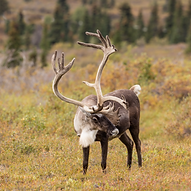
Ingstad ponders the population of the Caribou in the Canadian Arctic but acknowledges the toll of limiting the hunting would have on the natives.
If one accepts Hoare's estimate that there are five million caribou in all, and if one makes due allowance for the losses inflicted by wolf and wolverine, there would still be an appreciable surplus of calves every year. How many of these animals are annually shot by hunters can hardly be computed accurately. If, however, one makes a rough estimate of the human beings who are dependent upon the flesh of the caribou — a handful of white trappers and a few Indian and Eskimo tribes whose numbers are constantly diminishing — it would still seem that a steady increase of caribou is possible. This coincides with the view of the Indians who, influenced by the Canadian police, are, to an ever greater degree, abandoning their practices of purposeless mass slaughter. And now with the advent of the Thelon Game Sanctuary the caribou are assured of safe access to the western territories, provided this protected area is properly administered.
In this connection an additional fact of the utmost importance must be mentioned here. Trappers who live on the flesh of the caribou are simultaneously waging war upon its arch-enemy, the wolf. In order to gain some impression of the havoc wreaked by wolves, one would have to witness with his own eyes their wasteful slaughter. Often they slay for the sheer pleasure of killing and devour but a small portion of each carcass. Their murderous instincts affect, first of all, the calves. To throw some light on this situation, let me give some figures gleaned from the plainsmen east of Slave Lake: the dozen or so trappers who assemble there for the winter hunt, do away with some five hundred wolves annually. When one pauses to reckon that each wolf slays on the average of at least fifty caribou per year, the number of the latter whose lives are saved by men total twenty-five thousand. The deer in turn shot down by the hunters to provide themselves and their dogs with food constitute, in proportion to this, but a meager drain upon the herd.
If one looks a bit more closely at the other side of the question, with regard to the welfare of the people who live in the North, it is clear that their very existence would be threatened were the hunting of the caribou to be limited to any appreciable degree.
It would then no longer be possible for men to fare forth into the mighty wilderness where the dog-sled is the only means of transportation and the caribou the staple food of dog and man. And were we to deny the Caribou-Eaters their free nomad life on the trail of their daily bread, we should be robbing them of the very nerve-spring of their existence.

