

Eskimo
The Inuit lived for as long as 10,000 years in the far north of Canada, Alaska, and Greenland and likely come from Mongolian Bering-Strait travelers. They ate an all-meat diet of seal, whale, caribou, musk ox, fish, birds, and eggs. Their nutritional transition to civilized plant foods spelled their health demise.

Recent History
November 1, 1949
Helge Ingstad
Nunamuit: Among Alaska's Inland Eskimos

Against this background what the Nunamiuts have to tell is of interest. Paniaq says that in the past the people lived mainly on musk oxen.
The musk ox, that queer shaggy creature of prehistoric appearance, is not found in Alaska.
Some musk-ox horns have been found on the tundra north of the Brooks Mountains, and the Nunamiuts, among other things, have come upon several. A very old Eskimo at Point Barrow told me that there were no musk ox in his time nor in his father's, but that there were in his grandfather's.
Against this background what the Nunamiuts have to tell is of interest. Paniaq says that in the past the people lived mainly on musk oxen. He also tells an old story which confirms this. He adds: "The musk oxen disappeared eastward because they were hunted so much. Old people say that when this animal has been hunted one way it continues to go in that direction."
Thus it seems that the musk ox was exterminated in Alaska about a hundred years ago. When the Eskimos came upon a herd, it was doomed. The musk ox is helpless against men; it often stands still and lets itself be slaughtered. Thus it is quite reasonable to suppose that in northern Alaska the species was wiped out in quite early times.
February 15, 1950
Helge Ingstad
Nunamiut, Among Alaska's Inland Eskimos

Trapping in enclosures and hunting from the kayak were of special value to the Eskimos; they could thus obtain large quantities of meat at one stroke and provide for the future. Hunting with bows and arrows was also important, but to a lesser degree.
At another place I found the remains of a kangiraq, i.e. a large enclosure into which caribou are driven. These were usually set up on a height near a river and might be a hundred yards or more in diameter, consisting of a number of tall willow rods driven into the earth or snow. Along the inside of this enclosure snares are made of animals' skins were placed at suitable intervals and fastened to a stone or stick. There were usually several enclosures, one inside another; the maximum number was four, and then the contrivance was called a sisamailik. There were snares along each line totalling several hundreds.
The caribou found their way to the gate by following two lines of cairns which began several miles out in the open country, and which led across the river up the slope to the enclosure. Close to it there might be two snow walls. Thus a "street" was formed outside which the animals did not venture; far from the enclosure it was broad, and then gradually became narrower.
A herd of caribou had to be driven into this "street" often from a long way off; there are stories of drives which took several days. The drivers worked together, running continually. This was child's play to them, thoroughly trained as they were.
When the caribou had at last been driven up the slope towards the enclosure, people ran up from both sides, clapping their hands, hooting, and yelling. The beasts rushed in panic throught he opening and into the inner enclosure. A number went straight into the snares; others broke through the willows into the other enclosures and were snared there. Some of the hunters sent a rain of arrows at the beasts trying to escape, while others were busy with their flint spears. There was sometimes a large bag, which was divided equally among the families participating.
The Nunamiuts used this method for capture especially in the months of February and March, for that was usually the most difficult time with caribou and it was light enough for a long drive.
Trapping in enclosures and hunting from the kayak were of special value to the Eskimos; they could thus obtain large quantities of meat at one stroke and provide for the future. Hunting with bows and arrows was also important, but to a lesser degree.
January 1, 1951
Roger Buliard
Carnivore
Inuk - Our Daily Bread - Arctic Style

Ikraluk! The name has a cherished sound to the Eskimos, for this fish is their favorite. Fish, of course, is one of the basic foods of the Inuit. They eat it any old way--raw, frozen, dried, or even cooked. It is fed to the dogs, in certain camps, almost as their only food, meat being reserved for humans.
"Our Daily Bread" -- Arctic Style
It was after the Offertory. The celebrant (your humble servant) was gravely extending his hands toward the lavabo when his altar boy, a wrinkled old Eskimo, late for Mass and quite out of breath, rushed in just in time to catch the cruet. But his mind was obviously not on the ceremony, and while he poured out the water he said, "Falla, tikitoan--ataoserartoame!?..."Father, they have arrived. I got one!"
I was excited myself. For what he meant was that the fish had arrived, the fish of fish, the fish par excellence--Ikraluk, a spotted sea trout with pink flesh, properly called Arctic trout, but here always called salmon. Ikraluk! The name has a cherished sound to the Eskimos, for this fish is their favorite. Fish, of course, is one of the basic foods of the Inuit. They eat it any old way--raw, frozen, dried, or even cooked. It is fed to the dogs, in certain camps, almost as their only food, meat being reserved for humans.
Naturally, here, as elsewhere, the fishing used to be better. What angler doesn't tell you of the days when the fish in his favorite lake or stream were so plentiful they almost walked out of the water into you arms?
The Copper Eskimos still talk with dreamy melancholy of the good old days, when the whole camp trekked to the river in the spring, each man, woman, and child carrying his quote of rocks with which to build an artifical shallow in the stream, a little lake easily closed behind the fish, which were swimming upstream. When the trap was filled with salmon, everyone lept into the shallow water, splashing, yelling, striking out with spears and harpoons. It was a real old-fashioned bloody massacre, the kind of thing that would appeal to the Eskimo's temperament.
Sometimes, instead of building the stone trap, they simply rigged a weir across the river, leaving a few narrow openings through which the fish would be forced to swim. At each opening a man would be waiting, a sharp, three-pronged spear in his hands, and as the salmon, driven by age-old instinct to seek the spawning ground up river, passed through the holes they were slaughtered by the hundreds. And beside the falls--especially at Coppermine, at Bloody Falls--the Eskimos watched the glittering salmon gallantly attempting his final leap. With a catapulting blow of his powerful tail he soared from the spume in a sparkling arc, gaining the swift water above, swimming ecstatically upstream. But not for long. A spear was waiting for him just beyond the falls.
Here on Victoria Island the Inuit still like to try their skill with the three-pronged harpoon, but when they do it is usually for sport, or in desperation. Habitually, nowadays, the Eskimos use the fish nets of the white man, for nets are more practical and catch more fish faster.
Right beside the Eskimos, in the streams, along the rapids, and in the sea itself, the missionary spreads his own nets, emulating St. Peter. When the fish are running in true Arctic fashion, each venture to the fishing grounds yields a silver harvest that nearly fills our canoes. On the beach, sharpening their oloos--V-shaped knives much like the old-fashioned curved nut choppers--the women wait. As soon as the catch is ashore they begin, filleting the fish quickly and expertly. Each fish is placed on a wooden board, and a quick slash of the oloo cuts into the flesh at the gills, and in a second, with two flashing movements of the knife, the job is done. All that is left on the broad is the head and entrails of the fish, still attached to the main vertebrae. Blood flows, heads, guts and bones pile up, and long lines of fresh plump fish hang out in the sun to dry. The women bend ot their work, arms and hands streaming with blood, bowels, and offal, pausing only momentarily to lick their fingers or toss into their mouths some choice meat or a handful of fish eggs. During this bloody work the women laugh, loudly and continuously, reminding one of the sanguinary shrews who sat at the food of the guillotine during the French Revolution.
January 1, 1951
Roger Buliard
Carnivore
Inuk
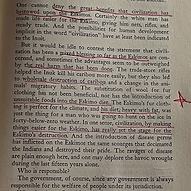
Buliard questions whether civilization has been positive for the people of the North: The Eskimo's fur clothing is perfect for the climate, and his diet, heavy with fat, was just the thing for a man who was going to hunt on the ice in forty-below-zero weather. In one sense, civilization, by making things easier for the Eskimo, has really set the stage for the Eskimo's destruction.
One cannot deny the great benefits that civilization has bestowed upon the Eskimos. Certainly the white man has made life easier for the Eskimo, giving him nets, rifles, and steady trade. And the possibilities for human development implicit in the word "civilization" have at least been indicated to the Inuit.
But it would be idle to contest the contest the statement that civilization has been a mixed blessing so far as the Eskimos are concerned, and sometimes the advantages seem to be outweighed by the real harm that has been done. The trade-store rifles helped the Inuk kill his caribou more easily, but they also led to wholesale destruction of caribou and a change in the animals' migratory habits. The substitution of wool for fur clothing has not been beneficial, nor has the introduction of unsuitable foods into the Eskimo diet. The Eskimo's fur clothing is perfect for the climate, and his diet, heavy with fat, was just the thing for a man who was going to hunt on the ice in forty-below-zero weather. In one sense, civilization, by making things easier for the Eskimo, has really set the stage for the Eskimo's destruction. And the introduction of disease germs has inflicted on the Eskimos the same scourges that decimated the Indians and destroyed their pride. The ravages of disease are plain enough here, and one may deplore the havoc wrought during the last fifteen years alone.
Who is responsible[not God, obviously]?
The government, of course, since any government is always responsible for the welfare of people under its jurisdiction.
What has been Canada's attitude toward "Natives" generally?[The same attitude that Catholic schools had?]
The goverment was unfair to the Indians. After the treaty, by means of which the Indians sold their birthright--the limitless prairies and rich forests--for a mess of lentils, the government permitted tuberculosis, starvation, and loss of liberty to reduce them from a proud, self-sufficient people to a race of permanent invalids.
Was this done innocently, or through oversight? Through ignorance?
One wonders. As an official told Bishop Breynat: "it had been thought that the Indian problem would resolve itself. Their number was diminishing steadily. They would disappear."
The same policy was adopted where Eskimos were concerned.
Toward them Canada had no written obligation, as it had toward the Indians, but only the Biblical warning that we are all our brothers' keepers. Nor did the government have any specific duty toward them, except in moral terms. And so the goverment fell back on a policy that can be summed up in a word: indifference.
Indifference!
January 1, 1951
Roger Buliard
Carnivore
Inuk

"The last time I ate human flesh, Falla, it was my little brother that I ate. I had loved him. He was always kind to me. The buttock, of course, is very good."
"Well, Falla, we were hungry. Starving. We started to eat the fallen ones. The old people went pretty quickly. Soon there were only a few of us left. The last time I ate human flesh, Falla, it was my little brother that I ate. I had loved him. He was always kind to me."
"Tell me, grandma, is that kind of meat any good?"
"Oh, yes, Falla," she said promptly. "Very good."
"What part is the best?" I asked.
She looked at me in surprise, as though I had asked a stupid question. "Why, the buttock, of course," she said. "You should know that, Falla."

