


Recent History
July 3, 1928
Helge Ingstad
The Land of Feast and Famine - Red Neighbors

A large trout is caught and is thrown to the Indian boys who carve it up and eat it raw "It is a point of honor for each to eat as much as each has cut of."
One day Pierre La Loche pulled from the lake a stalwart beast of a trout. It must surely have weighed in the neighborhood of forty pounds. He drags it into camp, lays it on a pile of dry spruce branches, and covers it over with fresh leaves. Meanwhile all the young boys in the camp gather about him in a laughing, noisy circle. Each of them has a hunting-knife tightly clasped in his fist. I ask what is about to take place, but La Loche replies secretively: " You see." Then he touches a match to the pile of spruce branches, which immediately flare up in a sheet of flame. This is a signal for the youngsters to crowd in close to the fire, their knives held high in the air. Some minutes pass. Then La Loche grasps the trout by the tail and hurls it off in the brush as far as he can. As he does so, the whole band of youngsters are after it and, with yells and shouts of jubilation, begin slashing into it with their knives. The first to reach it cut off good-sized chunks of the flesh and race triumphantly off with them. It is a point of honor for each to eat as much as each has cut off, and down goes that halfraw fish, no matter how large the piece, and soon there is nothing left of the trout save bones and scraps of the skin.
July 15, 1928
Helge Ingstad
The Land of Feast and Famine
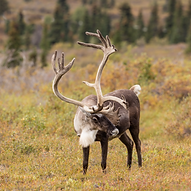
Ingstad ponders the population of the Caribou in the Canadian Arctic but acknowledges the toll of limiting the hunting would have on the natives.
If one accepts Hoare's estimate that there are five million caribou in all, and if one makes due allowance for the losses inflicted by wolf and wolverine, there would still be an appreciable surplus of calves every year. How many of these animals are annually shot by hunters can hardly be computed accurately. If, however, one makes a rough estimate of the human beings who are dependent upon the flesh of the caribou — a handful of white trappers and a few Indian and Eskimo tribes whose numbers are constantly diminishing — it would still seem that a steady increase of caribou is possible. This coincides with the view of the Indians who, influenced by the Canadian police, are, to an ever greater degree, abandoning their practices of purposeless mass slaughter. And now with the advent of the Thelon Game Sanctuary the caribou are assured of safe access to the western territories, provided this protected area is properly administered.
In this connection an additional fact of the utmost importance must be mentioned here. Trappers who live on the flesh of the caribou are simultaneously waging war upon its arch-enemy, the wolf. In order to gain some impression of the havoc wreaked by wolves, one would have to witness with his own eyes their wasteful slaughter. Often they slay for the sheer pleasure of killing and devour but a small portion of each carcass. Their murderous instincts affect, first of all, the calves. To throw some light on this situation, let me give some figures gleaned from the plainsmen east of Slave Lake: the dozen or so trappers who assemble there for the winter hunt, do away with some five hundred wolves annually. When one pauses to reckon that each wolf slays on the average of at least fifty caribou per year, the number of the latter whose lives are saved by men total twenty-five thousand. The deer in turn shot down by the hunters to provide themselves and their dogs with food constitute, in proportion to this, but a meager drain upon the herd.
If one looks a bit more closely at the other side of the question, with regard to the welfare of the people who live in the North, it is clear that their very existence would be threatened were the hunting of the caribou to be limited to any appreciable degree.
It would then no longer be possible for men to fare forth into the mighty wilderness where the dog-sled is the only means of transportation and the caribou the staple food of dog and man. And were we to deny the Caribou-Eaters their free nomad life on the trail of their daily bread, we should be robbing them of the very nerve-spring of their existence.
September 1, 1928
Helge Ingstad
The Land of Feast and Famine - Autumn Journey to the Land of the Caribou-Eaters

Ingstad meets Antoine, a Caribou-Eater who offers to take the trapper to his people near Lake Nonacho to hunt and fish. "From the caribou these Indians derive most of the food they require."
The factors had just returned to Snowdrift with a new stock of merchandise, and the Indians came paddling in from the islands in order to purchase toboggans and their winter supplies of ammunition, tobacco, and tea. Then they set their course eastward to Fond du Lac, whence they would start out for their hunting-grounds in the interior of the Barren Lands.
Dale was bound for the land of the Hudson Bay Eskimos. I, too, had made up my mind to leave Indian country behind, was thinking of going up north on my own, and was in the very act of making last-minute preparations, when I met Antoine.
Antoine was not a member of the Slave Lake tribe of Indians; he was a Caribou-Eater. The hunting-grounds of this tribe lie far off to the east and southeast of the lake. There a mighty arm of the forest extends far into the Barren Lands; it is crossed and recrossed by countless rivers and chains of large lakes. It is richer in fish and game than many another section and in olden times was the scene of many a bitter conflict between the tribes.
From the caribou these Indians derive most of the food they require. They live a more isolated life than the other tribes and are renowned as an energetic, nomadic hunter-folk, covering vast distances in the course of their travels. There exist many legends concerning their adventurous life, and their bitter struggles against hunger and cold when the caribou fail to appear. To be sure, the Indians who live in the neighborhood of Snowdrift are dependent upon the caribou during the greater part of each year, but the name " Caribou-Eater " has a natural association with the eastern plains, where the ancestors of this present folk chose emphatically to settle.
Originally there were large numbers of them, but sickness has claimed its toll, and today only a small group of them are left; these live on the banks of Nonacho Lake (the lake "with a string of islands"). It was from this district that Antoine had come.
I was sitting in front of my tent and struggling to repair a snowshoe when he suddenly appeared in front of me. Without uttering a word he picked up the snowshoe and with swift dexterity laced it with babiche; before I knew it, he smiled and returned the snowshoe to my hand. He then paused to admire my dogs and asked me whither I was bound. I motioned toward the north. Then he said: "Si, nen, Thelon thesi, white fox ihle, nezon (I, you, Thelon River go, many white fox, good)." I asked where we would be able to find fuel so far in the interior of the Barren Lands. He flung his arms out in the direction of the east and answered: " Nacha tue, detchen thle, sentilly (Big lake, lot of trees, all right)."
This interested me, not so much because of the hunting possibilities, but because it would give me an opportunity to live with the Caribou-Eaters and, together with them, penetrate into the country which had haunted my mind ever since I had come north: the country lying at the source of the Thelon River. The lower reaches of the river had been traced out by Tyrell; it winds its way through endless expanses of treeless plain before, at length, it empties as a mighty stream into Hudson Bay. But its head waters are unknown. They have forever been veiled in mystery. It is known, of course, that the Caribou-Eater Indians annually make long journeys by dog-sled to the upper Thelon, but they jealously guard the secrets surrounding this part of the country. Word had been spread abroad concerning a tract of forest growing about several large lakes in the very heart of the Barren Lands.
In the last analysis it is probable that this is the same freak of nature which Samuel Hearne heard mentioned when, in 1770-2, together with the Indians, he made his famous journey across the Barrens from Prince of Wales Fort on Hudson Bay to the mouth of the Coppermine River. In his travel notes, he writes: " For more than a generation past one family only, as it may be called . . . have taken up their Winter abode in those woods, which are situated so far on the barren ground as to be quite out of the track of any other Indians. . . . Few of the trading Northern Indians have visited this place; but those who have, give a pleasing description of it, all agreeing that it is situated on the banks of a river which has communication with several fine lakes. . . . The accounts given of this place, and the manner of life of its inhabitants, would, if related at full length, fill a volume. . . ." *
1 Samuel Hearne: A Journey from Prince of Wales Fort in Hudson's Bay, to the Northern Ocean. Undertaken by Order of the Hudson's Bay Company, for the Discovery of Copper Mines, a North West Passage, &c. In the Years 1769,1770, 1771, & 1772. (London: A. Strahan and T. Cadell; 1795.)
Antoine and I immediately came to an agreement. We decided that we would fish and hunt moose along the Snowdrift River until the caribou should appear from the north. On our first journey by sled we would follow the herd on their customary migration in a southeasterly direction as far as Otter Lake, where Antoine had arranged a meeting with other members of his tribe. Together with them, we would proceed to the main village of the Caribou-Eaters, on the shores of Nonacho Lake, from there making a rapid journey with a large following of Indians in the direction of the Thelon River.
Seven miles east, where the Snowdrift River empties into Stark Lake, was a well-known fishing-place. Thither we paddled, Antoine with his wife and children, and there, on the bank of the river, we raised our tents. We soon made the acquaintance of several other families belonging to the Slave Lake tribe. These, too, had planned to wait for good sledding before proceeding on into the Barrens. They were headed in a more northerly direction than we, in order that they might meet the Indians who, during the autumn, would be traveling through the country by canoe.
October 8, 1928
Helge Ingstad
The Land of Feast and Famine

With constant regularity the Indians went out after moose, and often indeed the camp could boast of fresh meat to eat. According to Indian custom, we then took with us the most tasty portions of the meat: the tongue, liver, and back-fat.
With constant regularity the Indians went out after moose, and often indeed the camp could boast of fresh meat to eat. Moose-hunting, if performed on foot and without dogs, is a most exacting sport. When it is said of a man that he is a good moose-hunter, it means that he enjoys the highest esteem in which the Indians can hold a person.
Antoine was the champion moose-hunter of the village. He seldom returned from the forest without having felled at least one, sometimes several, of these game. Once he allowed me to accompany him. We were two days on the trail of one moose. How distinctly I remember little Antoine as he went weaving or walking alertly along in front of me! Now he would bend down quickly and feel of the lichens beneath his feet, now he would point off to one side where a wolf or a fox had crossed the trail. If a twig should happen to crack beneath my foot, he would send me a lightning-like glance. Nothing escaped his attention, and his step was as light and noiseless as that of a lynx. It was approaching midnight of the second day when he suddenly halted, closely examined the trail, and pointed to a birchcovered slope ahead. We sneaked forward each by a different way and felled the moose, just as it came dashing past.
We flayed and quartered the carcass and spread the hide out over the pile of meat. According to Indian custom, we then took with us the most tasty portions of the meat: the tongue, liver, and back-fat. When, at midday, we came paddling back into camp, all were up and about, as is the tradition when hunters return from the field. It was also part of the custom that each person who met us was given a mouthful of the newly killed game to taste.
The following day all the men set out to transport the moose meat back to camp in preparation for the great autumn feast of the hunters. At these gatherings no women are permitted to be present.
We betake ourselves to one of the larger tepees and seat ourselves in a circle, our legs crossed beneath us. We wait. Suddenly, through the door of the tepee a little Indian boy appears carrying a pot of meat, so enormous that he is almost hidden behind it. Steam rises in billows from the pot, and the whole tepee is filled with the delicious aroma of moose venison. The Indian lad digs down into the pot with a forked stick and throws a huge chunk of fat in front of each hunter. He follows this first with one, then with another piece of lean meat, the result being an enormous portion for each one to feast upon. I squint out of the corners of my eyes at the others. There they sit, in silence and as stiff as pokers; no one would ever imagine that they have it in mind to partake of this food. Then Antoine gives the signal, and, in a flash, the entire assemblage pounce upon the food before them. They dig their teeth into gigantic pieces of meat and, with large knives, cut it off close to their lips, thus proceeding mouthful by mouthful. No sound is to be heard, save that of over-stuffed mouths chewing and the sound of cracking marrowbones. Everything is swallowed down; no more than a few slivers are left. A series of pleasurable belches are heard, whereupon, our pipes lit, we sink back on our caribou hides with a delightful sensation of having overeaten.
October 25, 1928
Helge Ingstad
The Land of Feast and Famine

The caribou arrive to the East provoking great joy and dancing among the hungry Caribou-Eaters.
Then comes another evening early in October. In the largest of the tepees the hunters are seated, staring into the open fire. Now and then one of them pushes aside the tent-flap and glances out. Down on the beach the squaws are standing in groups, peering out into the darkness. The mood of the night is definitely autumnal, with a gurgling from the river and a soft murmur from the lake. We are awaiting the moose-hunters. Three days ago they departed into the east, and tonight they must surely return. The eldest of the squaws has predicted it so, and thus there can be no doubt in our minds, for she feels it in her bones, and her intuition has seldom proved false.
As we are sitting there, we hear a sudden cry from the beach. Like one man, we leap to our feet and race outside. My, but those squaws have sharp ears! Every now and then the wind ever so faintly brings us the sound of distant paddles. These sounds increase in intensity and duration and, at length, the canoe grounds on the beach. The women run over to it. Suddenly a stir runs through the crowd, immediately followed by a wild cry of jubilation: " E-then! E-then! (Caribou! Caribou!) " Then it seems as though the devil himself is let loose. " E-then! E-then! " they all cheer together, dancing round and round in each other's arms like crazy folk, slapping each other on the back, smiling and laughing. Antoine puts both arms around me and whirls me away, the end of it being that I tumble over backwards down the sloping bank of the river. After regaining my balance somewhat, I do not hold myself aloof from these Indians. The last trace of civilization is blown to the four winds. I clutch little Antoine in my arms, and round and round we dance until our breath gives out, and then we shout, "E-then! E-then!" until our throats are raw.
Yes, the caribou had arrived. East of the mountains the hunters had encountered the herd streaming out of the northwest.
Ancient History
Vindija, 42000, Varaždin, Croatia
28500
B.C.E.
Neanderthal diet at Vindija and Neanderthal predation: The evidence from stable isotopes
The isotope evidence overwhelmingly points to the Neanderthals behaving as top-level carnivores, obtaining almost all of their dietary protein from animal sources
Archeological analysis of faunal remains and of lithic and bone tools has suggested that hunting of medium to large mammals was a major element of Neanderthal subsistence. Plant foods are almost invisible in the archeological record, and it is impossible to estimate accurately their dietary importance. However, stable isotope (13C and 15N) analysis of mammal bone collagen provides a direct measure of diet and has been applied to two Neanderthals and various faunal species from Vindija Cave, Croatia. The isotope evidence overwhelmingly points to the Neanderthals behaving as top-level carnivores, obtaining almost all of their dietary protein from animal sources. Earlier Neanderthals in France and Belgium have yielded similar results, and a pattern of European Neander- thal adaptation as carnivores is emerging. These data reinforce current taphonomic assessments of associated faunal elements and make it unlikely that the Neanderthals were acquiring animal protein principally through scavenging. Instead, these findings portray them as effective predators.
Stable Isotope Analyses.
Mammal bone collagen δ13C and δ15N values reflect the δ13C and δ15N values of dietary protein (14). They furnish a long-term record of diet, giving the average δ13C and δ15N values of all of the protein consumed over the last years of the measured individual's life. δ13C values can be used to discriminate between terrestrial and marine dietary protein in humans and other mammals (15, 16). In addition, because of the canopy effect, species that live in forest environments can have δ13C values that are more negative than species that live in open environments (17). δ15N values are, on average, 2–4‰ higher than the average δ15N value of the protein consumed (18). Therefore, δ15N values can be used to determine the trophic level of the protein consumed. By measuring the δ13C and δ15N values of various fauna in a paleo-ecosystem, it is possible to reconstruct the trophic level relationships within that ecosystem. Therefore, by comparing the δ13C and δ15N values of omnivores such as hominids with the values of herbivores and carnivores from the same ecosystem, it is possible to determine whether those omnivores were obtaining dietary protein from plant or animal sources.
Cheddar Reservoir, Cheddar BS26, UK
12000
B.C.E.
FOCUS: Gough’s Cave and Sun Hole Cave Human Stable Isotope Values Indicate a High Animal Protein Diet in the British Upper Palaeolithic
We were testing the hypothesis that these humans had a mainly hunting economy, and therefore a diet high in animal protein. We found this to be the case, and by comparing the human δ15N values with those of contemporary fauna, we conclude that the protein sources in human diets at these sites came mainly from herbivores such as Bos sp. and Cervus elaphus
We undertook stable isotope analysis of Upper Palaeolithic humans and fauna from the sites of Gough's Cave and Sun Hole Cave, Somerset, U.K., for palaeodietary reconstruction. We were testing the hypothesis that these humans had a mainly hunting economy, and therefore a diet high in animal protein. We found this to be the case, and by comparing the human δ15N values with those of contemporary fauna, we conclude that the protein sources in human diets at these sites came mainly from herbivores such as Bos sp. and Cervus elaphus. There are a large number ofEquus sp. faunal remains from this site, but this species was not a significant food resource in the diets of these Upper Palaeolithic humans.
If the humans hunted and consumed mainly horse, then their 15N values should be c. 3–5‰ (Equus 15N value of 0·7‰+enrichment of 2–4‰). Instead, their 15N values make more sense if they lived mostly off Bos and Cervus elaphus (Bos and Cervus values of c. 3‰+enrichment of 2–4‰=the observed values c. 6–7‰). It is also possible that other species, including Rangifer tarandus, were consumed by these individuals. Rangifer tarandus has 15N values similar to Cervus elaphus (Richards, 1998), and has more positive 13C values, which may explain the observed slight enrichment in the human 13C values. A number of artefacts made from Rangifer tarandus have been found at Gough’s, but there is no other evidence that this species was being exploited for food


