


Recent History
May 1, 1927
Helge Ingstad
The Land of Feast and Famine - Beaver Hunting

While starving and looking for anything to hunt, the trappers come across a moose and spend 4 days drying out the meat before hiking back home. However, "moose meat makes one nat-seri (strong), as the Indians say, and when a man has a full belly, he has a different outlook upon life."
It appears as though, on the other side of a birch-clad hill, there might be another lake. Sure enough; I can already glimpse it shining through the trees and am just on the point of emerging from the woods when — the unbelievable takes place! A moose heaves in sight across the lake, runs out across a stretch of muskeg, and halts to sniff the air. What a mountain of edible flesh!
At such long range I aim too low and succeed only in wounding the moose in one of its front legs. With that, it swings round and begins limping back toward the woods. It is just at this point that a fuzzy white shape darts from the woods and, before my very eyes, hurls itself upon the beast. I stare in utter amazement, until I suddenly recognize the familiar yelping of Trofast. Heavens, what a dog! He had probably thought to himself that we couldn't hope to do much hunting without him! So he had slipped his collar, a trick he can accomplish whenever he has a fit of hunting-fever, regardless of how tightly it fits. And here he is now, successful in running down his game and driving the moose straight in my direction.
Many a time have I seen moose and dog come to blows, but never before a battle so desperately waged as this one. Trofast is everywhere. Like a wolf, he lunges in at his adversary, first from the front, then from the rear. Now he is crouching on his fore-paws right in front of the moose, barking and doing his best to tantalize it; he escapes the hoofs and antlers of the other by a mere fraction of a second. The moose sees red, feels the pain in its leg, and is out for murder. With head bent low and stiff staring eyes it stands waiting for an opening, then limps in the direction of the dog. Like a sledge-hammer whizzing through the air, that wounded leg flies out at the dog. Mud from the marsh splashes up where it lands. Round and round they go.
I approach to within a short distance, neither of the combatants paying the slightest heed to me. At this point I deliver the coup de grace. At the very moment the moose topples over, Trofast pounces upon its rump with a snarl and begins wrestling to make it lie still. He is more eager than cautious, however, for the moose is still kicking, and it is not long before Trofast is sailing high and far through the air. He crawls to his feet again and returns, limping stiffly. This time, to be on the safe side, Trofast stations himself high up on the belly of the moose. Ah, there is a dog who can well feel proud of himself!
Now I must make some effort to get hold of Dale. I set off in the direction of the river, shouting at the top of my lungs. All at once he breaks from the woods and comes running as fast as he can in my direction, his finger on the trigger. " What's up? " he calls from a distance. " Just shot a moose," I reply. " Oh, well," he says dryly. " I thought the bear had got you."
The fact of the matter was that Dale had just been looking for some bear cubs he had heard squeaking up in a spruce-tree when he heard my wild shouts. There had been no doubt in his mind whatever but that the she-bear had got her dander up and was venting her spite upon me. . . .
We remained at the place where I brought down the moose, for four days, simply gorging ourselves with meat. Meanwhile we fleshed and dried the moose hide and laid in a large store of dried meat. When we struck camp and set our course back in the direction of Slave Lake, both we and our dogs had tremendous burdens to carry. But moose meat makes one nat-seri (strong), as the Indians say, and when a man has a full belly, he has a different outlook upon life. . . .
June 1, 1927
Helge Ingstad
The Land of Feast and Famine - Summer on Great Slave Lake

The trappers muse on the comings and goings of the mysterious caribou herds while also recounting periods of starvation in which they had to eat their own dogs.
There are many things which happen during the course of a year when one lives face to face with the wilderness and must rely entirely upon his dogs and his gun. The first matter of interest is the caribou, for they represent food. We have all encountered them, have seen the herds streaming out across the country, beneath a forest of antlers; we have all gorged ourselves on their flesh, haunted by the possibility of a day when the country would be empty of them, and the cold press in upon us and squeeze the life from our wretched bodies. We piece our recollections together and build for ourselves a picture of the caribou and its migrations, but we never succeed in discovering the first clue to the solution of the riddle of this mysterious animal.
Klondike Bill tells us about the time he was almost trampled underfoot by a herd of many thousand caribou. He had to crouch behind his sled, he said, whilst the herd, terrified by wolves, rushed by on every side. Joe had a hand-to-hand encounter with wolves up in the vicinity of the Coppermine River and escaped by the skin of his teeth. Bablet relates how once he was on the point of losing his dogs up on the Barrens — the very worst situation which could have confronted him. They were just making off with the sled in chase of a band of caribou, and Bablet had had no other choice but to shoot his train-leader. " The best dog that ever worked in the traces," he concludes. We others are not so willing to take his word on the latter point, however, for what trapper will ever admit that any but his own are the best dogs in the land? And woe be unto the man who, by innuendo or otherwise, dares to belittle them! Such is even worse than to mention to a man his wife's imperfections! A trapper may curse at his dogs and flog them unmercifully, but he always stands ready to do battle for them.
Price has had a tough time of it during the latter part of the winter. He was on a long journey east when the caribou vanished completely. The dogs starved and one of them •— one of the most powerful beasts I have ever seen — began to get nasty. A primitive struggle for supremacy developed between dog and man. The dog was harnessed at the time, but it had become so wild and violent that it dragged the rest of the team with it when it decided to launch a lunging, snapping attack. At length, hopping up on the sled, it continued to give battle from there. Price conquered after a time, but it was a victory dearly won, and he would rather have fought with a grizzly bear, he says. Later, on that same journey, he became snow-blind, was taken so whilst he was off looking to one of his traps and had to feel his way back over his own tracks in the snow in order to find his dogs. "Wasn't much fun," he adds dryly.
But, just the same, the one who had had the toughest time of all was certainly old Klondike Bill. Last autumn he had set off into the country with five big strapping dogs, and this spring he returned with but two. The other three he had eaten about Christmas time when he was starving on the shores of Kasba Lake. We all know of the affair, but it is a matter which no one ever mentions.
July 2, 1928
Helge Ingstad
The Land of Feast and Famine - Red Neighbors

Chief Marlo, an old Indian in the Arctic: "My rich country. Caribou, musk-ox, fish, much food. Before, Indians all over. Great hunters. White man come, Indians die, all-a time die."
Chief Marlo has not cut his hair like the others, for he is a member of the old school. Black and straight, it falls down over his shoulders. How old he is, not even he himself knows. " When I little, big battle, Dead Men's Island," he says. Now he is too feeble to join in the hunt. He remains indoors most of the time, smoking his pipe and giving advice. In a face of wrinkled parchment shine a pair of fun-loving eyes, and it may well be, as it is said, that he can still draw as fine a bead on a fleeing caribou as anyone.
Each evening when the sun is setting over Great Slave Lake, Mario emerges from his tent and totters down to the beach. There he sits for a long time. On one occasion I sit down beside him. Not a word has passed between us when he nods toward the sun, just as it is slowly slipping down into the water in an orgy of red, and " Who you think make sun? " he asks.
" Who do you think? " I parry.
"Jesus — mebbe so," he says hesitantly. Just how sincerely he believes this to be true is pretty hard to know, for he immediately begins talking about how the sun, from the very first, has been the all-powerful god of the Indians. He flings out his arms to it and says: " First all water, then sun."
But when Marlo begins to talk about his people, he is bitter and terse: "My rich country. Caribou, musk-ox, fish, much food. Before, Indians all over. Great hunters. White man come, Indians die, all-a time die." He points off toward the north where the woods melt like a bluish mist into the distance behind which lie the Barren Lands, and then he quietly adds: "When caribou come from Land without Trees, Indians choose new chief."
I object by saying that he certainly has a number of years left to live. But Marlo shakes his head conclusively, as though he is positive of his statement. "When caribou come," he repeats, knocks the ashes from his pipe, and totters back up to his tepee.
July 3, 1928
Helge Ingstad
The Land of Feast and Famine - Red Neighbors

A large trout is caught and is thrown to the Indian boys who carve it up and eat it raw "It is a point of honor for each to eat as much as each has cut of."
One day Pierre La Loche pulled from the lake a stalwart beast of a trout. It must surely have weighed in the neighborhood of forty pounds. He drags it into camp, lays it on a pile of dry spruce branches, and covers it over with fresh leaves. Meanwhile all the young boys in the camp gather about him in a laughing, noisy circle. Each of them has a hunting-knife tightly clasped in his fist. I ask what is about to take place, but La Loche replies secretively: " You see." Then he touches a match to the pile of spruce branches, which immediately flare up in a sheet of flame. This is a signal for the youngsters to crowd in close to the fire, their knives held high in the air. Some minutes pass. Then La Loche grasps the trout by the tail and hurls it off in the brush as far as he can. As he does so, the whole band of youngsters are after it and, with yells and shouts of jubilation, begin slashing into it with their knives. The first to reach it cut off good-sized chunks of the flesh and race triumphantly off with them. It is a point of honor for each to eat as much as each has cut off, and down goes that halfraw fish, no matter how large the piece, and soon there is nothing left of the trout save bones and scraps of the skin.
July 15, 1928
Helge Ingstad
The Land of Feast and Famine
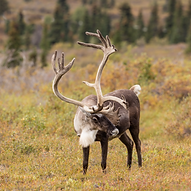
Ingstad ponders the population of the Caribou in the Canadian Arctic but acknowledges the toll of limiting the hunting would have on the natives.
If one accepts Hoare's estimate that there are five million caribou in all, and if one makes due allowance for the losses inflicted by wolf and wolverine, there would still be an appreciable surplus of calves every year. How many of these animals are annually shot by hunters can hardly be computed accurately. If, however, one makes a rough estimate of the human beings who are dependent upon the flesh of the caribou — a handful of white trappers and a few Indian and Eskimo tribes whose numbers are constantly diminishing — it would still seem that a steady increase of caribou is possible. This coincides with the view of the Indians who, influenced by the Canadian police, are, to an ever greater degree, abandoning their practices of purposeless mass slaughter. And now with the advent of the Thelon Game Sanctuary the caribou are assured of safe access to the western territories, provided this protected area is properly administered.
In this connection an additional fact of the utmost importance must be mentioned here. Trappers who live on the flesh of the caribou are simultaneously waging war upon its arch-enemy, the wolf. In order to gain some impression of the havoc wreaked by wolves, one would have to witness with his own eyes their wasteful slaughter. Often they slay for the sheer pleasure of killing and devour but a small portion of each carcass. Their murderous instincts affect, first of all, the calves. To throw some light on this situation, let me give some figures gleaned from the plainsmen east of Slave Lake: the dozen or so trappers who assemble there for the winter hunt, do away with some five hundred wolves annually. When one pauses to reckon that each wolf slays on the average of at least fifty caribou per year, the number of the latter whose lives are saved by men total twenty-five thousand. The deer in turn shot down by the hunters to provide themselves and their dogs with food constitute, in proportion to this, but a meager drain upon the herd.
If one looks a bit more closely at the other side of the question, with regard to the welfare of the people who live in the North, it is clear that their very existence would be threatened were the hunting of the caribou to be limited to any appreciable degree.
It would then no longer be possible for men to fare forth into the mighty wilderness where the dog-sled is the only means of transportation and the caribou the staple food of dog and man. And were we to deny the Caribou-Eaters their free nomad life on the trail of their daily bread, we should be robbing them of the very nerve-spring of their existence.


