


Recent History
October 25, 1949
Helge Ingstad
Nunamiut, Among Alaska's Inland Eskimos

A diet of tough caribou meat with practically no fat becomes dismal after a time.
It is October.
An important event is now imminent. Very soon the southward autumn migration of the caribou from the tundra to the mountains will begin. Great herds will go through the Anaktuvuk Pass during a comparatively short time. The Eskimos will then have to shoot sufficient caribou bulls, which until the mating season are very fat, to ensure our main fat requirements for the winter. Later the beasts become skinny, and without sufficient fat, people on a meat diet throughout a long, cold winter are in an awkward position.
.....
But something is. wrong. Day after day we range far over the countryside in every direction but see nothing but one or two small herds of lean bulls. A few animals are brought down, and we keep going more or less, but meals are scanty for both men and dogs.
The shortage of fat is now becoming serious. The only form of fat we have is the marrow in the bones; it is eaten raw and is a dish more delicious in times like these than words can describe. But as a caribou has only four legs and few beasts are shot, not much of this delicacy comes the way of each individual. No, a diet of tough caribou meat with practically no fat becomes dismal after a time. It is a diet which gives one the same empty feeling under the breastbone as when one has nothing to eat at all. We can eat almost unlimited quantities without feeling satisified. One's condition suffers accordingly; one feels the cold more: I have to make an effort to do things which otherwise would have been easy.
"It's rather like eating moss," Paniaq says with a smile as we attack the tough meat. And when we are out hunting together and look out from the heights over a wide area and do not see a living creature on the snow, only cold and nakedness as far as the eye can reach, he sometimes says in his dry manner: "A hungry land."
It is becoming common to borrow meat from one another. Here the Eskimos' sense of duty toward their nearest relations is clearly shown. When the hunter returns to the settlement with game, his wife immediately cuts off a few good portions of meat and gives them to her parents and parents-in-law. This diminishes the uncertainty which attaches to a single hunter's bag. In a way the community functions in hard times like a kind of mutual benevelent society.
Our situation would be more difficult if we had not a quantity of reserve provisions running about high up in the steepest mountains--the wild sheep. They are the bright spots in our existence. Leaving the lean caribou meat for the fat, tender mutton is like changing from bread and water in prison to the choicest dish at the Cafe de Paris. The sheep keep fat longer than the caribou, from the beginning of July to April.
Now and again we go out hunting sheep. But the beasts are rather scattered and in small herds, so even if we bring down some, they do not go far among sixty-five people(and 200 dogs).
....
But there was a report ahead, and I saw a ram in flight far away. There sat Paniaq, smoking his pipe beside a big ram.
We rolled and pulled the animal down to the foot of the mountain; as usual we ate the glands between the hooves and the dainty neck fat on the spot.
November 1, 1949
Helge Ingstad
Nunamuit: Among Alaska's Inland Eskimos

Against this background what the Nunamiuts have to tell is of interest. Paniaq says that in the past the people lived mainly on musk oxen.
The musk ox, that queer shaggy creature of prehistoric appearance, is not found in Alaska.
Some musk-ox horns have been found on the tundra north of the Brooks Mountains, and the Nunamiuts, among other things, have come upon several. A very old Eskimo at Point Barrow told me that there were no musk ox in his time nor in his father's, but that there were in his grandfather's.
Against this background what the Nunamiuts have to tell is of interest. Paniaq says that in the past the people lived mainly on musk oxen. He also tells an old story which confirms this. He adds: "The musk oxen disappeared eastward because they were hunted so much. Old people say that when this animal has been hunted one way it continues to go in that direction."
Thus it seems that the musk ox was exterminated in Alaska about a hundred years ago. When the Eskimos came upon a herd, it was doomed. The musk ox is helpless against men; it often stands still and lets itself be slaughtered. Thus it is quite reasonable to suppose that in northern Alaska the species was wiped out in quite early times.
February 15, 1950
Helge Ingstad
Nunamiut, Among Alaska's Inland Eskimos

Trapping in enclosures and hunting from the kayak were of special value to the Eskimos; they could thus obtain large quantities of meat at one stroke and provide for the future. Hunting with bows and arrows was also important, but to a lesser degree.
At another place I found the remains of a kangiraq, i.e. a large enclosure into which caribou are driven. These were usually set up on a height near a river and might be a hundred yards or more in diameter, consisting of a number of tall willow rods driven into the earth or snow. Along the inside of this enclosure snares are made of animals' skins were placed at suitable intervals and fastened to a stone or stick. There were usually several enclosures, one inside another; the maximum number was four, and then the contrivance was called a sisamailik. There were snares along each line totalling several hundreds.
The caribou found their way to the gate by following two lines of cairns which began several miles out in the open country, and which led across the river up the slope to the enclosure. Close to it there might be two snow walls. Thus a "street" was formed outside which the animals did not venture; far from the enclosure it was broad, and then gradually became narrower.
A herd of caribou had to be driven into this "street" often from a long way off; there are stories of drives which took several days. The drivers worked together, running continually. This was child's play to them, thoroughly trained as they were.
When the caribou had at last been driven up the slope towards the enclosure, people ran up from both sides, clapping their hands, hooting, and yelling. The beasts rushed in panic throught he opening and into the inner enclosure. A number went straight into the snares; others broke through the willows into the other enclosures and were snared there. Some of the hunters sent a rain of arrows at the beasts trying to escape, while others were busy with their flint spears. There was sometimes a large bag, which was divided equally among the families participating.
The Nunamiuts used this method for capture especially in the months of February and March, for that was usually the most difficult time with caribou and it was light enough for a long drive.
Trapping in enclosures and hunting from the kayak were of special value to the Eskimos; they could thus obtain large quantities of meat at one stroke and provide for the future. Hunting with bows and arrows was also important, but to a lesser degree.
January 1, 1951
Roger Buliard
Carnivore
Inuk
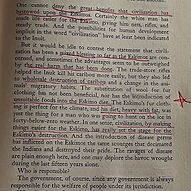
Buliard questions whether civilization has been positive for the people of the North: The Eskimo's fur clothing is perfect for the climate, and his diet, heavy with fat, was just the thing for a man who was going to hunt on the ice in forty-below-zero weather. In one sense, civilization, by making things easier for the Eskimo, has really set the stage for the Eskimo's destruction.
One cannot deny the great benefits that civilization has bestowed upon the Eskimos. Certainly the white man has made life easier for the Eskimo, giving him nets, rifles, and steady trade. And the possibilities for human development implicit in the word "civilization" have at least been indicated to the Inuit.
But it would be idle to contest the contest the statement that civilization has been a mixed blessing so far as the Eskimos are concerned, and sometimes the advantages seem to be outweighed by the real harm that has been done. The trade-store rifles helped the Inuk kill his caribou more easily, but they also led to wholesale destruction of caribou and a change in the animals' migratory habits. The substitution of wool for fur clothing has not been beneficial, nor has the introduction of unsuitable foods into the Eskimo diet. The Eskimo's fur clothing is perfect for the climate, and his diet, heavy with fat, was just the thing for a man who was going to hunt on the ice in forty-below-zero weather. In one sense, civilization, by making things easier for the Eskimo, has really set the stage for the Eskimo's destruction. And the introduction of disease germs has inflicted on the Eskimos the same scourges that decimated the Indians and destroyed their pride. The ravages of disease are plain enough here, and one may deplore the havoc wrought during the last fifteen years alone.
Who is responsible[not God, obviously]?
The government, of course, since any government is always responsible for the welfare of people under its jurisdiction.
What has been Canada's attitude toward "Natives" generally?[The same attitude that Catholic schools had?]
The goverment was unfair to the Indians. After the treaty, by means of which the Indians sold their birthright--the limitless prairies and rich forests--for a mess of lentils, the government permitted tuberculosis, starvation, and loss of liberty to reduce them from a proud, self-sufficient people to a race of permanent invalids.
Was this done innocently, or through oversight? Through ignorance?
One wonders. As an official told Bishop Breynat: "it had been thought that the Indian problem would resolve itself. Their number was diminishing steadily. They would disappear."
The same policy was adopted where Eskimos were concerned.
Toward them Canada had no written obligation, as it had toward the Indians, but only the Biblical warning that we are all our brothers' keepers. Nor did the government have any specific duty toward them, except in moral terms. And so the goverment fell back on a policy that can be summed up in a word: indifference.
Indifference!
January 2, 1960
Fred Bruemmer
Arctic Memories - Beginnings

"The whale meant food and life and glory, the primal thrill of being, and at that moment nothing else mattered.... We ate the steaming seal meat; drank the fat, scalding broth; and glowed with marvelous warmth."
WE TRAVELED FROM NOWHERE TO NOWHERE IN A WORLD ALL WHITE, eleven dogs, a long sled, a fur-clad Inuk and I. We had spent a week at the floe edge, the limit of landfast ice, and the hunting had been good. Jes had shot and harpooned eight seals. We had eaten well and our sled was heavy with meat - food for his family and dogs - and with seal pelts he would sell at the store.
We felt the coming of the storm. The air was still and oppressive. Gulls, screaming, flew toward the distant land. The sky turned leaden black. We should have left hours ago. But a pod of narwhals was feeding close to the floe edge; the eerie stillness was filled with the plosive "pooff," "pooff," "pooff" of their breathing. Small plumes of exhaled breath hung briefly in the icy air, and a few times we saw the gleaming ivory tusks of the males.
Jes wanted a whale. His entire hunter's spirit was focused on those whales, wishing them closer, closer. He was the perfect predator, quietly poised in total concentration, the ultimate Arctic hunter, as his people had been since the dawn of time. The whale meant food and life and glory, the primal thrill of being, and at that moment nothing else mattered.
While Jes's soul was in that strange mystic sphere that links the hunter to his prey, I sat apart and nursed my white man's worries. I had spent far too many years in the Arctic not to know that the coming storm would be hell, the trip home utter misery and, if the ice broke up, exceedingly dangerous. It was 60 miles (96 km) back to the village.
The storm struck, and Jes did not get his whale. He rose slowly, reluctantly. The tension seeped out of him and then he smiled a marvelously boyish smile, shrugged, and said: "Ayornamat. (It can't be helped.)" An Inuk does not rant and rave; his language has no swearwords. He does not rail against God or Nature, but simply accepts adversity. He does his best; the rest is fate.
We lashed the load upon the long pliant sled with utmost care, passing the bearded-seal thong back and forth, pulling it tight with all our strength. Jes called to the dogs. Normally they would have leapt into a joyous gallop. Now they moved without enthusiasm, their tails, usually cockily curled, drooping sadly. Like me, they feared the storm.
At first, brief lulls alternated with vicious gusts. Then the storm became steady and we traveled into a hissing, roaring avalanche of snow. The dogs hated it. The wind-lashed ice spicules hurt their eyes, and they tried to veer away from the wind. Jes beat them, coaxed them, directed them. There was only snow, the screaming wind, and nothingness; we seemed suspended in time and space. But Jes was guided by sastrugi, snow ripples created by prevailing winds, and by the knowledge of a thousand trips since he had first gone to the floe edge as a small boy with his father.
We traveled for hours, our faces seared by the wind, our fur clothing plastered with snow. The ice changed, became rugged, hummocky. We were in a tidal zone, close to a coast. For a moment I saw a cliff and then it vanished again in the whirling white. Jes walked ahead now, leading the dogs through a maze of ice blocks. Near the base of the cliff he tied the dogs securely to a stone upon the ice. "Come," he said. We clambered up an incline, perhaps a beach in summertime, walked past a house-high rock, squeezed through a triangular hole between the rock and the cliff, and were suddenly in a spacious cave. Jes laughed, delighted by my amazement, the magician who has performed the perfect trick.
Jes unharnessed and tethered the dogs, then cut up a seal and fed them. They rolled into balls, noses tucked under bushy tails, and soon the snow covered them with an insulating blanket. I lugged our sled load into the cave, shook the snow out of the bedding furs and my clothing, and made supper: a big pot of seal meat boiled on a Primus stove.
After the elemental chaos of the storm, the cave felt calm and secure. It had obviously served as sanctuary to other Arctic hunters for hundreds, perhaps thousands of years. In the back were low sleeping platforms of pebbles and flat stones. Soot streaks along the walls and roof showed where seal-oil lamps had burned and flared. The cave floor was scattered with bones, remnants of past meals. Bone, stone, and ivory shavings and splinters marked places where men had sat and made or repaired tools or hunting weapons, and broken toys spoke of children who had once played in the cave.
We ate the steaming seal meat; drank the fat, scalding broth; and glowed with marvelous warmth. Jes made tea, boiled it until it was coffee-black, and we drank it syrupy-thick with sugar. We were safe, warm, full of food, relaxed and utterly content. Long, long ago, said Jes, Tunit had lived in this cave, a giant people but stupid, and the Inuit had killed them. His stories - part myths, part ancient oral history - - spanned the ages. The Primus hissed, and outside roared the storm.
We spread our furs on the ancient sleeping platforms and, minutes later, his deep, even breathing told me that Jes was sound asleep. Cozy in my furry cocoon, I looked at the soot patterns on the cave wall, listened to the eldritch screeching of the storm, and thought sleepily about my other life: our pleasant, book-filled home in Montreal; my wife; our children. It was early May. Maud would be working in the garden. The boys should be home from school. The first tulips would be blooming. As I drifted off to sleep, it seemed part of a dream.


