

Trapping, Exploring, Hunting
The sales of furs, and the exploration of new routes to new lands, and finally the hunting of animals made a significant impact in the history of the modern world, and often the people living remote to civilization would have to take advantage of the ways of the native people and eat like them. In this way, they would be carnivores by need, as fishing, hunting, and eating trapped animals would be the best way to get a meal, and animals can be processed down into high fat pemmican to get the best bang for the buck when it comes to transporting fuel as weight.

Recent History
October 29, 1830
Trappers and Mountain Men - American Heritage Junior Library

"In addition to his other talents, the mountain man had to be a master of buffalo hunting, for meat comprised almost one hundred per cent of his normal diet. Buffalo meat has been called the greatest meat man has ever fed on. He cracked the marrow bones to make "trapper's butter."
The mountain man was a rugged individualist of whom Washington Irving wrote, "You cannot pay a free trapper a greater compliment than to persuade him that you have mistaken him for an Indian." In fact, he virtually had to become an Indian in order to survive. "A turned leaf," wrote George Frederick Ruxton in Adventures in Mexico and the Rocky Mountains, blade of grass pressed down, the uneasiness of wild animals, the flight of birds, are all paragraphs to him written in Nature's legible hand."
In addition to his other talents, the mountain man had to be a master of buffalo hunting, for meat comprised almost one hundred per cent of his normal diet--at least when in the buffalo country. As in everything else, he had to develop new techniques for "making meat." When hunting horseback, according to the traveler Rudolph Kurz, the hunters (those operating from fixed forts, at any rate) did not use long-barreled rifles because "they think the care required in loading them takes too much time unnecessarily when shooting at close range and, furthermore, they find rifle balls too small. The hunter chases buffaloes at full gallop, discharges his gun [a short- harreled shotgunk and reloads it with out slackening speed.
Buffalo meat has been called the greatest meat man has ever fed on. The mountain man usually boiled the outs from the hump, and roasted other pieces. He cracked the marrow bones to make "trapper's butter", or he used the marrow to make a fine thick soup.
January 1, 1839
Trappers and Mountain Men
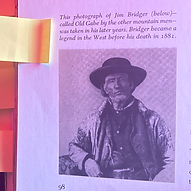
A mountain man who trapped across the plains and Rocky Mountains named Jim Bridger is described. He certainly sounded like an entertaining carnivore and an excellent outdoorsman. "he had been known to kill twenty buffaloes by the same number of consecutive shots. Tall-six feet at least- muscular, without an ounce of superfluous flesh ... he might have served as a model for a sculptor or painter, by which to express the perfection of graceful strength and easy activity."
Jim Bridger could not write his own name, but his skill in the mountains, was proverbial, and the American Fur Company was eventually happy to take him into its service. A writer who knew Jim in the late 1830's said that he had "a complete and absolute under-standing of the Indian character in all its different phases, and a firm, though by no means over-cautious distrust with regard to these savages." Jim was the perfect outdoorsman, his bravery was unquestionable, his horsemanship equally so, and ... he had been known to kill twenty buffaloes by the same number of consecutive shots. "
The physical conformation of this man was in admirable keeping with his character. Tall-six feet at least- muscular, without an ounce of superfluous flesh ... he might have served as a model for a sculptor or painter, by which to express the perfection of graceful strength and easy activity. His cheekbones were high, his nose hooked or aquiline, the expression of his eve mild and thoughtful, and that of his face grave almost to solemnity. "To complete the picture, he was perfectly ignorant of all knowledge contained in books, not even knowing the letters of the alphabet; put perfect faith in dreams and omens, and was unutterably scandalized if even the most childish of the superstitions of the Indians were treated with anything like contempt or disrespect; for in all these he was a firm and devout believer."
Like other mountain men, Jim became a guide and scout when the beaver trails thinned out. A West Point officer for whom Bridger worked in his later years said that Jim had never heard of Shakespeare until one night at the campfire he asked who wrote the world's best book. The West Pointer named the Bard of Avon, and Jim dashed away to find a covered-wagon train. He located a set of the plays which he bought for a yoke of oxen worth $125. He also hired a youth to 120 read the books to him. Jim was able to commit Shakespeare's poetry to memory as easily as he had absorbed every geographical detail of the West. There. after he entertained his mates by reciting the stories, with a liberal sprinkling of mountain vernacular, which he used for emphasis.
Like Jim Beckwourth, Bridger was a yarn-spinner of considerable genius After stories of petrified forests became current in the West, he liked to tell of petrified birds that sang petrified songs, and of a wide chasm that he could cross because the law of gravity was petrified. But Jim's tall tales never limited his usefulness. When in the late 1830's it became apparent that beaver could no longer maintain the fur trade-the emphasis was shifting to trade with the Indians for buffalo robes-and fixed posts were springing up at many places in the mountains, Jim began to think of establishing a post of his own somewhere in the Green River Valley. In 1841, in association with Louis Vasquez, he built the first of several such forts, finally made permanent in 1843 as Fort Bridger in the southwest corner of Wyoming, on what was then becoming the Oregon Trail. The fort served as a supply station for the emigrant trains, and Jim ended his active days in doing something he was well qualified to do-helping others in their struggle to settle in the West.
http://wyoming-fact-and-fiction.blogspot.com/2016/01/the-diet-of-mountain-man.html
The Diet of a Mountain Man
We read and watch daily opinions about our overweight society, “Americans are too fat,” we are continually told. Maybe so, today anyway, but not always. I smile each time I remember the story of Jim Bridger making his own supper. He skinned and gutted a jack rabbit and a nice sized trout, skewered them and propped both over the fire for roasting. Once they were cooked to his taste, likely not long, he ate both quietly and drank an entire pot of boiled coffee to wash down the meat. No seasoning of any kind, maybe smoke flavor from the fire, but that’s it. This was not uncommon for early hunters/trappers in the American West. Meat and coffee. Surprising to some, that many of these men also drank a lot of tea, it was as popular as coffee for many of the early explorers.
July 10, 1866
The Great Fur Trade - The Great Fall Hunt
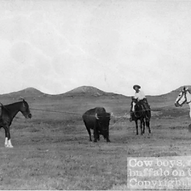
"Two active hunters, taking in their hands the long lines of raw-hide, called "shagnappe," isolate a buffalo cow from the herd. Then, seizing either end of the line, they proceed to revolve about their victim in opposite directions, so entwining her legs in the folds of the cord as to throw her to the ground by the very struggles she makes to escape."
As the hunt approaches the scene of its labors scouts are daily sent out to ascertain, if possible, the direction in which the large herds of buffalo are feeding. No attention is paid to the small bands that are encountered from day to day, and firing at them is strictly forbidden. The object is to encounter the main herds, when all the hunters may participate in the chase with equal chances of success. The longing for fresh meat, however, becomes at times too much for half-breed endurance, and to gain the coveted morsel, and avoid infringing the law, an amusing method of capture is resorted to.
Two active hunters, taking in their hands the long lines of raw-hide, called "shagnappe," isolate a cow from the herd. Then, seizing either end of the line, they proceed to revolve about their victim in opposite directions, so entwining her legs in the folds of the cord as to throw her to the ground by the very struggles she makes to escape. Once down, a few dexterous twists of the line secure her head, and a knife finishes the work. This sport furnishes considerable excitement, and is much affected as a relief from the monotony of the daily jog. Then, too, it supplies what is likely to be by this time a much-needed article--food. Strange as it may appear, the improvident plain-hunter scarcely ever begins his journey with a stock of provisions sufficient to last until the buffalo are reached. And all the lessons taught by years of experience and semi-annual privation and suffering have failed to impress him with the necessity of a more ample supply. Four or five days out from the camp of rendezvous, frequently in less time, half the train is invariably destitute of food. But little appearance of it, however, is presented to the spectator. The volatile hunter laughs and jokes and starves with a sangfroid truly admirable. For all that, he borrows of his neighbor, begs piteously for his children, or, when absolutely forced to it, kills a pony or ox to replace the provision he might easily have brought. Before this stage is reached, however, in nearly every covered cart of the line may be heard children crying for food, and wives pleading for the means of satisfying them.
July 27, 1866
The Great Fur Land - The Great Fall Hunt

The Great Fall Hunt of the buffalo is depicted in which thousands of hunters charge into a massive herd and shoot them point blank. "The hunter pauses not a moment, but loads and fires with the utmost rapidity, pouring in his bullets at the closest range, often almost touching the animal he aims at."
At length the scouts, who for days have been scouring the prairie in every direction, bring the welcome intelligence of the discovery of the main herds. The line of march is at once turned toward the point indicated, and the laws against firing and leaving the main body are rigidly enforced. The long train moves cautiously and as silently as possible. Advantage is taken of depressions in the prairie to keep the train concealed from the buffalo, and not a sound is raised that may give warning of its presence. Approach is made as closely as may be compatible with safety, always keeping to the windward of the herd. Then, if a convenient locality is reached, camp is made, and busy preparations for the ensuing hunt begin. Guns are carefully scanned, powder-flasks and bullet-pouches filled, saddles and bridles examined, and, above all, the horses to be used in the final chase carefully groomed, for highest among his possessions the plain-hunter ranks his "buffalo-runner." It is to him like the Arab's steed--a daily comrade to be petted and spoken to, the companion of his long journeys, and the means of his livelihood.
The buffalo-runner belongs to no particular breed, the only requisites being speed, tact in bringing his rider alongside the retreating herd and maintaining a certain relative distance while there, and the avoiding the numerous pitfalls with which the prairie abounds. Horses well trained in these duties, and possessing the additional requisite of speed, command high prices in the hunt, often ranging from fifty to eighty pounds sterling. On the hunt they are seldom used for any other purpose than that of the final race, except it may be to occasionally draw the cart of madame at times when her neighbor appears in unwonted attire.
Before daybreak on the following morning--for a chase is seldom begun late in the day--the great body of hunters are off under the guidance of scouts in pursuit of the main herd. A ride of an hour or more brings them within, say, a mile of the buffalo, which have been moving slowly off as they approached. The hunt up to this time has moved in four columns, with every man in his place. As they draw nearer at a gentle trot, the immense herd breaks into a rolling gallop- Now the critical and long-desired moment has arrived. The chief gives the signal. "Allee! allee!" he shouts, and a thousand reckless riders dash forward at a wild run. Into the herd they penetrate; along its sides they stretch, the trained horses regulating their pace to that of the moving mass beside them; guns flash, shots and yells resound; the dust arises in thick clouds over the struggling band; and the chase sweeps rapidly over the plain, leaving its traces behind in the multitude of animals lying dead upon the ground, or feebly struggling in their death-throes. The hunter pauses not a moment, but loads and fires with the utmost rapidity, pouring in his bullets at the closest range, often almost touching the animal he aims at. To facilitate the rapidity of his fire he uses a flint-lock, smooth-bore trading-gun, and enters the chase with his mouth filled with bullets. A handful of powder is let fall from the powder-horn, a bullet is dropped from the mouth into the muzzle, a tap with the butt-end of the firelock on the saddle causes the salivated bullet to adhere to the powder during the moment necessary to depress the barrel, when the discharge is instantly effected without bringing the gun to the shoulder.
The excitement which seizes upon the hunter at finding himself surrounded by the long-sought buffalo is intense, and sometimes renders him careless in examining too closely whether the object fired at is a buffalo or a buffalo-runner mounted by a friend. But few fatal accidents occur, however, from the pell-mell rush and indiscriminate firing; but it frequently happens that guns, as the result of hasty and careless loading, explode, carrying away part of the hands using them, and even the most expert runners sometimes find their way into badger-holes, breaking or dislocating the collar-bones of the riders in the fall.
The identification of the slain animals is left till the run is over. This is accomplished by means of marked bullets, the locality in which the buffalo lies--for which the hunter always keeps a sharp lookout--and the spot where the bullet entered. By the time the hunters begin to appear, returning from the chase, there have arrived long trains of carts from the camp to carry back the meat and robes. The animals having been identified, the work of skinning and cutting up begins, in which the women and children participate. In a remarkably brief time the plain is strewed with skeletons stripped of flesh, and the well-loaded train is on its return. Arrived at camp, the robes are at once stretched upon a frame-work of poles, and the greater part of the flesh scraped from them, after which they are folded and packed in the carts to receive the final dressing in the settlement. Of the meat, the choicest portions are packed away without further care, to be freighted home in a fresh state, the cold at that late season effectually preserving it. Large quantities are, however, converted into pemmican, in which shape it finds its readiest market.
August 1, 1867
The Great Fur Land - The Great Fall Hunt

"Pemmican forms the principal product of the summer buffalo-hunt, when, to preserve from decay the vast quantities of meat taken, some artificial process is necessary. Each bag weighs one hundred pounds, the quantity of fat being nearly half the total weight, the whole composition forming the most solid description of food that man can make. It is the traveling provision used throughout the Fur Land."
Pemmican forms the principal product of the summer buffalo-hunt, when, to preserve from decay the vast quantities of meat taken, some artificial process is necessary. A large amount is also made in the earlier part of the autumn hunt. To manufacture pemmican the flesh of the buffalo is first cut up into large lumps, and then again into flakes or thin slices, and hung up in the sun or over the fire to dry. When it is thoroughly desiccated it is taken down, placed upon raw-hides spread out upon the prairie, and pounded or beaten sometimes by wooden flails, again between two stones, until the meat is reduced to a thick, flaky substance or pulp. Bags made of buffalo hide, with the hair on the outside, about the size of an ordinary pillow or flour-sack, say two feet long, one and a half feet wide and eight inches thick, are standing ready, and each one is half filled with the powdered meat. The tallow or fat of the buffalo, having been boiled by itself in a huge cauldron, is now poured hot into the oblong bag in which the pulverized meat has previously been placed. The contents are then stirred together until they have been thoroughly mixed; the dry pulp being soldered down into a hard solid mass by the melted fat poured over it. When full the bags are sewed up as tightly as possible, and the pemmican allowed to cool. Each bag weighs one hundred pounds, the quantity of fat being nearly half the total weight, the whole composition forming the most solid description of food that man can make. It is the traveling provision used throughout the Fur Land, where, in addition to its already specified qualifications, its great facility of transportation renders it extremely valuable. There is no risk of spoiling it, as, if ordinary care be taken to keep the bags free from mould, there is no assignable limit to the time pemmican will keep. It is estimated that, on an average, the carcasses of two buffaloes are required to make one bag of pemmican one filling the bag itself, the other supplying the wants of the wild savage engaged in hunting it down.
It is only of late years that pemmican has come into public notice as a condensed food valuable to the commissariat upon long expeditions. Hitherto it has been a provision peculiar to the Fur Land, and particularly to the service of the Hudson's Bay Company. Notwithstanding the vast annual slaughter of buffalo south of the forty-ninth parallel, no pemmican is made there; the meat being used in the fresh or green state, or in the form of jerked beef. The pemmican of the English Arctic expeditions differs from the real article in being made of beef mixed with raisins and spices, and preserved from decay by being hermetically sealed. Buffalo pemmican may be said to keep itself, requiring no spices or seasoning for its preservation, and may be kept in any vessel and under any conditions, except that of dampness, for unlimited time. It is one of the most perfect forms of condensed food known, and is excelled by no other provision in its satisfying quality. The amount of it used throughout the territory is almost incredible, as, besides the enormous quantity consumed in the company's service, it appears, when attainable, upon the table of every halfbreed in the country. So essential is it to the wants of the voyageurs, as the staple article of food upon the long voyages made in the transportation service of the company, that its manufacture is stimulated in every way by the agents of that corporation, and every available pound is bought up for its use. Until a comparatively late year, it was the only article embraced in the trade-lists for which liquor was bartered.
Another form of provision, also the product of the summer hunt and extensively used, is dried meat. In its manufacture the flesh of the buffalo undergoes the same treatment as in the preparatory stages of pemmican-making-when it has been cut into thin slices it is hung over a fire, smoked and cured. It resembles sole-leather very much in appearance. After being thoroughly dried, it is packed into bales weighing about sixty pounds each, and shipped all over the territory.


